
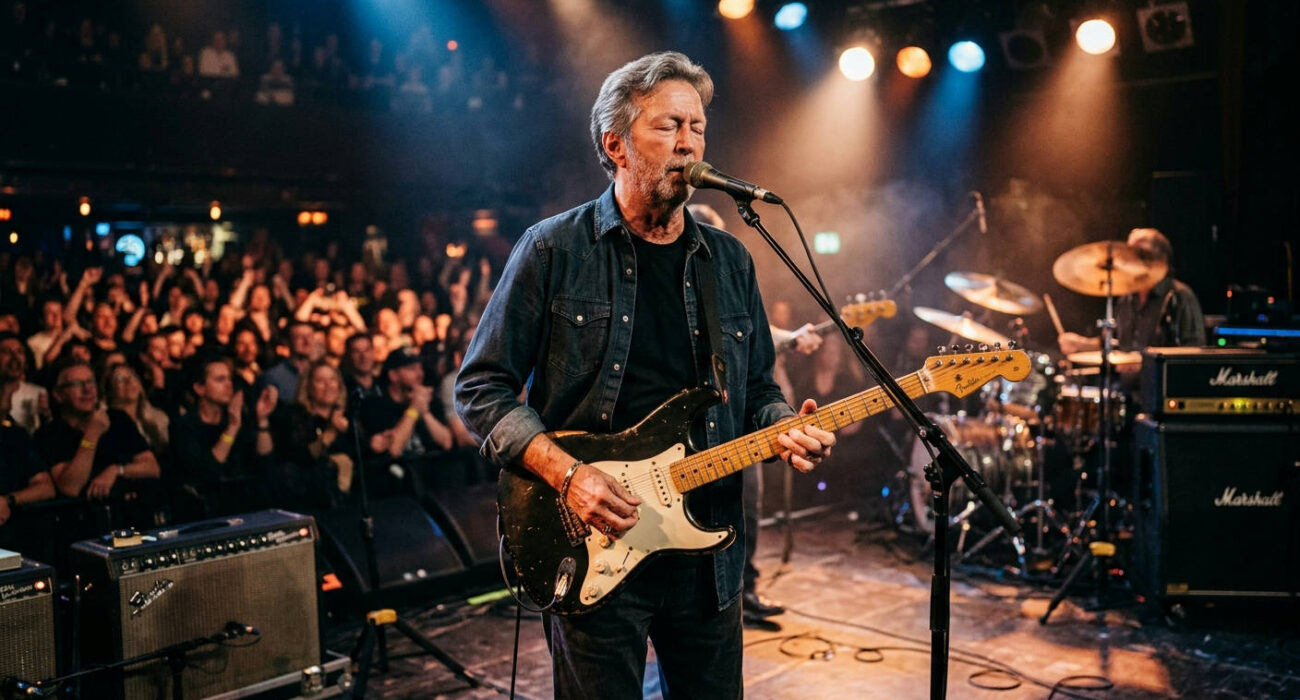
Let’s cut right to it. If you only know Eric Clapton from his studio records, you’re only getting half the story. The real, unfiltered magic happens on stage, where the guitar solos stretch out, the energy is palpable, and the blues get raw. For any serious collector or fan, the catalogue of Eric Clapton live albums isn’t just a supplement; it’s the main event. These records capture a musical titan in his natural habitat, showcasing an evolution from fiery blues prodigy to seasoned elder statesman of rock.
These aren’t just recordings of concerts. They are historical documents, bottling the lightning of specific moments in time. From the roaring feedback of his youth to the nuanced acoustic mastery of his later years, Clapton’s live output tells a richer, more compelling story than any studio album ever could. We’re here at Vinyl Gold UK to guide you through the essential pressings, the deep cuts, and the definitive moments that make these albums absolutely vital for your collection.
Why the Stage is Clapton’s True Home
Studio albums are controlled environments. They are about perfection, countless takes, and post-production polish. Live albums are the polar opposite. They are about risk, improvisation, and the symbiotic energy between the artist and the audience. This is where Clapton has always thrived.
The studio captures the song; the stage captures the performance. On his live records, a three-minute pop-rock single can transform into a ten-minute blues odyssey. You hear the musician thinking, reacting, and pushing the boundaries of the song right before your ears. It’s the sound of creation in real-time.
The Power of Improvisation
Clapton’s reputation was built on his jaw-dropping ability to improvise. While his contemporaries were sticking to the script, Clapton was rewriting it every single night. His live albums are a masterclass in this art form. Solos are never played the same way twice. He’ll quote other songs, change the tempo, or lock into a groove with the band that sends the music into entirely new territory.
This is particularly true of his 70s output. Albums like E.C. Was Here are less about the songs and more about the extended musical conversations happening on stage. This is the stuff that separates the legends from the merely talented.
Capturing a Moment in Time
Every live album is a snapshot. It captures the specific line-up of the band, Clapton’s mood on that particular tour, and the sound of that era. Listening to his live discography in chronological order is like a sonic time machine. You hear his voice change, his guitar tone evolve, and his musical interests shift from aggressive blues-rock to more laid-back, song-focused performances.
These recordings are not sterile. You hear the crowd roar, the occasional bum note, the spontaneous on-stage banter. It’s this raw authenticity that makes the best Eric Clapton live albums so compelling and endlessly listenable.
The Essential Collection: The Best Eric Clapton Live Albums
If you’re starting a collection or just want the absolute must-haves, this is your list. These albums represent the pinnacle of Clapton’s live career, each one a classic in its own right. Forget streaming playlists; owning these on vinyl is the definitive experience.
Derek and the Dominos – In Concert (1973)
Recorded in October 1970 at the legendary Fillmore East in New York, this album is pure fire. This isn’t the polished Clapton of later years; this is a man wrestling with his demons and channelling it all through his guitar. The band is an absolute powerhouse, and the extended jams on tracks like “Why Does Love Got to Be So Sad?” and “Let It Rain” are transcendent.
The interplay between Clapton and keyboardist Bobby Whitlock is electric. This double LP is a sprawling, ferocious document of a band at the peak of its powers, just before it all came crashing down. An essential piece of rock history.
Find your copy of Derek and the Dominos In Concert and hear the raw power for yourself.
E.C. Was Here (1975)
Often overlooked but fiercely loved by hardcore fans, E.C. Was Here captures Clapton’s mid-70s tour with a more relaxed, soulful band. The vibe is less frantic than the Dominos, but the musicianship is top-tier. His guitar playing is fluid and melodic, especially on the stunning version of “Have You Ever Loved a Woman.”
This album showcases Clapton settling into his role as a bandleader and frontman. The track list leans heavily on classic blues covers, and the performances are simmering with a slow-burn intensity. It’s the perfect soundtrack for a late night with a good glass of whiskey.
Just One Night (1980)
Recorded at the Budokan Theatre in Tokyo, Just One Night is a brilliant, career-spanning double album. It features a crack band including the legendary Albert Lee on second guitar. The production is crisp and powerful, a significant step up from the grittier recordings of the 70s.

Highlights are everywhere. A roaring “Cocaine,” a beautifully melancholic “Double Trouble,” and a fantastic reggae-infused “I Shot the Sheriff.” This is one of the most well-rounded and consistently excellent Eric Clapton live albums ever released, capturing the energy of his massive stadium shows from that period.
Secure a pressing of Just One Night on vinyl to add a cornerstone to your collection.
Unplugged (1992)
You knew this one was coming. The album that revitalized his career and introduced him to a new generation. While the term “unplugged” is a bit of a misnomer (the instruments are amplified), the intimate, acoustic setting was a revelation. It forced Clapton to re-interpret his own classics and lean into his deep blues roots.
The acoustic slide guitar on “Running on Faith” is masterful, and the heart-breaking, reimagined version of “Layla” became an instant classic. Of course, the emotional centrepiece is “Tears in Heaven.” Unplugged is not just a great live album; it’s one of the most important albums of the 1990s, full stop. Its massive success is well-documented, earning multiple Grammy Awards and selling tens of millions of copies worldwide.
Digging Deeper: Beyond the Obvious Picks
Once you have the essentials, it’s time to explore the rest of the catalogue. These albums might not be as famous, but they contain some of Clapton’s most interesting and rewarding live performances. This is where true collectors separate themselves from the casual listeners.
Rainbow Concert (1973)
This album documents Clapton’s comeback show after a period of heroin addiction and seclusion. Organized by his friend Pete Townshend of The Who, the concert featured an all-star band including Townshend, Steve Winwood, and Ronnie Wood.
The performance itself is a little ragged. Clapton is clearly rusty, but there’s a vulnerability and raw emotion here that is absolutely captivating. You can hear him fighting his way back to the top. It’s a historically significant recording and a testament to the power of friendship and music.
Crossroads 2: Live in the Seventies (1996)
This four-disc box set is a treasure trove for serious fans. It’s not a single concert but a curated collection of unreleased live tracks from 1974 to 1978. It fills in the gaps left by official releases like E.C. Was Here and provides a much more complete picture of his 70s tours.
The set is packed with stellar performances, extended jams, and different band line-ups. It shows the night-to-night evolution of the songs and Clapton’s solos. If you love the 70s era, this box set is non-negotiable.
Check for the Crossroads 2: Live in the Seventies box set to unearth some hidden gems.
Live from Madison Square Garden (with Steve Winwood) (2009)
A reunion decades in the making. This album captures Clapton and his old Blind Faith bandmate Steve Winwood tearing through a setlist of their shared history. They tackle Blind Faith classics (“Can’t Find My Way Home”), Traffic hits (“Dear Mr. Fantasy”), and Hendrix covers (“Voodoo Chile”) with absolute authority.
The chemistry between the two legends is undeniable. Both are in fantastic voice, and their instrumental interplay is a joy to behold. It’s a polished, professional, and deeply satisfying performance from two masters of their craft.
Tracing the Evolution of Slowhand’s Live Sound
Listening to Clapton’s live albums is a journey through the history of rock and blues guitar. His sound and style have changed dramatically over the decades, and the stage is the best place to hear that evolution unfold.
The Bluesbreaker & Cream Years: God is Born
In the mid-60s, Clapton was a blues purist. His time with John Mayall & the Bluesbreakers and later Cream was defined by a searing, aggressive guitar tone, largely achieved by plugging a Gibson Les Paul into a Marshall amplifier and turning everything up to ten.
“Clapton is God.” – Graffiti scrawled across London in 1966.
This era was about raw power and volume. The live recordings from this period, though often of dubious bootleg quality, capture a young guitarist pushing the limits of his instrument. He was instrumental in creating the template for the guitar hero. His early work with The Yardbirds laid the groundwork, but it was with Cream that he became a global phenomenon.

The 70s Journeyman: Stratocasters and Soul
In the 1970s, Clapton famously switched from Gibson guitars to the Fender Stratocaster, specifically his iconic “Blackie.” This change coincided with a musical shift. His tone became cleaner, thinner, and more “out-of-phase.” His music became more song-oriented, incorporating elements of soul, reggae, and country.
The extended, ferocious jams of Cream were replaced by a more laid-back, groovy approach. The focus was on the pocket, the feel, and the melodic narrative of the solo rather than pure pyrotechnics. This is the era of E.C. Was Here and Just One Night.
The 90s Renaissance: Acoustic Purity and Orchestral Grandeur
The massive success of Unplugged in 1992 marked another major shift. Clapton proved he didn’t need a loud amplifier to captivate an audience. His acoustic playing, particularly on Martin guitars, was a showcase of nuance, taste, and deep blues feeling.
This period also saw him experimenting with larger ensembles. The 24 Nights album and tour (1991) featured performances with a 4-piece band, a 9-piece band, a blues band, and a full orchestra conducted by Michael Kamen. This era showcased his versatility and willingness to frame his music in new and ambitious ways.
The 21st Century: The Elder Statesman
Since the 2000s, Clapton’s live shows have become a masterclass in taste and professionalism. His band is always world-class, and the performances are polished and impeccable. While some might miss the wild abandon of his youth, there’s no denying the sheer mastery on display.
His tone is refined, his voice is seasoned, and his song selection often pays tribute to his heroes like J.J. Cale and Robert Johnson. His modern live albums are the sound of a legend comfortable in his own skin, delivering his life’s work with grace and authority.
A Collector’s Guide to Hunting for Vinyl
At Vinyl Gold UK, we live for the thrill of the hunt. Finding a clean, original pressing of a classic live album is a special kind of victory. Here’s what you need to know when building your collection of Eric Clapton live albums on vinyl.
Original Pressings vs. 2026 Reissues
This is the eternal debate. An original 1973 pressing of In Concert has a certain magic and historical artifact quality. The analog warmth can be incredible. However, originals can be expensive and often show their age with pops, clicks, and surface noise.
Modern reissues, especially those done in 2026 and beyond, can be fantastic. Using modern audiophile mastering techniques from the original tapes, they can offer a cleaner, more detailed sound with a lower noise floor. The choice often comes down to budget and personal preference: do you want the authentic original artifact or the pristine modern pressing?
### How to Spot a Genuine First Pressing of an Eric Clapton Live Album
Identifying a true “first press” can be tricky, but it’s key to a valuable collection. Here are the clues:
- Matrix Numbers: This is the string of letters and numbers etched into the run-out groove (the dead wax near the label). These codes identify the specific stamper used to press the record. Dedicated collector sites like Discogs have databases to help you decode them.
- Record Labels: The design of the record label often changed over time. For example, an RSO Records pressing from 1975 will look different from one in 1980. Research the correct label design for the year of release.
- Sleeve and Cover Details: Look for subtle differences. Early pressings might have unique promotional stickers, different spine text, or specific inner sleeve designs that were later changed.
Upgrading Your Playback System
Owning these incredible records is one thing; hearing them as they were meant to be heard is another. A cheap, all-in-one turntable will not do justice to the dynamic range and sonic detail of these live recordings.
Investing in a quality setup is crucial. You don’t need to spend a fortune to get great sound. A solid deck, a good cartridge, and a decent phono preamp will make a world of difference, allowing the music to breathe and the instruments to have separation and clarity. If you’re looking for a place to start, there are many excellent options available, and we’ve even put together a guide on some of the best turntables under £300 in the UK.
The Final Spin
The discography of Eric Clapton live albums is more than just a collection of recordings; it’s the definitive document of a true musical journey. It’s where you’ll find his most daring, passionate, and honest performances. These albums are a testament to the raw, untameable power of live music.
The stage is the only place I feel I really belong. It’s my office. It’s my church. It’s where I feel most complete.
From the sweat-soaked clubs of the 60s to the sold-out arenas of the 21st century, these records have captured it all. They are essential listening for anyone who claims to love rock and roll, the blues, or the art of the electric guitar. Don’t just listen to the hits. Grab these albums, drop the needle, and experience the real Eric Clapton. Your record collection will thank you for it.