
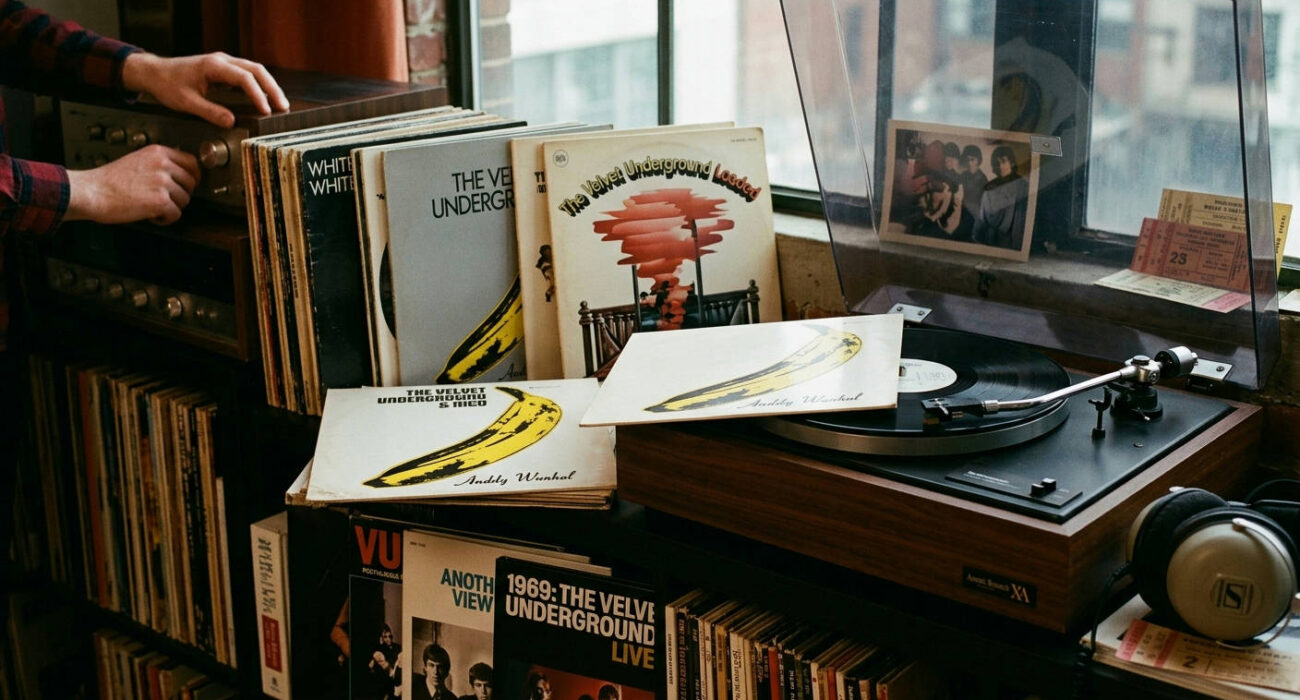
Trying to tackle The Velvet Underground complete discography is not for the faint of heart. It’s a journey through noise, poetry, heartbreak, and raw, unfiltered rock and roll that forever changed music. This wasn’t a band that wrote catchy singles for the radio; they were artists who documented the underbelly of 1960s New York City with a sound that was often as brutal and beautiful as their subject matter. At Vinyl Gold UK, we know that collecting their records is more than a hobby—it’s an essential education in sound.
This guide cuts through the noise. We’ll break down every studio album, essential live recording, and key archival release you need to know about. Forget the confusing timelines and questionable posthumous releases. This is your definitive map to one of the most important back catalogues in history.
The Core Four: Deconstructing the Studio Albums
The foundation of The Velvet Underground’s legacy rests on four studio albums released between 1967 and 1970. Each one is a distinct world, a snapshot of a band in constant, brilliant flux. This is where any exploration must begin.
The Velvet Underground & Nico (1967)
This is the one with the banana. Produced by Andy Warhol, the band’s debut album is a landmark recording that sounds as jarring and revolutionary in 2026 as it did upon its release. It’s a collision of Lou Reed’s street-level lyricism, John Cale’s avant-garde viola drones, and the icy, detached vocals of German singer Nico.
The album lurches between moments of delicate beauty and terrifying chaos. Tracks like “Sunday Morning” offer a fragile, almost hopeful opening, which is immediately shattered by the driving, distorted pulse of “I’m Waiting for the Man,” a song detailing a drug deal in Harlem. The subject matter was unheard of for the time. While other bands sang about peace and love, The Velvets gave you “Heroin,” a seven-minute epic that sonically mimics the rush and crash of the drug itself.
Warhol’s main contribution was his name and the inclusion of Nico, but his presence gave the band a platform they otherwise never would have had. He forced them into the art world, and they, in turn, dragged the art world into the gutter. It’s an essential, confrontational start to their story.
Ready to own this piece of history? You can find reissues of The Velvet Underground & Nico on vinyl.
Find The Velvet Underground & Nico on Amazon
White Light/White Heat (1968)
If the debut album was a controlled shock, White Light/White Heat is a full-blown electrocution. With Nico gone and Warhol’s influence waning, the band was free to indulge its most abrasive instincts. This is the sound of a band tearing itself apart and loving every second of it. It’s a masterpiece of noise and distortion.
The production is deliberately raw and overloaded. The title track is a chaotic blast of proto-punk energy, driven by a pounding piano and layers of fuzzed-out guitar. “The Gift” is an eight-minute spoken-word piece written by Reed in college, set to a churning instrumental jam. It’s weird, unsettling, and completely brilliant.
The album culminates in the seventeen-minute behemoth, “Sister Ray.” Recorded in a single take, it’s an improvised jam session built around a narrative of debauchery, violence, and murder. It’s the logical endpoint of the band’s experimental side, a wall of sound that would alienate mainstream listeners but cement their god-like status among future generations of noise-rockers and punks. This was John Cale’s final album with the band, and it serves as a fittingly explosive farewell.
The Velvet Underground (1969)
After John Cale’s confrontational exit, Lou Reed brought in a new bassist and multi-instrumentalist, Doug Yule. The result was a dramatic and unexpected shift in sound. The self-titled third album is the quiet after the storm, an intimate and deeply melodic record that proves The Velvet Underground could be just as powerful when they whispered as when they screamed.
The abrasive noise of White Light/White Heat is gone, replaced by clean guitar tones and heartfelt, introspective lyrics. Songs like “Pale Blue Eyes” and “Jesus” are stunningly beautiful, showcasing Reed’s skills as a vulnerable and sincere songwriter. The album feels like a private conversation, a late-night confession set to music.
But the darkness is still there, lurking beneath the surface. “The Murder Mystery” is a bizarre spoken-word experiment with overlapping vocal tracks, a final nod to their avant-garde past. And “Candy Says,” a tender ballad about Warhol superstar Candy Darling, touches on themes of identity and transformation with incredible grace. This album is a testament to the band’s versatility and Reed’s singular genius.
Loaded (1970)
Pressured by their label to deliver a “hit” album, The Velvet Underground produced Loaded. The title itself is a cynical joke—it was meant to be an album “loaded with hits.” Ironically, they succeeded. This is by far their most accessible and commercially oriented record, packed with some of their most iconic songs.
“Sweet Jane” and “Rock & Roll” are cornerstones of rock music, anthems of rebellion and romance built on unforgettable guitar riffs. The album is brighter, punchier, and more focused than anything they had done before. Doug Yule takes the lead vocal on several tracks, including the gentle “New Age,” lending a smoother, more polished feel to the proceedings.
This album is also marked by Lou Reed’s departure. He left the band in August 1970, before the album was even released, frustrated with the lack of commercial success and creative control. Loaded stands as the final statement from the classic era of the band, a bittersweet farewell packed with some of their most enduring tunes.

The “Lost” Albums and Post-Reed Confusion
The story gets murky after Loaded. Several albums exist that are part of the broader Velvet Underground story but sit outside the core four studio LPs. Understanding them is key to grasping The Velvet Underground complete discography.
The Saga of VU (1985) and Another View (1986)
These are not new albums. They are archival compilations of unreleased material recorded between their third and fourth LPs, mostly in 1969. When the band left MGM Records, they left behind a trove of finished, high-quality recordings that were shelved for over a decade.
VU is a revelation. It contains stone-cold classics like “I Can’t Stand It” and “Stephanie Says,” songs that are as good as anything on their official albums. It essentially functions as the “lost” fourth album, showcasing the band’s transition from the quiet introspection of the self-titled record to the pop-rock sensibilities of Loaded. For many fans, this is the true follow-up to The Velvet Underground.
Another View is a collection of the remaining odds and ends from those sessions. While not as consistently brilliant as VU, it still contains essential tracks like “We’re Gonna Have a Real Good Time Together” and an early, ferocious version of “Rock and Roll.” Together, these two releases are a vital part of the band’s catalogue.
What About Squeeze (1973)?
This is the most controversial album to bear the band’s name. After Lou Reed left, Doug Yule kept the band going for a couple of years with a rotating lineup of musicians. Squeeze, released in 1973, features none of the original members besides Yule.
Most fans and critics do not consider this a legitimate Velvet Underground album. It’s essentially a Doug Yule solo record released under the VU banner for contractual reasons. While not a terrible album in its own right, it lacks the vision, danger, and poetic genius of Reed and Cale. For anyone looking to explore the discography, this one can be safely skipped unless you’re a die-hard completionist.
Diving into the Live Recordings
The Velvet Underground was a formidable live act, and thankfully, several high-quality recordings exist that capture their power on stage. These aren’t just bonus material; they are essential documents that offer a different perspective on the band.
“The first Velvet Underground album only sold 30,000 copies in its first five years. Yet, that was an album that changed music. I was talking to Lou Reed the other day and he said that everyone who bought one of those 30,000 copies started a band!” – Brian Eno
1969: The Velvet Underground Live
Released in 1974, this double album is compiled from two different sets recorded in late 1969 in Texas and San Francisco. It perfectly captures the two sides of the band at that time: the introspective, lyrical band of the third album and the raw, improvisational rock and roll powerhouse.
The sound quality is excellent, and the performances are legendary. It features extended, reworked versions of classic songs, including a 13-minute jam on “What Goes On” and a beautifully weary take on “Pale Blue Eyes.” You also get to hear songs that never made it to a studio album, like the brilliant “Some Kinda Love.” It’s arguably the definitive live document of the band.
Live at Max’s Kansas City (1972)
This album captures a very different moment: Lou Reed’s final shows with the band in August 1970. It was recorded on a portable cassette recorder by an audience member, Brigid Polk, a Warhol associate. The sound quality is lo-fi and amateurish, but its historical importance is immense.
You can hear the clinking of glasses and the chatter of the crowd. It’s an incredibly intimate recording. Despite the poor fidelity, the performances are fantastic. The band runs through a set of classics, including many songs from the soon-to-be-released Loaded. It’s a raw, immediate snapshot of the end of an era.
The Modern Box Sets: The Matrix Tapes
For decades, fans had to settle for the often-bootleg quality of live recordings. That changed dramatically in the 21st century. The 2015 release, The Complete Matrix Tapes, is the holy grail for VU fans. Sourced from pristine, multi-track soundboard recordings from a series of 1969 shows in San Francisco, it presents the band with a clarity and power never heard before.
Listening to these recordings is like hearing the band for the first time. Every instrument is perfectly balanced, and Reed’s vocals are front and centre. It is, without a doubt, the best the band ever sounded on tape and a must-have for any serious collector.
Collecting The Velvet Underground on Vinyl in 2026

Building a collection of Velvet Underground records is a rewarding pursuit. The raw, analogue sound of their music is perfectly suited for the vinyl format. But knowing where to start can be tricky.
Your Guide to The Velvet Underground Complete Discography on Vinyl
- Original Pressings: These are for the serious collector with deep pockets. An original 1967 pressing of the debut with the “peelable banana” sticker intact can fetch thousands of pounds. These are historical artifacts.
- 70s and 80s Reissues: These offer a more affordable entry point and often sound fantastic. They capture the analogue warmth of the original recordings without the hefty price tag.
- Modern 180-Gram Reissues (2010-Present): For most listeners, this is the sweet spot. Remastered from the original tapes, these pressings offer superior sound quality, clarity, and durability. They are readily available and affordable. Getting a great listening experience doesn’t mean you need a vintage pressing, just a solid setup. If you’re building your system, our guide to the best turntables under £300 in the UK is a fantastic place to start.
Find The Velvet Underground (Self-Titled) Vinyl on Amazon
What to Look For: Identifying Key Pressings
When hunting for records, details matter. For the debut album, look for the “torso” cover. The very first pressings had a photo of actor Eric Emerson, a Warhol star, superimposed on the back cover. After Emerson threatened to sue, the image was airbrushed out, making the “torso” covers highly collectible.
Also, check the label. Early pressings were on the Verve Records label. Later reissues appeared on MGM or Polydor. These details can help you date a pressing and determine its value. Always check the condition of both the vinyl and the sleeve—a worn-out record is no good, no matter how rare it is.
The Influence and Legacy: Why Their Discography Still Matters
It’s impossible to overstate The Velvet Underground’s impact. They laid the groundwork for punk, post-punk, noise-rock, shoegaze, and indie rock. Without them, there would be no Sonic Youth, no Joy Division, no The Strokes.
“Everything I learned, I learned from Lou Reed.” – David Bowie
Their unflinching look at the darker side of life, combined with their willingness to experiment with noise, feedback, and drone, opened up a new vocabulary for rock music. They proved that pop songs could be about more than just cars and girls—they could be high art. Their induction into the Rock & Roll Hall of Fame in 1996 was a long-overdue acknowledgment of their pioneering status.
The band’s connection to Andy Warhol and the New York art scene of the 60s also cemented their place in cultural history. They weren’t just a rock band; they were a multimedia art project, a living embodiment of the collision between high and low culture.
## Your Essential Guide to The Velvet Underground Complete Discography
So, where do you start with this monumental body of work? Here’s a quick roadmap from us at Vinyl Gold UK.
### For the Beginner: The Starting Point
Don’t dive into White Light/White heat first unless you want to scare yourself off. The best entry points are:
- The Velvet Underground & Nico (1967): It’s the iconic debut. You get the perfect mix of their art-rock tendencies and pop sensibilities. It’s challenging but essential.
- Loaded (1970): If you want the hits, start here. “Sweet Jane” and “Rock & Roll” are timeless classics that will ease you into their world.
### For the Adventurous: The Deep Dive
Once you’re hooked, it’s time to explore the extremes.
- White Light/White Heat (1968): This is the ultimate test. If you can handle the glorious noise of “Sister Ray,” you are a true fan.
- 1969: The Velvet Underground Live: To understand their power as a live band, this is the record. It shows their full range, from delicate ballads to raging jams.
### Navigating The Velvet Underground Complete Discography: A Checklist
For the collector who wants it all, here is the essential list. This is what a “complete” collection looks like to a purist.
- Core Studio Albums:
- The Velvet Underground & Nico (1967)
- White Light/White Heat (1968)
- The Velvet Underground (1969)
- Loaded (1970)
- Essential Archival Albums:
- VU (recorded 1968-69, released 1985)
- Another View (recorded 1967-69, released 1986)
- Definitive Live Albums:
- 1969: The Velvet Underground Live (recorded 1969, released 1974)
- Live at Max’s Kansas City (recorded 1970, released 1972)
- The Complete Matrix Tapes (recorded 1969, released 2015)
Exploring the music of The Velvet Underground is a commitment, but it’s one that pays off endlessly. Their records are a source of constant discovery, revealing new layers and depths with every listen. They weren’t just a band; they were a force of nature. Their complete discography is not just a collection of songs but a vital piece of 20th-century art that continues to inspire and provoke decades later. Happy collecting.