

Trying to wrap your head around the full Isley Brothers discography is like trying to map a mountain range. It’s vast, full of towering peaks, hidden valleys, and a timeline that stretches across nearly seven decades of American music. This isn’t just a collection of albums; it’s a living document of R&B, soul, funk, and rock, constantly evolving and influencing everything that came after. At Vinyl Gold UK, we live for these kinds of epic musical journeys, and there are few more rewarding than the one the Isleys offer.
This is not a simple task. From their early doo-wop and R&B hits to their genre-defining funk anthems and smooth quiet storm ballads, the sheer breadth of their work can be intimidating. But that’s why we’re here. We’re going to break down the eras, spotlight the must-have LPs, and show you why this family band from Cincinnati, Ohio, remains one of the most vital and sampled groups in history.
The Foundation: From Gospel Roots to Motown Frustration
Before the funk, before the screaming guitar solos, there were four brothers singing gospel in the suburbs of Cincinnati. The death of Vernon Isley in a tragic accident could have ended things, but the remaining trio—O’Kelly, Rudolph, and Ronald—pushed forward, moving to New York City with a raw, powerful sound that was impossible to ignore.
“Shout” and the Birth of T-Neck Records
Let’s get one thing straight: “Shout,” released in 1959, wasn’t a massive chart hit initially. Its legacy was a slow burn, built on a frantic, call-and-response energy that was part gospel revival, part rock and roll explosion. It was a sound no one else was making. The song’s two-part structure was a commercial anomaly, but its raw power made it an anthem.
This early period showed the Isleys’ fierce independence. Frustrated with a lack of creative control and financial transparency from labels, they took a bold step and formed their own: T-Neck Records, named for their new home in Teaneck, New Jersey. This move was decades ahead of its time, a declaration that they would control their own musical destiny.
The Motown Machine
In the mid-60s, the Isleys took a detour to Detroit and signed with Motown. On paper, it was a perfect match. In reality, it was a cage. The legendary label tried to sand down their rough edges, fitting them into the polished “Sound of Young America.”
They scored a massive hit with “This Old Heart of Mine (Is Weak for You),” a brilliant piece of pop-soul, but the brothers felt creatively stifled. They were a self-contained unit being forced into a production-line system. Stories from this era often mention their clashes with the Motown hierarchy over song choices and arrangements. They knew their sound better than anyone, and being told what to do didn’t sit right.
The Jimi Hendrix Connection
During this wandering period, a young, unknown guitarist named Jimmy James joined their backing band. You know him better as Jimi Hendrix. He toured extensively with the Isleys and recorded with them on tracks like “Testify.” The Isleys gave him a platform, and in return, his electrifying, futuristic guitar work undoubtedly left its mark on their sound, planting the seeds for the rock-infused funk that would later define them. You can feel that raw energy in The Best Of Jimi Hendrix and see how his style would echo in their later work.
A Collector’s Guide to the Isley Brothers Discography: The 3+3 Funk Dynasty
By 1973, everything changed. The Isleys had fully reactivated T-Neck Records and expanded the family business. Younger brothers Ernie Isley (guitar), Marvin Isley (bass), and brother-in-law Chris Jasper (keyboards) joined the original trio, creating the legendary “3+3” lineup. This wasn’t just a personnel change; it was a sonic detonation.
“We always wanted to be a band. When Ernie and Marvin and Chris came in, we could finally be the Isley Brothers band, not just the Isley Brothers singers.” – Ronald Isley
This new formation fused Ronald’s iconic vocals with Ernie’s Hendrix-inspired guitar pyrotechnics, Marvin’s deep pocket basslines, and Chris Jasper’s sophisticated keyboard textures. The Isley Brothers discography from this era is a goldmine of funk, soul, and rock.
3+3 (1973): The Album That Ignited a Decade
This is the ground-zero moment for the Isleys’ imperial phase. The album cover, featuring the band decked out in denim and leather, was a statement. The music was even louder. It kicks off with “That Lady,” a radical reinvention of one of their own ’60s tracks, now supercharged with Ernie’s scorching, phase-shifted guitar solo.
But the album is more than just one hit. Their cover of Seals and Crofts’ “Summer Breeze” is arguably one of the greatest reinterpretations of all time, transforming a soft-rock tune into a smouldering, epic soul ballad. It proved they could be both tender and ferocious on the same slab of wax.
- Grab the essential 3+3 album on vinyl from Amazon: https://www.amazon.com/s?k=Isley+Brothers+3+3+vinyl&tag=vinylgolduk-21
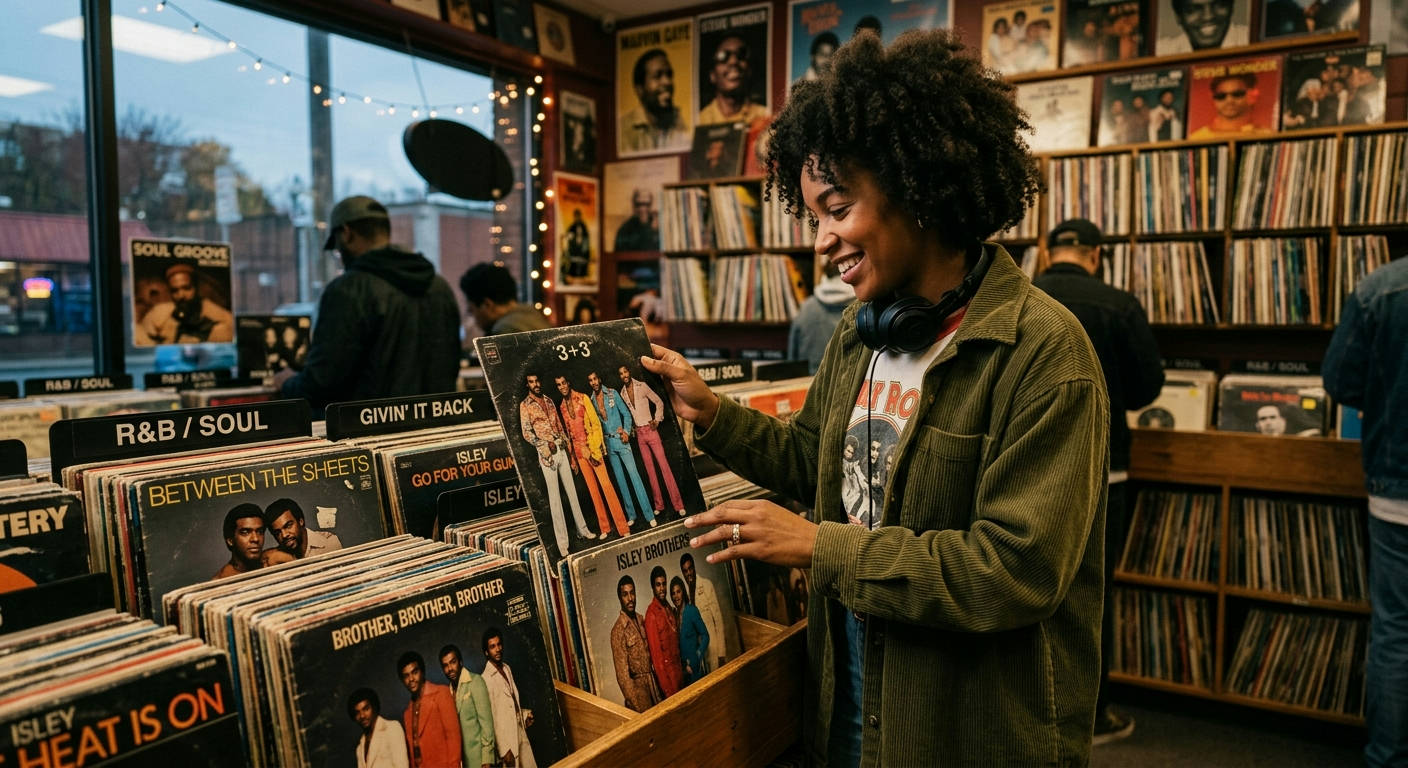
The Heat Is On (1975): A Masterclass in Album Sequencing
This album is a perfect storm. It hit No. 1 on the Billboard pop charts, a massive achievement. The genius of The Heat Is On lies in its “two-sided” concept. Side A is pure, uncut funk, kicking off with the aggressive, confrontational “Fight the Power (Part 1 & 2).” Side B flips the script entirely, delivering a suite of silky, seductive ballads, including the timeless “For the Love of You.”
This structure wasn’t an accident. It was a deliberate artistic choice, showcasing their incredible range and giving listeners two distinct moods on one record. It’s an album designed for a start-to-finish listen, a journey from the streets to the bedroom.
- Find your copy of The Heat Is On and feel the fire: https://www.amazon.com/s?k=Isley+Brothers+The+Heat+Is+On+vinyl&tag=vinylgolduk-21
Peak Funk: Go for Your Guns (1977) & Showdown (1978)
If the mid-70s were the ascent, this two-album run was the summit. Go for Your Guns is raw, slick, and confident. Tracks like “The Pride” and “Voyage to Atlantis” are cornerstones of the funk and quiet storm genres, respectively. Ernie Isley’s guitar work on “Climbin’ Up the Ladder” is simply breath-taking.
Showdown continued the hot streak with the cinematic “Take Me to the Next Phase” and the smooth groove of “Groove With You.” The band was a well-oiled machine, churning out complex, multi-layered arrangements that still sound fresh and innovative in 2026. This period cemented their status as funk royalty, placing them alongside giants like Parliament-Funkadelic and Earth, Wind & Fire.
The 80s Shift: Quiet Storm and a Family Divided
The 1980s brought significant changes to the music world and within the Isley Brothers themselves. The raw funk of the 70s began to give way to the smoother, more polished sounds of R&B and the emerging “quiet storm” radio format.
Between the Sheets (1983): An Enduring Slow Jam
This album would be the last from the classic 3+3 line-up, and it was a spectacular finale. The title track, “Between the Sheets,” is a masterpiece of sensual, atmospheric R&B. Its slinky bassline, shimmering keyboards, and Ronald Isley’s suggestive vocals created a blueprint for romantic ballads for decades to come.
The song’s DNA is everywhere. It became one of the most sampled tracks in hip-hop history, most famously providing the backbone for The Notorious B.I.G.’s “Big Poppa.” This album demonstrated the Isleys’ ability to adapt their sound without losing their core identity, proving they were masters of the ballad as much as the funk jam.
Isley-Jasper-Isley: The Inevitable Split
Creative and financial tensions finally led to a split in 1984. Ernie, Marvin, and Chris Jasper departed to form Isley-Jasper-Isley. They found success with their own funk-pop anthem, “Caravan of Love,” a beautiful, socially conscious track that showcased Chris Jasper’s song writing prowess.
Meanwhile, the original trio of Ronald, O’Kelly, and Rudolph continued as The Isley Brothers. This period was marked by tragedy when O’Kelly Isley passed away in 1986, a devastating blow to the family and the band.
Building Your Isley Brothers Vinyl Collection
Diving into the Isley Brothers discography on vinyl is a crate-digger’s dream. With so many albums across so many labels, knowing where to start is key.
The Essential First Three Albums for Any Collector
If you’re just starting, you can’t go wrong with the holy trinity of their 70s funk era. These albums provide the perfect entry point into their most influential period.
- 3+3 (1973): This is the genesis of the 3+3 sound. “That Lady” alone is worth the price of admission, but the deep cuts and masterful covers make it a front-to-back classic.
- The Heat Is On (1975): The perfect funk/ballad split. It’s an album that demonstrates their full emotional and sonic range. An essential piece of 70s soul.
- Go for Your Guns (1977): This is the sound of a band at the peak of their creative powers. It’s slick, powerful, and impeccably produced.
Finding Quality Pressings
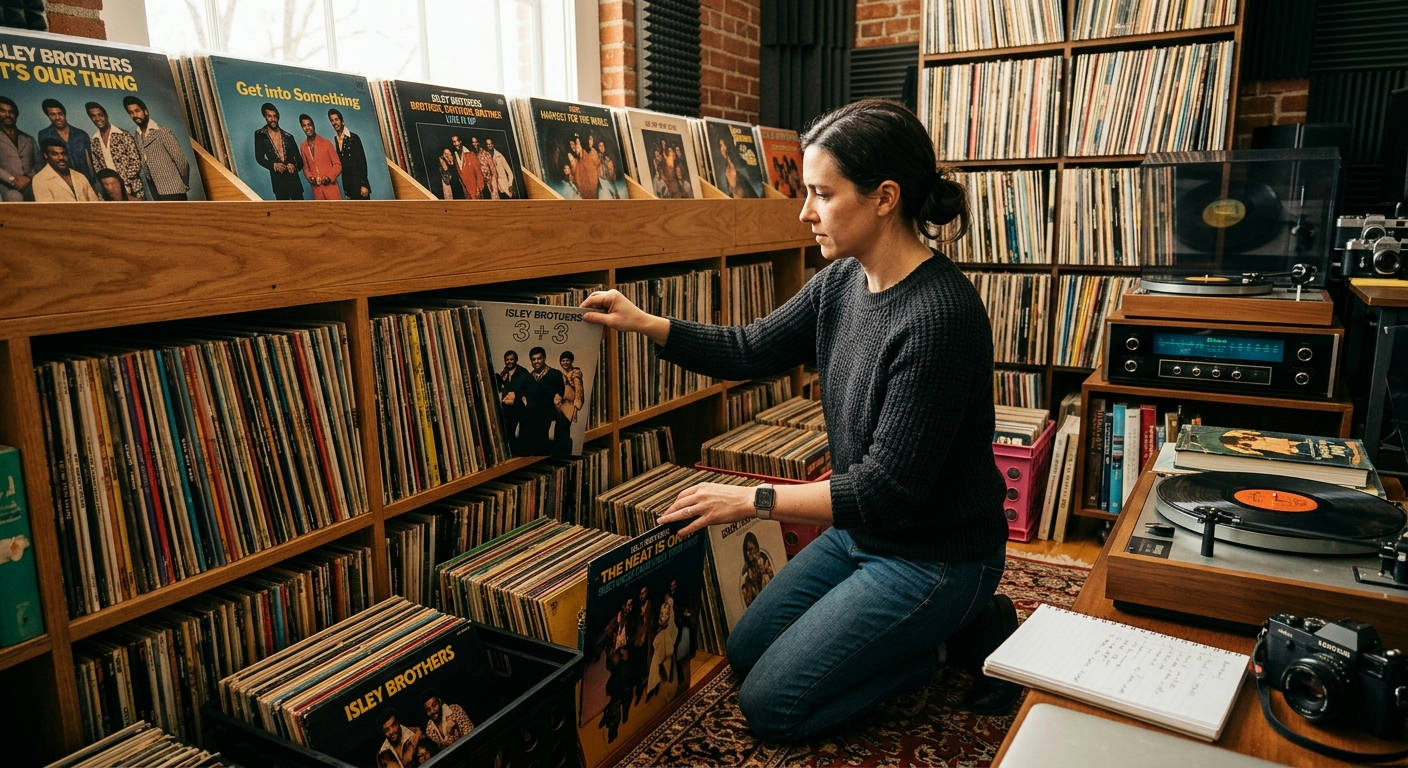
When hunting for original T-Neck pressings, condition is everything. Look for clean vinyl with minimal surface noise, as the dynamic range on these records is huge—you want to hear every crisp hi-hat and booming bass note. Pay attention to the gatefold sleeves, many of which featured iconic photography and full liner notes. A good quality turntable will make all the difference, pulling out the warmth and detail that streaming misses. If you’re looking for an upgrade, check out our guide to the best turntables under £300 in the UK.
For the Deep Diver: The Isley Brothers Discography Beyond the Hits
Once you have the essentials, the real fun begins. Look for their early ’60s Wand label recordings or the gritty, transitional albums like Givin’ It Back (1971), where they covered rock anthems from artists like Stephen Stills and Neil Young, infusing them with their signature soul. These records show the bridge between their Motown past and their funk future.
The Unshakeable Influence and Everlasting Legacy
It’s almost impossible to overstate the Isleys’ impact. Their music is woven into the fabric of modern pop, hip-hop, and R&B. They are more than a band; they are a source code.
Hip-Hop’s Favorite Sample Source
From the G-funk of the West Coast to the boom-bap of the East, Isley Brothers samples are everywhere. Ice Cube’s “It Was a Good Day” floats on the dreamy guitar of “Footsteps in the Dark.” Kendrick Lamar used “That Lady” for his hit “i.” A Tribe Called Quest, De La Soul, J Dilla, 2Pac—the list of artists who have built classics on the foundation of Isley grooves is endless.
Their music provided a rich palette of sounds: Ernie’s searing guitar riffs, Marvin’s melodic basslines, and Chris Jasper’s atmospheric keyboards were practically begging to be looped and repurposed.
“You can’t have a history of Black music in America without the Isley Brothers. They are the DNA of so much of what came after.” – Questlove, 2026 interview
From Covers to Collaborations
The Isleys were also masters of the cover song, often completely reinventing the original track. Their versions of “Summer Breeze,” “Love the One You’re With,” and Todd Rundgren’s “Hello It’s Me” are definitive. It’s a skill few possess, making a song so thoroughly your own that many forget the original even existed. This mastery is a theme we explored in our piece on cover songs better than the original.
In later years, Ronald Isley, under his “Mr. Biggs” persona, became an R&B icon for a new generation, collaborating with R. Kelly, Kendrick Lamar, and a host of others. This reinvention kept the Isley name relevant and introduced their incredible legacy to millions of new fans.
The Later Years and the 2026 Perspective
The Isley Brothers never stopped. Through line-up changes, tragedy, and shifting musical tastes, Ronald Isley has kept the flame alive.
The 90s R&B Renaissance
The 1996 album Mission to Please was a major comeback, a lush, contemporary R&B record that put them back on the charts. It was followed by Eternal (2001), which spawned the hit “Contagious,” proving that even five decades into their career, they could still craft a song that dominated the airwaves.
These albums were slick and modern, but the core was still there: Ronald’s unmistakable, velvet-and-grit voice telling stories of love, heartbreak, and desire.
The Isleys in the 21st Century
The group has continued to tour and record, including a celebrated 2017 collaboration with Santana, Power of Peace, and the 2022 album Make Me Say It Again, Girl. As of 2026, Ronald and Ernie Isley are the torchbearers, continuing to perform their incredible catalogue to sold-out crowds.
Looking back, the Isley Brothers discography is more than just a collection of songs. It’s a testament to family, perseverance, and fearless artistic evolution. They refused to be pigeonholed, transitioning seamlessly from genre to genre while always sounding like no one but themselves. Their Rock & Roll Hall of Fame induction in 1992 was a long-overdue acknowledgment of their monumental contributions.
Their music is timeless because the emotions are real. The joy in “Shout,” the defiance in “Fight the Power,” and the deep passion in “For the Love of You” are universal. They created the soundtrack for every part of life, and that is a legacy that will never fade. For any serious collector of soul and funk vinyl, exploring their work isn’t just recommended; it’s essential.