Let’s cut right to the chase. You want to know how did the Sex Pistols influence punk rock? The simple answer is they didn’t just influence it; they were the cultural explosion that took a scattered, underground sound and turned it into a full-blown, snarling youth movement. They were the match that lit the fuse on a powder keg of teenage boredom, economic despair, and musical bloat in 1970s Britain.
While bands in the US were laying the sonic groundwork, the Sex Pistols provided the attitude, the aesthetic, the media strategy, and the pure, undiluted nihilism. They were a perfect, chaotic storm of music, fashion, and outrage that changed everything, proving you didn’t need technical skill to make a powerful statement. You just needed three chords and something to say.
The Pre-Pistols Scene: A Powder Keg Waiting for a Match
To grasp the sheer force of the Sex Pistols’ impact, you first need to understand the musical world they crashed into. It was a world ripe for rebellion, dominated by untouchable rock gods and sprawling musical opuses that felt a million miles away from the grimy reality of British council estates.
The Bloat of 1970s Rock: Prog and Stadium Anthems
The mid-1970s was the golden age of progressive rock and stadium-filling behemoths. Bands like Yes, Genesis, and Emerson, Lake & Palmer were crafting 20-minute songs with complex time signatures and fantasy-based lyrics. Led Zeppelin and Pink Floyd were selling millions of albums, playing to vast arenas with colossal light shows.
This music required immense technical proficiency to play and, frankly, a lot of patience to listen to. It was brilliant in its own way, but it was also inaccessible. It had created a chasm between the rock star and the fan. The message was clear: we are virtuosos on a stage, and you are down there to worship us. This period produced some of the best albums of the 1970s, but it also created a desperate need for something raw, immediate, and grounded.
Proto-Punk Stirrings: The American Connection
The punk sound didn’t appear out of thin air. Across the Atlantic, the seeds had been sown for years. The raw, primal noise of The Stooges and MC5 in Detroit and the glam-infused rock ‘n’ roll of the New York Dolls had already torn up the rulebook.
By 1975-76, the Ramones were hammering out two-minute, three-chord anthems at CBGB in New York. They had the speed and the simplicity, but their influence was, at that point, mostly confined to the small downtown Manhattan scene. These bands were crucial architects of the sound, but they lacked the specific cultural accelerant that the Sex Pistols would ignite in the UK.
How Did The Sex Pistols Influence Punk Rock? By Demolishing the Rockstar Myth
The single greatest influence the Sex Pistols had was ideological. They single-handedly destroyed the idea that you needed to be a trained, polished musician to be in a band. They made rock and roll dangerous and accessible again.
Anyone Can Do It: The DIY Ethos
The Sex Pistols were gloriously, confrontationally amateurish. Guitarist Steve Jones famously learned to play on stolen equipment, including gear he’d lifted from David Bowie’s crew. Their drummer, Paul Cook, was solid but basic. Sid Vicious, who replaced original bassist Glen Matlock, could barely play at all.
This wasn’t a weakness; it was their mission statement. Their very presence on a stage was a two-fingered salute to the guitar heroes of the day.
“We’re not into music. We’re into chaos.” – Johnny Rotten
This message resonated powerfully. Kids who saw the Pistols play didn’t leave the gig thinking, “I’ll never be that good.” They left thinking, “I can do that.” And they did. Members of The Clash, Buzzcocks, Siouxsie and the Banshees, and countless others were directly inspired to form bands after seeing one of the Pistols’ early, chaotic shows. This DIY (Do It Yourself) spirit is the absolute bedrock of punk rock.
The Three-Chord Assault: A Sonic Reset
The music itself was a deliberate regression to the raw energy of early rock and roll, stripped of all pretension and complexity. Steve Jones’ guitar sound was a thick, overdriven wall of noise—a stark contrast to the clean, intricate solos of his contemporaries.
Their songs were short, fast, and built on simple, powerful chord progressions. The production on their one and only studio album, Never Mind the Bollocks, Here’s the Sex Pistols, is a masterclass in controlled aggression. It wasn’t designed to be audiophile-friendly; it was engineered to feel like a physical assault.
Johnny Rotten’s Vocal Venom: A New Kind of Frontman
John Lydon, aka Johnny Rotten, was perhaps their most potent weapon. He didn’t sing; he sneered, snarled, and accused. His stage presence was a contorted mix of rage and boredom, his eyes glaring at the audience with pure contempt.
He wasn’t a golden-haired rock god singing about mystical lands. He was a pale, wiry kid with bad teeth, screaming about urban decay, apathy, and his hatred for everything. He was the antithesis of the rock frontman, and in doing so, he created a brand new archetype that countless punk singers would emulate.

Fashion as a Weapon: The Anarchic Aesthetic of Punk
A huge part of the answer to “how did the Sex Pistols influence punk rock” lies in their look. They understood that in an era of mass media, image was just as important as sound. The music and the fashion were inseparable parts of the same attack.
Malcolm McLaren and Vivienne Westwood’s SEX Shop
The visual identity of the Sex Pistols was forged in a shop on the King’s Road in London called SEX, run by their manager, Malcolm McLaren, and his partner, fashion designer Vivienne Westwood. This wasn’t just a clothing store; it was an ideological laboratory.
McLaren and Westwood curated a look that was designed to shock and offend the conservative sensibilities of 1970s Britain. They sold t-shirts with provocative slogans and images, fetish wear, and customized clothing that incorporated ripped fabric, safety pins, and bondage straps. The Pistols became walking advertisements for this confrontational new style.
From Niche Style to Tribal Uniform
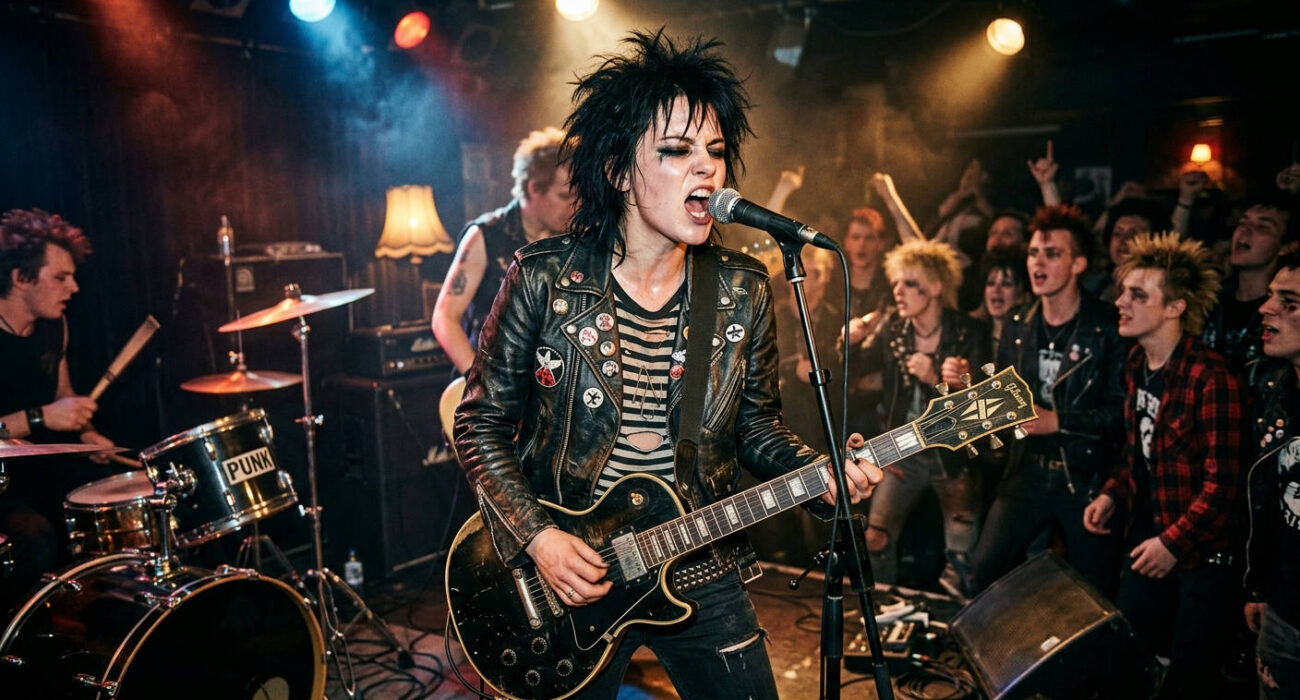
The Sex Pistols took this boutique aesthetic and broadcast it to the nation. The ripped t-shirts, the safety pins holding torn clothes together, the spiky hair, the leather jackets—it all became a recognizable uniform.
If you saw someone on the street dressed this way, you knew they were part of your tribe. It was a visual shorthand for rebellion, a way to signal your opposition to the mainstream without saying a word. This fusion of a specific sound with a specific, easily replicable look was a powerful combination that allowed punk to spread like wildfire.
The Media Firestorm: Manufacturing Outrage for Maximum Impact
Malcolm McLaren was a brilliant provocateur who understood the power of the press better than anyone. He knew that in Britain, getting banned was a better promotional tool than getting airplay. The Sex Pistols didn’t just stumble into controversy; they courted it, and their influence on punk is inseparable from their mastery of media manipulation.
The Bill Grundy Incident: The Swear Heard ‘Round the Nation
On December 1, 1976, the Sex Pistols were late replacements for the band Queen on the London regional news show Today, hosted by Bill Grundy. Goaded by a smirking Grundy, the band, particularly Steve Jones, let loose a string of swear words on live television.
The reaction was immediate and hysterical. Newspapers like the Daily Mirror ran the headline “THE FILTH AND THE FURY!” overnight. The band became public enemy number one. As detailed by many sources, including the BBC’s retrospective on the event, this single two-minute TV appearance catapulted punk from a small subculture into a national moral panic. Every kid in the country knew who the Sex Pistols were the next morning.
“God Save the Queen” and the Silver Jubilee
McLaren’s masterstroke came in 1977, the year of Queen Elizabeth II’s Silver Jubilee. He had the band release their single “God Save the Queen,” a vitriolic attack on the monarchy (“She ain’t no human being / And there’s no future / In England’s dreaming”).
The song was promptly banned by the BBC and most independent radio stations. Major retailers refused to stock it. Despite the blackout, it sold in huge numbers, reportedly reaching number one on the charts, though the official chart compilers controversially placed it at number two to avoid embarrassment. To rub salt in the wound, the band chartered a boat to perform the song on the River Thames, right outside the Houses of Parliament, leading to arrests and yet more headlines.
### How The Sex Pistols Influence Punk Rock by Creating a Media Blueprint
This is a critical point. The Sex Pistols and McLaren wrote the playbook for how to use controversy to your advantage. They demonstrated that being hated by the establishment was a badge of honour.
This taught a vital lesson to the punk bands that followed: don’t court mainstream approval. Provoke, challenge, and use the inevitable backlash as free publicity. The more the old guard hated you, the more the kids would love you. This strategy of “scandal as marketing” became a core tenet of punk rock’s relationship with the wider world.
The Lyrical Revolution: No More Love Songs
Before the Pistols, rock lyrics, even in heavier bands, largely stuck to familiar themes: love, loss, sex, drugs, and rock ‘n’ roll. The Pistols pointed their lyrical machine gun at much bigger targets: the government, the class system, the monarchy, and societal apathy itself.
Attacking the Monarchy, Government, and Apathy
Listen to the opening lines of “Anarchy in the U.K.”: “I am an antichrist / I am an anarchist / Don’t know what I want / But I know how to get it.” This wasn’t a metaphor. It was a direct, nihilistic declaration of intent.
“God Save the Queen” wasn’t just a protest song; it was a denial of the entire national identity. Lyrics like “a fascist regime” and “no future for you” were a shocking slap in the face to a country celebrating its heritage. This was social commentary delivered with the subtlety of a brick through a window.

A Voice for the “Blank Generation”
These lyrics connected because they articulated the bleak reality for many young people in Britain in the mid-70s. The country was facing economic crisis, high unemployment, and union strikes—the so-called “Winter of Discontent” was just around the corner.
“Ever get the feeling you’ve been cheated?” – Johnny Rotten, at the Sex Pistols’ final concert.
The Sex Pistols gave a voice to this “blank generation” that felt it had no stake in society and no future to look forward to. They weren’t offering solutions; they were simply reflecting the anger and frustration back at the world, and that was more than enough. This raw, political honesty became a pillar of punk rock lyricism.
The Legacy: A Short, Sharp Shock with Long-Lasting Aftershocks
The Sex Pistols burned out as quickly as they ignited, imploding during a disastrous American tour in January 1978 after just one album and two-and-a-half years. But their short, chaotic career left a permanent crater in popular culture.
The Immediate Aftermath: The Rise of Post-Punk
The band’s collapse didn’t kill the movement they started; it liberated it. The initial, rigid “rules” of punk (three chords, spiky hair) dissolved, allowing for a wave of creativity. This new phase was dubbed “post-punk.”
John Lydon formed Public Image Ltd. (PiL), a band that deconstructed rock music into something far more experimental and challenging. Other bands like Joy Division, The Fall, and Gang of Four took the DIY spirit and political anger of punk and channelled it into more artistic, complex, and atmospheric directions. The Pistols blew the doors open, and these bands fearlessly explored what was on the other side.
The Global Domino Effect: From UK Punk to American Hardcore
The Sex Pistols’ notoriety had a massive impact back in the US. While the first wave of American punk bands like the Ramones and Blondie were more rooted in pop and garage rock, the Pistols’ sheer aggression and political fury inspired a new, harder, and faster subgenre: hardcore.
Bands like Black Flag in California and Minor Threat in Washington, D.C. took the Pistols’ speed and anti-authoritarian stance and pushed it to its absolute limit. The influence is direct; without the blueprint of British punk’s fury, the American hardcore scene would have looked and sounded very different. For a taste of the New York scene that ran parallel, check out our guide to Five Of The Best From Blondie.
Punk’s Enduring Ethos in 2026 and Beyond
Decades later, the core principles the Sex Pistols championed are still incredibly relevant. The DIY ethos is alive and well in the age of bedroom producers and self-releasing artists on platforms like Bandcamp. The idea of music as a vehicle for social and political protest is as potent as ever.
Their influence extends far beyond punk. Kurt Cobain of Nirvana, a band that caused its own cultural shift in the 90s, frequently cited the Sex Pistols as a primary influence. The fusion of art, music, fashion, and politics they perfected can be seen in countless movements since. They proved that a band could be more than just a collection of songs; it could be an idea.
Get the Sound: Essential Sex Pistols on Vinyl
To truly understand their impact, you have to hear it. The raw power of the Sex Pistols is best experienced on vinyl, the way it was meant to be heard—loud and unapologetic. Here at Vinyl Gold UK, we believe every serious record collection needs a dose of this essential chaos.
Never Mind the Bollocks, Here’s the Sex Pistols
This is it. The one and only official studio album. It’s a relentless, 12-track assault that contains all their key anthems: “Anarchy in the U.K.,” “God Save the Queen,” “Pretty Vacant,” and “Holidays in the Sun.” It is, without exaggeration, one of the most important albums ever recorded. If you own one punk record, this is the one.
Grab your copy of this seminal album today. Search for Never Mind the Bollocks, Here’s the Sex Pistols on vinyl on Amazon.
Beyond the Bollocks: Compilations and Live Recordings
While Bollocks is the definitive statement, several compilations round out the picture. Flogging a Dead Horse collects their essential singles, while various bootlegs and official live albums capture the raw, unhinged energy of their concerts—something the studio album, for all its power, couldn’t fully replicate.
To explore their singles and B-sides, a great starting point is the classic compilation. Search for The Great Rock ‘n’ Roll Swindle on vinyl on Amazon.
The Sex Pistols were more than a band. They were a cultural event, a social catalyst, and a work of performance art that held a cracked mirror up to a decaying society. Their influence wasn’t just in the fast music or the ripped clothes; it was in the fundamental idea that anyone, anywhere, could stand up and scream their truth, regardless of talent or permission. They cheated, they lied, and they created a beautiful, chaotic mess that we’re still cleaning up, and for that, we should all be grateful.