
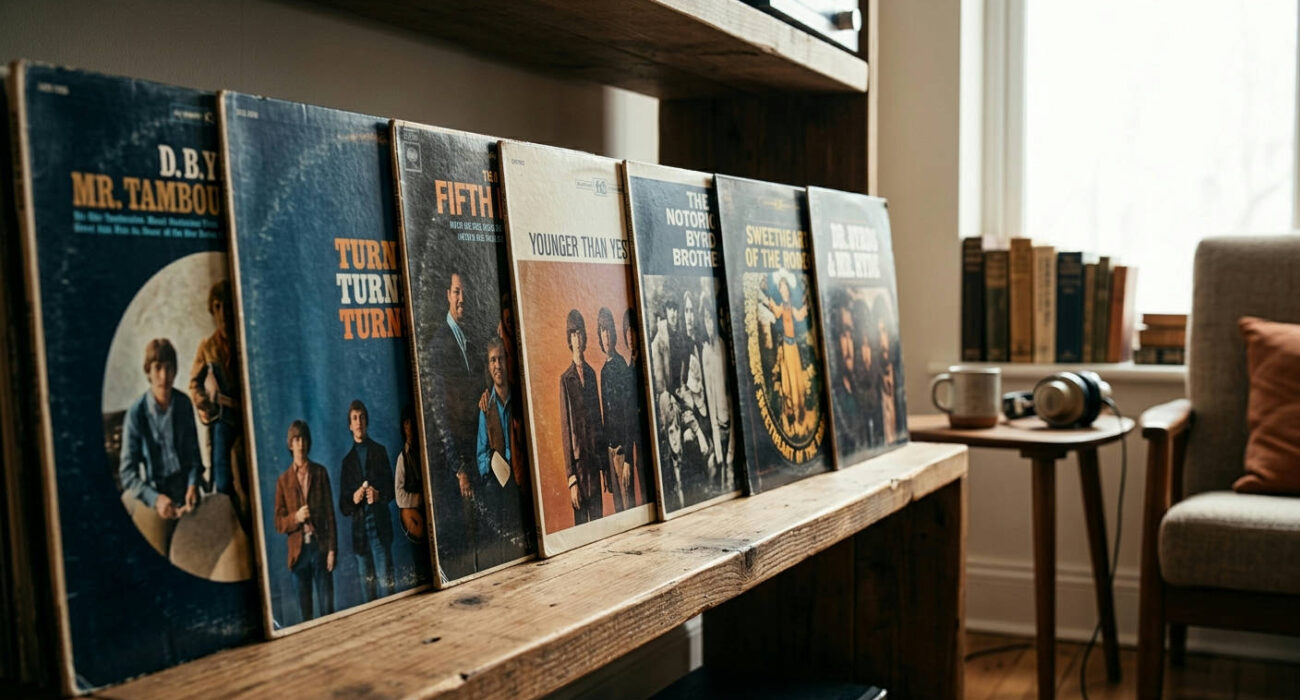
Trying to tackle The Byrds discography in order is more than just listing albums; it’s tracing the very evolution of American popular music in the 1960s. From inventing folk-rock overnight to pioneering psychedelia and then defining country-rock for generations to come, The Byrds were a restless, brilliant, and often chaotic force. This guide, from us at Vinyl Gold UK, breaks down their entire studio output, album by album, so you can follow their groundbreaking journey from start to finish.
This isn’t just a history lesson. It’s a roadmap for your ears and your record collection.
The Jingle-Jangle Genesis: The Original Five (1965-1966)
This is where it all began. Five guys—Roger McGuinn, Gene Clark, David Crosby, Chris Hillman, and Michael Clarke—plugged in folk songs, armed themselves with a Rickenbacker 12-string guitar, and created a sound that changed everything.
Mr. Tambourine Man (1965)
This is ground zero for folk-rock. The band took a then-unreleased Bob Dylan demo and supercharged it with chiming electric guitars and Beatles-esque harmonies. The result was a transatlantic number-one hit that felt like a bolt from the blue.
The album itself is a perfect capsule of 1965. Alongside the Dylan covers that made them famous (“All I Really Want to Do,” “Chimes of Freedom”), the record showcases the formidable songwriting talent of Gene Clark. Tracks like “I’ll Feel a Whole Lot Better” and “Here Without You” are masterclasses in melodic, melancholic pop, proving The Byrds were far more than just a Dylan cover band.
Want to own the album that started a genre? You can find vinyl reissues of Mr. Tambourine Man right here: https://www.amazon.com/s?k=The+Byrds+Mr+Tambourine+Man+Vinyl&tag=vinylgolduk-21
Turn! Turn! Turn! (1965)
Released just months after their debut, Turn! Turn! Turn! cemented the band’s signature sound. The title track, with lyrics adapted from the Book of Ecclesiastes by Pete Seeger, became an anthem for a generation grappling with war and social change. It was a perfect, poignant follow-up hit.
The album sees the band stretching their wings slightly. While still heavy on Dylan, they also start to find their own voice more consistently. Gene Clark again delivers some of the best material with “Set You Free This Time” and “The World Turns All Around Her.” It’s the sound of a band brimming with confidence, even if internal tensions were already beginning to simmer.
Fifth Dimension (1966)
Here’s where the trip gets weird, and the band truly becomes interesting. By 1966, chief songwriter Gene Clark was gone, a major blow that forced the others to step up. The result is a bold, experimental album that marks the birth of psychedelic rock.
The centerpiece is the legendary “Eight Miles High.” Inspired by a flight to London and the music of John Coltrane, it’s a swirling, chaotic, and brilliant piece of raga-rock that got banned by radio stations for supposed drug references. The rest of the album follows suit, with sci-fi themes (“Mr. Spaceman”) and studio experimentation. This is the moment The Byrds stopped following trends and started creating them. It’s a pivotal record in The Byrds discography in order.
Navigating Psychedelia and Personnel Upheaval (1967-1968)
With Gene Clark gone and David Crosby’s influence growing, the band dove headfirst into the expanding consciousness of the late 60s. This period produced some of their most acclaimed—and challenging—work, all while the group was fracturing from within.
Younger Than Yesterday (1967)
This album is a stunning display of creative recovery. With the song writing void left by Clark, bassist Chris Hillman emerged as a major talent, contributing gems like “Have You Seen Her Face” and the country-tinged “Time Between.”
The album is incredibly diverse. You have Crosby’s jazzy, questioning “Everybody’s Been Burned,” McGuinn’s Moog-synthesizer experiments on “C.T.A. – 102,” and the sardonic hit “So You Want to Be a Rock ‘n’ Roll Star,” a direct jab at manufactured bands like The Monkees. It’s a confident, eclectic statement from a band refusing to stand still.
The Notorious Byrd Brothers (1968)
This is the masterpiece. A beautiful, haunting, and fragmented album created amidst total chaos. By the time it was finished, both David Crosby and Michael Clarke had been fired. Gene Clark even briefly returned, only to leave again.
Somehow, producer Gary Usher and the remaining members stitched together a stunning tapestry of sound. It seamlessly blends country, psychedelia, Moog synthesizers, and studio effects like phasing and backward tapes. Tracks like “Goin’ Back” and “Wasn’t Born to Follow” are sublime, while “Tribal Gathering” and “Draft Morning” capture the unsettling mood of 1968 America. It’s a complex, rewarding listen that many fans and critics consider their absolute peak.
As music journalist David Fricke noted, this album was “a work of profound, unsettling beauty, the sound of The Byrds simultaneously falling apart and reaching their creative zenith.”
Find this essential piece of psychedelic history on vinyl: https://www.amazon.com/s?k=The+Notorious+Byrd+Brothers+Vinyl&tag=vinylgolduk-21
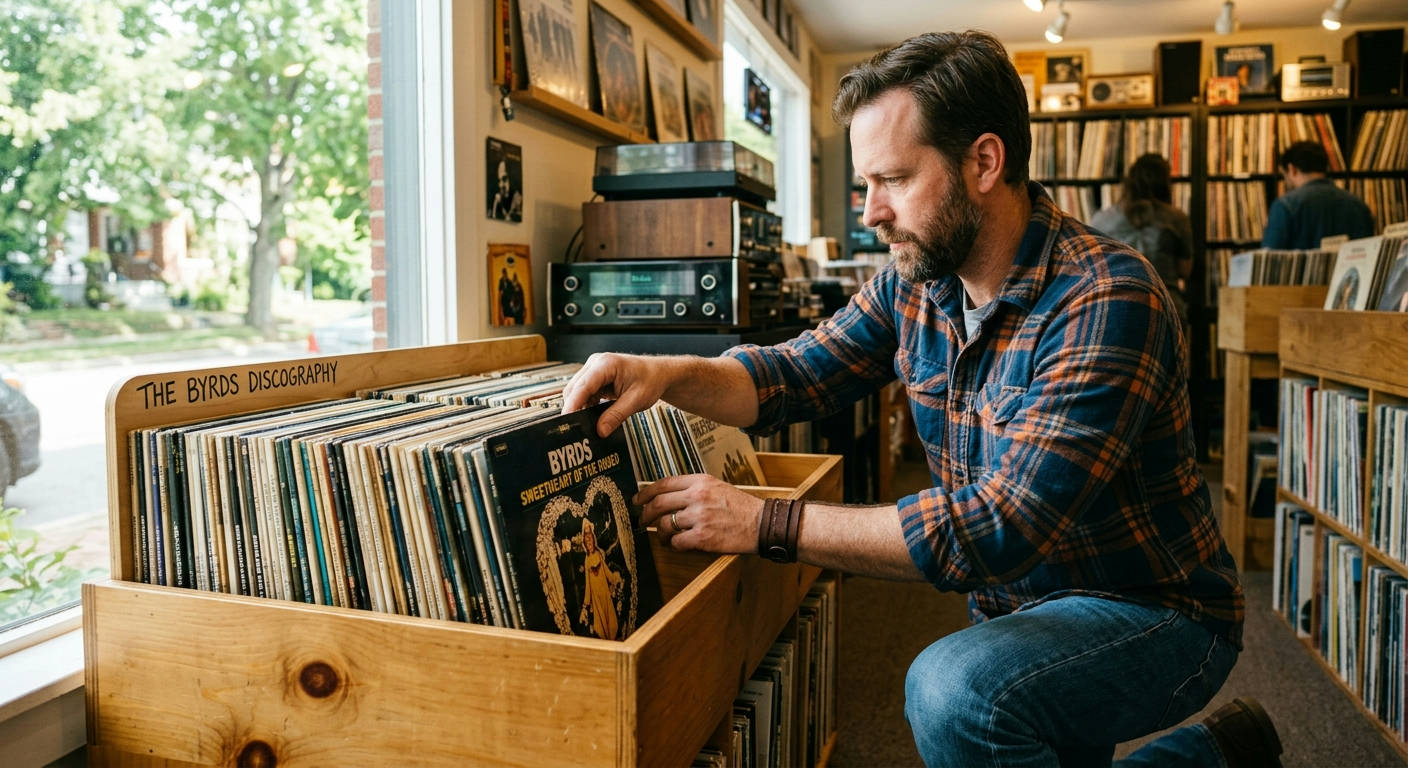
The Definitive Guide to The Byrds Discography in Order: The Country-Rock Era
With Crosby gone, McGuinn and Hillman were left to pick up the pieces. Their next move was so radical, so unexpected, that it alienated half their audience and invented a whole new genre of music.
Sweetheart of the Rodeo (1968)
Enter Gram Parsons. The charismatic, country-obsessed singer and songwriter joined the band and immediately steered the ship straight to Nashville. The plan was to record an ambitious double album tracing the history of American popular music, but Parsons’ vision was more focused: pure, unadulterated country.
The resulting album, Sweetheart of the Rodeo, is the foundational text of country-rock. They covered songs by the Louvin Brothers, Merle Haggard, and Bob Dylan (a country version of “You Ain’t Goin’ Nowhere”), alongside Parsons’ own classic, “Hickory Wind.” It was a complete rejection of the psychedelic explorations that had defined them.
Why Was Sweetheart So Controversial?
To understand the backlash, you have to remember the time. In 1968, rock and country were two separate worlds with a deep cultural divide. The hippie counter-culture loathed the perceived conservatism of Nashville, and the Nashville establishment saw rock musicians as long-haired, drug-addled freaks.
When The Byrds showed up to play the legendary Grand Ole Opry, they were met with jeers and hostility. The rock press was baffled, and their psychedelic fanbase felt betrayed. The album sold poorly. But its influence is immeasurable, paving the way for bands like The Eagles, and the entire alternative country movement decades later. By the time Gram Parsons quit the band just before the album’s release, the damage—and the innovation—was done.
The Clarence White Years: A New Kind of Flight (1969-1971)
With Hillman and Parsons leaving to form The Flying Burrito Brothers, Roger McGuinn was the sole original member left. He rebuilt the band around the phenomenal talent of guitarist Clarence White, a former bluegrass prodigy who would redefine the sound of the electric guitar.
Dr. Byrds & Mr. Hyde (1969)
This is the first album from the new McGuinn-White lineup. It’s a strange, often heavy record that feels like a band finding its footing. The “Dr. Byrds” side features country-flavored tunes, while the “Mr. Hyde” side leans into harder, psychedelic-tinged rock.
It’s an uneven listen, but Clarence White’s guitar playing is a revelation throughout. His invention, the “B-Bender,” allowed him to bend the B-string a full step, perfectly mimicking the sound of a pedal steel guitar. You can hear its magic starting to take shape here.
Ballad of Easy Rider (1969)
A much more focused and cohesive effort, this album benefited from the title track’s inclusion in the counter-culture film classic Easy Rider. The record is largely mellow and acoustic, with a warm, lived-in feel.
Highlights include a beautiful version of Woody Guthrie’s “Deportee (Plane Wreck at Los Gatos)” and the stunning “Gunga Din.” This album proved the new Byrds could create music just as compelling as the original line-up, albeit with a different, earthier energy. Clarence White’s guitar work is tasteful and brilliant, weaving intricate lines that elevate every track.
(Untitled) (1970)
A triumphant double album that stands as one of the best in their catalogue. The first LP is a live recording from New York, showcasing the McGuinn-White line-up as a formidable and powerful live act. They tear through an extended 16-minute version of “Eight Miles High” that is absolutely electrifying.
The second LP is all new studio material, and it’s flawless. “Chestnut Mare,” a song McGuinn had been working on for years, became a hit. “Just a Season” and “Truck Stop Girl” are prime examples of their perfected country-rock sound. This album was a huge commercial and critical success, rightfully putting The Byrds back on top. It’s a key part of their later work and a highlight of many guides to the best albums of the 1970s.
Byrdmaniax (1971)
The one everyone loves to hate. The band recorded a solid set of songs, but without their consent, producer Terry Melcher added syrupy strings, gospel choirs, and orchestration after the fact.
The band was horrified when they heard the final mix. McGuinn famously said, “I was in the Albert Hall with a string section and a 100-voice choir, and I was just a sideman in my own music.” While there are good songs buried underneath (“I Trust,” “My Destiny”), the cloying production makes it a difficult listen for many fans.
Farther Along (1971)
This was the band’s direct response to Byrdmaniax. They flew to London and rushed out a new album in just a few weeks, determined to release something that sounded like them. The result is a stripped-down, back-to-basics record with a loose, relaxed vibe.
It’s a pleasant, if not particularly groundbreaking, album. Standouts include the title track and “Bristol Steam Convention.” It has the feel of an ending, and it was. This line-up of The Byrds would dissolve soon after, marking the end of another major era.
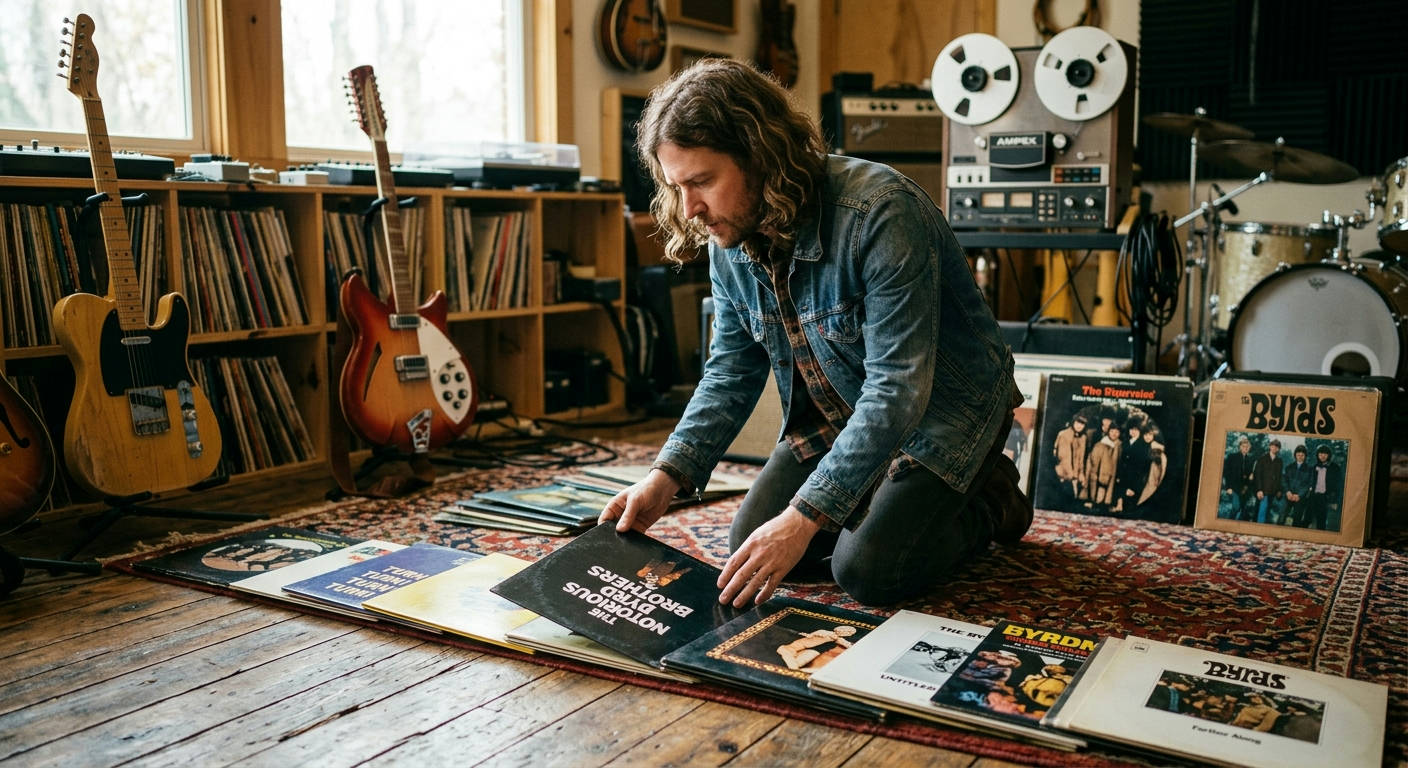
The Reunion and Beyond
The story doesn’t quite end there. The legacy of The Byrds continued through a brief, disappointing reunion and the various successful careers of its key members.
Byrds (1973)
In 1973, David Crosby orchestrated a reunion of the original five members for an album on Asylum Records. Hopes were sky-high, but the result was a critical and commercial disappointment.
The magic was gone. The signature “jingle-jangle” sound was largely absent, the song-writing felt uninspired, and the production was slick and generic for the era. It felt less like a true reunion and more like five solo artists recording in the same building. It served as a final, underwhelming chapter for the original band.
Post-Byrds Careers and Influence
The Byrds’ family tree is one of the richest in rock history.
- David Crosby found immense fame with Crosby, Stills, Nash & Young.
- Chris Hillman and Gram Parsons formed The Flying Burrito Brothers, further defining the country-rock sound.
- Gene Clark released a string of critically acclaimed but commercially ignored solo albums that are now revered by fans of singer-songwriter music.
- Roger McGuinn carried on with a solo career, often performing Byrds classics.
- Their influence is recognized by the Rock & Roll Hall of Fame, which inducted them in 1991.
This web of influence shows that while the band itself was often unstable, the talent it contained was undeniable and foundational to multiple genres. They were less a single band and more of an incubator for incredible music. For listeners exploring sixties rock, their story has parallels with other innovative groups like The Yardbirds, who also served as a launchpad for legendary guitarists.
Collecting The Byrds on Vinyl: A Buyer’s Guide for 2026
Building a collection of Byrds records is a rewarding pursuit. Their catalogue offers a tangible connection to the seismic shifts of the 1960s. Here’s how to approach it.
### Understanding The Byrds Discography in Order for Collectors
For the first four albums, you have a critical choice: mono or stereo? In the 60s, mono was the primary format, and stereo was often an afterthought.
- Mono Mixes: Generally considered the “punchier” and more definitive mixes. The band and producer focused their energy on the mono mix, so it’s often the most powerful and coherent version of the album.
- Stereo Mixes: Early stereo can be gimmicky, with hard-panning of vocals to one channel and instruments to the other. However, for the more psychedelic albums like Fifth Dimension and Notorious Byrd Brothers, the stereo separation can enhance the trippy, experimental nature of the music.
Ultimately, it’s a matter of preference. Serious collectors in 2026 often seek out clean original copies of both.
Key Pressings to Hunt For
If you’re looking for holy grails, here are a few to keep an eye out for:
- Original US Mono Pressings: A clean, original mono copy of Mr. Tambourine Man or The Notorious Byrd Brothers on the Columbia “2-eye” label is a true collector’s prize.
- Sweetheart of the Rodeo (Original Mix): The initial pressings featured more of Gram Parsons’ lead vocals, which were later replaced by Roger McGuinn’s on subsequent reissues. Finding an original with Parsons’ vocals intact is a key find for enthusiasts.
“There’s nothing quite like dropping the needle on an original mono Byrds LP. It’s not just sound; it’s a time machine. That Rickenbacker just jumps out of the speaker in a way that no digital version can replicate.”
Modern Reissues: Are They Any Good?
Don’t have the budget for pristine vintage copies? Don’t worry. The Byrds’ catalogue has been well-served by modern reissues. Labels like Sundazed Music have done fantastic, all-analogue reissues from the original master tapes, often in both mono and stereo.
These reissues offer a clean, quiet pressing and excellent sound quality at a fraction of the price of an original. They are a perfect way to experience this music on vinyl without breaking the bank.
Start your collection with the country-rock classic: https://www.amazon.com/s?k=Sweetheart+of+the+Rodeo+Vinyl&tag=vinylgolduk-21
The Final Takeaway
To follow The Byrds discography in order is to witness constant, fearless reinvention. They were never content to repeat a formula. When they perfected folk-rock, they abandoned it for psychedelia. When they mastered psychedelia, they pivoted to pure country. This relentless innovation is what makes them one of the most important and enduring American bands of all time.
Their journey was messy, full of firings, fights, and commercial missteps. But through it all, the music soared. From the first chime of McGuinn’s Rickenbacker to the last lament of Farther Along, The Byrds left an indelible mark. Start at the beginning, take the whole ride, and discover the band that never stopped flying in new directions.