
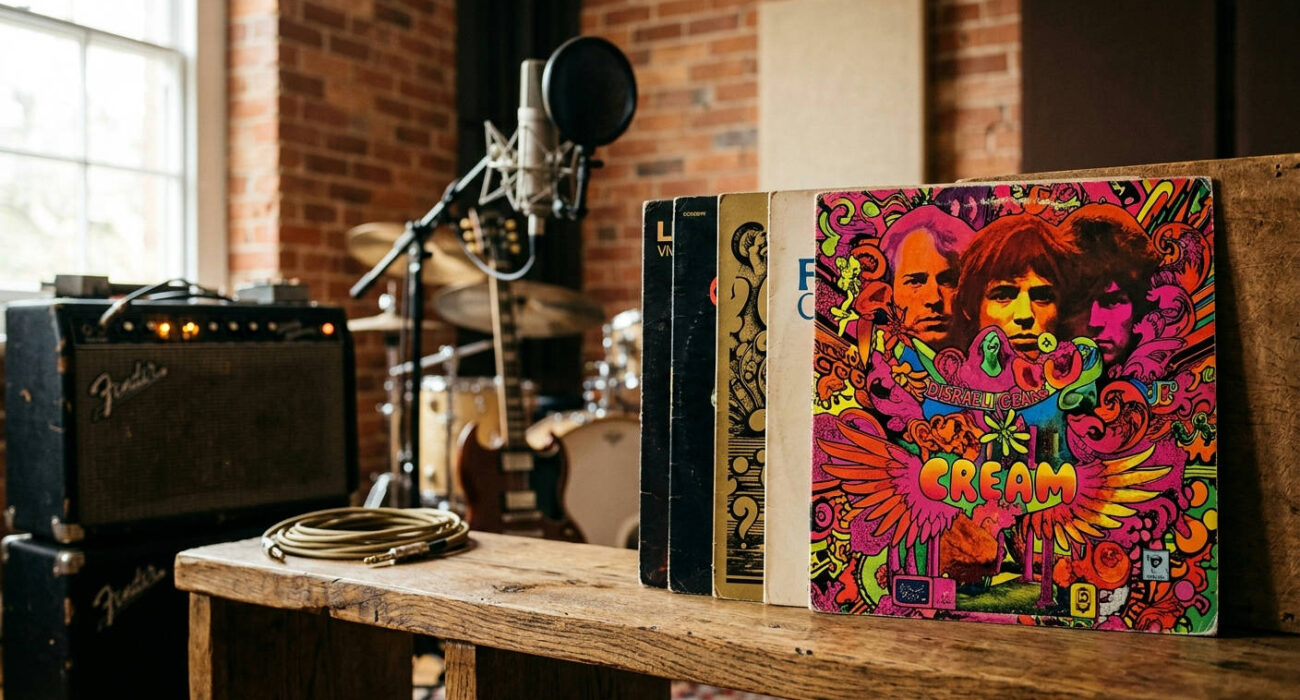
Trying to pin down a definitive list of the best Cream studio albums ranked is a task that sparks debate in record shops and online forums to this day. It’s a tight, four-album discography from a band that exploded onto the scene, burned impossibly bright, and vanished in just over two years. But what a two years it was. Eric Clapton, Jack Bruce, and Ginger Baker didn’t just play music; they detonated it, creating a fusion of blues, psychedelia, and jazz-fueled improvisation that set the template for hard rock.
Here at Vinyl Gold UK, we’re not just selling records. We live and breathe this stuff. We’ve spent countless hours with these albums, comparing pressings and dissecting every riff and drum fill. This isn’t just another list. This is our final word on the matter, forged in the grooves of the vinyl itself. We’re going to break down their entire studio output, from their raw debut to their fractured farewell.
Who Were Cream? The 60s’ First True Supergroup
Before the term “supergroup” became a tired cliché, there was Cream. Formed in London in 1966, the trio was an unprecedented concentration of instrumental firepower. Each member was already a titan in the British blues and R&B scene, a top-tier player looking for more freedom than their previous bands allowed.
Eric Clapton was “God,” a guitar hero fresh from his revolutionary work with John Mayall & the Bluesbreakers and, before that, The Yardbirds. He was seeking an environment to push his blues-based playing into uncharted territory.
Jack Bruce, a classically trained cellist turned bass virtuoso and powerful vocalist, had done time with Manfred Mann and the Bluesbreakers. He wasn’t just a rhythm player; his melodic, counter-rhythmic bass lines were a lead instrument in their own right.
Then there was Ginger Baker. A force of nature behind the drum kit, he brought a deep-seated love of jazz and African rhythms to the rock format. His use of two bass drums and his explosive, polyrhythmic style was unlike anything rock audiences had heard before.
The combination was volatile, both personally and musically. Their live shows were legendary, often stretching single songs into 20-minute improvisational epics. This raw power and technical brilliance are why their short career left such a massive crater in rock history.
How We Judged Them: The Ranking Criteria
Ranking a discography this iconic isn’t about just picking favourites. We applied a consistent set of criteria to each record to determine its place in the hierarchy. This isn’t about which album has the most famous songs, but which one stands as the most complete and influential artistic statement.
Songwriting and Composition
We looked beyond the searing solos. How strong are the core songs? We considered the quality of the lyrics, the melodic structures, and the overall collaborative effort between Bruce, Clapton, and their outside collaborators like Pete Brown and Felix Pappalardi. An album with a few great jams but weak foundational songs won’t score as highly.
Instrumental Prowess and Improvisation
This is the heart of Cream. We evaluated how well each album captured the legendary interplay between Clapton, Bruce, and Baker. Did the studio environment stifle their improvisational fire, or did it channel it into something focused and powerful? The best albums showcase their individual genius while highlighting their almost telepathic chemistry.
Production and Sonic Impact
How does the album sound? We assessed the production choices, the audio fidelity, and the overall sonic texture. From the raw blues of their debut to the swirling psychedelia of their later work, the sound of the record itself is a critical part of the experience, especially for us vinyl enthusiasts. A great production can elevate good songs to legendary status.
Lasting Influence and Legacy
Finally, we considered each album’s place in the broader story of rock music. Which record had the biggest impact? Which one influenced more subsequent artists and genres? An album’s legacy is a testament to its power and timelessness, a key factor in our ranking of the best Cream studio albums.
The Official Vinyl Gold UK: Best Cream Studio Albums Ranked
Alright, let’s get down to it. After weighing all the factors, this is our definitive ranking. We’re starting from the bottom and working our way to the undisputed champion of the Cream studio discography.
#4 — Goodbye (1969)

Placing Goodbye last feels almost unfair, as it’s not a traditional studio album. Released after the band had already broken up, it’s a hybrid, featuring three blistering live tracks and three studio recordings. It’s more of an epilogue than a cohesive statement, which is precisely why it lands at the bottom of our list of the best Cream studio albums ranked.
The studio side feels fragmented. “Badge,” co-written by Clapton and George Harrison, is an absolute masterpiece and arguably one of the band’s finest-ever songs. Its concise structure and melodic sophistication hinted at the direction Clapton would soon take with Blind Faith and his solo career.
However, the other two studio cuts, Bruce’s “Doing That Scrapyard Thing” and Baker’s “What a Bringdown,” feel more like solo efforts than unified Cream tracks. They’re interesting, but they lack the collaborative spark that defined the band’s best work. The magic was clearly fading. While the live tracks (“I’m So Glad,” “Politician,” “Sitting on Top of the World”) are phenomenal, they don’t count towards its standing as a studio album.
Goodbye is essential for “Badge” alone, but as a complete album experience, it’s a bittersweet and somewhat disjointed farewell.
- Find it on Amazon: Search for Cream’s Goodbye on Vinyl
#3 — Fresh Cream (1966)
The one that started it all. Fresh Cream is a raw, energetic document of three masters finding their footing together. It’s heavily steeped in the blues, featuring powerful covers of classics like “Spoonful” (Willie Dixon) and “Rollin’ and Tumblin'” (Muddy Waters). This is the sound of the British blues boom being pushed to its absolute limit.
Clapton’s guitar tone is sharp and aggressive, Bruce’s vocals are soulful and commanding, and Baker’s drumming is a revelation. The UK version of the album is arguably superior, kicking off with the Bruce/Janet Godfrey original “N.S.U.” The US version famously swapped out “Spoonful” for their first hit single, “I Feel Free,” a track that hinted at the psychedelic pop sensibilities they would explore later.
“There was a rebellion that was happening in the music… to get away from the short, three-minute pop song. We wanted to play, to stretch out.” – Eric Clapton
The album’s power lies in its directness. Tracks like “Sleepy Time Time” and “Toad” (featuring one of rock’s first iconic drum solos) showcase their incredible chops. Yet, it feels more like a collection of brilliant performances than a unified album with a singular vision. It’s an essential debut, but they were just getting warmed up.
- Find it on Amazon: Search for Fresh Cream on Vinyl
#2 — Wheels of Fire (1968)
This is where things get really tough. Wheels of Fire is an audacious, sprawling double album, with one disc recorded in the studio and the other live at the Fillmore and Winterland. For the purpose of this ranking, we’re focusing primarily on Disc One: In the Studio. And what a disc it is.
This is Cream at their most experimental and musically ambitious. They pushed beyond the blues into full-blown psychedelia, jazz fusion, and ornate arrangements. The production, handled by Felix Pappalardi (who essentially became the fourth member), is rich and layered. Jack Bruce and Pete Brown’s songwriting partnership hit a creative peak with tracks like the surreal “White Room,” the haunting “As You Said,” and the politically charged “Politician.”
Clapton’s playing is at its most fiery and innovative, particularly on “White Room” where he introduced the world to the wah-wah pedal in a way no one had heard before. Ginger Baker’s “Pressed Rat and Warthog” is a bizarre but brilliant piece of spoken-word poetry over a marching beat. The album is a dizzying display of creativity.
So why isn’t it number one? While the highs are stratospheric, it’s slightly less consistent than our top pick. The sheer ambition sometimes leads to moments that feel a bit indulgent. Still, Wheels of Fire is a monumental achievement and a cornerstone of late-60s rock.
- Find it on Amazon: Search for Cream’s Wheels of Fire on Vinyl
#1 — Disraeli Gears (1967)
Here it is. The perfect fusion of blues, pop, and psychedelia. Disraeli Gears is not just Cream’s best studio album; it’s one of the greatest rock albums ever made. In just 33 minutes, the band created a masterpiece that defined the sound of 1967’s Summer of Love and laid the groundwork for hard rock.
Recorded in a whirlwind session in New York with producer Felix Pappalardi, every single track is essential. There is zero filler. The album kicks off with the one-two punch of “Strange Brew” and “Sunshine of Your Love,” two songs that have become part of the very DNA of rock and roll. The riff for “Sunshine of Your Love” alone is one of the most recognizable in music history.
But the album is so much more than its hits. “Tales of Brave Ulysses” is a mythical, wah-drenched epic. “SWLABR” (She Was Like A Bearded Rainbow) is a blast of pure psychedelic energy. Bruce’s vocals are at their peak, and the band’s interplay is tight, focused, and explosive. Pappalardi’s production is key, polishing their raw power into radio-friendly gems without sacrificing an ounce of their intensity.
“Disraeli Gears was our pop album. We tried to get in there and be a pop group, and it worked.” – Jack Bruce

Disraeli Gears is the moment when all the promise of Fresh Cream was fully realized. It’s the perfect balance of their blues roots, their instrumental virtuosity, and a newfound pop sensibility. It’s a concise, powerful, and endlessly listenable statement from a band at the absolute zenith of its powers. That’s why it’s the undisputed champion on our list of the best Cream studio albums ranked.
- Find it on Amazon: Search for Cream’s Disraeli Gears on Vinyl
The Gear That Forged the Fire: Deconstructing Cream’s Sound
You can’t talk about Cream’s impact without talking about the tools they used to create their thunderous sound. The technology of the late 1960s was struggling to keep up with the sheer volume and power of bands like Cream, who in turn pushed manufacturers to build bigger and louder equipment.
Clapton’s “Woman Tone”
During the Cream era, Eric Clapton’s signature sound came from a potent combination: a 1964 Gibson SG guitar (the one with the famous psychedelic paint job) plugged into a 100-watt Marshall JMP Superlead stack. He would turn the amp’s volume and tone controls all the way up and then roll back the tone knob on his guitar, creating a thick, singing, violin-like sustain he called the “woman tone.” This sound, first heard prominently on “I Feel Free,” became one of the most sought-after guitar tones in rock.
Jack Bruce’s Revolutionary Bass
Jack Bruce didn’t just play the bass; he wrestled with it. He primarily used a Gibson EB-3, a short-scale bass with a famously muddy “mudbucker” pickup in the neck position. Through a stack of powerful Marshall amps, he produced a distorted, overdriven sound that was anything but subtle. His fluid, melodic lines often functioned as a second lead guitar, weaving complex counter-melodies against Clapton’s riffs. He fundamentally changed the role of the bass guitar in rock music, elevating it from a simple rhythm instrument to a lead voice.
Ginger Baker’s Double-Bass Assault
Ginger Baker was one of the first rock drummers to popularize the use of a double bass drum setup, something previously common only in jazz. His custom Ludwig kit was a behemoth for the time. This setup, combined with his jazz training and love for African rhythms, allowed for a level of rhythmic complexity and raw power that was simply staggering. His solos, like the one on “Toad,” were not just displays of speed but were structured, musical compositions.
Collecting Cream on Vinyl in 2026: A Guide for Crate Diggers
For vinyl enthusiasts, collecting Cream’s discography is a rewarding journey. The way these albums were meant to be heard is on a turntable, with the warmth and dynamic range that only vinyl can provide. But with decades of reissues, it can be tricky to know what to look for.
Original Pressings vs. Modern Reissues
Finding a clean, first-press copy of a Cream album from the 60s is the holy grail for collectors. UK originals on the Reaction or Polydor labels are particularly prized for their sonic quality. These original mono mixes, especially for Fresh Cream and Disraeli Gears, often have a punch and immediacy that the stereo versions lack. However, these can be expensive and hard to find in good condition as of 2026.
Modern reissues offer a more accessible and often pristine alternative. High-quality, 180-gram vinyl reissues from recent years often use the original master tapes and can sound absolutely incredible on a good system. They provide a quiet, clean listening experience without the pops and crackles that can come with a 60-year-old record. For a deep dive into what makes a good setup, check out our guide on the best turntables under £300 in the UK.
### Our Top Pick: A Deeper Look at the Best Cream Studio Albums Ranked Vinyl Experience
When it comes to reissues, the 2015 pressings from Polydor, remastered at Abbey Road Studios, are widely regarded as fantastic. They balance modern mastering clarity with the original analogue warmth. For Disraeli Gears, specifically, the 2015 vinyl reissue is a must-have, capturing the psychedelic swirl and raw power of the original recording with stunning fidelity. It’s a perfect starting point for anyone looking to experience the best Cream studio albums ranked on vinyl.
Cream’s Lasting Echo: The Supergroup Blueprint
Cream’s influence can’t be overstated. They were gone in a flash, but their impact is still felt decades later. They fundamentally altered the course of rock music.
They showed that a rock band could be a trio of virtuosos, each a master of their instrument. They pioneered the “power trio” format, a setup that would be adopted by countless bands, from The Jimi Hendrix Experience to Rush to Nirvana. Their extended, improvisational jams paved the way for progressive rock and jam bands.
Most importantly, they were the architects of hard rock. Their combination of blues-based riffs, high volume, and instrumental firepower provided the direct blueprint for bands like Led Zeppelin, Deep Purple, and Black Sabbath. As noted by the Rock & Roll Hall of Fame, they “laid the foundation for much of British heavy metal and hard rock.” Without Cream, the rock of the 1970s and beyond would have sounded very different.
Their brief, brilliant career proved that a band didn’t need to last for decades to change the world. They created a near-perfect, concise body of work that continues to inspire and awe listeners. And when you drop the needle on Disraeli Gears, you can still hear the explosion.