
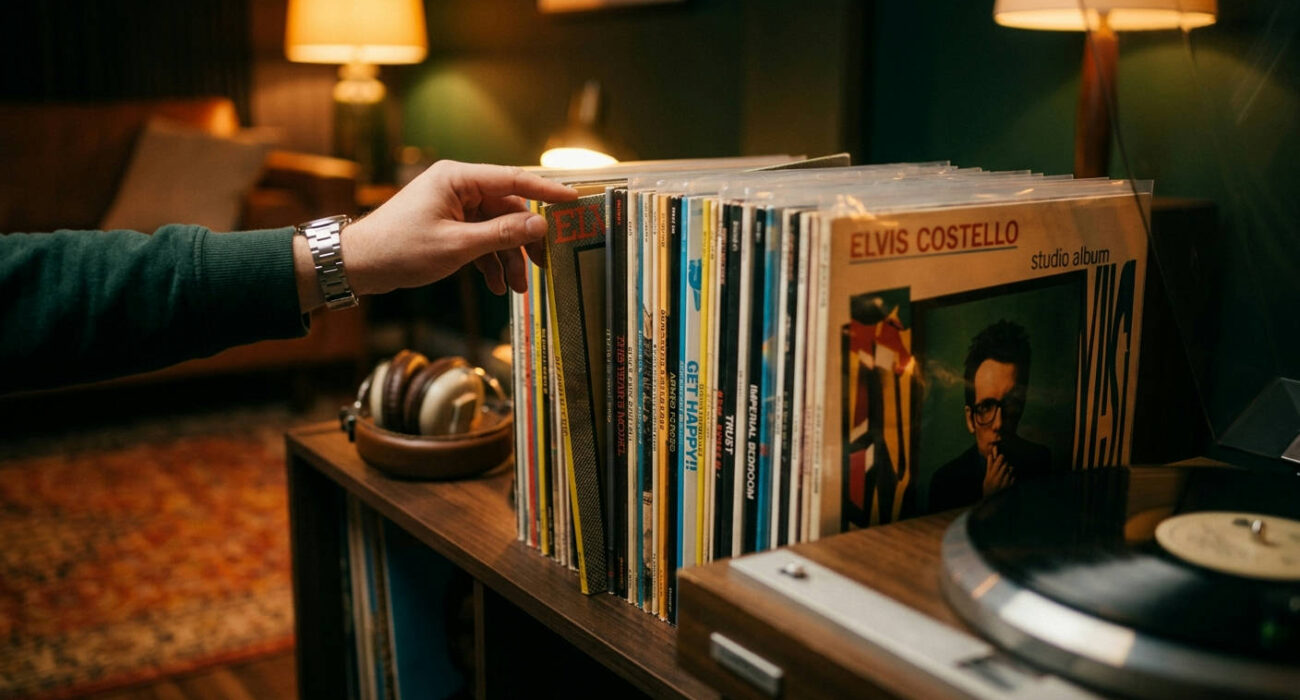
Trying to get a grip on the complete Elvis Costello studio albums chronology is a monumental task. The man has been so absurdly prolific for nearly five decades that his catalogue can feel intimidating. From angry new wave upstart to sophisticated pop craftsman, country crooner, and classical collaborator, his journey is one of constant, restless reinvention. This is not a discography you can casually dip into; it’s a sprawling, brilliant, and sometimes confounding body of work that demands a roadmap. At Vinyl Gold UK, we’re here to provide that definitive guide, navigating you through every twist and turn.
This deep dive will walk you through the entire Elvis Costello studio albums chronology, era by era. We’ll break down the sound, the context, and the essential tracks of each release, giving you the ultimate companion to one of music’s most enduring and vital careers.
The First Shot: The Pub Rock and New Wave Invasion (1977-1979)
This is where it all began. Declan MacManus, armed with a new name, a Fender Jazzmaster, and a notebook full of vitriolic, brilliantly constructed songs, crashed the party. This initial trio of albums remains one of the most potent opening statements in rock history.
My Aim Is True (1977)
Costello’s debut is a raw nerve. Recorded on the cheap with the American band Clover (minus their singer, Huey Lewis), it’s a perfect fusion of American roots music and British punk attitude. The songs are short, sharp, and dripping with lyrical venom and romantic despair.
Tracks like “Alison” showed a surprising tenderness beneath the sneer, while “(The Angels Wanna Wear My) Red Shoes” and “Less Than Zero” were pure, caffeinated pop genius. It announced a songwriter who had arrived fully formed. Even though the legendary Attractions weren’t on this record, their shadow looms large, as this album was the catalyst for their formation.
Grab your copy of this foundational album on vinyl.
Find My Aim Is True on Amazon
This Year’s Model (1978)
If the debut was the warning shot, This Year’s Model was the full-scale assault. Now officially backed by The Attractions—Steve Nieve on keys, Bruce Thomas on bass, and Pete Thomas on drums—the sound was explosive. Nieve’s carnivalesque organ lines, Bruce’s intricate bass melodies, and Pete’s relentless drumming created a sonic hurricane for Costello’s jagged guitar and cynical lyrics.
This is the sound people think of when they think of “classic” Elvis Costello. From the driving paranoia of “Pump It Up” to the sinister pop of “(I Don’t Want to Go to) Chelsea,” the album is a masterclass in tension and release. It’s aggressive, impossibly catchy, and an absolute cornerstone of the new wave movement. The energy is palpable on every single track.
Armed Forces (1979)
Originally titled Emotional Fascism, this album saw Costello and The Attractions honing their pop instincts to a razor’s edge. The production is bigger, the arrangements more complex, and the melodies are sublime. It’s a Trojan horse of an album, smuggling in deeply cynical observations about love and politics inside immaculate pop packages.
Nick Lowe’s production is glossy but powerful, allowing songs like “Oliver’s Army” and “Accidents Will Happen” to become massive hits without sacrificing their lyrical bite. The album solidified Costello’s status as a major international star and proved he was far more than just a punk with glasses. He was a pop composer of the highest order, referencing ABBA and the Beach Boys as much as he did The Clash.
An Elvis Costello Studio Albums Chronology of Change: The Experimental 80s
The 1980s were a period of frantic and fearless exploration for Elvis Costello. He actively resisted being pigeonholed, releasing a flurry of albums that swung wildly in style and tone, often to the confusion of his record label and some of his fans. It was a decade of deconstruction and daring reinvention.
Get Happy!! (1980)
After the lushness of Armed Forces, Costello did a complete 180. Get Happy!! is a frantic, 20-track onslaught of Stax and Motown-inspired soul-punk. The songs are incredibly short, averaging around two minutes, and packed with hooks and raw energy.
It was a deliberate move away from the polish of its predecessor, recorded quickly and with a live-in-the-studio feel. The album is a testament to The Attractions’ versatility, effortlessly channelling the spirit of classic R&B. Tracks like “I Can’t Stand Up for Falling Down” and “High Fidelity” are pure joy, even when the lyrics are laced with Costello’s signature heartache.
The Country & Western Detour: Almost Blue (1981)
This was, at the time, a truly shocking move. Costello went to Nashville to record an entire album of classic country covers, produced by the legendary Billy Sherrill. He tackled songs by icons like George Jones, Gram Parsons, and Hank Williams.
Many critics and fans in 1981 didn’t know what to make of it. Punk’s angry hero was singing sad country ballads? In retrospect, it makes perfect sense. Costello has always been a student of great song writing, regardless of genre. His impassioned delivery on “A Good Year for the Roses” proved he could inhabit these songs with genuine emotion, making Almost Blue a crucial and courageous part of the Elvis Costello studio albums chronology.
The Baroque Pop Masterpiece: Imperial Bedroom (1982)
Hailed by many as his magnum opus, Imperial Bedroom is Costello’s Sgt. Pepper. Working with famed Beatles engineer Geoff Emerick, he crafted a dense, ornate, and musically ambitious album. The songs are layered with intricate arrangements, from string sections and harpsichords to brass and piano flourishes.
Lyrically, it’s one of his darkest and most complex works, exploring the decay of relationships with stunning verbosity. Songs like “Almost Blue” (a Costello original, despite the previous album’s title), “Man Out of Time,” and “Beyond Belief” are staggering achievements. This is not an easy listen, but it is an endlessly rewarding one, revealing new layers with every spin. A must-have for any serious collector.

Find Imperial Bedroom on Amazon
The Pop Sell-Out? Punch the Clock (1983) & Goodbye Cruel World (1984)
This pair of albums represents Costello’s most overt flirtation with mainstream 80s pop production. Working with producers Clive Langer and Alan Winstanley, he brought in slick synths, a horn section (The TKO Horns), and female backing vocalists (TKO’s Afrodiziak).
Punch the Clock yielded the massive hit “Everyday I Write the Book,” a soulful pop gem. The album also contained the politically charged “Shipbuilding,” a beautiful and haunting ballad featuring a trumpet solo by Chet Baker. Goodbye Cruel World, from 1984, was even slicker and is an album Costello himself has famously disparaged. Despite his feelings, songs like “The Only Flame in Town” have a certain charm. It’s a fascinating period that showcases the pop sounds that were topping the charts in what was number 1 in 1984.
The American Roots Revival: King of America (1986) & Blood & Chocolate (1986)
In an astonishing display of creative energy, Costello released two completely different, yet equally brilliant, albums in 1986. First came King of America, credited to “The Costello Show featuring Elvis Costello.” He teamed up with producer T-Bone Burnett and a stellar band of American session musicians (The Confederates), including members of Elvis Presley’s TCB Band. It’s a masterful album of acoustic-driven folk, country, and rockabilly, featuring some of his most mature and narrative-driven song writing, like “Brilliant Mistake” and “Indoor Fireworks.”
Just a few months later, he reunited with The Attractions for Blood & Chocolate. The gloves were off. It’s a raw, loud, and angry rock and roll record, sounding like it was recorded in a garage. The bitterness and fury in songs like “I Want You” and “Tokyo Storm Warning” are visceral. The contrast between these two 1986 albums is a perfect microcosm of his entire career: a constant pendulum swing between refined songcraft and raw, emotional power.
Navigating the 90s: Collaborations and Returns to Form
The 1990s saw Costello continue his eclectic path, collaborating with classical musicians, reuniting with The Attractions, and working with a Beatle. He cemented his status as a musician’s musician, someone unbound by genre or expectation.
Spike (1989) & Mighty Like a Rose (1991)
Released at the tail end of the 80s, Spike was a huge commercial success. It’s a sprawling, star-studded affair featuring everyone from Paul McCartney and Roger McGuinn to the Dirty Dozen Brass Band. The album’s centrepiece is “Veronica,” a poignant and catchy hit he co-wrote with McCartney about his grandmother’s struggle with Alzheimer’s.
Mighty Like a Rose followed in a similar vein but was darker and more lyrically dense. “The Other Side of Summer” is a scathing, Phil Spector-esque takedown of sunny pop clichés, and the album as a whole is a challenging but brilliant work that rewards patient listeners.
The Classical Turn: The Juliet Letters (1993)
This was another move no one saw coming. Costello collaborated with the acclaimed Brodsky Quartet for an entire album of songs structured as letters. It’s a unique fusion of classical chamber music and pop song writing, with Costello’s voice serving as another instrument in the string quartet.
“I wanted to write a song cycle for this combination of instruments. A series of letters, some from characters, some in my own voice, that would correspond with one another, as if in a strange, unresolved soap opera.” – Elvis Costello
The project was a critical success and demonstrated the sheer breadth of his musical ambition. It proved he could operate with credibility and creativity in a completely different musical world, a feat few of his rock peers could ever attempt.
A Rock and Roll Reunion: Brutal Youth (1994)
Fans longing for the fire of the early days got their wish with Brutal Youth. This was a full-throated reunion with The Attractions (though bassist Bruce Thomas only played on a few tracks) that felt like a direct sequel to Blood & Chocolate.
The album is packed with powerful, guitar-driven rockers like “13 Steps Lead Down” and “20% Amnesia.” It’s the sound of a band rediscovering its chemistry and raw power. This record is a vital part of the Elvis Costello studio albums chronology for showcasing that the old anger and energy could be summoned at will.
The End of an Era: Kojak Variety (1995) & All This Useless Beauty (1996)
This pair of albums closed out his long relationship with Warner Bros. Records. Kojak Variety was a covers album, recorded years earlier in 1990, featuring his interpretations of songs by Screamin’ Jay Hawkins, Willie Dixon, and Randy Newman.
All This Useless Beauty was the final studio album with the original Attractions line-up. It was conceived as a collection of songs Costello had written for or offered to other artists, like Aimee Mann and Johnny Cash. As a result, it has a wonderfully diverse and melodic quality, with “The Other End of the Telescope” and the title track standing as late-period classics.
The Elder Statesman: The 21st Century Songwriter
Entering the new millennium, Costello showed no signs of slowing down. He embraced collaborations, formed a new backing band, and continued to explore every corner of the musical map, earning a well-deserved induction into the Rock & Roll Hall of Fame in 2003.
The Burt Bacharach Partnership: Painted from Memory (1998)
This collaboration, which began for the film Grace of My Heart, blossomed into a full album that stands as a modern classic. The fusion of Costello’s intricate lyrics and Bacharach’s sophisticated, unconventional melodies was a match made in heaven.

Painted from Memory is an album of lush, heart-breaking balladry. Songs like “God Give Me Strength” and “This House Is Empty Now” are masterpieces of song writing, arrangement, and vocal performance. It set a new standard for Costello and remains one of the most beloved albums in his entire discography.
Introducing The Imposters: When I Was Cruel (2002) & The Delivery Man (2004)
With Steve Nieve and Pete Thomas from The Attractions joined by new bassist Davey Faragher, The Imposters were born. Their debut, When I Was Cruel, was a noisy, vibrant, and thoroughly modern-sounding rock record. It incorporated loops and different sonic textures, highlighted by the brilliant, snarling “45.”
The Delivery Man was a looser, grittier affair, recorded in the American South. It’s a concept album of sorts, full of bluesy, country-inflected rock and roll. It features guest appearances from Lucinda Williams and Emmylou Harris, grounding the record in a rich, Americana tradition.
Unbound by Genre: North (2003), Il Sogno (2004), The River in Reverse (2006)
This three-album stretch is perhaps the most eclectic of his career. North is a quiet, contemplative album of piano-led ballads about divorce and new love. It’s a deeply personal and beautifully orchestrated record.
He followed that with Il Sogno, a full-scale instrumental ballet score based on Shakespeare’s A Midsummer Night’s Dream, recorded with the London Symphony Orchestra. Then came The River in Reverse, a powerful and soulful collaboration with the legendary New Orleans songwriter and pianist Allen Toussaint, recorded in the aftermath of Hurricane Katrina. This run demonstrates a creative freedom that is simply staggering.
The Modern Era: Prolific, Unpredictable, and Essential (2010-2026)
In his later career, Costello has become even more prolific, releasing a string of diverse and critically acclaimed albums. He continues to challenge himself and his audience, proving that his creative well is far from dry. The most recent additions to the Elvis Costello studio albums chronology are as vital as his earliest work.
Roots and Rhythms: National Ransom (2010) & Wise Up Ghost (2013)
National Ransom was another collaboration with producer T-Bone Burnett, a sprawling and brilliant collection of American roots music styles, from folk and bluegrass to roaring electric rock.
Then, in a move that surprised everyone, he partnered with hip-hop legends The Roots for Wise Up Ghost. This is not a rap-rock album. It’s a dense, dark, and rhythmically complex album where Costello’s lyrics and melodies are woven into The Roots’ deep, layered grooves. It’s a testament to both artists’ willingness to step outside their comfort zones to create something entirely new.
A Grammy-Winning Return: Look Now (2018)
His first album with The Imposters in a decade, Look Now is a stunning return to the sophisticated pop of his Bacharach collaboration. The songs are elegant, beautifully arranged, and feature some of his most empathetic and character-driven lyrics.
“I knew if we could make an album with the scope of Imperial Bedroom and the beauty of Painted From Memory, then we would really have something.” – Elvis Costello on the ambitions for Look Now
The album won the Grammy Award for Best Traditional Pop Vocal Album in 2020, a well-deserved honour for a record that feels like a culmination of a lifetime spent mastering the art of the popular song.
The Lockdown Flurry and Beyond: Hey Clockface (2020) to Today
The period from 2020 onwards has seen another burst of creativity. Hey Clockface was a fascinating experiment, recorded in Helsinki, Paris, and New York. It swings from spoken-word pieces to raucous rock and gentle ballads.
He followed that with Spanish Model (2021), a brilliant concept where he had Spanish-language artists sing new vocals over the original 1978 master tapes of This Year’s Model. In early 2022, he and The Imposters released The Boy Named If, a raw and energetic rock and roll album that harkens back to the power of their early work. As of 2026, it remains his most recent studio effort, a powerful statement that the fire still burns brightly.
Collecting Costello: A Vinyl Gold UK Guide
With such a vast and varied discography, collecting Elvis Costello on vinyl can be a rewarding journey. The warmth and detail of a good vinyl pressing can bring new life to these classic recordings.
### Your Starting Point: The Essential LPs
For newcomers, the sheer volume can be overwhelming. Here’s a quick guide to the absolute must-haves for your shelf:
- This Year’s Model (1978): The quintessential album with The Attractions. The energy leaps from the grooves. A perfect starting point.
- Imperial Bedroom (1982): For when you’re ready for a deeper dive. The lush, detailed production sounds absolutely magnificent on vinyl. This is an album to be explored with a good set of headphones and perhaps a turntable from our guide to the best turntables under £300 in the UK.
- King of America (1986): To appreciate his song writing in a more stripped-back, Americana context. The acoustic instruments have a wonderful presence on a vinyl pressing.
Find the King of America Vinyl on Amazon
### Understanding the Elvis Costello Studio Albums Chronology for Collectors
Knowing the sequence of these albums is crucial for any collector. It helps you understand the context of each release. You can trace his evolution from the raw punk energy of ’77 to the soulful R&B of Get Happy!! and the baroque pop of Imperial Bedroom. Each album is a reaction to, or an evolution from, the one that came before it. This chronological understanding transforms collecting from simple acquisition into a deeper appreciation of his artistic journey.
The journey through the Elvis Costello studio albums chronology is long, but it’s one of the most rewarding in modern music. There are very few artists who have remained so consistently brilliant, so creatively restless, and so utterly essential for so long. His is a catalogue to be lived with, explored, and endlessly debated. Get digging.