
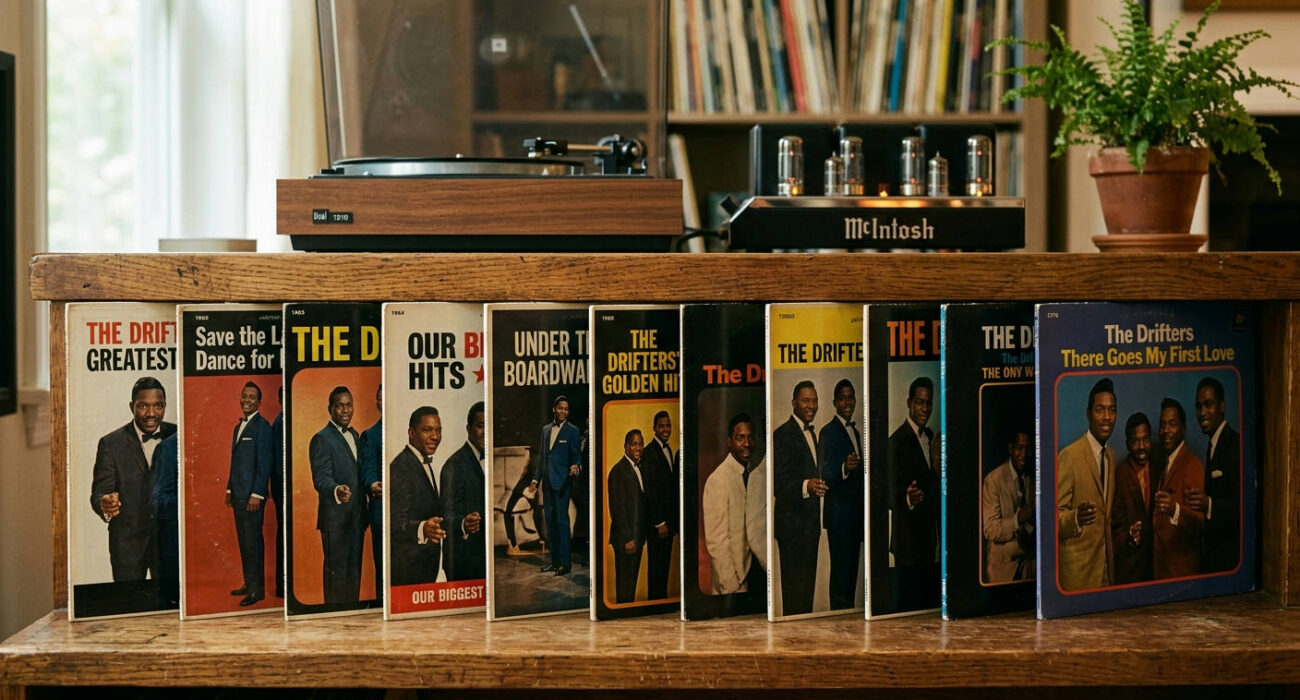
Trying to pin down the definitive discography for The Drifters is like trying to nail jelly to a wall. With a lineup that changed more often than the weather, their story is one of constant reinvention. If you’re looking for a complete guide to all The Drifters albums in order, you’ve come to the right place. We’re going to cut through the confusion and walk you through every key era, from their raw R&B beginnings to their 70s chart domination here in the UK.
This isn’t just a list; it’s the story of a musical institution. The Drifters weren’t a band in the modern sense; they were a brand, a vocal concept that outlasted every single one of its members. So, grab your headphones, and let’s dive into the sprawling, brilliant, and often complicated catalogue of one of the greatest vocal groups of all time.
The Genesis: Clyde McPhatter & The Original R&B Titans (1953–1956)
Before the string arrangements and the pop polish, The Drifters were a gritty R&B powerhouse. Formed by the legendary Clyde McPhatter after he left Billy Ward and His Dominoes, this first incarnation laid the groundwork for everything that followed. Their sound was a potent cocktail of gospel fervour and secular swagger.
This era is primarily defined by a string of hugely influential singles on Atlantic Records. While a formal studio album wasn’t the standard practice then, these tracks were later compiled, creating a de facto first album for collectors.
Clyde McPhatter & The Drifters (1956)
This record is essentially a greatest hits of the original lineup. It’s the ground zero of The Drifters’ sound. Listening to this today, you can hear the raw energy that set them apart from their peers. It’s less about pop hooks and more about pure, unadulterated soul.
Key tracks like “Money Honey” hit with an electrifying force, showcasing McPhatter’s incredible tenor vocal, which would go on to influence countless singers. Other standouts include the bluesy “Such a Night” and the Billboard R&B number one “Honey Love.” This album is a crucial historical document, capturing the birth of a legend.
You can hunt for a vintage pressing of this foundational record on vinyl.
Find Clyde McPhatter & The Drifters on Amazon: https://www.amazon.com/s?k=Clyde+McPhatter+The+Drifters+Vinyl&tag=vinylgolduk-21
The Sound That Started It All
The McPhatter-led Drifters were instrumental in bridging the gap between gospel and rock and roll. Their arrangements were sparse but powerful, letting the vocal harmonies and McPhatter’s dynamic lead shine. This wasn’t the smooth, orchestral sound people later associated with the group; it was raw, immediate, and full of passion.
McPhatter’s departure in 1954 for a solo career (after being drafted into the army) could have been the end. Instead, it was just the first of many pivotal line-up shifts that would come to define the group’s entire existence. It closed chapter one and set the stage for a complete reinvention.
The “Second” Drifters: Ben E. King and the Golden Age (1959–1962)
Here’s where the story gets truly interesting. In 1958, the group’s manager, George Treadwell, had a falling out with the post-McPhatter line-up. In a move that would be unthinkable today, he fired the entire band and hired a completely different group, The Five Crowns, to become the new Drifters.
Leading this new lineup was a charismatic young singer named Benjamin Earl Nelson, who you probably know better as Ben E. King. This was the start of The Drifters’ commercial peak, thanks in no small part to the ground breaking production of Jerry Leiber and Mike Stoller.
As Leiber and Stoller recalled, “We didn’t want to just make records. We wanted to make movies for the ears.” This philosophy transformed The Drifters’ sound, adding cinematic strings and Latin rhythms that had never been heard in R&B before.
The Drifters’ Greatest Hits (1960)
Though technically a compilation, this 1960 release on Atlantic is arguably the most important album from the Ben E. King period. It gathered the revolutionary singles that redefined pop music. It’s an absolute masterclass in song writing and production.
The track list is a murderer’s row of classics. “There Goes My Baby,” with its soaring strings and baion rhythm, was a revelation. Then you have the timeless romance of “This Magic Moment” and the impossibly smooth “Save the Last Dance for Me,” which became one of their signature songs and a global smash hit.
Save the Last Dance for Me (1962)
This was the first proper studio LP from the new line-up, released just as Ben E. King was leaving for his own legendary solo career. The album expands on the sound of the hit singles, creating a cohesive and beautifully crafted listening experience.
Besides the iconic title track, the album features gems like “Sweets for My Sweet” (later a hit for The Searchers) and “When My Little Girl Is Smiling.” It perfectly captures the “uptown soul” sound they pioneered—sophisticated, romantic, and emotionally resonant. This album cemented The Drifters not just as a singles act, but as a group that could deliver a complete, compelling project.
A Definitive Guide to All The Drifters Albums in Order: The Rudy Lewis & Johnny Moore Years (1962–1970)
With Ben E. King gone, The Drifters needed another star vocalist. They found one in the gospel-trained Rudy Lewis. This era continued the group’s run of hits, albeit with a slightly different flavour. Later, the return of an earlier member, Johnny Moore, would steer them through the rest of the decade.
This period saw the group navigating the rapidly changing musical currents of the 1960s, from the rise of Motown to the British Invasion.
Up on the Roof (1963)

Led by Rudy Lewis’s smooth, effortless vocals, the title track of this album became an instant classic. Written by Gerry Goffin and Carole King, “Up on the Roof” was an anthem of urban escapism, and the album built beautifully around that theme.
The album is a quintessential example of the Brill Building pop sound. It’s polished, impeccably arranged, and filled with melodic gems. Lewis’s voice was warmer and less raw than King’s, giving tracks like “Another Night With The Boys” a gentle, persuasive charm.
Under the Boardwalk (1964)
This album is defined by one of the most famous—and tragic—stories in music history. Rudy Lewis, who was set to sing lead on the title track, was found dead in his hotel room from a suspected overdose the night before the recording session.
In a pinch, Johnny Moore, who had briefly been in the group years earlier, was brought back in. He stepped up to the mic and delivered the legendary, laid-back vocal for “Under the Boardwalk” that we all know and love. The album itself is a masterpiece, perfectly balancing upbeat summer anthems with heart-wrenching ballads like “I’ve Got Sand in My Shoes.”
The Good Life with The Drifters (1965)
By 1965, the musical world was a very different place. This album saw The Drifters adapting to the times. The production is a little fuller, and you can hear the influence of the British bands that had, ironically, been influenced by The Drifters themselves.
While it didn’t produce a monster hit on the level of their previous work, it’s a solid and enjoyable listen. Tracks like “At the Club” and “Come On Over to My Place” are prime examples of mid-60s soul, showcasing Johnny Moore’s reliable and emotive lead vocals.
I’ll Take You Where the Music’s Playing (1966)
This album continued the trend of adapting their sound. The title track is a fantastic, driving soul number that deserved to be a bigger hit than it was. The record shows the group trying to hold their own against the dominance of Motown and Stax.
By this point, their chart success in the United States had started to wane. The Drifters’ brand of sophisticated pop-soul was being overshadowed by harder-edged soul and psychedelic rock. This album marks the end of their classic Atlantic Records era in the US, but it was far from the end of their story.
The British Renaissance: The Bell Records Revival (1972–1976)
Just as their star faded in America, it was reborn brighter than ever across the Atlantic. In the early 1970s, the Johnny Moore-led Drifters signed with Bell Records in the UK and began a new chapter that was, in many ways, even more successful than their 60s heyday. They became superstars in Britain.
This era is a testament to their incredible adaptability. They shed their 60s sound for a slick, contemporary, and incredibly catchy brand of 70s soul-pop that the UK audience couldn’t get enough of. This period is essential for anyone wanting to understand all The Drifters albums in order.
The Drifters Now (1973)
This comeback album was a statement of intent. The sound was fresh, modern, and perfectly tailored for the 70s. Produced by Roger Greenaway and Geoff Stephens, the album spawned the massive UK hit “Like Sister and Brother.”
The production is lush, with sweeping strings and tight rhythm sections. Johnny Moore’s voice had matured beautifully, full of warmth and character. This album reintroduced The Drifters to a new generation and kicked off a string of Top 10 hits in the UK.
Love Games (1975)
This might be the peak of their 70s UK success. The album is packed with hit singles that are now considered classics of the era. It’s an incredibly joyful and infectious record from start to finish.
“Kissin’ in the Back Row of the Movies” is a perfect piece of pop storytelling, a nostalgic look back at young love that resonated deeply with the British public. The album also features “Down on the Beach Tonight” and the soulful “Love Games.” If you’re exploring their 70s output, this is the place to start. For fans of the decade, it’s a must-have, fitting right in with the best soul and pop of the time, and a worthy inclusion on any list of the Best Albums Of The 1970s.
There Goes My First Love (1975)
Released in the same year as Love Games, this album kept the momentum going at full speed. The title track was another monster hit, a beautiful, melancholic ballad that showcased the group’s incredible harmonies and Moore’s expressive lead.
The album demonstrates their mastery of the 70s soul-pop formula. The songs are impeccably crafted, emotionally resonant, and produced with a glossy sheen that made them irresistible for radio. It solidified their status as adopted national treasures in the UK.
Every Nite’s a Saturday Night (1976)
The final album from their golden run on Bell Records, Every Nite’s a Saturday Night delivered yet another classic single. “You’re More Than a Number in My Little Red Book” is an impossibly catchy tune that became another fixture on UK radio and in discos.
The album as a whole is a celebration, capturing the feel-good vibe of the time. It was the perfect capstone to their incredible UK revival, proving that The Drifters’ name was synonymous with quality vocal music, regardless of the decade or the continent.
A Collector’s Guide: Hunting for Drifters Vinyl

Building a collection of Drifters records is a rewarding journey that takes you through decades of music history. Whether you’re a seasoned collector or just starting out, here’s what you need to know.
Essential Pressings to Own
For the purist, nothing beats the sound of an original mono pressing from the 1960s on the iconic Atlantic Records label. The raw power of the Ben E. King and Rudy Lewis years truly comes alive on these records. They can be pricey, but they are the definitive article.
For the 70s UK material, look for original pressings on Bell Records. These are generally more affordable and easier to find in good condition here in the UK. They capture that slick, warm 70s production perfectly. A clean copy of Love Games or Under the Boardwalk is a cornerstone of any serious soul collection.
Find a wide selection of Drifters records on Amazon: https://www.amazon.com/s?k=The+Drifters+Vinyl+Album&tag=vinylgolduk-21
Reading the Vinyl: Originals vs. Reissues in 2026
The market is flooded with reissues of varying quality. To spot an original, pay close attention to the record label design, the weight of the vinyl, and the details on the cover. Check sites like Discogs to compare catalogue numbers and matrix etchings in the run-out groove.
A good rule of thumb: original Atlantic pressings from the 60s will have a sturdy, thick cardboard cover and often feature the black fan or red and purple label design. Later 70s and 80s reissues will feel flimsier. Don’t be afraid to ask sellers questions and do your research before you buy.
The Legacy: A Vocal Group Institution
The Drifters’ impact on popular music is immeasurable. They weren’t just a band; they were an ever-evolving musical concept, a testament to the power of great songs and incredible vocalists.
According to the Rock and Roll Hall of Fame, which inducted the group in 1988, “The Drifters served as a training ground for future soul stars and a vehicle for some of the greatest songs in rock and roll history.”
The Revolving Door of Legends
Over 60 singers have passed through the ranks of The Drifters. This constant flux of talent is what kept the group fresh and relevant for so long. Legends like Clyde McPhatter and Ben E. King became stars in their own right after leaving the group, but the group itself endured.
This model of a manager-owned brand with rotating members was unique and controversial, but it undeniably worked. The Drifters became a seal of quality, assuring audiences that no matter who was on stage, they were going to hear those iconic songs performed with passion and skill. Their influence on other vocal groups, from Motown’s finest like The Four Tops to countless doo-wop and soul acts, is undeniable.
From R&B to Uptown Soul to Pop Stardom
The Drifters’ sonic journey is a roadmap of 20th-century pop music. They started with raw, gospel-infused R&B, invented the sophisticated, string-laden “uptown soul” sound, and then seamlessly transitioned into the slick pop-soul that made them superstars in the 1970s.
They were chameleons, but they never lost their core identity: beautiful melodies, impeccable harmonies, and a lead vocalist who could tell a story. Their songs have become part of our collective cultural fabric, appearing in countless films, commercials, and TV shows, ensuring their music will live on for generations to come.
Your Questions Answered: FAQs
Navigating such a vast and complex discography can bring up a lot of questions. We’ve compiled some of the most common ones to help you on your journey.
What is considered the “best” Drifters album?
This is the ultimate debate among fans. For the classic 1960s American sound, many point to Under the Boardwalk (1964). It has the iconic title track, a perfect blend of joy and melancholy, and captures the group at the peak of their “uptown soul” phase.
For the 1970s UK revival, the essential album is Love Games (1975). It’s a joyous, hit-packed record that perfectly encapsulates the sound that made Britain fall in love with them all over again.
How many official studio albums did The Drifters release?
This is a tricky question due to the sheer number of compilations and regional releases. Focusing on the key studio LPs from their most significant periods, there are roughly a dozen core albums. However, their discography is massively expanded by greatest hits collections, which often contain non-album singles that are essential to their story.
A complete list of all The Drifters albums in order.
To give you the clearest possible overview, here is a chronological list of their major studio LPs and key early compilations. This provides the definitive road map to exploring all The Drifters albums in order.
- Clyde McPhatter & The Drifters (1956) – Compilation of early singles
- The Drifters’ Greatest Hits (1960) – Key compilation of the Ben E. King era
- Save the Last Dance for Me (1962)
- Up on the Roof (1963)
- Under the Boardwalk (1964)
- The Good Life with The Drifters (1965)
- I’ll Take You Where the Music’s Playing (1966)
- The Drifters Now (1973)
- Love Games (1975)
- There Goes My First Love (1975)
- Every Nite’s a Saturday Night (1976)
The story of The Drifters is one of survival, adaptation, and timeless music. From the streets of Harlem to the top of the British charts, their legacy is etched in the grooves of these incredible records. Happy listening, and happy collecting.