

You pull out a favourite LP, line up the cue, and the first thing the room hears isn’t the intro. It’s crackle. Then a little burst of static. Then a dull swish that wasn’t there when you bought the record.
That’s usually not bad luck. It’s storage.
For working DJs and serious collectors, inner sleeves for vinyl records aren’t a fussy add-on. They’re the layer that touches the playing surface every time the record goes in and out of the jacket. If that layer sheds dust, grips with static, crumples in the bag, or scuffs the disc on every use, you’ll hear it sooner or later. At a wedding, private party, or corporate set, that matters. A pristine record sounds confident. A neglected one sounds like your prep was sloppy.
A lot of generic advice online treats sleeves as a collector-only topic. That misses the actual problem. Records used at events get handled often, moved between venues, packed and unpacked, and exposed to changing rooms, damp storage, and rushed changes. The right sleeve helps the record survive actual use, not just look tidy on a shelf.
Why Your Record Collection Deserves Better
The inner sleeve is easy to ignore because it sits out of sight. Then you inherit a stack of old records in rough paper inners, or you buy a used soul LP that looks clean until playback starts, and you realise the sleeve has been doing damage for years.
That matters even more in the UK because inner sleeves weren’t some late audiophile obsession. They were built into the way records were sold. In the 1950s and 1960s, UK shops didn’t shrink-wrap albums. They displayed empty outer sleeves and kept the actual LPs behind the counter in inner sleeves, often marked with handwritten catalogue numbers. EMI changed the game in September 1956, moving from basic polythene bags to paper sleeves lined with polythene and a centre hole to show the label, a shift that improved protection and became standard across its labels, as documented in this history of UK LP inner sleeves and EMI’s 1956 design change.
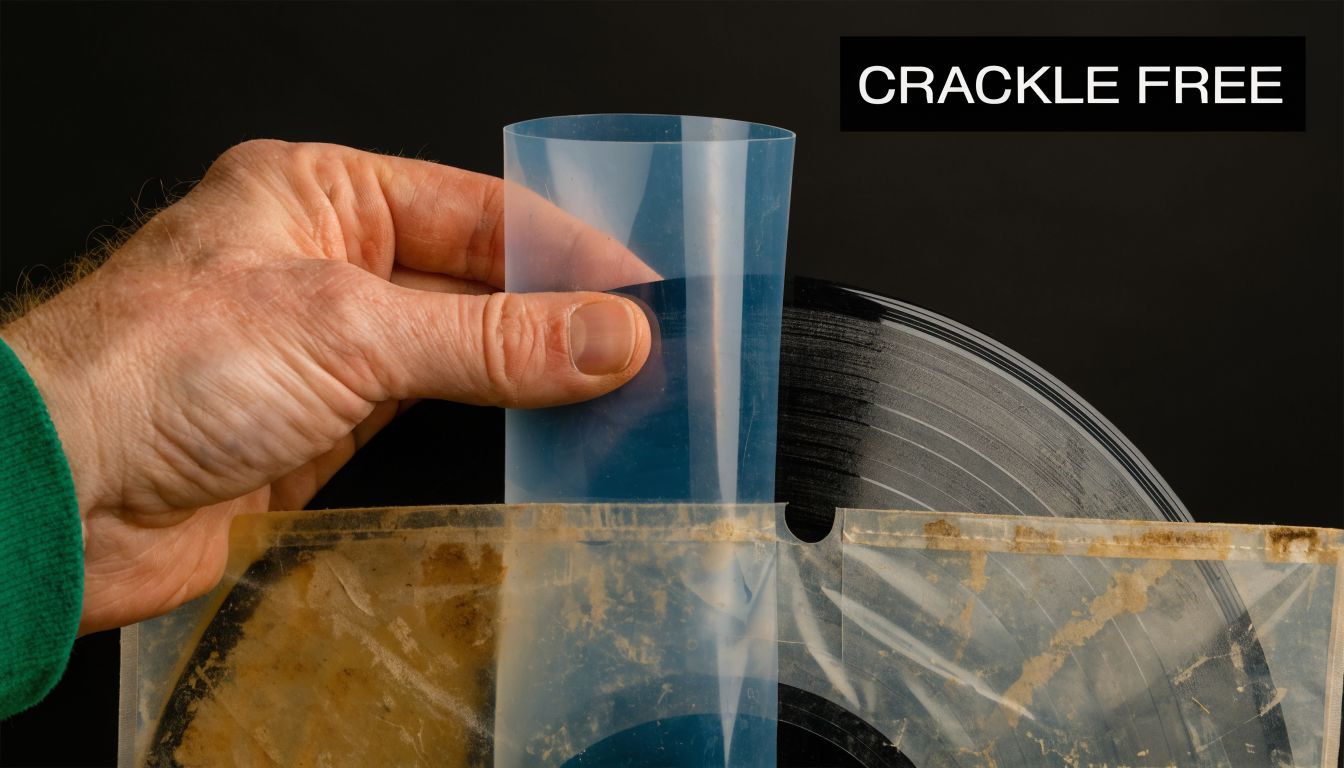
That history tells you something useful. The industry learned early that the record itself needed its own protection, separate from the outer artwork. Cardboard jackets look sturdy, but the inside edge and paper dust can be brutal on a playing surface over time.
What DJs hear first
A sleeve problem rarely announces itself dramatically. It shows up as small faults that build:
- Paper dust in the grooves that creates low-level noise
- Static cling that turns a clean record into a dust magnet
- Hairlines and sleeve scuffs from rough insertion and removal
- Crumpled inners that make fast record changes awkward
For event DJs, these are practical issues, not collector trivia. You want the opening bars of the first dance, the soul classic after dinner, or the late-night disco tune to sound clean. If your collection is part of your working kit, every sleeve choice either helps that result or works against it.
A record can look excellent under room light and still sound tired if it’s lived in the wrong inner sleeve.
There’s also a presentation side to this. Clean records suggest discipline. Clients might not know why playback sounds smooth, but they notice the result. The same goes for how you handle and prepare your collection, whether it’s for home listening or a set built around personal favourites and carefully chosen vinyl imagery like this event-focused music visual.

Understanding the Inner Sleeve’s Role in Preservation
Think of the inner sleeve as the bodyguard for your record. The outer jacket protects the package. The inner sleeve protects the playing surface.
That distinction matters because people often mix up three different things: the outer jacket, the inner sleeve, and any printed insert or lyric sheet. A printed insert may carry artwork, credits, or lyrics, but it isn’t automatically safe storage for the disc. Plenty of them were made for presentation, not protection.
What the sleeve actually does
A proper inner sleeve has three jobs.
First, it creates a softer barrier between vinyl and cardboard. Without that barrier, every slide in and out of the jacket risks abrasion from the jacket itself or from debris trapped inside.
Second, it helps control static. Static doesn’t just make the record cling to the sleeve. It attracts airborne dust and loose fibres, which then end up where you don’t want them, right in the grooves.
Third, it reduces contact with general dirt from handling and storage. Even a careful owner can’t stop dust in the room. A decent sleeve cuts down how much reaches the record between plays.
What it does not do
An inner sleeve won’t rescue a dirty record on its own. If a used LP has grime, mould spots, or residue, a premium sleeve stores that contamination more neatly until you clean the record.
It also won’t fix bad handling. Touching grooves, forcing a tight fit, or dragging a disc against a split old paper sleeve can still mark the vinyl.
Practical rule: If the sleeve touches the grooves, its material and condition matter every single time you handle the record.
For beginners, the simplest way to judge the sleeve’s role is this: if you wouldn’t wipe your glasses with rough cardboard, don’t store a record bare against a cardboard jacket or in a tired inner that sheds and scrapes.
A Material Guide to Inner Record Sleeves
Once you understand the job, the next question is material. At this stage, many buyers waste money. They either buy the cheapest paper sleeves and replace them repeatedly, or they import premium options that don’t suit how they use records.
The best sleeve depends on whether the record is a working copy, an archive piece, or both.
Plain paper sleeves
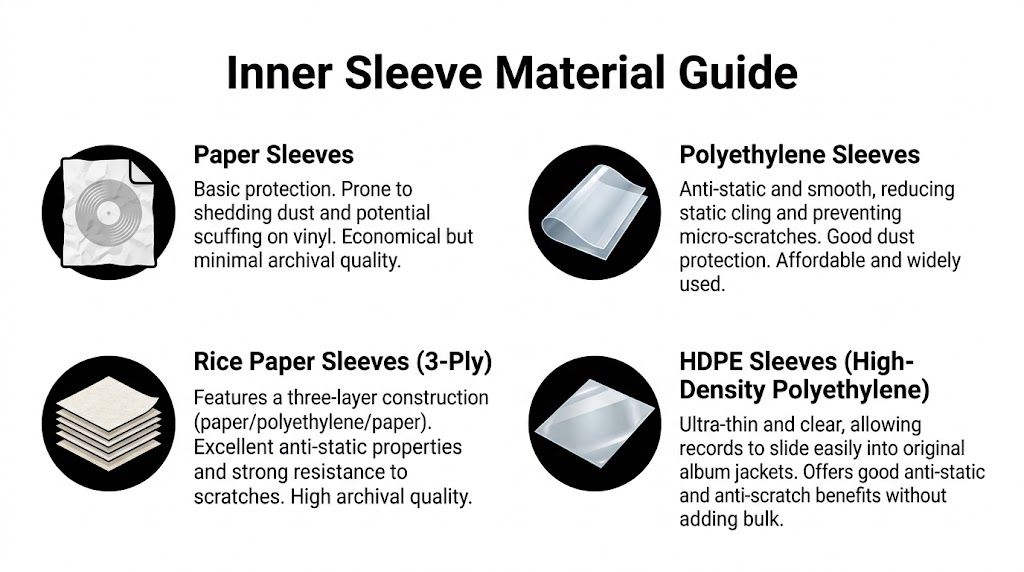
Plain paper is the old standard. It’s cheap, easy to replace, and still common in second-hand bins and many stock inner sleeves.
The downside is obvious once you’ve handled enough records. Paper can crease, split at the seams, shed fibres, and feel abrasive compared with smoother materials. For records you use often, plain paper is usually the weakest option unless it’s just a temporary placeholder to preserve an original printed inner separately.
Best for:
- Originality-minded collectors keeping era-correct packaging
- Short-term holding before a proper replacement
- Low-cost bulk sorting of records not yet cleaned
Poor choice for:
- High-frequency DJ use
- Freshly cleaned records
- Long-term protection where low dust matters
Polyethylene sleeves
Polyethylene sleeves feel smoother and usually reduce static better than plain paper. They slide more easily and don’t throw off paper dust. For many collections, they’re a noticeable upgrade from basic paper without feeling over-engineered.
The trade-off is structure. Some very light plastic sleeves can collapse, bunch up, or become annoying when you’re trying to put a record away quickly. In a home environment that might just be irritating. In a DJ bag, it becomes a routine handling problem.
HDPE sleeves
HDPE, or high-density polyethylene, is where things get more serious. It’s favoured because it’s smooth, light, and easy to work with while staying relatively stable for storage. Good HDPE sleeves let the record slide without that rough paper drag you feel with budget inners.
For collectors, HDPE is appealing because it protects without much bulk. For DJs, the attraction is consistency. If you need to pull records in and out repeatedly, a slick but controlled surface is far better than a cheap paper sleeve that grips, wrinkles, and slows you down.
Polypropylene and similar plastics
Some DJs like polypropylene-lined styles because they’re reusable and handle frequent movement well. The feel can be crisp and practical. The caution is that “plastic” on its own doesn’t tell you enough. Build quality matters more than the marketing label. A poor thin plastic sleeve can still frustrate you if it folds too easily or catches inside the jacket.
Polylined paper sleeves
A polylined paper sleeve nicely integrates form and function, offering the structure of paper with the smoother contact surface of poly. In practical terms, that means easier insertion, less crumpling, and better day-to-day handling than a flimsy single-layer option.
That structural advantage isn’t just theory. Premium polylined inner sleeves used in the UK often rely on a multi-layer build where outer poly reduces static and a paper core keeps the sleeve from collapsing. Thin single-layer sleeves can generate PVC dust through friction, increasing pops and clicks, while multi-layer designs can mitigate this wear by an estimated 80 to 90%, according to the product data and discussion around Reloop premium polylined inner sleeves.
Rice paper style sleeves
Collectors often talk about “rice paper” sleeves as the premium choice. In practice, many of these are composite sleeves rather than literal simple paper. The appeal is straightforward: soft feel, low drag, and a premium reputation.
They can be excellent. But they’re not automatically the best choice for every UK collection. Climate, storage habits, and how often the record is handled all matter. A sleeve that’s lovely in a dry listening room may be less convincing in a damp cupboard or a DJ setup that sees frequent travel.
A quick comparison
| Material | Strengths | Weaknesses | Best use |
|---|---|---|---|
| Plain paper | Cheap, original look | Dust, scuff risk, seam splits | Temporary or original packaging |
| Polyethylene | Smooth, better dust control | Can feel flimsy | Everyday home use |
| HDPE | Smooth, low friction, low bulk | Needs good sizing and build | Collectors and regular playback |
| Polylined paper | Better structure, easier handling | Slightly bulkier than ultra-thin sleeves | DJs and mixed-use collections |
| Rice paper style | Premium feel, gentle handling | Not always ideal in every storage condition | Careful archival use |
If you handle records often, don’t choose a sleeve purely by prestige. Choose the one you can use repeatedly without wrestling it.
Matching the Sleeve to the Record Size and Shape
Material matters, but shape matters too. A great sleeve in the wrong size is still a bad sleeve. If it’s too tight, you’ll force the record in and out. If it’s too loose, the disc shifts more than it should.
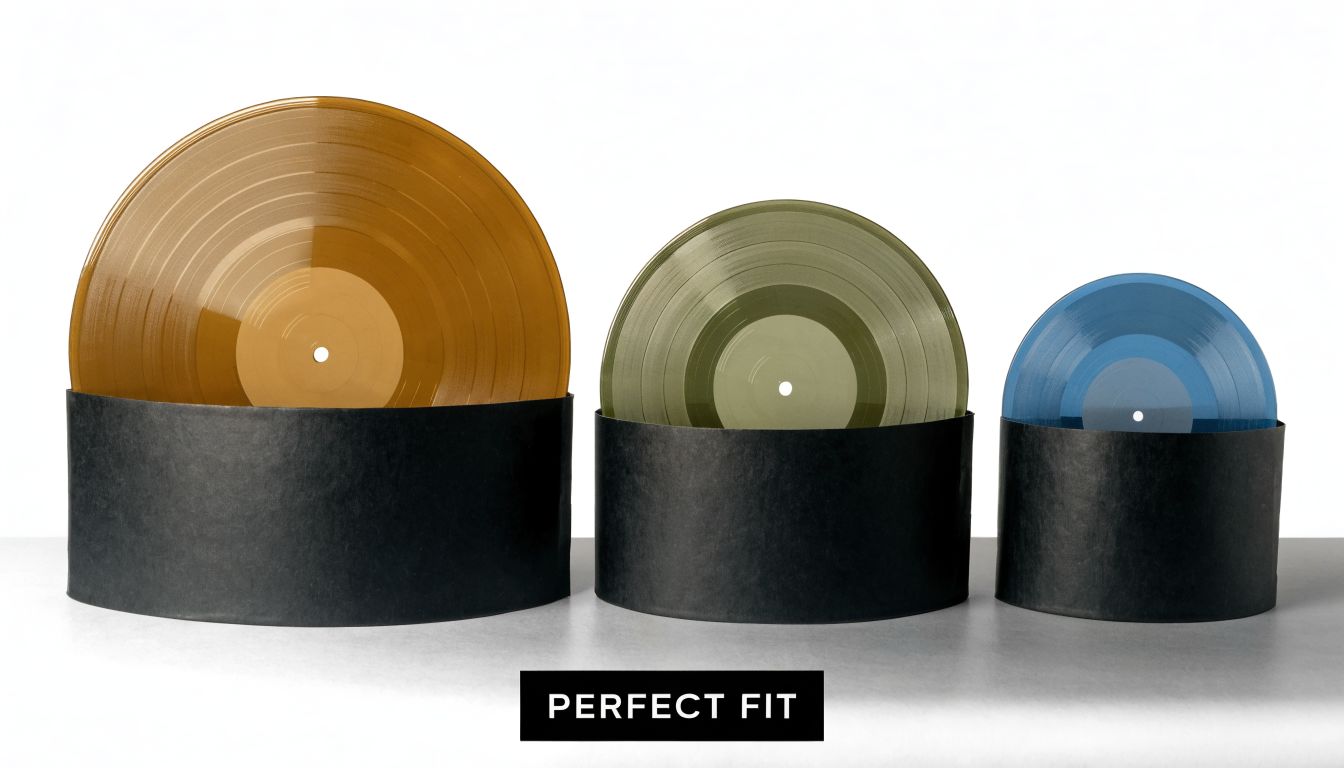
A working collection often includes more variation than people expect. Standard LPs are one thing. Then you’ve got tight vintage jackets, chunky reissues, odd 10-inch releases, and 7-inch singles that don’t behave like miniature LPs.
Size first, then opening style
Start with the obvious match:
- 12-inch sleeves for LPs and most dance records
- 10-inch sleeves for niche releases and older formats
- 7-inch sleeves for singles and jukebox-style stock
After that, focus on how the sleeve behaves in your hand.
A rounded bottom sleeve tends to slide into jackets more easily and catches less. That’s helpful if you’re pulling records in and out quickly during a set. A square-bottom sleeve often feels a bit more substantial and can give fuller coverage, which some collectors prefer for shelf storage.
A die-cut centre hole is useful when label identification matters, especially with plain company bags or quick sorting. A solid face gives more coverage and a cleaner look but slows down visual identification.
What DJs usually prefer
For event use, I’d lean towards sleeves that don’t fight you. Fast access matters more than perfect shelf aesthetics when you’re working through a bag in low light. Rounded bottoms and sleeves that keep their shape usually win.
There’s also the issue of alignment. If the inner opening catches against the jacket opening every time, small handling mistakes become repeated stress.
A visual example of sleeve-friendly record handling and compact DJ presentation can be seen in this small-format DJ graphic.

For a useful demonstration of record sleeve handling in practice, this short clip is worth watching before you buy in bulk.
Heavy pressings and tight jackets
Heavyweight records can expose bad sleeve choices quickly. A sleeve that fits a standard LP may feel cramped inside a thick modern jacket. If the fit is too snug, people compensate by forcing the record, which defeats the whole point of upgrading the sleeve.
Check for three things:
- A snug fit without resistance
- Enough rigidity to reinsert cleanly
- No bunching at the corners once inside the jacket
If a sleeve looks good on a product page but folds into a soft triangle every time you use it, it isn’t practical for a real collection.
The Right Way to Replace and Install Inner Sleeves
Buying better sleeves only helps if you fit them properly. A lot of marks happen during the “upgrade” itself because people rush, pinch the grooves, or drag the record against a torn old sleeve.
Remove the old sleeve carefully
If the record is sitting in a split or clingy paper inner, don’t yank it out by the edge. Tilt the sleeve slightly, support the disc by the labelled centre and outer edge, and let gravity help.
If the old sleeve sticks, widen the opening gently rather than scraping the vinyl along the seam. This matters most with older paper inners that have gone rough with age.
Decide whether the record needs cleaning
Before a clean record goes into a fresh sleeve, stop and check the surface. If there’s visible dust, paper residue, or static cling, deal with that first. There’s no point trapping loose debris inside a premium sleeve.
Use whatever cleaning method you trust, but the principle is simple. Don’t re-sleeve dirt.
A new inner sleeve should be the end of a cleaning job, not the substitute for one.
Insert the record without adding new scuffs
Hold the record by the outer edge and label area. Open the new sleeve with the other hand and let the disc slide in rather than pushing it hard against the inner wall.
A few practical points help here:
- Support the sleeve from underneath so it doesn’t buckle
- Avoid over-gripping because finger pressure can flex the sleeve into the vinyl
- Don’t force square corners into a jacket that’s already tight
- Keep the workspace clean so the record isn’t picking up dust mid-swap
Orient the sleeve properly inside the jacket
The best setup for most collections is to avoid lining up every opening in the same direction. If the inner sleeve opening and the jacket opening face the same way, dust has a straight path in.
Many collectors prefer turning the inner so its opening faces upward or sideways relative to the outer jacket opening. That creates a simple barrier against dust and makes accidental slippage less likely when pulling the jacket from the shelf.
Keep originals without making them do the hard work
Original printed sleeves often have value, especially if they include lyrics, credits, adverts, or label artwork. You don’t have to throw them away. A practical compromise is to store the record in a modern protective inner and keep the original printed sleeve inside the jacket as a separate piece.
That way you preserve the package without making a rough vintage paper sleeve carry the record itself.
Archival Secrets for Long-Term Vinyl Protection
Collectors sometimes focus so much on playback gear that they forget storage chemistry. But long-term damage often starts with materials, not turntables. If a sleeve tears, sheds, traps static, or reacts badly to the environment, years of careful buying can be undermined.
In the UK, climate makes this more than a theoretical concern.
Why UK conditions change the decision
For UK archival standards, 3 to 3.5 mil HDPE or polylined paper sleeves are recommended because they balance durability and anti-static performance in the UK’s 70 to 80% average humidity, according to this guide on vinyl inner sleeve buying and archival thickness. The same source notes that thinner sleeves can tear and build static, while 3-mil HDPE keeps flexibility and clarity over time. It also reports that poly/paper hybrids can produce 50% less noise floor elevation than paper-only sleeves in long-term storage.
That should change how you think about “cheap but good enough” sleeves. In a damp environment, compromise tends to show up later as noise, dust retention, and awkward handling.
What archival thinking looks like
Proper archival care is less glamorous than stylus upgrades, but it’s more forgiving over time if you get it right.
- Choose stable materials such as HDPE or quality polylined paper rather than the roughest stock paper inners.
- Separate presentation from protection by keeping printed originals in the jacket while storing the record in a cleaner modern sleeve.
- Avoid overpacked shelves that crush jacket openings and stress sleeve seams.
- Store records vertically so the disc and sleeve sit naturally rather than under uneven pressure.
Don’t ignore the room itself
A premium sleeve can’t fully compensate for a bad storage environment. If records live in a damp loft, a cold outbuilding, or a cupboard with poor airflow, the sleeve is doing defensive work all the time.
If you need a cleaner environment for overflow stock, event gear, or a collection you can’t keep safely at home, proper long-term storage solutions are worth considering because stable storage conditions support everything your sleeves are trying to achieve.
Good sleeves protect the record. Good storage protects the sleeve and the record together.
What works best over years
For long-term keeping, the safest habit is consistency. Use one reliable sleeve standard across the collection, replace damaged inners promptly, and don’t mix rough originals back into regular use out of nostalgia.
That approach is less exciting than chasing boutique sleeve brands, but it works.
Smart Buying Decisions for DJs and Collectors
Not everyone needs every premium sleeve on the market. They need the right sleeve for the way they use records.
The mistake I see most often is buying like a forum reader and storing like a gigging DJ, or the reverse. Those are different jobs.
If you’re a working DJ
Prioritise sleeves that are easy to handle in real conditions. You want smooth insertion, enough structure that the sleeve doesn’t collapse, and material that won’t turn every removal into a static event.
A practical DJ checklist looks like this:
- Choose shape over hype. A sleeve that opens cleanly and slides back into the jacket without folding is worth more than a fashionable brand name.
- Buy for repetition. Event records are handled often, so flimsy sleeves become annoying quickly.
- Keep stock consistent. Mixed sleeve types slow down sorting and make the bag feel disorganised.
- Use UK suppliers where possible. It’s easier to top up when you run low and compare fit across the same range.
If you’re a home collector
Collectors can be fussier about archival qualities and presentation. That’s fair. But even then, practicality still matters. A premium sleeve that’s a nightmare inside a tight original jacket won’t get used properly.
Look for:
- low static
- smooth contact surface
- clean fit in original jackets
- sensible thickness for shelf use
- compatibility with keeping original printed inners separately
The UK sourcing problem
UK buyers often get pointed towards US-made sleeves without any real discussion of cost or delay. That’s not ideal if you need sleeves now, or if you’re buying enough to maintain a working collection.
According to this discussion of UK pricing and import issues for premium sleeves, VAT and customs can increase costs by 25 to 40%, and a 50-pack of MoFi sleeves can cost £25 to £30 with shipping delays. That doesn’t make imported sleeves bad. It just means they aren’t automatically the sensible buy for every UK collector or DJ.
A simple buying framework
| Buyer type | What to prioritise | What to avoid |
|---|---|---|
| Working DJ | Structure, quick handling, anti-static performance | Ultra-flimsy sleeves that collapse in use |
| Serious collector | Archival stability, fit, low abrasion | Rough paper-only inners for regular storage |
| Mixed-use owner | Polylined or HDPE balance | Buying purely on reputation |
For buyers building a visual, well-organised vinyl setup around event culture and music presentation, details matter as much as product names. Even a strong image-led cue like this DJ booth visual points to the same truth: gear that works cleanly in practice beats gear that only sounds impressive in discussion.

Your Pressing Questions on Inner Sleeves Answered
Are original printed inner sleeves safe for storage
Sometimes, but not always. Many original printed inners are worth keeping for completeness, artwork, and credits. That doesn’t mean they should remain the main storage sleeve. If the material feels rough, dusty, split, or thin, store the record in a modern inner and keep the original alongside it inside the jacket.
What about PVC sleeves
Avoid them for direct record contact. For inner storage, the safest route is chemically stable materials such as HDPE or quality polylined designs. If a sleeve’s material is unclear and it feels heavy, sticky, or odd-smelling, I wouldn’t trust it with valuable vinyl.
Should you replace the inner sleeve on a brand-new record
Not every new record needs immediate replacement, but plenty do. If the supplied sleeve is rough paper, visibly dusty, or awkward in use, upgrading it makes sense straight away. New pressing doesn’t automatically mean good packaging.
Is rice paper always better than HDPE
No. That’s one of the most repeated assumptions in vinyl circles, and UK conditions complicate it. In the UK’s 70 to 80% relative humidity, some audiophile tests suggest HDPE can reduce surface noise more effectively over time in damp storage, while rice paper may be more susceptible to mould, according to this discussion on record sleeves and humidity-related trade-offs.
That doesn’t mean rice paper style sleeves are poor. It means climate matters. If your records live in a dry, controlled room, your priorities may differ from someone storing vintage disco and soul in a more humid London or Kent setting.
Do DJs need different sleeves from collectors
Often, yes. A collector may accept a slower, fussier sleeve if it offers shelf-friendly archival benefits. A DJ usually needs a sleeve that survives repeated handling and quick swaps without bunching up or slowing down access.
Buy for the life your records actually have, not the life you imagine for them.
If you care about clean playback, reliable gear, and records that still sound right when the room matters most, VinylGold is built around that same standard. From timeless DJ sets across London and Kent to carefully chosen vinyl-friendly equipment, the focus stays on practical quality, dependable performance, and music that lands exactly as it should.