Trying to pin down a complete sex pistols studio albums list is a paradox. On one hand, it’s the shortest list in rock history: one album. Just one. But that single, searing blast of vinyl changed everything. On the other hand, to truly understand the sonic chaos and cultural impact of the Sex Pistols, you have to look beyond that one official record. Their story is told in the bootlegs that beat the label to the punch, the cynical soundtracks released after their collapse, and the compilations that tried to make sense of the wreckage.
This isn’t just a list; it’s an autopsy of a revolution. At Vinyl Gold UK, we deal in the grooves that matter, and few grooves ever mattered more than these. Forget the neat, tidy discographies of lesser bands. The Sex Pistols’ output was messy, contradictory, and utterly brilliant. Let’s cut through the noise and get to the real story pressed into wax.
The Cornerstone: The One and Only Official Studio Album
There is only one true entry on any official list of Sex Pistols studio albums. It’s the year zero of punk rock, the ground floor of a new musical tenement. It is everything.
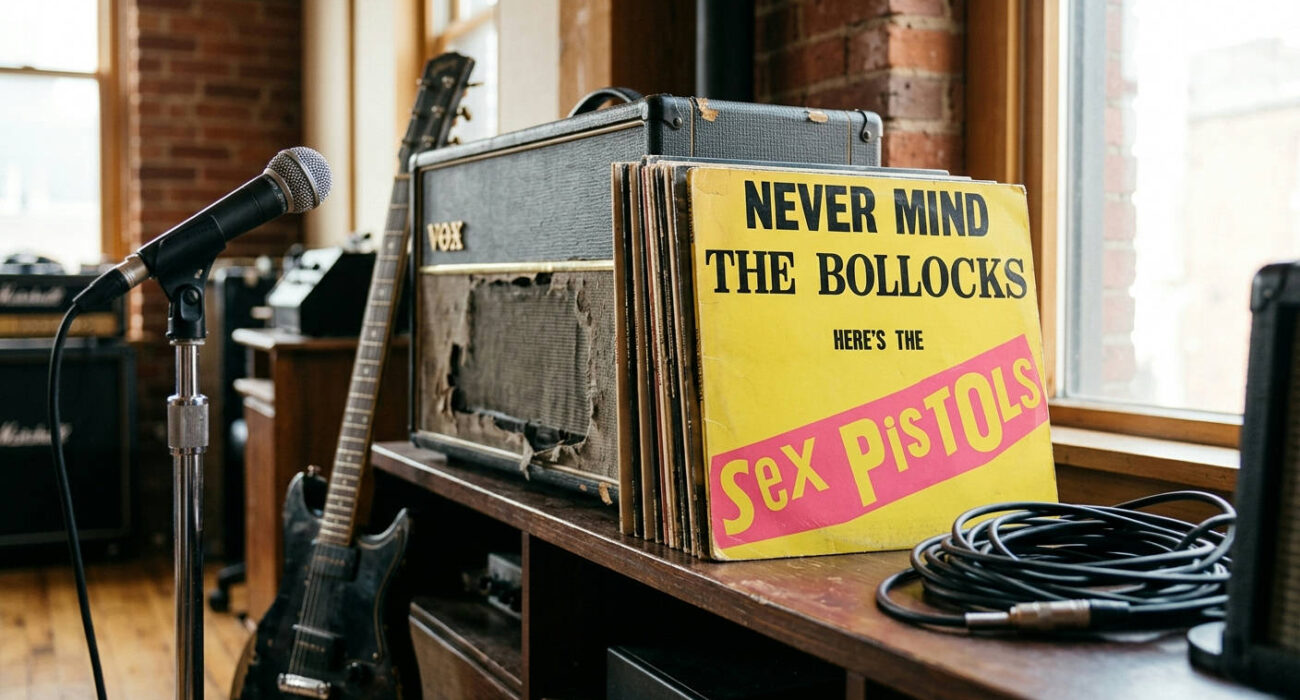
Never Mind the Bollocks, Here’s the Sex Pistols (1977)
This is it. The alpha and the omega. Released in October 1977, Never Mind the Bollocks is a monument of pure defiance. It’s the sound of boredom, anger, and social decay channelled into twelve perfect blasts of three-chord fury. Anyone expecting a lo-fi garage recording, based on the band’s tabloid reputation for chaos, was in for a shock.
The secret weapon was producer Chris Thomas. Thomas, who had worked with Roxy Music and Pink Floyd, gave the album a production quality that was anything but amateur. He understood that to make the noise truly powerful, it had to be clear, sharp, and massive. Steve Jones’s guitar isn’t just a riff; it’s a multi-tracked wall of sound, a Les Paul roaring through a cranked Fender Twin, layered again and again until it became an unstoppable force. John Lydon’s vocals, snarling and dripping with contempt, were captured with chilling clarity.
The content was a direct reflection of a grim, grey late-70s Britain. “Holidays in the Sun” opens the record with the paranoia of the Cold War, a desperate escape over the Berlin Wall into more misery. “Bodies” is a visceral, horrifying account of a fan’s abortion, a track so raw and confrontational it still has the power to shock in 2026. This wasn’t abstract rebellion; it was a gritty, unflinching documentary of the world outside the studio window.
For any serious vinyl collector, this album is non-negotiable. It is a foundational text.
“You don’t write ‘God Save the Queen’ because you hate the English race. You write a song like that because you love them, and you’re fed up with them being mistreated.” – John Lydon
Getting your hands on a quality pressing of this masterpiece is the first step in any punk collection.
- Get it on vinyl: Find Never Mind the Bollocks, Here’s the Sex Pistols on Amazon
The Authentic Outtakes: Bootlegs and Soundtracks
The story gets complicated here. After the one official album, the rest of the essential “albums” from their original run are a chaotic mix of demos, film music, and cash-ins. But they are absolutely crucial to understanding the band’s rapid evolution and destruction.
Spunk (1977)
Released as a bootleg in early October 1977, just weeks before Bollocks, Spunk is the ultimate punk rock “what if?”. These are the raw demo sessions recorded primarily with original bassist and chief songwriter Glen Matlock, before he was ousted for the far more photogenic (and musically inept) Sid Vicious.
Many critics and hardcore fans argue that Spunk is the real Sex Pistols album. The energy is undeniable. It’s looser, faster, and less polished than the official LP. Dave Goodman’s production is raw and immediate. Lydon’s vocals are less filtered, and Matlock’s melodic-yet-driving basslines are front and centre, revealing just how much of the band’s musicality was lost with his departure.
Listening to the Spunk versions of “Anarchy in the U.K.” or “Pretty Vacant” is like hearing the songs in their natural, untamed state. It’s the sound of a hungry, vicious rock and roll band, before the producer’s gloss and the weight of infamy settled in. It’s not better or worse than Bollocks—it’s a different beast entirely, a parallel-universe version of a classic.
- Find this raw gem: Search for Spunk by the Sex Pistols on Amazon

The Great Rock ‘n’ Roll Swindle (1979)
If Bollocks was the statement of intent and Spunk was the raw blueprint, then The Great Rock ‘n’ Roll Swindle is the chaotic, cynical funeral pyre. Released in 1979, long after the band had imploded, this is the soundtrack to Julien Temple’s mockumentary of the same name. It’s less a cohesive album and more a scrapbook of the band’s implosion, curated by their manipulative manager, Malcolm McLaren.
This double album is a bizarre mishmash. You get early demos with Matlock, live tracks, and Steve Jones and Paul Cook messing about on vocals. McLaren himself “sings” on a track, laying out his supposed master plan to manufacture the band and swindle the record industry.
The most famous (and infamous) contributions come from Sid Vicious. His sneering, off-key, but undeniably brilliant cover of “My Way” is the album’s centrepiece—a perfect two-fingered salute to the establishment and the band’s own legacy. His take on Eddie Cochran’s “Something Else” is equally vital. The Swindle album is the sound of an idea being milked for every last drop, a document of how the purest punk rebellion was packaged and sold as a commodity. It’s essential, but for entirely different reasons than Bollocks.
- Own the chaos: Look for The Great Rock ‘n’ Roll Swindle on Amazon
The Complete Sex Pistols Studio Albums List: Compilations and Curiosities
Because the band’s official output was so limited, the compilations that followed their demise are more important than they would be for any other artist. They aren’t just cash-grabs; they are vital parts of the puzzle, collecting the singles that shook a nation and the media noise that surrounded them.
Flogging a Dead Horse (1979)
This was the first official “greatest hits,” and it does exactly what it says on the tin. Released in 1979, it gathered the four monumental singles the band released on three different labels (EMI, A&M, and Virgin) into one place. For anyone in the late 70s and early 80s wanting a concise dose of the Pistols’ power, this was the record to buy.
It’s a punchy, direct collection of the A-sides that caused all the trouble: “Anarchy in the U.K.,” “God Save the Queen,” “Pretty Vacant,” and “Holidays in the Sun.” It also includes key B-sides like the brilliant “No Fun,” a thunderous Stooges cover that became a staple of their live set.
While a hardcore fan might already have these tracks, Flogging a Dead Horse serves as the perfect, streamlined introduction to the band’s musical core. It’s the Sex Pistols with all the fat trimmed away, leaving only the world-changing hits. A pristine vinyl copy is a great way to experience the singles as they were meant to be heard: loud and back-to-back.
Understanding the Importance of ‘Flogging a Dead Horse’ in the Sex Pistols Studio Albums List
Even though it’s a compilation, its release so soon after the band’s split cemented the “official” canon of their key songs. It defined their legacy for a generation of listeners who came to punk after the initial explosion. It turned the chaos into a digestible, marketable package, proving McLaren’s point from The Swindle even as it delivered the pure, unadulterated music.
Carri On Sex Pistols (1979)
Here’s where things get truly weird. Also released in 1979, this is less a music album and more a piece of avant-garde sound art. It’s a collage of radio interviews, snippets of their most controversial media appearances (like the infamous Bill Grundy television incident), advertisements, and bits of their songs stitched together into a jarring, often hilarious, and deeply unsettling experience.
This record is crucial because it highlights that the Sex Pistols were more than just a band; they were a media phenomenon. Their strategy was to weaponize outrage. They courted controversy, knowing that every banned single and cancelled gig was free publicity. Carri On Sex Pistols is the audio document of that strategy in action.
You don’t put this record on for a casual listen. You put it on to understand the culture war they instigated. It’s the sound of a moral panic, orchestrated and conducted by the band and their manager. For collectors interested in the full story, this strange, confrontational record is an absolutely essential piece of the puzzle.
Building Your Definitive Sex Pistols Vinyl Collection
So, you want to own the revolution? Collecting the Sex Pistols on vinyl is a rewarding journey. The music feels most at home on a physical format you can hold, read, and drop a needle on.
Your First Purchase: The Non-Negotiable Album

Start with Never Mind the Bollocks, Here’s the Sex Pistols. There is no substitute.
- What to look for: An early UK pressing on the Virgin Records label (V 2086) is the holy grail for audiophiles. However, the 2012 and more recent reissues from Universal Music are excellent, high-quality pressings that capture the album’s power without the high price tag of a vintage original. Don’t get bogged down in finding a perfect first pressing; just get a clean copy and play it loud. It’s a record that sounds phenomenal on a decent setup, proving that punk can be both raw and sonically powerful. Ensuring you have one of the best turntables under £300 will do this iconic record justice.
The Collector’s Deep Dive: Beyond ‘Bollocks’
Once you have the cornerstone, it’s time to explore the fascinating fringes.
- Spunk: This is your next step. It provides the crucial context for the official album. Look for one of the many “official” re-releases on labels like Castle or Sanctuary. These are readily available and sound great. Owning both Spunk and Bollocks allows you to A/B test the tracks and decide for yourself which version has more bite.
- The Great Rock ‘n’ Roll Swindle: This is a must-have for the completist. It’s a double LP, often with a large movie poster insert. It’s a fascinating, sprawling document of the band’s end. The tracklist is all over the place, but that’s the point. It’s a beautiful mess.
The Lasting Echo: Why This Short Discography Still Burns Bright in 2026
How can a band with one album still be so relevant almost 50 years later? Because their impact was never just about the number of records they sold. It was about what those records represented.
Demolishing the Music Industry
The Sex Pistols exposed the hypocrisy and pomposity of the 1970s music industry. They were signed to EMI and dropped after the Bill Grundy incident. They were then signed to A&M Records, only to be dropped six days later in a legendary showdown. They finally landed at Virgin Records, a label that was willing to handle the controversy.
This chaos sent a message to aspiring musicians everywhere: you don’t need the machine. You can do it yourself. This DIY ethos fuelled the rise of independent labels and thousands of bands who realised they didn’t have to wait for a major label to give them permission. The influence on bands in the 90s, for example, is undeniable, shaping many of the sounds you’ll find in our list of five alt-rock albums from the 1990s.
A Masterclass in Visual Identity
The Sex Pistols’ visual aesthetic, primarily crafted by artist Jamie Reid, was as revolutionary as their music. His use of ransom-note lettering, garish colours, and defaced images of the Queen created an instantly recognisable brand of anarchy.
This visual language became the default for punk rock. As detailed by institutions like the Victoria and Albert Museum, Reid’s work was a form of cultural détournement, taking establishment symbols and twisting them into messages of rebellion. When you bought a Sex Pistols record, you weren’t just buying music; you were buying a piece of confrontational art.
Common Questions About The Sex Pistols Discography
Even for seasoned fans, the Pistols’ output can be confusing. Let’s clear up a few common points.
How many official studio albums did the Sex Pistols release?
One. Only one. Never Mind the Bollocks, Here’s the Sex Pistols is the only album conceived of, recorded, and released as a new, cohesive studio album by the band during their active existence. Everything else is a compilation, a soundtrack, a bootleg, or a live recording.
Who actually played bass on ‘Never Mind the Bollocks’?
This is a point of major contention. Although Sid Vicious was the band’s bassist at the time and is credited, he was notoriously incompetent on the instrument. The vast majority of the bass parts on the album were actually recorded by guitarist Steve Jones. According to producer Chris Thomas, Sid’s bassline was used on only one track, “Bodies,” and even then, it was buried low in the mix. This fact, widely confirmed in music journalism and biographies, underscores how much of the Pistols’ image was theatre.
Is ‘Spunk’ an official album?
No. It began life as a bootleg, an unauthorised release of the band’s demos. However, it has since been re-released so many times in an official or semi-official capacity that it is now considered an essential part of their catalogue. It’s the definitive look at the band with their original, musically-gifted bassist, Glen Matlock.
The Sex Pistols burned out in a blaze of media fury and internal conflict, leaving behind a discography that is as brief as it is potent. To understand their legacy, you must embrace the chaos. The complete sex pistols studio albums list is more than just Never Mind the Bollocks. It’s the raw demo tape that preceded it, the cynical film soundtrack that followed it, and the brilliant singles that held it all together. It’s a short, sharp shock to the system that still resonates today. Go drop the needle and feel it for yourself.