
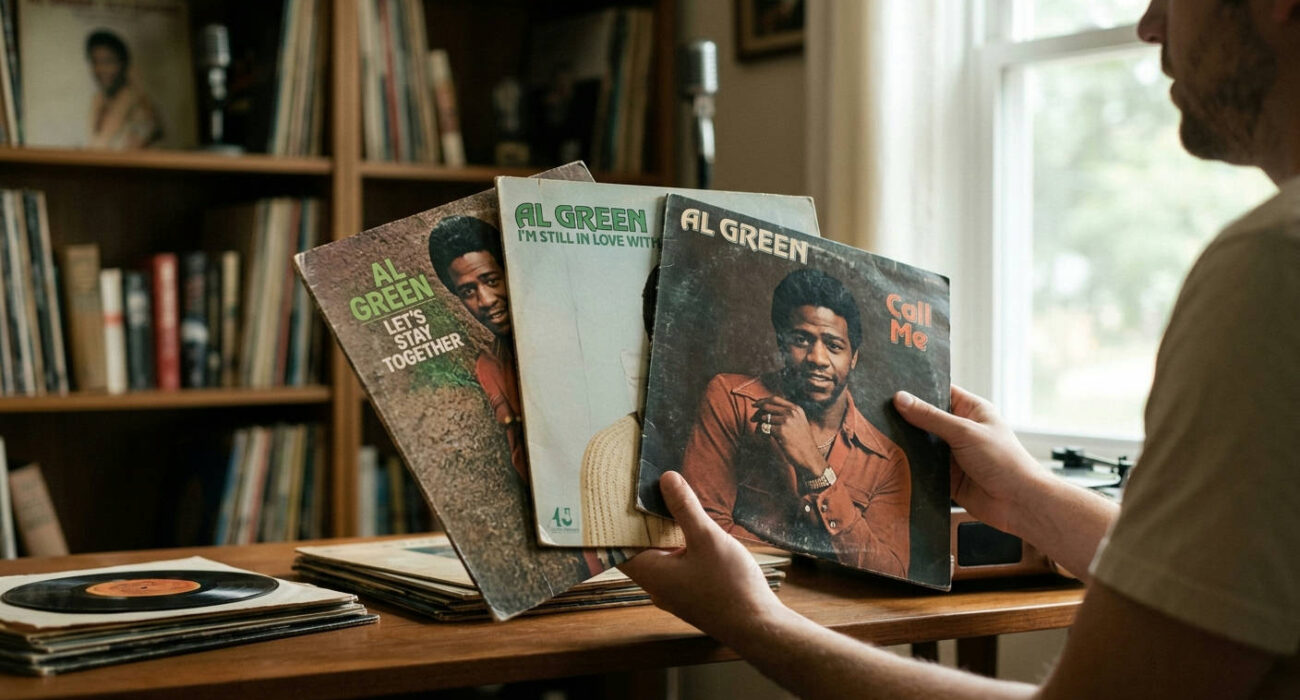
Let’s get one thing straight. You can’t talk about soul music without talking about the Reverend Al Green. His voice is a force of nature—a delicate, yet powerful instrument that can glide from a sensual whisper to a gut-wrenching wail in a single breath. But the genius of the man is most evident when you dive deep into the full collection of Al Green solo studio albums. These records aren’t just collections of hits; they are fully-realized statements, sonic tapestries woven with grit, grace, and unparalleled emotion. Here at Vinyl Gold UK, we live and breathe this stuff, and it’s time to give these albums the track-by-track, era-by-era breakdown they deserve.
This isn’t just a list. It’s a journey through one of the most vital discographies in popular music. We’ll explore the monumental Hi Records years, the spiritual detour into gospel, and the triumphant return to secular soul. We’re going beyond the radio staples to uncover the deep cuts and understand the magic that made these records timeless.
The Hi Records Golden Era: Defining Southern Soul
The period from 1971 to 1974 is staggering. Working with producer Willie Mitchell and the inimitable Hi Rhythm Section at Royal Studios in Memphis, Green released a string of albums that didn’t just top the charts—they redefined the very sound of soul music. This was lightning in a bottle, a perfect storm of talent, chemistry, and timing.
Gets Next to You (1971) – The Breakthrough
Before this album, Al Green was a promising singer with a minor hit. After Gets Next to You, he was a star. The album saw him pivot from the grittier R&B of his debut, finding the signature sound that would make him a legend. The title track, a cover of The Temptations’ classic, is re-imagined with a simmering, laid-back groove that is pure Al Green.
But the real magic begins with “Tired of Being Alone.” This is where the blueprint for ’70s Al Green is laid bare: the tight-as-a-drum rhythm section, the lush string arrangements, and Green’s voice floating effortlessly on top. He wasn’t just singing the lyrics; he was living them, imbuing every line with a palpable sense of longing and vulnerability.
Let’s Stay Together (1972) – The Commercial Peak
If Gets Next to You was the breakthrough, Let’s Stay Together was the coronation. The title track is, of course, one of the most iconic songs ever recorded. It’s a masterclass in subtlety and restraint, a gentle plea that feels more powerful than any shouted declaration. As of 2026, it remains a wedding standard for a reason—it’s pure, unadulterated devotion set to music.
The album itself is a perfectly sequenced journey. From the simmering opener “Let’s Stay Together” to the surprisingly funky “La-La for You” and the heart breaking cover of the Bee Gees’ “How Can You Mend a Broken Heart?”, every track is essential. Willie Mitchell’s production is flawless, creating a warm, intimate atmosphere that makes you feel like you’re right there in the studio.
I’m Still in Love with You (1972) – The Masterpiece
Released just nine months after its predecessor, I’m Still in Love with You is arguably Green’s finest hour. The pressure was on, but instead of cracking, Green and Mitchell doubled down, delivering an album that is both deeper and more consistent. The hits are undeniable: the title track is a blissful mid-tempo groove, and “Love and Happiness” is a stone-cold classic, a perfect fusion of sacred and secular energy.
“Love can make you do wrong, make you do right.” – Al Green, “Love and Happiness”
This is where you find the true treasures. “Look What You Done for Me” is an anthem of gratitude, while “I’m Glad You’re Mine” is one of the most tender ballads he ever recorded. The album cemented Green’s status not just as a hitmaker, but as a premier album artist, a creator of complete, immersive listening experiences. You can find this masterpiece and other best albums of the 1970s in our curated guides.
Call Me (1973) – Critical Acclaim and Artistic Apex
While other albums might have sold more, Call Me is often cited by critics as Green’s artistic peak. It’s a more contemplative, nuanced record, showcasing a songwriter and vocalist at the absolute height of his powers. The emotional range here is breath taking.
He delivers a stunning rendition of Hank Williams’ “I’m So Lonesome I Could Cry,” transforming the country classic into a piece of smouldering soul. “Here I Am (Come and Take Me)” is a confident, almost demanding, slice of funk, while the title track is a lesson in understated elegance. The album feels like a long, late-night conversation, full of confessions, pleas, and moments of quiet reflection.
A Comprehensive Guide to Al Green Solo Studio Albums
To truly appreciate the genius behind the Al Green solo studio albums, you have to look beyond the track-lists. The magic was in the process, the people, and the evolving themes that defined his career arc. It’s a story of collaboration, faith, and artistic integrity.
Understanding the Willie Mitchell Sound
You cannot discuss Al Green’s classic period without paying homage to producer Willie “Pops” Mitchell. His production was the canvas on which Green painted his vocal masterpieces. Mitchell had a minimalist’s touch, understanding that space was just as important as the notes being played.
The foundation of this sound was the Hi Rhythm Section: the Hodges brothers—Charles on organ, Leroy on bass, and Mabon “Teenie” on guitar—along with drummer Howard Grimes or Al Jackson Jr. They were a telepathic unit, masters of the deep pocket groove. Their playing was deceptively simple but incredibly sophisticated, creating a rhythmic bed that was tight, funky, and always in service of the song. Mitchell would then layer on tasteful strings and horns, adding a touch of uptown class to the down-home Memphis grit.
Thematic Evolution: From Secular Seduction to Spiritual Salvation

Listening to the Al Green solo studio albums chronologically is like reading a diary. The early ’70s records are dominated by themes of earthly love—its joys, its pains, its complexities. Songs like “Let’s Stay Together” and “I’m Still in Love with You” are odes to romantic devotion, while tracks like “Tired of Being Alone” explore the heartache of its absence.
But even in these early works, there’s a spiritual undercurrent. The line between romantic and divine love is often blurred. This tension comes to a head with 1977’s The Belle Album, the crucial turning point where Green explicitly shifts his focus from loving a woman to loving God. The gospel albums that follow are a complete immersion in this newfound purpose, a radical and brave departure for an artist at the commercial top of his game.
### Essential Deep Cuts from the Al Green Solo Studio Albums You Need to Hear
Everyone knows the hits. But true fans know that the soul of these albums often lies in the lesser-known tracks. Here are a few essential deep cuts that showcase the breadth of Green’s talent:
- “Jesus Is Waiting” (from Call Me, 1973): A haunting, seven-minute gospel-infused plea that foreshadows his later career. It’s raw, emotional, and utterly captivating.
- “The Letter” (from Green Is Blues, 1969): A blistering, psychedelic-tinged cover of The Box Tops’ hit. It shows a rawer, grittier side to Green’s voice before he fully developed his smooth Hi Records persona.
- “All Because” (from The Belle Album, 1977): A beautiful, self-produced track where Green plays acoustic guitar. It’s a stripped-down, intimate declaration of faith that feels incredibly personal and sincere.
- “For the Good Times” (from I’m Still in Love with You, 1972): A masterful cover of the Kris Kristofferson country ballad. Green completely inhabits the song, turning it into a poignant soul epic.
The Spiritual Pivot: The Gospel Years
In the late 1970s, following a series of personal crises and a profound religious conversion, Al Green made a decision that shocked the music world. He walked away from pop stardom to dedicate his life and his music to God. This wasn’t a temporary dalliance; it was a complete commitment that produced a remarkable, if often overlooked, body of work.
The Belle Album (1977) – The Bridge Between Two Worlds
Before he fully embraced the gospel circuit, Green released The Belle Album. It stands as one of the most fascinating records in his discography—a bridge between his secular past and his spiritual future. He produced it himself for the first time, and the sound is more sparse and personal.
The title track is the centrepiece, a stunning song where Green sings about the conflict between two loves: a woman named Belle and God. It’s an autobiographical masterpiece, with Green’s acoustic guitar work front and centre. The album is a raw, honest document of a man at a crossroads, making it one of the most essential Al Green solo studio albums for understanding his journey.
The Myrrh Records Era: A New Devotion
After The Belle Album, Green signed with Christian label Myrrh Records and began releasing a series of pure gospel albums. Records like The Lord Will Make a Way (1980) and Higher Plane (1981) saw him fully immersed in his new calling. While the lush strings of the Hi Records days were gone, the soul was not.
These albums are fiery and passionate, with Green’s voice finding new power and purpose in praise and worship. The arrangements are often simpler, built around church organ, choir vocals, and a solid rhythm section. For his efforts, he won a string of Grammy Awards in the Gospel category throughout the 1980s, proving that his talent transcended genre. You can find his early gospel work on vinyl with a search on Amazon: Al Green The Lord Will Make a Way Vinyl.
Did the Gospel Albums Hold Up? A 2026 Re-evaluation
For decades, many secular fans dismissed Green’s gospel work. In 2026, however, there’s a growing appreciation for this period. These albums are not just religious artifacts; they are incredible soul records. The passion is real, the vocal performances are astonishing, and the songwriting is often as strong as his classic ’70s material.
Albums like Soul Survivor (1987) even began to subtly blend his gospel themes with more contemporary R&B sounds, hinting at a potential return to the mainstream. For any serious collector of Al Green solo studio albums, this era is essential, not optional.
The Return to Secular Music: Later Career Highlights
After more than a decade dedicated to gospel, Al Green began to slowly re-engage with the secular music that made him a star. This comeback wasn’t a desperate cash-grab; it was a series of thoughtful, well-crafted albums that saw him collaborating with both old friends and new admirers, proving the fire still burned bright.
I Can’t Stop (2003) – Reuniting with Willie Mitchell
The news that Al Green and Willie Mitchell were back in the studio together was monumental. The result was I Can’t Stop, an album that aimed to recapture the magic of the Hi Records heyday. And incredibly, it succeeded.
The album sounds like a lost classic from 1974. The Hi Rhythm Section was back, the Memphis Horns were back, and Mitchell’s production was as warm and inviting as ever. Green’s voice, though slightly weathered by time, had lost none of its emotional power. Tracks like the title song and “I’ve Been Waitin’ on You” were a powerful reminder of their unparalleled chemistry. The album was a critical and commercial success, a triumphant return to form.
Everything’s OK (2005) – Solidifying the Comeback
Following the success of their reunion, Green and Mitchell quickly returned with Everything’s OK. This album felt even more relaxed and confident. It wasn’t trying to recreate the past so much as comfortably inhabit the classic sound they had pioneered.
The songs are uniformly strong, from the upbeat “You Are So Beautiful” to the tender ballad “Perfect to Me.” It was proof that the comeback was no fluke. Green was still a vital, creative force, and his partnership with Mitchell remained one of the greatest in music history. It was a fitting final collaboration, as Willie Mitchell passed away in 2010.

Lay It Down (2008) – Collaborating with a New Generation
For his next project, Green took a different approach. Lay It Down saw him working with a younger generation of musicians and producers, including Questlove of The Roots and James Poyser. They weren’t trying to imitate the Willie Mitchell sound; they were trying to create a new context for Green’s legendary voice.
The album is a brilliant fusion of classic and contemporary soul. Guest appearances from artists like John Legend and Corinne Bailey Rae feel natural and respectful. The production is modern yet organic, with live instrumentation and a deep reverence for the soul tradition. Lay It Down introduced Al Green to a new audience and proved that his artistry was timeless and adaptable. It’s a fantastic modern entry in the catalogue of Al Green solo studio albums. You can explore it on vinyl here: Al Green Lay It Down Vinyl.
Collecting Al Green on Vinyl: A Buyer’s Guide
There’s no better way to experience the warmth and depth of the Al Green solo studio albums than on vinyl. The analogue sound brings out the nuances of the Hi Rhythm Section and the richness of Green’s voice. For collectors, his discography offers a rewarding challenge.
Original Pressings vs. Modern Reissues
This is the classic debate for any collector. Original pressings from the 1970s on the Hi Records label offer the most authentic experience. They were mastered from the original analogue tapes and possess a certain sonic character that can be hard to replicate. However, finding clean, near-mint copies in 2026 can be difficult and expensive.
Modern reissues from reputable labels like Fat Possum Records (who now own the Hi Records catalog) or audiophile imprints are a fantastic alternative. They are often pressed on high-quality, 180-gram vinyl and sourced from the best available masters. For many, a new reissue will offer a quieter, cleaner listening experience than a worn original. Your choice depends on your budget and your priorities as a collector. And of course, you’ll need a great setup to play them on; consider checking out our guide to the best turntables under £300 in the UK.
Identifying First Pressings of Key Al Green Solo Studio Albums
Want to hunt down those originals? Here are a few tips. For the classic Hi Records albums, look for the red and white label with the “HI” logo in a black box. Early pressings often have a “deep groove” indentation on the label. Pay close attention to the dead wax—the space between the last song and the label. The matrix numbers etched here can help identify the specific pressing plant and mastering information, which is detailed on websites like Discogs.
For example, an authentic first pressing of Call Me will typically have the catalogue number SHL 32077 and specific matrix etchings. Condition is everything. Look for records with minimal surface noise and covers that are free from major wear, seam splits, or writing.
Where to Find Al Green Records in 2026
The hunt is part of the fun. Independent record stores are your best friend. Digging through the crates can unearth hidden gems. Record fairs and conventions are also excellent places to find multiple dealers under one roof.
Online marketplaces are, of course, a massive resource. You can find everything from common reissues to rare promotional copies. Just be sure to buy from sellers with high ratings and clear descriptions of the record’s condition. The community of vinyl lovers is strong, and a well-preserved Al Green record is a treasure worth seeking out.
The Enduring Legacy of Al Green’s Studio Work
Why are we still obsessing over the Al Green solo studio albums in 2026? Because they are more than just old records. They are foundational texts of American music, with a reach and influence that continues to expand with each passing year.
Influence on Modern R&B, Soul, and Hip-Hop
Al Green’s DNA is everywhere. You can hear his influence in the smooth falsetto of modern R&B singers like Frank Ocean and Daniel Caesar. His blend of romantic yearning and spiritual ecstasy laid the groundwork for countless artists.
As noted by the Rock & Roll Hall of Fame, into which he was inducted in 1995, Green “bridged the chasm between deep soul and smooth Philadelphia soul” and “put the love back into love songs.”
Hip-hop producers have also mined his catalogue for decades. The deep grooves and atmospheric textures of his Hi Records work have provided the basis for tracks by artists like The Notorious B.I.G., Wu-Tang Clan, and Drake. His music is a renewable resource of inspiration.
The Voice: What Makes Al Green’s Vocals Unique?
Al Green’s voice is one of the most instantly recognizable instruments in music. It’s not just about his famous falsetto. It’s about his incredible control, his phrasing, and his ability to convey a universe of emotion in a single line.
He possesses a unique vocal “cry,” a catch in his voice that communicates vulnerability and passion. He stretches notes, plays with rhythm, and moves between a soft croon and a powerful shout with breathtaking agility. It’s a technical marvel, but it never feels calculated. It always feels honest, raw, and straight from the heart.
Al Green in Pop Culture: Film and TV Placements
The timelessness of Green’s music is proven by its constant presence in film and television. Quentin Tarantino’s use of “Let’s Stay Together” in Pulp Fiction is perhaps the most famous example, introducing Green to a new generation and cementing the song’s cool, iconic status.
His songs have appeared in countless other movies and shows, from The Sopranos to How to Get Away with Murder. They are a director’s shorthand for setting a mood, whether it’s romantic, tense, or contemplative. This constant re-contextualization keeps the music alive and relevant, ensuring that the genius of the Al Green solo studio albums will continue to be discovered for years to come.