
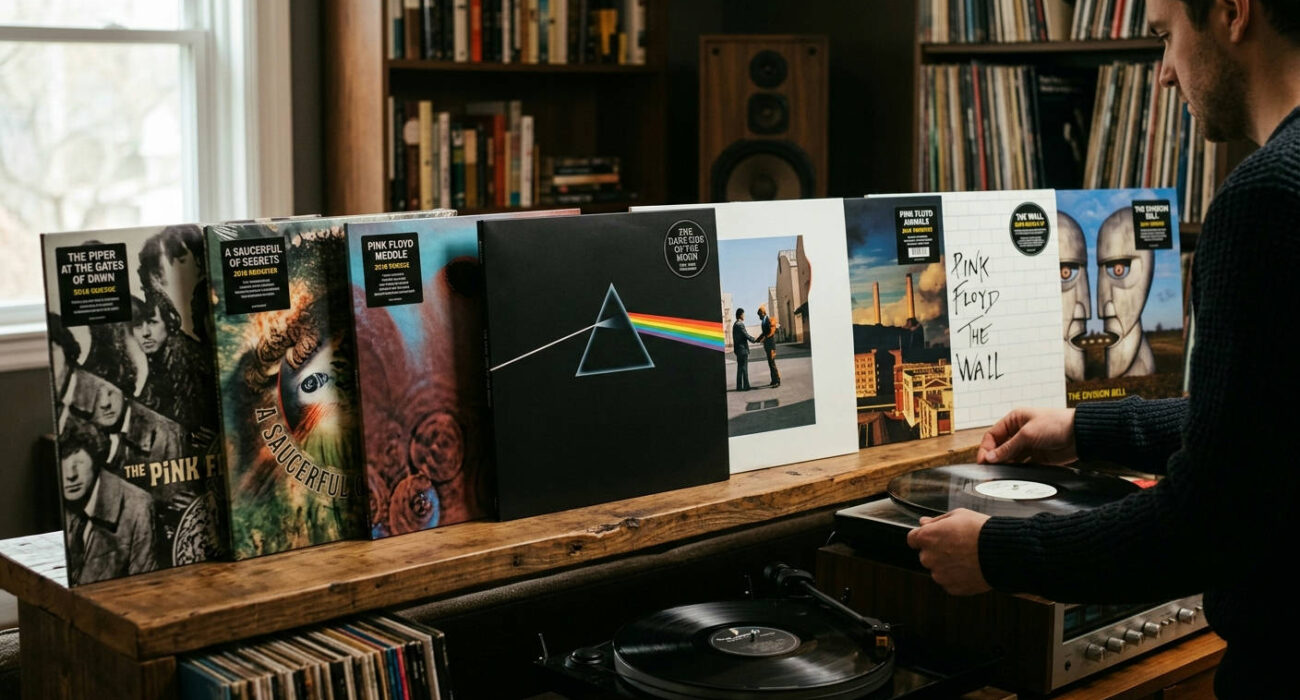
Let’s cut right to it. The resurgence of vinyl isn’t just a trend; it’s a full-blown revolution in how we appreciate music. And at the heart of this vinyl renaissance sits a monolith of sound, art, and ambition: Pink Floyd. For serious collectors and new fans alike, navigating the world of Pink Floyd studio albums vinyl reissues can be as complex and rewarding as the music itself. Here at Vinyl Gold UK, we live and breathe this stuff, and we’re here to give you the definitive guide to getting the best possible pressings of these iconic albums in 2026.
This isn’t about grabbing any old record off a shelf. It’s about understanding the sources, the mastering engineers, and the subtle differences that separate a good reissue from a truly transcendent listening experience. From the psychedelic swirls of Syd Barrett to the stadium-sized concepts of Roger Waters, we’ll break down everything you need to know.
Why the Unending Obsession with Pink Floyd on Wax?
It’s a valid question. In an age of instant streaming, why are people still spending serious money on these physical artifacts? The answer goes far deeper than simple nostalgia. The continuing demand for high-quality Pink Floyd studio albums vinyl reissues is driven by a potent mix of audio fidelity, tangible art, and long-term value.
The Audiophile’s Pursuit of Purity
Pink Floyd’s music was meticulously crafted in the analogue domain. The layers of sound, the subtle panning effects, and the vast dynamic range were all designed to be heard on a format that could do them justice. A great vinyl reissue, especially one sourced from the original analogue master tapes, can present this music with a warmth and depth that compressed digital files often struggle to replicate.
When you drop the needle on a pristine 180-gram reissue of Wish You Were Here, you’re hearing the breath before a vocal, the subtle decay of a cymbal, and the sheer space in the mix. It’s an active listening experience, not just background noise. Getting this right means having a decent setup, and if you’re just starting, you don’t need to break the bank. Check out our guide to the best turntables under £300 in the UK to get a solid foundation for your Floyd collection.
More Than Just Music: The Tangible Experience
Let’s be honest: a big part of the appeal is the physical object itself. Pink Floyd, arguably more than any other band, understood the album as a complete art package. The iconic artwork by Hipgnosis is as much a part of the experience as the music.
Owning a vinyl reissue means you can hold the gatefold sleeve of The Dark Side of the Moon in your hands. You can pore over the cryptic lyrics and imagery on the inner sleeve of Animals. These reissues faithfully recreate the original packaging, including posters and stickers, connecting you to the album in a way a tiny thumbnail on a screen never can. It’s a multi-sensory experience that streaming simply can’t offer.
Investment and Collectability in 2026
High-quality vinyl is an asset. While you should always buy music for the love of it, there’s no denying the investment potential. Well-mastered, well-cared-for Pink Floyd studio albums vinyl reissues often hold or increase their value over time.
Unlike a digital file that you merely license, you own the physical record. The 2016-2018 reissue campaign, for example, is already seen as a benchmark for quality. As these pressings go out of print, their value on the secondary market is likely to rise, making them a smart buy for the discerning collector in 2026.
The Definitive Guide to the Main Pink Floyd Studio Albums Vinyl Reissues Campaign
Not all reissues are created equal. To truly understand what you’re buying, you need to know about the most significant reissue program of the modern era, which has set the standard for how these albums should sound on vinyl today.
The 2016-2018 Campaign: The Core Catalogue Remastered
Starting in 2016, Pink Floyd Records began a comprehensive campaign to reissue the entire studio album catalogue on vinyl. This was a monumental undertaking, managed by the band’s long-time collaborators and trusted engineers. The goal was to use the best possible sources and present the albums with the highest fidelity on 180-gram vinyl.
This series is the go-to for most collectors today. The quality control was exceptionally high, the packaging is superb, and they are, for the most part, readily available and affordable. If you see a new Pink Floyd album in a shop today, it’s almost certainly from this stellar reissue series.
Who are James Guthrie, Joel Plante, and Bernie Grundman?
These names are your guarantee of quality. You’ll find them etched in the deadwax (the blank space near the record label) of the best reissues.
- James Guthrie: Has been Pink Floyd’s studio guru since working on The Wall in 1979. He’s the guardian of the master tapes and has overseen virtually every remastering project for decades. His involvement is a non-negotiable seal of approval.
- Joel Plante: Guthrie’s right-hand man and a brilliant mastering engineer in his own right. He has co-piloted many of the recent high-resolution digital remasters that were used for the vinyl reissues.
- Bernie Grundman: A legend in the world of vinyl mastering. Grundman was brought in to cut the lacquers for the vinyl reissues from the new remasters prepared by Guthrie and Plante. His expertise ensures that the digital source is translated perfectly to the analogue medium of vinyl.
When you see “Remastered by James Guthrie, Joel Plante and Bernie Grundman” on the hype sticker, you know you’re holding a product that has been treated with the utmost respect and technical skill.
“There’s a warmth to the vinyl sound that a CD doesn’t have. It’s not a question of which one is better. It’s a question of what your taste is.” – David Gilmour
Understanding the Sources for Your Pink Floyd Studio Albums Vinyl Reissues
This is where it gets technical, but it’s crucial. Most of the 2016-2018 reissues were sourced from high-resolution digital remasters of the original analogue master tapes, done in 2011 by Guthrie and Plante. While audiophile purists often seek “AAA” (all-analogue) pressings, this modern approach has its benefits.

The original tapes are now over 50 years old and extremely fragile. By creating a flawless digital transfer, Guthrie could meticulously clean up any minor imperfections and prepare a perfect source for Bernie Grundman to cut to vinyl. The result is a sound that is incredibly clean, detailed, and true to the original master, but without the potential degradation of using the aging tapes directly for every pressing. A handful of reissues, like The Dark Side of the Moon, Wish You Were Here, and Animals (2018 Remix), did receive a fresh all-analogue cut, making them particularly sought-after.
A Chronological Breakdown: Key Reissues to Hunt Down
Let’s walk through the discography. Each era of the band presents a different sonic challenge, and the reissues reflect this.
The Syd Barrett Era: The Piper at the Gates of Dawn & A Saucerful of Secrets
The earliest albums are a kaleidoscopic burst of British psychedelia. The 2016 mono reissue of Piper is particularly noteworthy. Sourced from the original 1967 mono mix, it’s a punchier, more direct experience than the more common stereo version.
- The Piper at the Gates of Dawn (2016 Mono): Essential for experiencing the album as it was first heard in 1967. A must-have for serious fans. Find it on Amazon here.
- A Saucerful of Secrets (2016 Stereo): The reissue beautifully captures the transition from Barrett’s whimsy to the band’s more experimental, space-rock leanings.
The Experimental Years: More, Ummagumma, & Atom Heart Mother
This period saw the band stretching out, exploring long-form compositions and atmospheric soundscapes. The vinyl reissues are fantastic, presenting these sometimes-dense albums with newfound clarity.
The live portion of Ummagumma sounds particularly massive on the 2016 vinyl, while the orchestral arrangements on Atom Heart Mother have a richness and texture that really benefits from the format. These might not be the albums you start with, but they are essential parts of the story.
The Breakthrough: Meddle & The Birth of a Sound
This is where the classic Floyd sound begins to coalesce. The 2016 reissue of Meddle is a masterpiece. The clarity and dynamic range on the 23-minute epic “Echoes” are simply breathtaking. The subtle sonar “ping” at the beginning of the track has never sounded so clear and defined. This is a reference-quality disc that will test the limits of your sound system.
The Holy Trinity: The Dark Side of the Moon, Wish You Were Here, & Animals
These are the big ones. For these crucial albums, the band and their engineers pulled out all the stops.
- The Dark Side of the Moon (2016 Analogue Remaster): Cut by Bernie Grundman directly from the original analogue tapes, this is arguably the definitive modern pressing of the album. It captures the seamless flow and sonic detail of this landmark recording perfectly. You can search for it on Amazon.
- Wish You Were Here (2016 Analogue Remaster): Another all-analogue triumph. The acoustic guitars on the title track shimmer, and the synthesizers on “Shine On You Crazy Diamond” have a three-dimensional quality. The packaging, which replicates the original black shrink-wrap, is a fantastic touch.
- Animals (2018 Remix, released 2022): This is a special case. James Guthrie created a stunning new stereo remix of the album from the original multi-track tapes. Released on vinyl in 2022, it offers a fresh perspective on a classic, with more punch in the drums and greater clarity in the keyboard parts. It’s a must-own, even if you have an original pressing.
The Later Years: The Wall, The Final Cut, & The Post-Waters Era
The reissue of The Wall is a behemoth, and it sounds incredible. The grand, theatrical production benefits immensely from the vinyl treatment. The 2017 reissue of The Final Cut also gives this often-overlooked album a chance to shine, highlighting its incredible sonic detail and Roger Waters’ raw vocal performance.
The David Gilmour-led albums, A Momentary Lapse of Reason (remixed and updated in 2019) and The Division Bell, also received excellent reissues that do justice to their slicker, more modern production styles.
How to Spot a Quality Pressing: A Buyer’s Guide
So you’re in the record shop, holding a potential purchase. How do you know it’s the right one? Look for these key indicators.
Decoding the Hype Sticker
The sticker on the front shrink-wrap is your first clue. For the 2016-2018 campaign, it will typically mention:
- “Remastered from the original analogue tapes”
- The names “James Guthrie, Joel Plante, Bernie Grundman”
- “180-gram heavyweight vinyl”
- “Original UK release date”
These details confirm you’re getting the officially sanctioned, high-quality product.
What Does “180-Gram” Actually Mean?
Heavier vinyl (180 or 200 grams, versus the old standard of 120-140 grams) has become a marketing staple for audiophile releases. While the weight itself doesn’t inherently improve the sound, it does provide a more substantial, warp-resistant platter.
The real benefit is what the weight implies: it signals a premium product. A record company isn’t going to press a poorly mastered album on expensive, heavyweight vinyl. It’s an indicator of the care and attention paid to the entire release.

Checking the Deadwax: Runout Groove Etchings
This is the pro move. The deadwax is the silent area between the last song and the label. Here, you’ll find hand-etched or machine-stamped matrix numbers. On the best Pink Floyd studio albums vinyl reissues, you should look for the initials “BG” for Bernie Grundman. Finding his initials is like finding a signature from the artist, confirming it was cut at his legendary studio and is the genuine article.
According to a 2026 report from the Recording Industry Association of America (RIAA), vinyl sales have continued to post double-digit growth for the 19th consecutive year, with classic rock catalogues leading the charge. This sustained interest ensures that quality reissues remain a priority for labels.
Analogue vs. Digital Sourcing: The Debate in 2026
The “analogue vs. digital” debate is a hot topic among vinyl collectors. For Pink Floyd, the story is nuanced, and it’s not as simple as one being universally “better” than the other.
The Case for All-Analogue (AAA)
An “AAA” record is one that has been recorded, mixed, and mastered entirely in the analogue domain, with the lacquer for the vinyl cut directly from the final master tape. Purists chase these because they represent the shortest, purest path from the original performance to your turntable.
As mentioned, the 2016 reissues of Dark Side and Wish You Were Here are prime examples of modern AAA mastering done right. The sound is incredibly organic and fluid.
When Digital Sourcing Makes Sense for Vinyl
For the majority of the Pink Floyd reissue campaign, a high-resolution (24-bit/192kHz) digital step was used. This is not the same as a CD-quality file. This “digital master” is of such high resolution that it captures every nuance of the analogue tape.
This process allows the engineers to make microscopic repairs—removing a tiny bit of tape hiss or a dropout—that would be impossible in a pure analogue chain. When this pristine digital file is then handed to a master like Bernie Grundman to cut to vinyl, the result can be astonishingly good. It combines the best of both worlds: the perfection of digital restoration and the warmth of analogue playback.
“The potential of vinyl is for a better sound, but you’ve got to have the whole chain right. A good turntable, a good cartridge, a good amp, good speakers. If you’ve got all that, then it’s a wonderfully rewarding medium.” – Nick Mason
Building Your Collection: Strategy and Priorities
With 15 studio albums to choose from, where do you begin? It can be overwhelming, but a simple strategy will help you build a fantastic collection of Pink Floyd studio albums vinyl reissues without breaking the bank.
The Essential “First Three” Purchases
If you are new to Pink Floyd on vinyl, these three albums are your non-negotiable starting point. They represent the band at their absolute peak and are arguably the three best-sounding reissues in the entire campaign.
- The Dark Side of the Moon: It’s not just an album; it’s a cultural phenomenon. The 2016 reissue is flawless and serves as the perfect introduction.
- Wish You Were Here: A deeply emotional and sonically beautiful record. The all-analogue reissue is a demonstration disc for any high-quality audio system.
- Animals (2018 Remix): While The Wall is more famous, the Animals reissue offers a more cohesive and sonically adventurous listen. The new mix is powerful, clear, and essential.
Start with these, and you can’t go wrong. Secure your copy of Wish You Were Here on vinyl from Amazon.
Finding Hidden Gems Beyond the Big Sellers
Once you have the essentials, it’s time to dig deeper. These albums may not have sold 45 million copies, but their reissues are stunning and offer a different side of the band.
- Meddle: As mentioned, the reissue is spectacular. “Echoes” alone is worth the price of admission.
- A Saucerful of Secrets: To understand where the band was headed, you need to hear this album. It’s a fascinating bridge between two eras.
- The Division Bell: The 2014 reissue, cut by Doug Sax from the analogue tapes, is phenomenal. It’s a lush, expansive-sounding album that truly shines on vinyl.
Budgeting for Your Floyd Vinyl Habit
The good news is that these standard reissues are not prohibitively expensive. You can typically find them for between £20 and £30. Set aside a small amount each month, and you can build the complete studio collection in about a year. Avoid the temptation to buy expensive, sealed original pressings until you have a solid foundation of these modern, high-quality reissues. They offer 99% of the sound quality for a fraction of the price.
This strategic approach ensures you get the best sound for your money. You can find more information about the complete Pink Floyd discography on their Wikipedia page, which provides a comprehensive overview of every release.
Final Thoughts on Your Vinyl Journey
Collecting the Pink Floyd studio albums vinyl reissues is more than just a hobby. It’s an exploration of one of the most important and innovative bodies of work in music history. The care, technology, and artistry that have gone into the recent reissue campaign mean that in 2026, we can hear these albums sounding better than ever before.
By focusing on the official remasters from 2016 onwards, you are guaranteeing yourself a listening experience that is authentic, detailed, and deeply moving. Take your time, enjoy the process of hunting down each album, and savour the ritual of placing the needle on the groove. The dark side of the moon has never been brighter.