
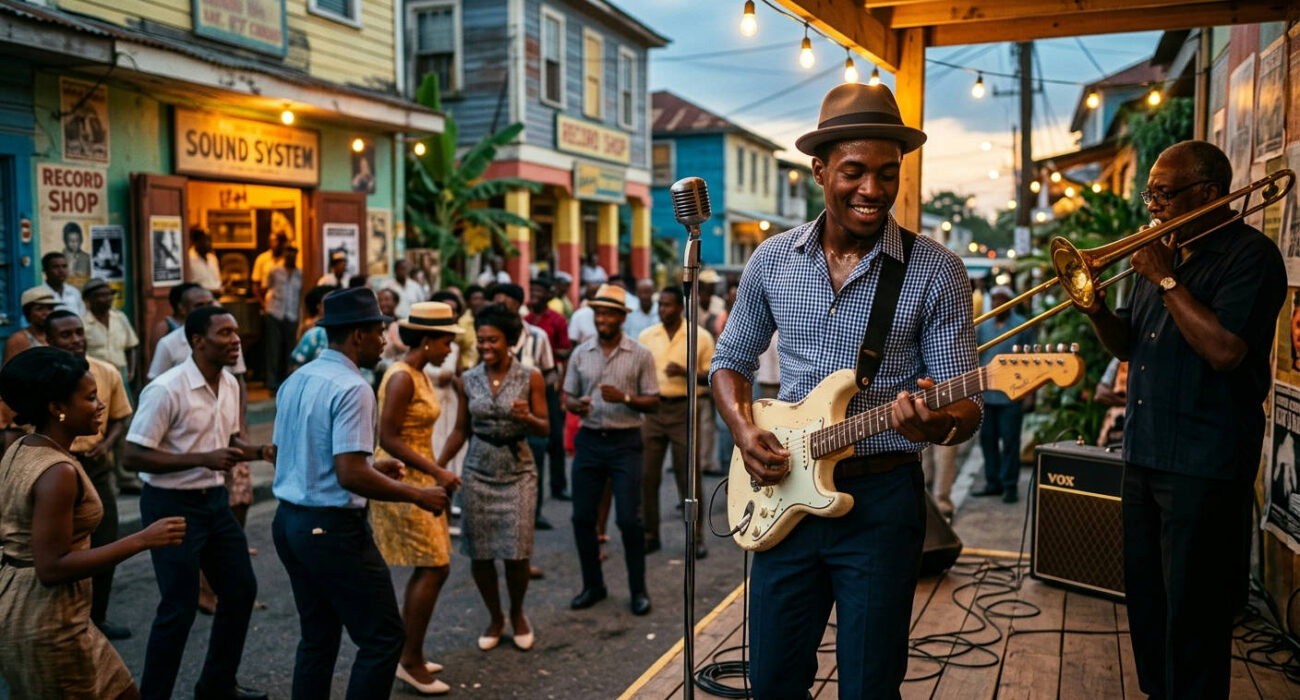
That infectious, lurching rhythm—the one that makes it impossible not to move—is unmistakable. It’s the sound of ska. But before it fuelled punk rock energy or mellowed into reggae, it was the sound of a newly independent nation finding its voice. To truly appreciate its impact, you have to dig deep into the origins of ska music history, a story born from innovation, competition, and the sweltering heat of 1950s Jamaica. This isn’t just about a genre; it’s about a cultural explosion that sent shockwaves across the globe.
We’re going to trace that offbeat rhythm right back to its source. From the mobile sound systems of Kingston to the legendary session players at Studio One, we’ll uncover how American R&B and local folk traditions collided to create something entirely new, vibrant, and enduring.
The Kingston Sound System Crucible
Long before Spotify playlists, there were the sound systems. In 1950s Jamaica, owning a record player was a luxury, and live bands were scarce. The real musical power lay with enterprising men who built massive, mobile speaker stacks and blasted music in the streets and dancehalls.
These weren’t just DJs; they were musical warlords. Men like Duke Reid (The Trojan) and Clement “Coxsone” Dodd (Downbeat) built colossal systems, powered by huge amplifiers, and waged sonic battles for the loyalty of the dancing crowds. The “selector”—the man choosing the records—was king, and his job was to keep the energy high with tunes nobody else had.
The American R&B Lifeline
The fuel for these sound systems was initially imported. Selectors would make trips to the southern United States, particularly New Orleans and Miami, to hunt for rare and explosive American Rhythm & Blues 45s. They were digging for artists whose sound resonated with the Jamaican audience—the raw energy of Louis Jordan, the rolling piano of Fats Domino, and the shuffling boogie of Rosco Gordon.
These records provided the rhythmic DNA for what was to come. The shuffle beat, with its heavy emphasis on the backbeat, was the direct precursor to the ska rhythm. It was the sound that got people moving, but soon, just playing American records wouldn’t be enough. The competition demanded exclusivity.
“The sound system was the news. People came to the dance to hear what was happening, what was the latest sound, what was the latest style.” – Winston Blake, Merritone Sound System
The Birth of the Jamaican Recording Industry
The fierce rivalry between sound systems created an urgent problem: how to get tunes no one else could copy? The answer was simple: make your own. Sound system owners like Coxsone Dodd and Duke Reid began producing their own records, initially recording local artists doing covers or imitations of American R&B hits.
They established legendary studios like Studio One (Dodd) and Treasure Isle (Reid). This wasn’t just about making a few exclusive “specials” to cut down a rival. This act laid the foundation for the entire Jamaican music industry. It created a space where local musicians could experiment, and out of that experimentation, a truly Jamaican sound was about to be born.
Forging a New Beat: The True Origins of Ska Music History
The shift from imitation to innovation happened fast. Jamaican musicians, steeped in both the imported R&B and their own local traditions, started tinkering with the formula. They weren’t content to just copy; they had their own rhythm to contribute.
The result was a musical revolution. They took the American shuffle, flipped it on its head, and created a sound that was uniquely, unapologetically Jamaican. This is the core of the origins of ska music history.
The “Skank”: Inventing the Offbeat
The defining element of ska is the guitar “skank” or “upstroke.” Instead of the R&B shuffle’s emphasis, Jamaican guitarists like the pioneering Ernest Ranglin started accentuating the off-beats—the ‘and’ between the main beats (1-and-2-and-3-and-4-and).
This simple change had a massive effect. It created a syncopated, driving pulse that felt like it was constantly pushing forward. This wasn’t a lazy shuffle; it was an energetic, propulsive rhythm. Paired with a walking bassline borrowed from jazz and punctuated by powerful, often improvised horn lines, the sound was complete. It was raw, exciting, and brand new.
### Mento and Calypso: The Caribbean Foundations
While R&B provided the rhythmic engine, the melodic soul of early ska came from closer to home. Mento, a Jamaican folk music, and Calypso from Trinidad provided a rich well of inspiration. These styles offered a different flavour, one that was distinctly Caribbean.

Mento’s lyrical storytelling and often humorous or topical themes found their way into ska songs. The instrumentation, featuring acoustic guitars, banjos, and hand percussion, also informed the texture of the new music. The fusion was the magic ingredient. This blend of American swagger and island spirit is fundamental to understanding the origins of ska music history.
The Architects of the Sound
A new genre needs its masters, and ska had them in spades. A core group of musicians, producers, and artists defined the first wave.
- The Skatalites: If ska had a house band, it was The Skatalites. This collective of jaw-droppingly talented musicians—including trombonist Don Drummond, saxophonists Tommy McCook and Roland Alphonso, and drummer Lloyd Knibb—were the session players on countless hits from Studio One. They didn’t just play the music; they essentially invented its language. To explore their sound, check out compilations like Ska-Boo-Da-Ba. You can start your search for their definitive LPs on Amazon here: https://www.amazon.com/s?k=The+Skatalites+vinyl&tag=vinylgolduk-21.
- Prince Buster: A true powerhouse. Cecil Campbell, aka Prince Buster, was a former boxer who ran his own sound system, “Voice of the People.” He became a prolific producer and artist, known for his raw energy and sharp social commentary. His 1961 track “Oh Carolina,” which famously incorporated Rastafarian Nyabinghi drumming, was a ground-breaking moment that pushed the boundaries of the emerging genre.
- Derrick Morgan & Laurel Aitken: These two vocalists were among ska’s first stars. Laurel Aitken, often called the “Godfather of Ska,” was recording R&B-influenced tracks even before the term “ska” was coined. Derrick Morgan became a star for Prince Buster’s label before a famous musical rivalry (and friendship) with him produced a string of classic hits.
Ska’s Golden Age: The Sound of Independence
In 1962, Jamaica gained independence from Great Britain. The national mood was one of immense pride, optimism, and celebration. Ska, with its upbeat tempo and joyful horn riffs, became the official soundtrack to this new era.
The music was everywhere. It poured out of sound systems, radios, and record shops. It was the sound of a nation stepping onto the world stage, confident and full of life. Songs like Desmond Dekker’s “007 (Shanty Town)” and The Maytals’ “54-46 Was My Number” captured the spirit of the times.
From Dancehall Fun to Rude Boy Reality
The lyrical content of first-wave ska evolved quickly. Early tunes were often simple, upbeat instrumentals or songs about dancing, romance, and having a good time. Tracks like “Madness” by Prince Buster were designed for one thing: to make the dancehall erupt.
As the 60s progressed, a new subculture emerged: the Rude Boy. These were disenfranchised, sharply dressed youths from the tougher areas of Kingston. Their reality of street politics and defiance began to seep into the music. The Wailers’ (featuring a young Bob Marley, Peter Tosh, and Bunny Wailer) first hit, “Simmer Down,” was a direct plea to the Rude Boys to cool their tempers and stop the violence. This marked a shift towards more socially conscious lyrics, a trend that would fully blossom in reggae.
Ska Takes the UK by Storm
The music didn’t stay on the island for long. The Windrush generation had brought Jamaican culture to the UK, and with them came the sound of ska. Labels like Blue Beat Records and Chris Blackwell’s Island Records became crucial importers, pressing Jamaican hits for a growing audience of Caribbean immigrants and British mods.
The true breakthrough came in 1964. A teenage singer named Millie Small released her cover of “My Boy Lollipop,” a song with a bubbling ska beat. It became a colossal international hit, reaching number 2 in both the UK and US charts. For millions around the world, this was their first taste of the Jamaican rhythm. It put ska on the map and proved the island’s music had global appeal, paving the way for the British scene that would later explode. The charts of this era were a fascinating mix, as detailed in our look at the UK Number 1 Singles 1967.
The Slow Down: From Ska to Rocksteady
By the mid-1960s, the frenetic pace of ska began to cool. The legend says that the exceptionally hot summer of 1966 made the tempo too frantic for dancers. While a great story, the musical evolution was more deliberate. Musicians were looking for more space in the arrangement.
This new, slower, and more soulful sound was dubbed Rocksteady. It was a short-lived but absolutely critical phase, serving as the bridge between the energy of ska and the deep groove of reggae.
Rocksteady’s Defining Groove
Rocksteady’s genius was in its subtraction. The tempo dropped significantly, allowing the bassline to step out of the shadows and become the primary melodic element. Guitarists still played the offbeat “skank,” but it was less frantic, more of a relaxed chop.
The biggest change was the focus on vocals. The slower pace gave singers room to breathe, and vocal harmonies became much more intricate and important. Jamaican artists were heavily influenced by American soul groups like The Impressions, led by the incredible Curtis Mayfield, and you can hear that influence all over Rocksteady. Alton Ellis, “The Godfather of Rocksteady,” delivered some of the era’s most iconic and soulful performances.

The Final Step to Reggae
Rocksteady’s reign lasted only a couple of years, from roughly 1966 to 1968. But its innovations were profound. The prominent, melodic basslines became the absolute foundation of what came next.
Musicians continued to experiment. Drummers developed the “one drop” rhythm, where the emphasis is on the third beat of the bar. The organ “bubble”—a staccato, bubbling organ pattern—became a signature texture. The bass grew even heavier. The transition was complete. Ska’s grandchild, reggae, had been born.
Collecting Ska Vinyl: A Crate Digger’s Guide
For any of us at Vinyl Gold UK, digging into the origins of ska music history means getting our hands on the original wax. Collecting first-wave ska is a rewarding journey, a direct connection to that explosive period of creativity.
Original Jamaican pressings are the holy grail for collectors. They often have a raw, lo-fi sound quality due to the recording and pressing techniques of the time, but that’s a huge part of their charm. They sound immediate, vital, and alive.
Essential First-Wave Ska Albums and Compilations
Getting started can be daunting. Here are a few must-have LPs and compilations to kick off your collection. They offer a fantastic overview of the key players and the evolution of the sound.
- The Skatalites – Ska-Boo-Da-Ba: A foundational document from the masters of the form.
- Various Artists – The Wailing Wailers at Studio One: Captures the early energy of Bob Marley, Peter Tosh, and Bunny Wailer in their ska and rocksteady phase.
- Prince Buster – I Feel The Spirit: A brilliant collection from one of ska’s most important and charismatic figures.
- Various Artists – Trojan Ska Box Set: An excellent and widely available entry point, covering dozens of essential tracks.
- Desmond Dekker & The Aces – 007 (Shanty Town): An iconic artist with one of the genre’s defining hits.
You can find many of these classic albums and excellent reissues on vinyl. A great place to start your hunt is with a broad search on Amazon for “Ska vinyl compilations“.
Understanding Ska Pressings
When you’re buying ska vinyl, you’ll encounter a few different types of pressings.
- Original Jamaican Pressings: These are on labels like Studio One, Treasure Isle, and Prince Buster’s “Buster” label. They are the most authentic but can be rare, expensive, and in rough condition.
- Original UK Pressings: Labels like Blue Beat, Island, and Trojan licensed Jamaican tracks for the UK market. These are often of higher pressing quality and are a great way to collect the music.
- Modern Reissues: Many labels, like Soul Jazz Records, do a fantastic job of reissuing classic ska with excellent sound quality and informative liner notes. These are perfect for new collectors.
A good record deserves a good system. Ensuring you have a quality deck will make these historic recordings truly sing. If you’re looking to upgrade, exploring some of the best turntables under £300 in the UK is a solid starting point.
“Ska music is not a trend or a fad. It is a way of life. It is a music of the people. It is a music of rebellion. It is a music of unity.” – Heather Augustyn, Author and Ska Historian
The Enduring Legacy of Ska’s First Wave
The influence of that first burst of Jamaican creativity is staggering. It didn’t just fade away; it planted seeds that have continued to sprout new and exciting musical forms for over 60 years. Understanding the origins of ska music history is to understand the root system of so much popular music that followed.
The 2-Tone Revival
In late 1970s Britain, a new generation of musicians, living in a time of social and political unrest, rediscovered the energy of first-wave ska. Bands like The Specials, The Selecter, Madness, and The Beat fused ska’s rhythm with the raw anger and speed of punk rock. This “2-Tone” movement, named after the iconic record label founded by Jerry Dammers of The Specials, was explicitly anti-racist, bringing together black and white musicians and fans in a powerful statement of unity. They frequently covered old Prince Buster and Desmond Dekker tunes, introducing the original sound to a whole new audience.
Third-Wave and Beyond
The influence didn’t stop there. In the 1990s, the United States saw a “third wave” of ska, dominated by ska-punk bands like No Doubt, Sublime, and Reel Big Fish. They amped up the guitars and punk energy, creating a sound that dominated alternative radio for years.
Even in 2026, the global impact is undeniable. You can find vibrant ska scenes from Tokyo to Buenos Aires. Bands continue to draw inspiration from those original Skatalites recordings, proving that a great rhythm is truly timeless.
That offbeat guitar skank is more than just a musical quirk. It’s the sound of a culture finding its feet, a nation celebrating its freedom, and a musical idea so powerful it continues to echo decades later. The story of ska is a testament to the power of fusion—the magic that happens when different cultures and sounds collide. So go put on a record, drop the needle, and let that rhythm take hold. You’re not just listening to music; you’re connecting with a revolution.