

Trying to chart the career of a true pop titan is no small task. For over four decades, she has dictated trends, courted controversy, and consistently reinvented her sound and image, leaving an indelible mark on music history. The only way to truly grasp her artistic journey is by exploring the Madonna studio albums in chronological order, a discography that serves as a masterclass in evolution and staying power.
This isn’t just a list; it’s a roadmap through pop culture itself. From the post-disco pulse of early 80s New York to the global experiments of the 2020s, each album is a snapshot of a specific moment, a sonic diary of an artist who refuses to stand still. Here at Vinyl Gold UK, we believe the best way to experience this legacy is through the warm, expansive sound of vinyl, where the iconic artwork and detailed production can truly be appreciated.
The New York Beginnings: The 1980s Pop Explosion
The 1980s were Madonna’s crucible. Arriving in New York with a dream and an iron will, she forged a sound that would define the decade. These first four albums are not just pop records; they are foundational texts of modern superstardom.
Madonna (1983): The Blueprint for a Superstar
This is where it all began. Her self-titled debut is a brilliant slice of raw, synth-heavy, post-disco magic. It’s hungry, ambitious, and packed with an energy that feels unstoppable. The production, helmed by Reggie Lucas and later polished by John “Jellybean” Benitez, captured the sound of the New York clubs and broadcast it to the world.
Tracks like “Holiday,” “Lucky Star,” and “Borderline” are more than just hits; they are perfectly crafted pop songs that established her as a formidable new voice. The album laid the groundwork for everything that followed, blending danceable rhythms with an undeniable star quality. It’s an essential piece of pop history.
Find Madonna on vinyl over at Amazon.
Like a Virgin (1984): Global Domination
If the debut was the spark, Like a Virgin was the explosion. Teaming up with Chic’s Nile Rodgers, Madonna created an album that was slicker, more confident, and deliberately provocative. This was the moment she transitioned from club sensation to global phenomenon, mastering the art of the music video and creating an iconic image that would be emulated by millions.
The title track, with its infamous wedding dress performance at the MTV Video Music Awards, cemented her reputation as a pop provocateur. But beyond the controversy, the album is a pop powerhouse. “Material Girl” became a new anthem for the decade’s aspirations, while “Into the Groove” (added to a 1985 reissue) remains one of the greatest dance tracks ever recorded. The success of this album was a key event in a massive year for pop, which you can read more about in our guide to what was number 1 in 1984.
True Blue (1986): The Pop Masterpiece
With True Blue, Madonna shed any remaining doubts about her abilities as a serious artist and songwriter. Co-writing and co-producing every track, she delivered her most cohesive and commercially massive album of the decade. The record is a brilliant showcase of her growing maturity and versatility.
She tackled teen pregnancy with surprising empathy in “Papa Don’t Preach,” crafted a timeless Latin-pop classic with “La Isla Bonita,” and delivered pure pop perfection with “Open Your Heart.” True Blue demonstrated her incredible knack for melody and her ability to create music that was both deeply personal and universally appealing. It remains one of the best-selling albums of all time for a reason.
Like a Prayer (1889): The Artistic Turning Point
This is the one. Like a Prayer is the album where Madonna the pop star became Madonna the artist. It’s a deeply personal, ambitious, and complex record that saw her taking monumental creative risks. She fearlessly blended pop with rock, gospel, and funk, writing about her family, her faith, and her newfound independence.
The album is famous for the controversy surrounding its title track’s music video, which led to Pepsi dropping a multi-million dollar sponsorship deal. As The New York Times reported back then, the backlash was intense, but it only solidified her status as a cultural icon who refused to be silenced. From the funk-rock workout of “Express Yourself” to the heart breaking ballad “Oh Father,” Like a Prayer is a flawless, deeply moving masterpiece.
“Art should be controversial, and that’s all there is to it.”
This sentiment, often attributed to Madonna around this period, perfectly encapsulates the fearless approach she took with this album.
Reinvention and Controversy: The Provocative 1990s
The 90s saw Madonna fully embrace her role as a provocateur, but it was also a decade of profound artistic growth. She pushed buttons, explored new sonic directions, and ultimately produced some of the most acclaimed work of her entire career.
Erotica (1992): The Sound of Seduction
Released alongside her infamous Sex coffee table book, the Erotica album was unfairly overshadowed by the ensuing media firestorm. Listened to today, it stands as one of her most cohesive and sonically adventurous records. Working with producers Shep Pettibone and André Betts, she crafted a dark, hypnotic sound heavily influenced by house music and S&M culture.
The album is a cool, confident exploration of desire and power. The title track is an icy, spoken-word masterpiece, while “Deeper and Deeper” is a euphoric disco tribute. It was a bold, uncompromising statement that alienated many at the time but has since been rightfully re-evaluated as a brave and influential work.
Bedtime Stories (1994): The R&B Pivot
After the aggressive sexuality of Erotica, Madonna made a calculated pivot with Bedtime Stories. It was a deliberate softening of her image, a warm and inviting album that embraced contemporary R&B. Collaborating with producers like Dallas Austin, Babyface, and Nellee Hooper, she created a smooth, soulful, and incredibly sophisticated record.
The lead single “Secret” perfectly captures the album’s laid-back, mid-tempo groove, while the stunning ballad “Take a Bow” gave her a record-breaking number-one hit in the US. The album closes with the hypnotic, Björk-penned title track, a hint of the electronic experimentation that was to come.
Ray of Light (1998): The Electronic Rebirth
Arguably her greatest artistic achievement, Ray of Light is a stunning, transformative album. Following a period of personal growth—including the birth of her first child and a deep dive into spiritual studies—Madonna teamed up with electronic producer William Orbit to create a masterpiece.
The album is a breath taking fusion of electronica, trip-hop, ambient textures, and pop melody. Lyrically, it’s her most introspective and profound work, exploring themes of fame, motherhood, and spiritual awakening. From the frantic energy of the title track to the serene beauty of “Frozen,” Ray of Light is a rich, rewarding listening experience that earned her critical adoration and a fistful of Grammy Awards. It’s an absolute must-have on vinyl.
Grab the essential Ray of Light vinyl from Amazon.
The Unstoppable Force: Navigating the 21st Century
Entering a new millennium, Madonna refused to rest on her laurels. Instead, she continued to innovate, collaborating with cutting-edge producers and reinventing her sound for a new generation while solidifying her legendary status.
Music (2000): The Electro-Folk Experiment
Following the spiritual depth of Ray of Light, Madonna took a sharp left turn with Music. Working primarily with French electronic producer Mirwais Ahmadzaï, she delivered a quirky, playful, and brilliantly futuristic album. The record is a fascinating blend of dance-pop, folk acoustic guitars, and heavily processed, glitchy electronics.
The vocoder-drenched title track was a global smash, a simple yet irresistible call to the dance floor. “Don’t Tell Me” masterfully fused a country-esque guitar riff with stuttering electronic beats, proving once again that she could merge genres like no one else. Music was a bold, confident statement from an artist still at the peak of her creative powers.
American Life (2003): The Political Statement
American Life is perhaps Madonna’s most misunderstood and unfairly maligned album. Released in the politically charged atmosphere of the post-9/11 era and the invasion of Iraq, her critique of the American dream and materialism was met with fierce backlash, particularly in the United States.
Sonically, it continued the “folktronica” sound of Music, but with a rawer, more confrontational edge. Tracks like “Hollywood” and the title track (complete with an infamous rap) saw her questioning the price of fame. While its initial reception was poor, American Life has been re-evaluated over time as a brave, personal, and prescient album that was simply ahead of its time.
Confessions on a Dance Floor (2005): A Triumphant Return to the Club
After the introspection of American Life, Madonna decided it was time to dance again. Confessions on a Dance Floor is a pure, unapologetic celebration of disco and club culture. Working with producer Stuart Price, she created a seamless, hour-long DJ set of a record, where one track flows directly into the next.
The album is a joyous explosion of glitter and synths, heavily inspired by the disco era of Giorgio Moroder and Donna Summer, and most famously, ABBA, whose music she sampled for the lead single “Hung Up.” It was a massive global success that re-energized her career and proved that nobody could command a dance floor quite like the Queen of Pop.
Exploring the Madonna Studio Albums in Chronological Order: The Modern Era
The latter part of her career has been defined by a continued engagement with contemporary sounds and a reflection on her own incredible legacy. It’s a period that shows an artist still willing to take risks and collaborate with the biggest names in modern music.
Hard Candy (2008): The Urban Pop Crossover
For her eleventh studio album, Madonna fully embraced the dominant sounds of late-2000s radio: urban pop and R&B. She assembled an A-list team of producers, including The Neptunes (Pharrell Williams), Timbaland, and Danja, and collaborated with artists like Justin Timberlake and Kanye West.
The result, Hard Candy, is a slick, commercially focused album with undeniable swagger. The lead single “4 Minutes” was a massive, urgent hit, while tracks like “Give It 2 Me” and “Beat Goes On” are confident, beat-driven bangers. While some critics accused her of trend-chasing, the album was a commercial success that proved she could still compete at the top of the charts.
MDNA (2012): The EDM Declaration
As electronic dance music (EDM) exploded into the mainstream, Madonna dived in headfirst with MDNA. It’s an aggressive, loud, and often chaotic album that reflects a period of personal turmoil, including her divorce. She worked with contemporary EDM producers like Martin Solveig and Benny Benassi to create a sound that was pure, high-octane club fuel.
The album is one of her most polarizing. Tracks like “Girl Gone Wild” and “Gang Bang” are relentless and abrasive, while poppier moments like “Give Me All Your Luvin'” (featuring Nicki Minaj and M.I.A.) felt more lightweight. It’s a messy, angry, and fascinating record from an artist refusing to go quietly.
Rebel Heart (2015): The Sprawling Retrospective
Rebel Heart‘s creation was famously plagued by a series of unprecedented leaks, forcing an early release. The final album is a sprawling, 19-track affair that feels like a journey through her entire career. It’s a chaotic mix of styles, featuring an army of collaborators including Diplo, Avicii, Kanye West, and Ryan Tedder.
Despite its lack of focus, the album contains some of her strongest work in years. “Living for Love” is a glorious house anthem of survival, “Ghosttown” is a stunning post-apocalyptic ballad, and “Bitch I’m Madonna” is a chaotic, unapologetic trap banger. Rebel Heart is the sound of an icon reflecting on her past while still trying to push forward.
The Latest Chapter: Pushing Boundaries in the 2020s
Even into her fifth decade of making music, Madonna’s impulse to explore and experiment remains undiminished. Her most recent work demonstrates a continued curiosity and a refusal to be defined by her past.
Madame X (2019): The Global Experiment
Inspired by her time living in Lisbon, Portugal, Madame X is her most eccentric and experimental album in years. Adopting the persona of a secret agent traveling the world, she crafted a multilingual, genre-bending record that incorporates Latin pop, trap, fado, and art-pop.
It’s a challenging, sometimes bizarre, but ultimately rewarding listen. The collaboration with Colombian singer Maluma on “Medellín” is a dreamy cha-cha-cha, while “God Control” is a wild, politically charged disco epic. Madame X is the work of a truly restless artist, more interested in challenging her audience than simply pleasing them.
Chiaroscuro (2025) and The Legacy in 2026
In a surprise move in late 2025, she released Chiaroscuro, a darker, more atmospheric record that saw her reunite with producers like William Orbit and Mirwais. The album stripped back the pop bombast for a sound rooted in downtempo electronica and minimalist arrangements, earning widespread critical acclaim for its vulnerability and sophisticated production. It proved, yet again, that her creative well is far from dry.
As of 2026, her influence is everywhere. The ongoing vinyl revival has brought a new appreciation for her extensive catalogue, with fans old and new discovering the richness of her work. For those just starting their journey, a quality turntable is essential to get the full experience, and you can find great options in our guide to the best turntables under £300 in the UK.
Collecting Madonna on Vinyl: A Buyer’s Guide
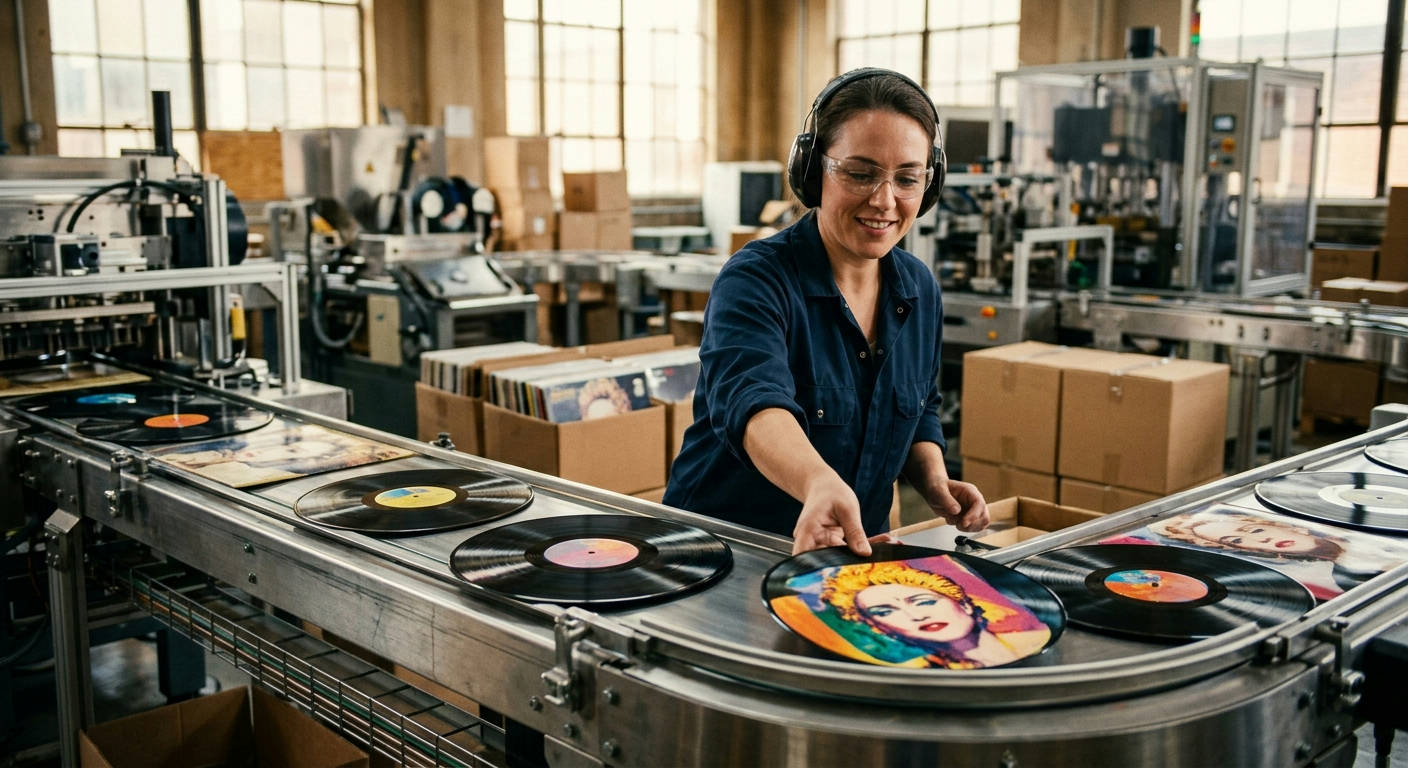
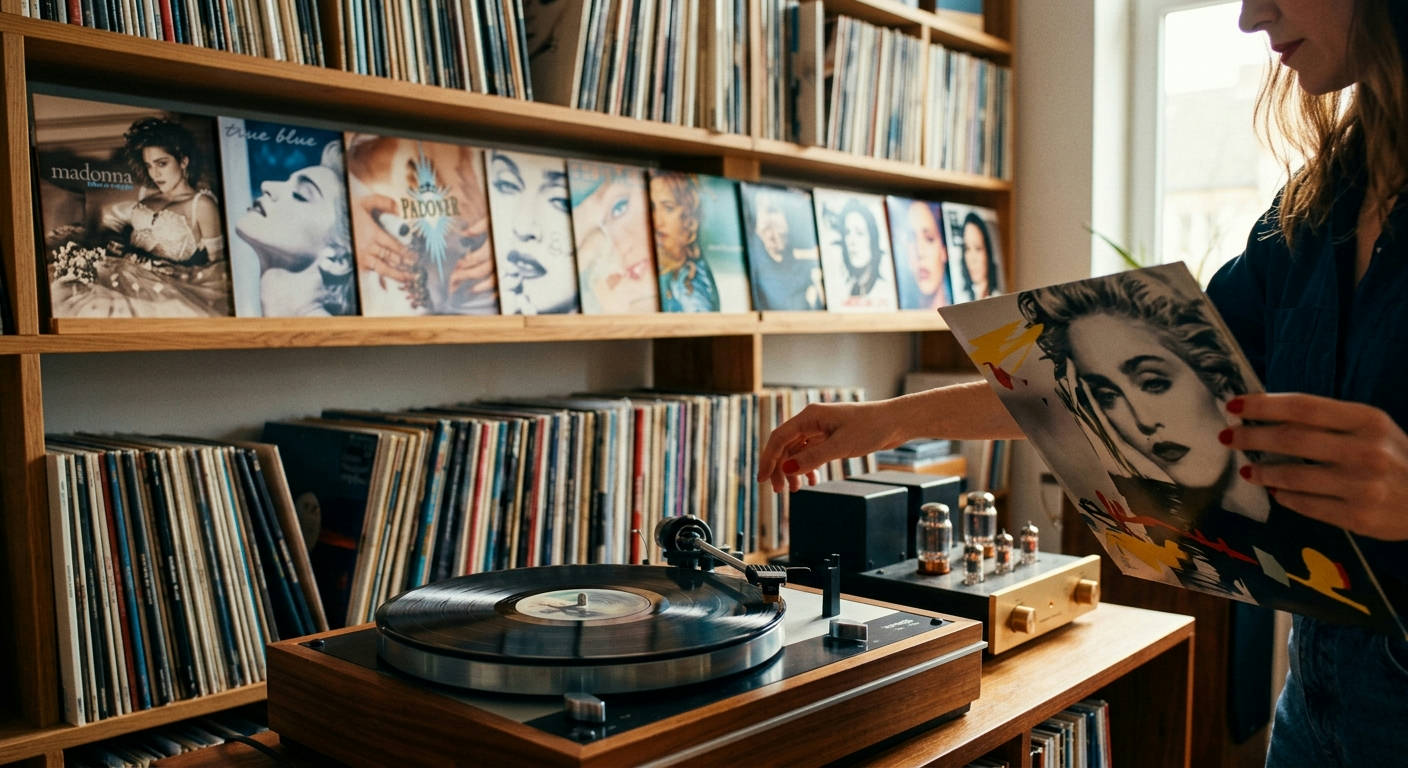
Exploring the Madonna studio albums in chronological order is one thing, but collecting them on vinyl is a truly rewarding pursuit. The large-format artwork, the tangible object, and the superior analog sound make it the definitive way to experience her music.
Why Vinyl is the Ultimate Format for the Queen of Pop
Madonna is, and always has been, a visual artist. The album cover is not an afterthought; it’s a key part of the era’s identity. From the iconic portrait on True Blue to the Jean-Baptiste Mondino photography for Ray of Light, her album art is meant to be seen and held. Vinyl provides the canvas this art deserves.
“Music makes the people come together.” – Madonna, “Music”
That communal experience of sharing music is perfectly captured by the ritual of putting a record on the turntable. It’s an active, engaging way to listen, far removed from the passive consumption of digital playlists.
### Essential Madonna Studio Albums in Chronological Order for Your Collection
Where do you begin with such a vast discography? If you’re building a collection from scratch, here is the essential starter pack from Vinyl Gold UK:
- Like a Prayer (1989): This is her artistic big bang. The blend of pop, rock, and gospel sounds incredible on vinyl, and the patchouli-scented sleeve of original pressings is a legendary collector’s item.
- Ray of Light (1998): William Orbit’s layered, complex electronic production truly shines on a vinyl pressing. The deep bass and shimmering highs create an immersive, almost three-dimensional listening experience.
- Confessions on a Dance Floor (2005): Usually pressed on stunning pink vinyl, this album was designed to be heard as a continuous mix. Experiencing it on two LPs, with the brief pause to flip the record, enhances the feeling of being in a club with a world-class DJ.
Find Confessions on a Dance Floor on pink vinyl via Amazon.
Identifying First Pressings vs. Reissues
For the serious collector, telling an original pressing apart from a modern reissue is key. While reissues often sound fantastic (thanks to 180-gram vinyl and modern mastering), originals hold historical value.
- Check the Barcode: Albums from the early 80s, like her debut, may not have a barcode on the original pressing. Its presence almost always indicates a later reissue.
- Examine the Catalogue Number: Use a resource like Discogs to cross-reference the catalogue number etched into the runout groove (the blank space near the record’s label). This is the most reliable way to identify the exact pressing you have.
- Look for Hype Stickers: Original pressings often came with “hype stickers” on the shrink wrap advertising hit singles. While not definitive, their presence can be a good indicator.
Tracing the path of Madonna’s career is a dizzying, thrilling ride. Her refusal to be categorized, her constant sonic shifts, and her unwavering artistic vision are what make her a true one-of-a-kind icon. Each album tells a story, and together, they form one of the most significant narratives in the history of popular music. The only thing left to do is drop the needle and listen for yourself.