
It’s more than just a song. It’s a five-act play packed into three and a half minutes, a philosophical treatise disguised as a country-pop hit. For decades, the Kenny Rogers The Gambler lyrics have served as a source of campfire wisdom, poker night quotes, and profound life advice. The story of a chance encounter on a train has become a modern fable, its chorus a mantra for anyone facing a tough decision.
This isn’t just about a card game. The genius of the song, penned by the legendary Don Schlitz, is its use of poker as a perfect metaphor for life itself. Every day we’re dealt a hand, and we have to decide what to do with it. The old gambler’s advice isn’t about winning big; it’s about survival, about knowing yourself, and about living to play another day.
Here at Vinyl Gold UK, we believe some stories are best told with the warm crackle of a needle in a groove. Let’s shuffle the deck and take a deep dive into the meaning, history, and enduring power of one of the greatest story-songs ever recorded.
Unpacking the Story: A Deep Dive into the Kenny Rogers The Gambler Lyrics
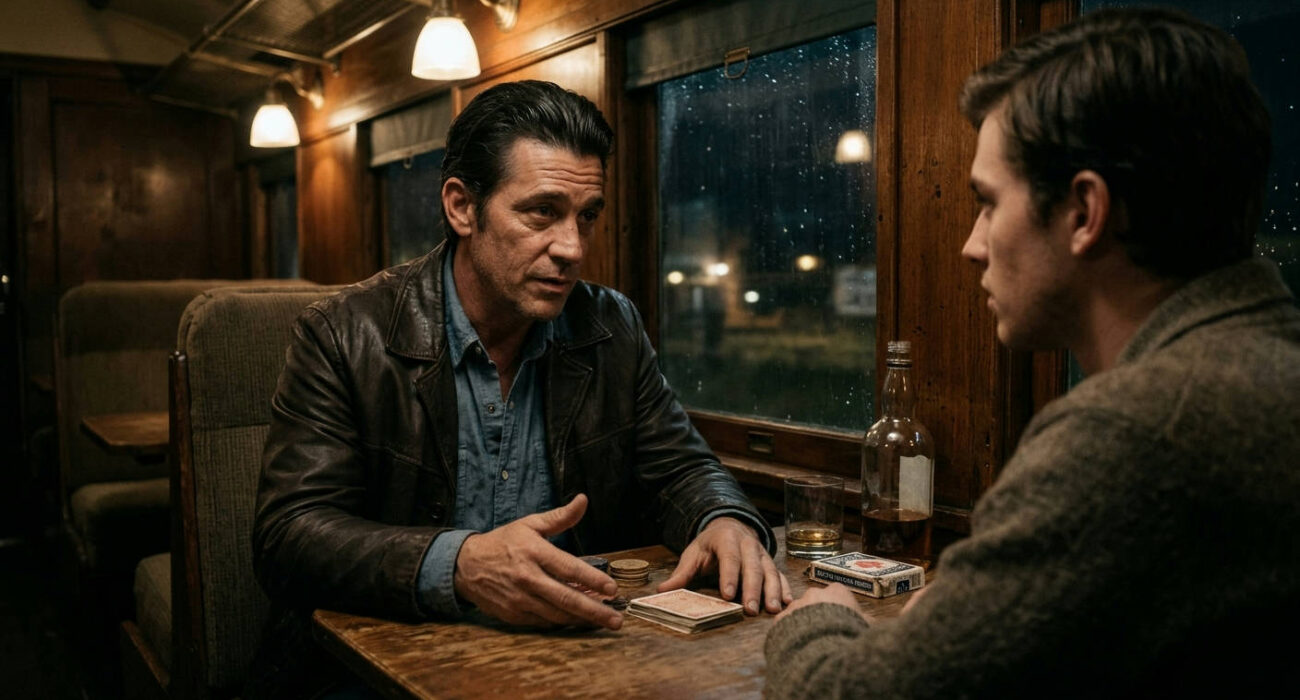
The song opens with an atmosphere you can almost feel. “On a warm summer’s evenin’ on a train bound for nowhere.” Right away, we’re in a liminal space. The characters aren’t going to a specific destination; they’re in transit, between chapters of their lives, making the gambler’s philosophical insight feel all the more potent.
The narrator is “out of aces,” a simple but brilliant line that establishes his desperation. He’s broke, directionless, and looking for an answer. This makes him the perfect audience for the wisdom the old gambler is about to share.
The Initial Encounter
The scene is set with cinematic detail. The train, the boredom, the darkness outside. The gambler’s introduction is quiet and unassuming: “Then a stranger sat down beside me.” He’s not flashy. His presence is defined by his silence and the simple act of sharing a drink.
The exchange is a transaction of the old world. The narrator offers his last swallow of whiskey for a piece of advice. This isn’t a business deal; it’s a moment of human connection, where wisdom is valued more than material possessions. The gambler, seeing the pain in the narrator’s eyes, agrees to share his life’s philosophy.
The Gambler’s Creed: The Famous Chorus
This is the heart of the entire song, a masterclass in lyrical economy where every word carries immense weight. Let’s break down the core advice from the Kenny Rogers The Gambler lyrics.
- “You’ve got to know when to hold ’em, know when to fold ’em.” This is the central thesis. It’s about assessment. It’s the art of knowing whether the situation you’re in—be it a job, a relationship, or an investment—has the potential for a positive outcome or if it’s a losing battle. Holding is about commitment and seeing things through. Folding is about the courage to cut your losses and move on.
- “Know when to walk away, and know when to run.” This escalates the previous line. Walking away is a strategic retreat. It’s recognising a no-win situation and preserving your energy and resources. Running, however, implies danger. It’s for those toxic, destructive situations where staying any longer will cause irreparable harm.
- “You never count your money when you’re sittin’ at the table.” This is a lesson in focus and humility. Don’t celebrate prematurely. Stay focused on the task at hand and don’t get distracted by potential future gains. The game isn’t over until it’s over. Getting complacent is a surefire way to lose.
- “There’ll be time enough for countin’ when the dealin’s done.” This reinforces the previous point. There is a time and place for reflection and celebration, and it is after the work is complete. It speaks to a discipline of seeing a process through to its conclusion before judging the outcome.
The Gambler’s Final Act
After imparting his wisdom, the gambler’s story ends with a quiet, poignant finality. “And the gambler, he broke even.” He didn’t die a rich man. He didn’t win the ultimate jackpot. He survived.
This is perhaps the most profound and realistic part of the song. The goal isn’t always to win; sometimes, the victory is simply in not losing. Breaking even means he played the game of life with skill and lived to see the end. He then “faded off to sleep,” a peaceful, dignified exit. The narrator is left alone with a powerful “ace that I could keep.” The wisdom has been passed on.
The Man Behind the Words: Don Schlitz
While Kenny Rogers’s warm, gravelly voice made the song a global phenomenon, the words themselves sprang from the mind of a young, struggling songwriter named Don Schlitz. Understanding the origin of the Kenny Rogers The Gambler lyrics adds a whole new layer of appreciation.
Schlitz was just 23 years old and working the night shift at a computer lab at Vanderbilt University when he wrote the song in 1976. The six-minute walk to and from work was his creative time, and the entire narrative of “The Gambler” came to him during these commutes, inspired by his own father’s advice.
The Long Road to a Hit
The song wasn’t an immediate success. Far from it. Schlitz pitched “The Gambler” to every label on Nashville’s Music Row for two years, facing constant rejection. The song was deemed too long, too narrative-driven, and just not commercial enough for country radio at the time.
Finally, in 1978, the legendary Bobby Bare recorded it on his album Bare. Johnny Cash also cut a version around the same time. But it was Kenny Rogers who heard the song and saw its massive potential. He and producer Larry Butler sped up the tempo, added the iconic train-track rhythm, and turned it into the story-song masterpiece we know today.
The Impact on Song writing History
“The Gambler” completely transformed Don Schlitz’s life, turning him from an unknown songwriter into an industry legend. He went on to write dozens of other hits for artists like Randy Travis and Mary Chapin Carpenter.
“I thank God for that song every day. It’s been a gift from the very first, and it continues to be. It’s the song that introduced me to the world.” – Don Schlitz
His induction into the Songwriters Hall of Fame was a testament to his incredible talent for storytelling. “The Gambler” stands as a perfect example of how a simple, powerful idea can resonate across generations if it’s told with honesty and heart.
Applying The Gambler’s Wisdom in 2026
The advice in the song is timeless for a reason. While the setting is a train in the 1970s, the core principles are just as relevant in our hyper-connected world of 2026. The “table” might be a Zoom meeting and the “cards” might be data points, but the game is the same.
Career and Business: Holding vs. Folding
In the professional world, “knowing when to hold ’em” is about perseverance. It’s sticking with a difficult project when you believe in the long-term vision. It’s backing your team through a rough quarter because you know their potential.
“Knowing when to fold ’em” is the harder, but often more crucial, skill. It’s the courage to shut down a failing startup before it sinks you completely. It’s declining a promotion that would destroy your work-life balance. It’s leaving a toxic job, even if the pay is good. Walking away preserves your capital—both financial and mental—for a better opportunity.
Personal Relationships and Knowing When to Run
The lyrics offer a stark but useful framework for personal relationships. Some friendships and partnerships are worth fighting for (“holding”). You invest time and emotional energy because the connection is valuable.
“Walking away” might mean ending a friendship that has fizzled out or a romance that has no future. It’s a mutual, often sad, parting of ways. But “knowing when to run” applies to destructive, one-sided, or abusive relationships. It is the critical act of self-preservation, recognising a situation that will only lead to more pain.
Financial Strategy: The Gambler’s Portfolio
The gambler’s advice is practically a mantra for sound financial management.
- Hold ‘Em: Your long-term, blue-chip investments. The reliable assets you believe in for the long haul.
- Fold ‘Em: Cutting losses on a speculative stock that has clearly tanked. Don’t let ego or “hope” keep you in a losing position.
- Walk Away: Cashing out of an investment that has met your target, even if it might go a little higher. Secure your gains.
- Run: Pulling your money out during a clear market crash or from a fraudulent scheme. The priority is to limit the damage.
- Never Count Your Money: Don’t obsessively check your portfolio every five minutes. Set your strategy and let it play out. “Time enough for countin’ when the dealin’s done.”
The Gambler’s Unstoppable Cultural Reach
The song quickly became more than just a radio hit. It evolved into a cultural touchstone, a piece of Americana that spawned a media franchise and cemented Kenny Rogers’s image as the wise, silver-haired storyteller.
The TV Movie Franchise
The success of the song led to a series of five popular television films, starting with Kenny Rogers as The Gambler in 1980. Rogers starred as Brady Hawkes, a fictional gambler on a quest to find the son he never knew.
These movies expanded the lore of the song, giving a name and a face to the mysterious figure on the train. The series, which ran until 1994, was incredibly popular and became a staple of television, further embedding the Kenny Rogers The Gambler lyrics into the public consciousness. The success of these films is well-documented on platforms like Wikipedia.
References and Parodies in Pop Culture
A surefire sign of a song’s iconic status is how often it’s referenced, parodied, and paid tribute to. “The Gambler” has been a go-to punchline and source of inspiration for decades.
It has appeared in countless TV shows, from The Office to Family Guy. Commercials have used the famous chorus to sell everything from insurance to snack foods. Its simple, memorable melody and profound lyrics make it an easy and effective cultural shorthand for making a tough choice. Even other musicians have tipped their hats, with covers and lyrical nods appearing across genres. This broad appeal is something few songs ever achieve, placing it in the same league as narrative epics from other genres, like those found in our Meat Loaf Hits Album Review.
Why the Kenny Rogers The Gambler Lyrics Endure
Why, in 2026, are we still talking about this song? Fads come and go, but “The Gambler” remains. Its longevity comes down to a few key elements that make it a perfect piece of song writing.
“Every gambler knows that the secret to survivin’ is knowin’ what to throw away and knowin’ what to keep.”
This line, delivered just before the first chorus, encapsulates the song’s entire philosophy. Life is a constant process of curation. We have finite time, energy, and resources. The “secret” is learning to distinguish between what is valuable and what is holding us back.
The Universal Power of Metaphor
The poker game is the ultimate metaphor because it’s a perfect blend of luck and skill. You can’t control the cards you’re dealt (luck), but you can control how you play them (skill). This mirrors life perfectly. We can’t control the circumstances we’re born into or the random events that befall us, but we have agency in our responses.
This simple, powerful metaphor makes complex life strategies accessible to everyone. You don’t need to know a thing about poker to understand what the gambler is saying. It’s a framework for decision-making that is universally understood.
The Quiet Realism of the Ending
In a world of Hollywood endings, the conclusion of “The Gambler” is refreshingly and profoundly realistic. The gambler doesn’t win a mountain of gold or ride off into the sunset.
He breaks even.
This is a powerful statement. He navigated the treacherous game of life and came out whole. He didn’t lose. He survived with his dignity and wisdom intact, able to pass it on to the next generation. It’s a quiet victory, but a victory nonetheless. This subtle, melancholic ending gives the song a depth and honesty that has allowed it to endure.
Experiencing The Gambler on Vinyl: The Definitive Guide
To truly appreciate a story-song like “The Gambler,” you need to give it your full attention. That’s where vinyl comes in. The ritual of placing a record on the turntable and dropping the needle creates a focused listening experience that a streaming playlist just can’t replicate.
The warmth and analogue depth of a vinyl pressing bring Kenny Rogers’s voice to the forefront, making it feel like he’s in the room with you, sharing his story. The slight surface noise becomes part of the atmosphere, like the gentle rocking of the train.
### Finding Your Copy of The Gambler Album
The song is the title track of Rogers’s 1978 album, The Gambler. When looking for a copy, you have a few options. Original pressings from 1978 on the United Artists Records label are plentiful and offer that authentic vintage sound.
Later reissues can also sound fantastic, often pressed on heavier-grade vinyl. Look for a copy with a clean, glossy cover and a record free of deep scratches for the best listening experience. You can start your search for a great copy of Kenny Rogers The Gambler lyrics on vinyl right here on Amazon.
### Building the Perfect System for Story-Songs
You don’t need a high-end audiophile setup to enjoy “The Gambler” on vinyl, but a solid turntable will make all the difference. A good deck will pull all the detail out of the grooves and deliver Rogers’s narrative with clarity and impact.
If you’re looking to get started or upgrade your current setup without breaking the bank, a quality turntable is your first and most important investment. We’ve put together a guide on the best turntables under £300 in the UK that can help you find the perfect foundation for your vinyl journey.
Ultimately, “The Gambler” is more than a song. It’s a piece of folk wisdom passed down through vinyl grooves and radio waves. It’s a reminder that in the game of life, the best you can often hope for is to play the hand you’re dealt with skill, courage, and the wisdom to know when to walk away. The Kenny Rogers The Gambler lyrics are a masterclass in storytelling, and the gambler’s final lesson—the ace he leaves with the narrator—is one we can all carry with us. He broke even, and in the end, that’s a win.