
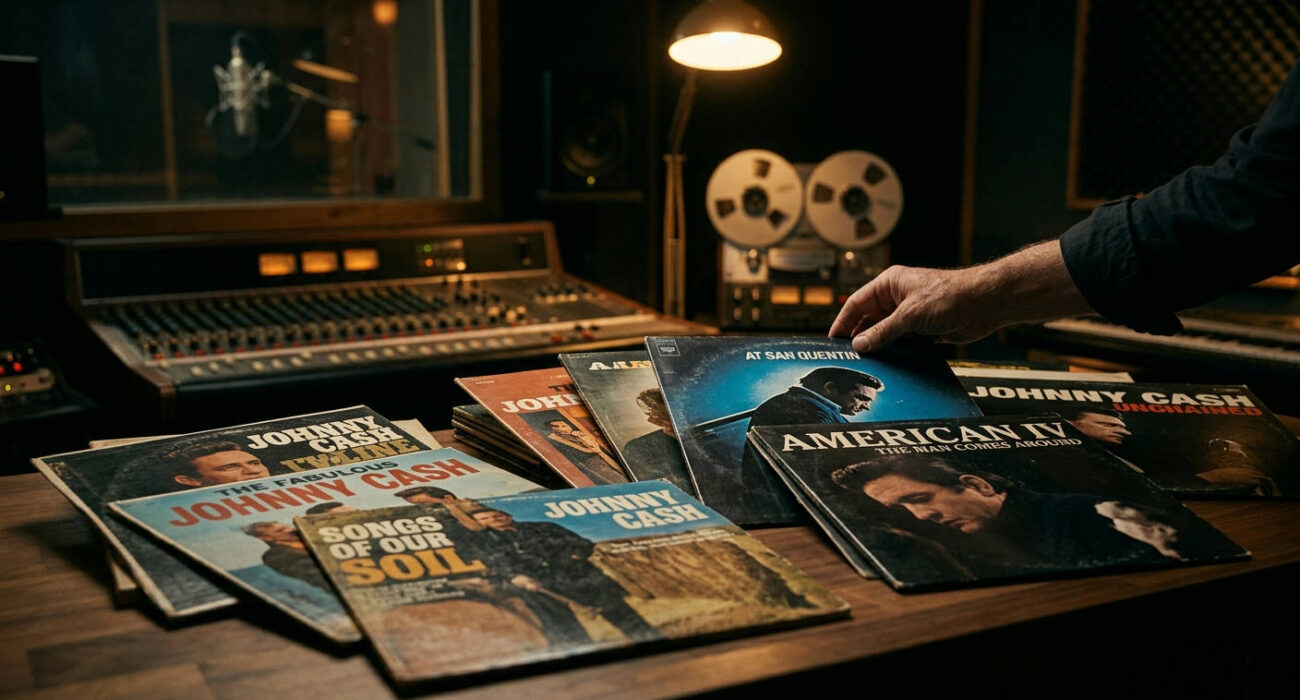
Trying to grasp the sheer volume and monumental impact of the Johnny Cash studio albums discography can feel like trying to count all the stars in a vast, dark sky. From his raw, revolutionary beginnings at Sun Records to the haunting, reflective finality of the American Recordings, Johnny Cash didn’t just make music; he chronicled the American experience through his studio work. At Vinyl Gold UK, we live and breathe this stuff, and we’re here to guide you through the canyons and peaks of one of the most important bodies of work in modern music history. This isn’t just a list; it’s a journey through the life of The Man in Black, one studio album at a time.
The Sun Records Era: Stripping Music to its Bone
Before the black suits, the prison concerts, and the global fame, there was a young man from Arkansas with a guitar and a voice that sounded like it was dredged from the bottom of a river. Sam Phillips at Sun Records in Memphis knew he had something special, something that wasn’t quite country and wasn’t quite rock and roll. It was just… Cash.
Johnny Cash with His Hot and Blue Guitar! (1957)
This is ground zero. His debut album is a raw nerve of early rockabilly and stark country storytelling. It contains the pillars of his early career: “I Walk the Line,” “Cry! Cry! Cry!,” and “Folsom Prison Blues.” What’s striking about this record in 2026 is its profound simplicity. There are no orchestral swells or slick production tricks. It’s just Cash, Luther Perkins’ iconic “boom-chicka-boom” guitar, and Marshall Grant’s stand-up bass.
Listening to this album on vinyl is the only way to truly appreciate its stripped-down power. The warmth of the analogue recording brings out the tremble in his voice and the clean, biting tone of Perkins’ Telecaster. It’s the sound of a legend being born in real-time, and it’s an essential starting point for anyone exploring the Johnny Cash studio albums discography.
You can feel the sparseness of the arrangements, a deliberate choice by Sam Phillips to let Cash’s larger-than-life baritone command the entire track. This wasn’t just a collection of songs; it was a statement of intent.
Sings the Songs That Made Him Famous (1958)
While technically his second Sun LP, this one is more of a greatest hits collection of his singles up to that point. It includes massive tracks like “Ballad of a Teenage Queen” and “Big River.” It’s a crucial snapshot of his meteoric rise but lacks the cohesive thematic feel of a true “studio album” in the modern sense.
Nonetheless, it showcases the incredible run of hits he produced in a very short time. Sun Records was essentially squeezing every last drop of commercial potential from its star before he departed for the greener pastures of a major label. It’s a testament to his song writing and immediate connection with the public.
The Columbia Years: Building a Legacy, Brick by Brick
Signing with Columbia Records in 1958 was a seismic shift. It gave Cash a bigger budget, more creative freedom, and a platform to become a global superstar. This era, spanning nearly three decades, is where he cemented his image and produced an almost overwhelming number of studio albums, experimenting with gospel, folk, and concept records.
The Concept Album Pioneer: Ride This Train (1960)
Long before The Who’s Tommy or Pink Floyd’s The Wall, Johnny Cash was already mastering the art of the concept album. Ride This Train is a travelogue across America, with each song representing a different location and story, linked by Cash’s spoken-word narration and the sound of a train.
He sings about miners in “Loading Coal” and lumberjacks in “Lumberjack.” It was a bold, ambitious project that showcased his deep love for American history and the working man. The album wasn’t a massive commercial hit at the time, but it established him as a serious artist with a vision far beyond churning out three-minute singles. It proved he was a folk historian as much as a country singer.
The Man of Faith: Hymns by Johnny Cash (1959) & The Holy Land (1969)
You cannot understand the Johnny Cash studio albums discography without acknowledging his deep, unwavering Christian faith. It was the bedrock of his life, his constant source of strength through years of personal turmoil. His first album for Columbia wasn’t a country record; it was a gospel album, Hymns by Johnny Cash.
This was a daring move. The label wanted hits, but Cash insisted on recording these songs of faith. A decade later, he would release The Holy Land, another concept album documenting his spiritual journey through Israel, complete with on-location recordings of his family and local sounds. These albums weren’t cynical grabs for a specific market; they were earnest expressions of the man’s soul.
The Outlaw Persona in the Studio: Man in Black (1971)
While the live prison albums At Folsom Prison and At San Quentin defined his outlaw image, the 1971 studio album Man in Black was its mission statement. The title track, a spoken-word protest song, explains exactly why he chose to wear black: for the poor, the beaten down, the prisoner, and the sick.

The album is a powerful mix of social commentary, storytelling, and gospel. It’s Cash using his massive platform to speak for the voiceless. This wasn’t a character he was playing; it was an extension of his own empathy and his own struggles.
“I wear the black for the poor and the beaten down, livin’ in the hopeless, hungry side of town, I wear it for the prisoner who has long paid for his crime, but is there because he’s a victim of the times.”
This era at Columbia saw him become a television star, a social activist, and one of the most recognizable figures in the world. His studio output was prolific, sometimes inconsistent, but always authentic.
A Deeper Look at the Johnny Cash Studio Albums Discography: The Mercury Years (1986–1991)
By the mid-1980s, Cash’s relationship with Columbia had soured. Country music was moving toward a slicker, pop-oriented sound, and the industry seemed to have forgotten about The Man in Black. He signed with Mercury Records, a period often dismissed by casual fans but one that contains some fascinating and underrated work.
Finding His Footing: Johnny Cash Is Coming to Town (1987)
His first Mercury release was produced by “Cowboy” Jack Clement, who had engineered his early sessions at Sun. It was an attempt to recapture some of that old magic, and it partially succeeded. The album features a killer version of “The Night Hank Williams Came to Town” and collaborations with Waylon Jennings, Jessi Colter, and his daughter, Rosanne Cash.
It’s a solid record, but it struggled to find a home on the radio. Despite the quality of the songs, the production can sound a bit too polished for its own good, a common issue for many 80s country records. Still, it’s an essential piece of the puzzle for anyone trying to understand the complete Johnny Cash studio albums discography.
Collaborations and Covers: Water from the Wells of Home (1988)
This album is a star-studded affair. It features duets with Paul McCartney, Glen Campbell, Emmylou Harris, and even his old Sun Records stablemates Roy Orbison and Jerry Lee Lewis. The standout track is arguably “The Last of the Drifters,” a collaboration with Tom T. Hall that feels incredibly poignant.
While a bit of a mixed bag sonically, the album is a testament to the immense respect his peers had for him, even when he wasn’t topping the charts. It’s a “friends and family” record that shows Cash still had the fire, even if the industry at large wasn’t paying attention. You can find a copy of this often-overlooked gem on vinyl. A quick search on Amazon for Johnny Cash Water from the Wells of Home Vinyl can sometimes yield results.
The End of the Road (For Now): Boom Chicka Boom (1990)
The title itself was a defiant nod to his signature sound. This album felt like a conscious effort to get back to basics. It included a fantastic cover of Harry Chapin’s “Cat’s in the Cradle” and the powerful “A Backstage Pass.”
Despite its strengths, the Mercury era ultimately saw Cash artistically adrift. He was an icon in a format that no longer valued icons. He was dropped by the label in 1991, leaving many to believe his recording career was over. They couldn’t have been more wrong.
The American Recordings: A Resurrection
Enter Rick Rubin. The producer famous for his work with the Beastie Boys, Slayer, and Run-DMC seemed like the most unlikely partner for Johnny Cash. But Rubin had a simple, revolutionary idea: just put Johnny Cash and his acoustic guitar in a room and press record. The result was one of the greatest late-career comebacks in music history.
### The Stunning Simplicity of the Johnny Cash Studio Albums Discography Debut: American Recordings (1994)
The first album in the series, American Recordings, was a revelation. It was stark, intimate, and profoundly powerful. Stripped of all studio gloss, Cash’s voice, now weathered by age and hardship, sounded more commanding than ever. He sang traditional folk songs, his own compositions, and covers from artists like Leonard Cohen (“Bird on a Wire”) and Glenn Danzig (“Thirteen”).
This album didn’t just restart his career; it redefined it. It introduced him to a whole new generation of fans—kids in rock and grunge t-shirts who heard the same raw authenticity in Cash’s voice that they heard in Kurt Cobain’s. As the Rock & Roll Hall of Fame notes, he was an artist who transcended genre boundaries entirely.
Unchained (1996) and Facing Mortality
If the first American album was a solo statement, the second, Unchained, saw Cash backed by Tom Petty and the Heartbreakers. The sound was fuller, but the raw emotional core remained. His cover of Soundgarden’s “Rusty Cage” was mind-blowing, transforming a grunge anthem into a country-rock stomper.
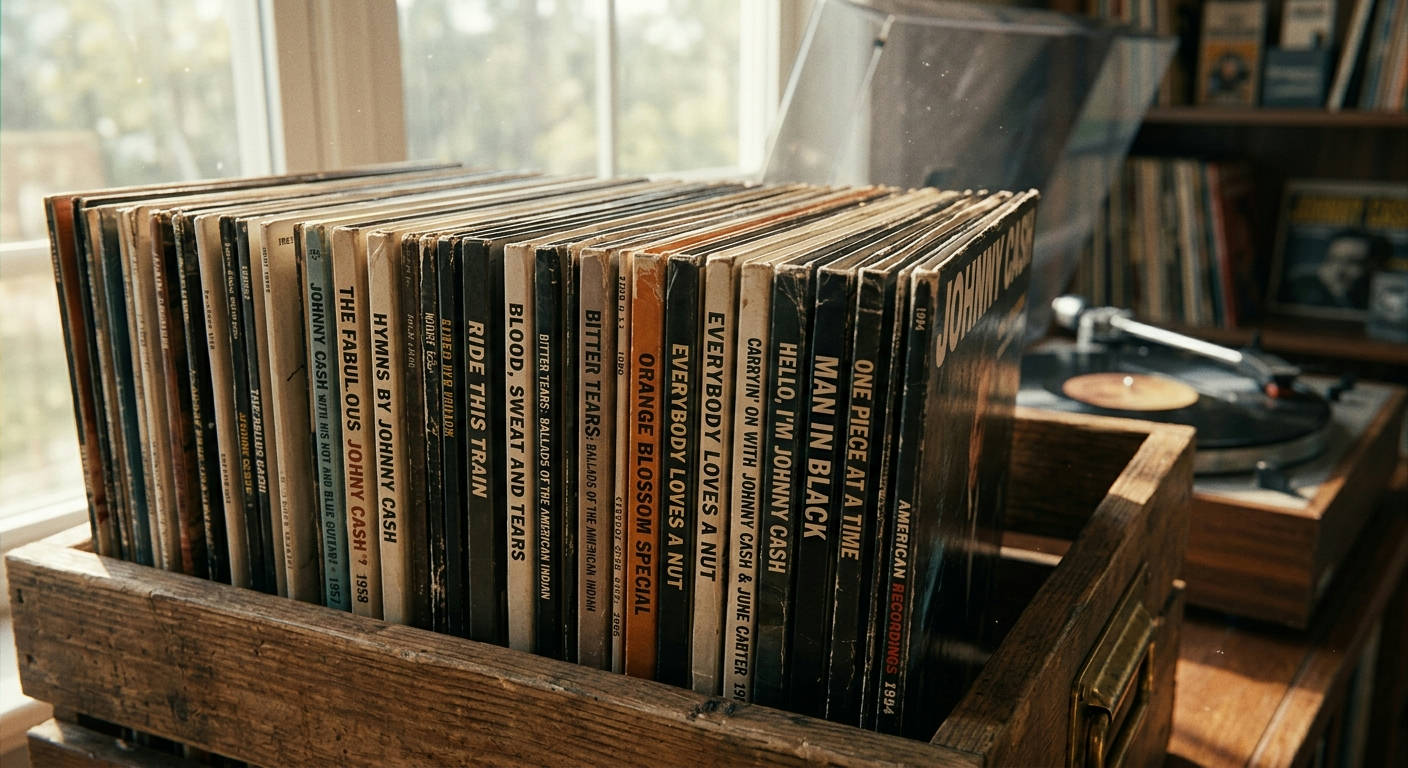
This album earned him a Grammy for Best Country Album, a sweet piece of validation from an industry that had written him off. You can find this masterpiece on vinyl on Amazon here: Johnny Cash Unchained Vinyl.
As the series progressed with American III: Solitary Man (2000) and American IV: The Man Comes Around (2002), the themes of mortality and faith grew more pronounced. Cash was now frail, his health failing, but his voice had taken on an almost biblical authority.
His cover of Nine Inch Nails’ “Hurt” from American IV is perhaps his definitive final statement. The accompanying music video is one of the most moving pieces of film ever created. It’s the ultimate example of an artist making a song completely their own, a topic we explore further in our article on cover songs better than the original. It was a devastatingly honest self-eulogy.
The Posthumous Legacy
Johnny Cash passed away in 2003, but he had recorded a wealth of material with Rick Rubin. This led to a series of incredible posthumous releases that continued to build upon his legend.
American V: A Hundred Highways (2006) & American VI: Ain’t No Grave (2010)
These albums are almost unbearably poignant. Released after his death, they feature recordings made in his final months. His voice is frail, cracking, and audibly weak, yet it carries more weight and emotion than ever before. Songs like “God’s Gonna Cut You Down” and “Ain’t No Grave (Gonna Hold My Body Down)” are chilling testaments to his unbreakable spirit and faith.
Listening to these records feels like sitting with the man himself as he confronts his own end. It’s a listening experience that stays with you long after the needle lifts.
The “Lost” Album: Out Among the Stars (2014)
Unearthed by his son, John Carter Cash, this album consists of recordings from the mid-1980s, during his commercially challenging years at Columbia. Produced by country-politan architect Billy Sherrill, the sessions were shelved by the label at the time.
Released in 2014, Out Among the Stars is a fascinating listen. It captures Cash in a more upbeat, classic country style than his Mercury or American recordings. It’s a wonderful “what if” that fills a crucial gap in the Johnny Cash studio albums discography.
Collecting the Johnny Cash Studio Albums Discography on Vinyl
For vinyl enthusiasts, collecting Johnny Cash is a rewarding, lifelong pursuit. The sheer breadth of his output means there’s always something new to discover.
“You build on failure. You use it as a stepping stone. Close the door on the past. You don’t try to forget the mistakes, but you don’t dwell on it. You don’t let it have any of your energy, or any of your time, or any of your space.” – Johnny Cash
This philosophy is reflected in his career; every era, even the less-celebrated ones, was a stepping stone to the next.
Where to Start Your Collection
For a newcomer, the path is clear:
- The Foundation: Start with an early Sun pressing or a good reissue of Johnny Cash with His Hot and Blue Guitar!.
- The Prime: Get a clean copy of At Folsom Prison. Yes, it’s a live album, but it’s non-negotiable for any Cash fan. For studio work, Man in Black or Ride This Train are excellent choices from his Columbia peak.
- The Resurrection: Any of the American Recordings on vinyl are essential. The 180-gram pressings of American Recordings and Unchained sound absolutely incredible. You can start your search here: Johnny Cash American Recordings Vinyl.
Sound Quality and Pressings
The debate between mono and stereo mixes for his early Columbia albums is a hot topic among audiophiles. The original mono pressings often have a punchier, more direct sound that many feel is more authentic to the “boom-chicka-boom” style.
Regardless of the pressing, the quality of your playback system matters. You don’t need to spend a fortune to get great sound. A solid turntable can make all the difference in bringing these classic recordings to life. If you’re looking to upgrade your setup, we’ve put together a guide on the best turntables under £300 in the UK to help you get the most out of your records.
The Johnny Cash studio albums discography is more than just a collection of music. It’s a roadmap of a complex, troubled, and ultimately triumphant life. It’s a body of work that speaks of sin and redemption, love and loss, justice and faith. From the Sun to Columbia, Mercury to American, each album is a chapter in an epic story that continues to resonate with unparalleled power in 2026. Happy listening, and happy digging.