
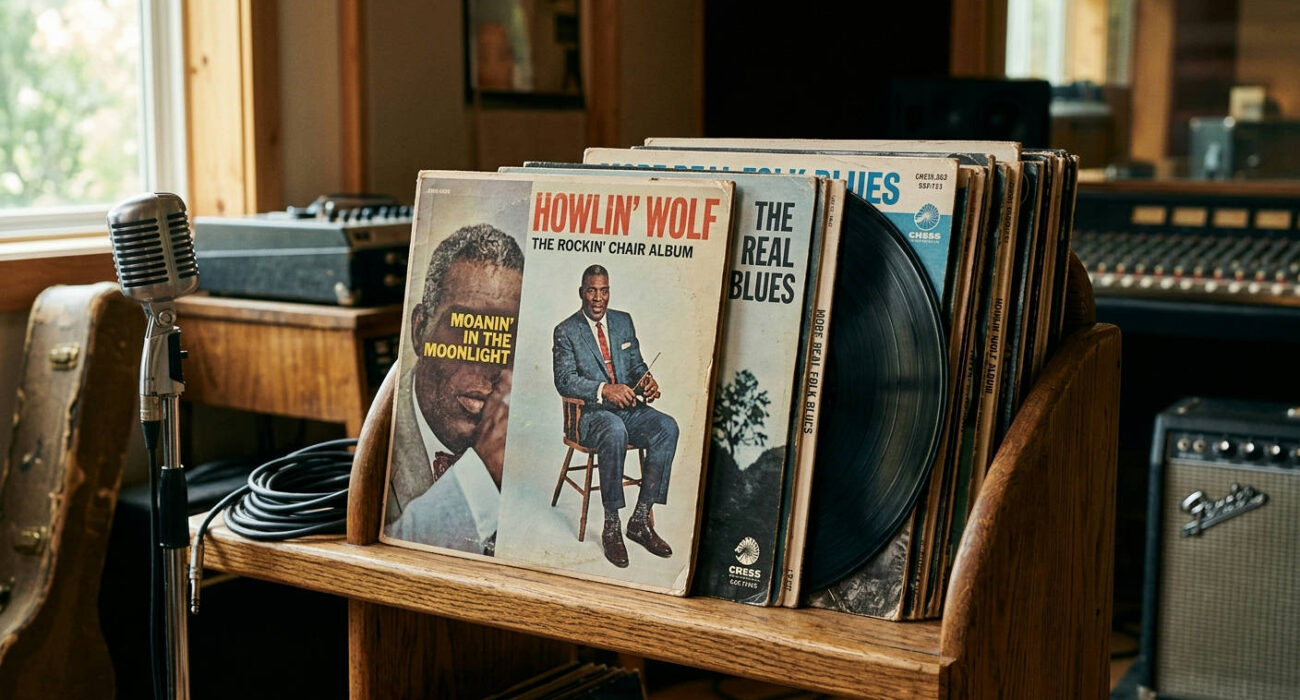
Trying to build a definitive Howlin Wolf official studio albums list can feel like wrestling with the man himself—it’s a raw, powerful, and deeply rewarding experience. Chester “Howlin’ Wolf” Burnett wasn’t just a bluesman; he was a force of nature. His voice, a gravel-pit growl that could strip paint, and his towering stage presence left an indelible mark on music. For vinyl collectors and new fans alike, navigating his discography is an essential journey into the heart of the blues. Here at Vinyl Gold UK, we’re cutting through the noise to give you the ultimate guide to the Wolf’s studio output.
This isn’t just about listing records. It’s about understanding the context, the sound, and the sheer, earth-shaking impact of each release. From the primal singles of the 1950s to the all-star London sessions, we’re cracking open the vault.
The Man, The Myth, The Growl: Understanding Howlin’ Wolf
Before we spin the first record, you need to know who you’re dealing with. Born Chester Arthur Burnett in 1910 in White Station, Mississippi, Howlin’ Wolf was an imposing figure. Standing at 6-foot-3 and well over 275 pounds, his physical presence was as massive as his voice. He didn’t just sing the blues; he embodied them.
His journey took him from the Mississippi Delta to the legendary Sun Studio in Memphis, where Sam Phillips first captured his terrifying sound on tape. But it was in Chicago, under the wing of Chess Records, that he became a king. He and Muddy Waters were the twin pillars of the Chicago blues scene—rivals, contemporaries, and mutual admirers who pushed each other to greatness.
The Wolf’s Sonic Signature
What made Howlin’ Wolf’s music so potent? It was a volatile cocktail of raw ingredients that no one has ever been able to replicate.
- The Voice: It’s the first thing you notice. It wasn’t just a growl; it was a complex instrument capable of conveying menace, sorrow, and unbridled joy. He learned his signature yodel and howl from country star Jimmie Rodgers, blending white country traditions with black Delta blues.
- Hubert Sumlin’s Guitar: You can’t talk about the Wolf’s sound without talking about his long-time guitarist, Hubert Sumlin. Sumlin’s playing was jagged, unpredictable, and filled with dissonant, angular phrases that twisted around Wolf’s vocals like a thorny vine. His work on tracks like “Spoonful” and “Killing Floor” is a masterclass in tension and release.
- The Power of the Band: Wolf demanded the best from his musicians. The rhythm sections on his Chess recordings were airtight, providing a heavy, hypnotic groove that made the music physically move. It was a sound built for smoky, packed juke joints.
This potent combination didn’t just define Chicago blues; it laid the groundwork for rock and roll. Bands like The Yardbirds and The Rolling Stones didn’t just cover his songs; they studied his every move, trying to capture a fraction of his raw energy.
Before the LP: The Singles That Built the Legend
In the 1950s, the album as we know it today wasn’t the primary format. The music world ran on 78 and 45 RPM singles. For artists like Howlin’ Wolf, the goal was to cut a hit single that would get played on the radio and in jukeboxes across the country.
His earliest recordings for Sam Phillips in 1951, like “Moanin’ at Midnight” and “How Many More Years,” were licensed to Chess Records and became immediate hits. These tracks were utterly primal, sounding like they were dredged up from the deepest part of the swamp. They were revolutionary.
When he moved to Chicago and began recording exclusively for Chess, he teamed up with the label’s secret weapon: songwriter and producer Willie Dixon. Dixon’s songwriting prowess, combined with Wolf’s unparalleled delivery, resulted in a string of singles that are now considered blues standards: “Smokestack Lightnin’,” “Evil (Is Goin’ On),” and “Forty-Four.” These weren’t just songs; they were three-minute horror movies, tales of paranoia, jealousy, and supernatural dread.
The Complete Howlin Wolf Official Studio Albums List
Finally, as the long-playing (LP) record gained popularity in the late 1950s, Chess Records began compiling these monstrous singles into albums. This is the official studio discography—the essential records you need in your collection.
Moanin’ in the Moonlight (1959)
This isn’t a studio album in the modern sense of a single, cohesive project. Instead, Moanin’ in the Moonlight is a compilation of the killer singles Wolf recorded for Chess between 1951 and 1959. But what a compilation it is. It’s essentially the opening chapter of the Chicago blues bible.
This record is a hall-of-fame lineup from start to finish. You get the haunting “Smokestack Lightnin’,” the menacing “Evil (Is Goin’ On),” and the frantic, unhinged “Moanin’ at Midnight.” It’s a perfect introduction to the Wolf’s early sound and remains one of the most important blues albums ever released. Finding a clean original pressing is a holy grail for collectors, but the 2017 reissue is a fantastic, affordable option.
Find it on Amazon: Search for Howlin’ Wolf Moanin’ in the Moonlight Vinyl on Amazon.com
Howlin’ Wolf (aka “The Rockin’ Chair Album”) (1962)
If Moanin’ was the foundation, this is the skyscraper built on top of it. Known universally as “The Rockin’ Chair Album” thanks to its iconic cover photo, this 1962 release is arguably the single greatest Chicago blues album ever made. It is a flawless collection of Willie Dixon-penned masterpieces, delivered with terrifying conviction by the Wolf.

Every single track is a classic. “Wang Dang Doodle.” “Spoonful.” “The Red Rooster.” “Back Door Man.” “I Ain’t Superstitious.” British bands devoured this record whole. The Rolling Stones famously covered “The Red Rooster” (as “Little Red Rooster”) and took it to #1 in the UK charts. This album is a direct link between the Mississippi Delta and the British Invasion. It’s an absolutely essential, non-negotiable cornerstone of any serious record collection.
Find it on Amazon: Search for Howlin’ Wolf The Rockin’ Chair Album Vinyl on Amazon.com
The Real Folk Blues (1966)
By the mid-1960s, a new generation of listeners was discovering the blues through the “folk revival.” Chess Records smartly capitalized on this by launching their “Real Folk Blues” series, packaging older recordings for this new audience. Howlin’ Wolf’s entry in the series is a magnificent, raw collection of tracks recorded between 1956 and 1965.
This album contains one of his most ferocious and influential tracks, “Killing Floor.” The riff is so iconic that it was famously borrowed by Led Zeppelin for “The Lemon Song.” Other standouts include the swaggering “Built for Comfort” and the Willie Dixon gem “Three Hundred Pounds of Joy.” The production is grittier and less polished than the “Rockin’ Chair” album, making it feel incredibly immediate and powerful.
More Real Folk Blues (1967)
A year later, Chess dipped back into the vault for a follow-up. While not as legendary as its predecessor, More Real Folk Blues is still a fantastic collection that fills in more pieces of the puzzle. It compiles recordings from 1953 to 1957, showcasing the Wolf in his prime.
Highlights include the swinging “Just My Kind,” the heart-wrenching “I’ve Got a Woman,” and the paranoid classic “Who’s Been Talking?” For serious fans, this album is crucial. It captures a slightly different flavour of his 50s work and contains some of Hubert Sumlin’s most inventive guitar playing. It’s an often-overlooked gem in the Howlin Wolf official studio albums list.
The Psychedelic Detour: Wolf in the Age of Aquarius
As the 1960s wore on, the music world changed dramatically. Psychedelic rock was dominant, and record labels grew desperate to make their older artists relevant to a younger, rock-oriented audience. This led to one of the most controversial chapters in blues history.
The Howlin’ Wolf Album (1969)
This is the one. The infamous 1969 psychedelic experiment. Marshall Chess, son of the label’s founder, put Wolf in the studio with a new group of young musicians who drenched his classic songs in fuzz guitar, wah-wah pedals, and trippy studio effects. The result was… divisive.
This is Howlin’ Wolf’s new album. He doesn’t like it. He didn’t like his electric guitar at first either.
The quote above, printed directly on the album’s stark white cover, says it all. Wolf himself reportedly detested the sessions and the final product, feeling it was a bastardization of his music. Purists agreed. Yet, in the decades since its release, the album has been critically re-evaluated. Tracks like the fuzzed-out “Evil” and the spacey “Spoonful” are now seen as fascinating, if flawed, artifacts of their time. It’s a bizarre, compelling listen and a must-have for adventurous collectors. According to a detailed retrospective by Pitchfork, the album’s initial failure has since given way to a cult following that appreciates its audaciousness.
Message to the Young (1971)
Two years later, Wolf and Chess tried the “modern” approach again with Message to the Young. This time, the results were a bit more grounded. The psychedelic excess was toned down in favour of a more funk- and soul-influenced sound, complete with a horn section.
While still a departure from his classic 50s and 60s sound, this album feels more like a genuine collaboration than a forced experiment. Wolf sounds more engaged, and his powerhouse voice cuts through the modern production on tracks like “She’s Looking Good” and the socially conscious “I Smell a Rat.” It’s an interesting late-career record that shows Wolf was still capable of adapting and delivering with authority.
The Elder Statesman: The London Sessions and Final Recordings
In the early 1970s, the trend shifted from trying to make blues legends sound “modern” to celebrating them as the masters they were. This led to a series of “super session” albums pairing them with their rock star disciples.
### The Critical H3 Howlin Wolf Official Studio Albums List Entry: The London Howlin’ Wolf Sessions (1971)
This was the big one. Chess flew Howlin’ Wolf to London to record with a who’s who of British rock royalty who worshipped him. The backing band included Eric Clapton, Steve Winwood on keys, and the legendary Rolling Stones rhythm section of Bill Wyman and Charlie Watts.
The album is a joyous, respectful celebration of Wolf’s catalogue. The band locks into incredible grooves on fresh takes of classics like “The Red Rooster,” “Wang Dang Doodle,” and “Do the Do.” Wolf is in fine form, his voice booming with authority, clearly enjoying the reverence from his musical children. The session was famously captured on film, showing a relaxed Wolf mentoring and leading the rock stars.

“He was the greatest singer I’ve ever heard. To this day, he’s still the greatest.” – Eric Clapton
The album was a commercial success and introduced Howlin’ Wolf to a massive new rock audience. It cemented his status as a living legend and remains a highlight of his later career.
Find it on Amazon: Search for The London Howlin’ Wolf Sessions Vinyl on Amazon.com
The Back Door Wolf (1973)
Released just a few years before his death in 1976, The Back Door Wolf stands as his final official studio album. It’s a powerful and dignified final statement. The psychedelic experiments were gone, replaced by a return to the gritty, no-nonsense Chicago blues he pioneered.
Backed by his long-time touring band, Wolf sounds right at home. His health was failing, but you’d never know it from the strength of his voice on tracks like the funky “Coon on the Moon” (a commentary on the space race) and the topical “Watergate Blues.” It’s an underrated record that proves the Wolf never lost his bite. It’s a fitting end to one of music’s most incredible recording careers.
Collecting Howlin’ Wolf on Vinyl: A Guide for 2026
Ready to start digging in the crates? Collecting Howlin’ Wolf on vinyl is a rewarding pursuit. Here’s what you need to know.
Original Pressings vs. Modern Reissues
The eternal debate for vinyl lovers. An original 1950s or 60s mono pressing on the classic blue Chess label is a thing of beauty. The sound is raw, direct, and powerful. However, they are rare, expensive, and often in rough condition after decades of play.
For most collectors in 2026, a high-quality modern reissue is the way to go. Labels like Music On Vinyl and recent reissues from the Chess/Universal catalogue often use the original master tapes and are pressed on quiet, 180-gram vinyl. You get pristine sound without the pops, clicks, and high price tag of an original.
What to Look For: A Buyer’s Checklist
Whether you’re buying online or at a record fair, keep these points in mind:
- Sleeve Condition: Look for sharp corners, a strong spine, and minimal “ring wear” (the circular impression of the record on the cover). A sleeve graded as VG+ (Very Good Plus) or better is ideal.
- Vinyl Condition: Hold the record under a bright light. Look for deep scratches that you can feel with a fingernail—those will cause skips. Minor surface scuffs or “paper scuffs” are often just cosmetic and won’t affect play.
- Pressing Details: To identify early pressings, research the specific label design for that era. Check the “dead wax” (the space between the last song and the label) for matrix numbers, which can help pinpoint the exact pressing. For a deep dive on how to grade records accurately, the Goldmine Grading Standard is the industry bible.
Beyond the Studio: Essential Live & Compilation Albums
While our focus is the official studio LPs, no discussion of the Wolf is complete without mentioning a few other key releases that belong in your collection.
The Essential Live Album: ‘Live and Cookin’ at Alice’s Revisited’ (1972)
To truly understand Howlin’ Wolf’s power, you have to hear him live. This album captures him on his home turf at a Chicago club, and the energy is electric. The sound quality is raw, and the performance is absolutely blistering. This is the Wolf in his natural habitat, and it’s a thrilling document of his legendary stage show.
The Best Compilation: ‘His Best’ (The Chess 50th Anniversary Collection)
For a newcomer who just wants the hits, this is the perfect starting point. It contains 20 of his most essential tracks, from “Moanin’ at Midnight” to “Killing Floor.” It’s a flawless single-disc introduction. For the hardcore fan, the comprehensive The Chess Box is the ultimate treasure trove, containing nearly his entire recorded output for the label, plus rare alternate takes.
Find it on Amazon: Search for Howlin’ Wolf His Best Vinyl on Amazon.com
The legacy of Howlin’ Wolf is monumental. He was a true original whose influence can still be heard today in everything from rock and punk to hip-hop. His growl was the sound of truth, a raw and unfiltered expression of the human experience. Building your collection of his work isn’t just about owning records; it’s about owning a piece of music history. So get digging, drop the needle, and let the Wolf howl.