
Ever wonder how a company goes from a bombed-out department store in post-war Tokyo to a global titan synonymous with innovation? It wasn’t luck. The story of how Sony Corporation started its global expansion is a masterclass in vision, audacious risk-taking, and a relentless focus on creating things people didn’t even know they wanted. It’s a journey from makeshift rice cookers to products that would redefine entire industries, built by two men who saw a future others couldn’t imagine.
This isn’t just a history lesson. It’s the blueprint for how a brand can conquer the world, one brilliant idea at a time. We’re going to dissect the critical moments, the killer products, and the marketing genius that transformed a tiny Japanese company into the Sony we know today.
The Post-War Foundation: Tokyo Tsushin Kogyo
Before there was Sony, there was Tokyo Tsushin Kogyo, or TTK. Founded in 1946 by Masaru Ibuka and Akio Morita, the company’s beginnings were anything but glamorous. Operating out of a damaged building with just a handful of employees and minimal capital, their initial mission was simply to survive and rebuild in a shattered economy.
Their early days were marked by experimentation. They repaired radios and built voltage meters, but their first attempt at a consumer product was a spectacular failure: an electric rice cooker that consistently either undercooked or burned the rice. It was a humbling start, but it taught them a crucial lesson about product development and market need.
Masaru Ibuka and Akio Morita: The Visionary Duo
The partnership between Ibuka, the engineering genius, and Morita, the marketing and business mastermind, was the engine of the company. Ibuka was the dreamer, obsessed with technology and its potential. He penned the company’s founding prospectus, which famously stated a goal of creating an “ideal factory that stresses a spirit of freedom and open-mindedness.”
Morita was the pragmatist who could turn Ibuka’s visions into commercial reality. He was a physicist by training but had an innate understanding of sales, branding, and, most importantly, the Western consumer mindset. This complementary skill set was the secret sauce that allowed TTK, and later Sony, to not just innovate but to sell that innovation to the world.
From Rice Cookers to Tape Recorders: Early Product DNA
After the rice cooker flop, TTK found its footing with Japan’s first magnetic tape recorder, the Type-G, in 1950. It was a bulky, expensive machine, but it was a technological marvel for its time. Initially, its primary customers were government offices and schools, not the general public.
This experience was formative. It established the company’s identity as a leader in audio technology and miniaturization. They learned how to take complex technology and package it, even if their first attempt wasn’t exactly pocket-sized. The DNA for future products like the Walkman was already being coded into the company’s culture.
The Power of a New Name: Why ‘Sony’?
As TTK began looking towards international markets in the mid-1950s, Morita realized their name was a major hurdle. Tokyo Tsushin Kogyo was difficult for Westerners to pronounce and remember. They needed something simple, catchy, and universal.
They brainstormed, eventually landing on “Sony.” It was a blend of two words: the Latin word sonus, meaning sound, and the American slang term “sonny boy,” which they felt conveyed a spirit of youthful energy. The name was perfect—short, memorable, and not tied to any specific country or language. In 1958, the company officially changed its name to Sony Corporation, a pivotal step in its global branding strategy.
The Transistor Radio: Sony’s Trojan Horse into America
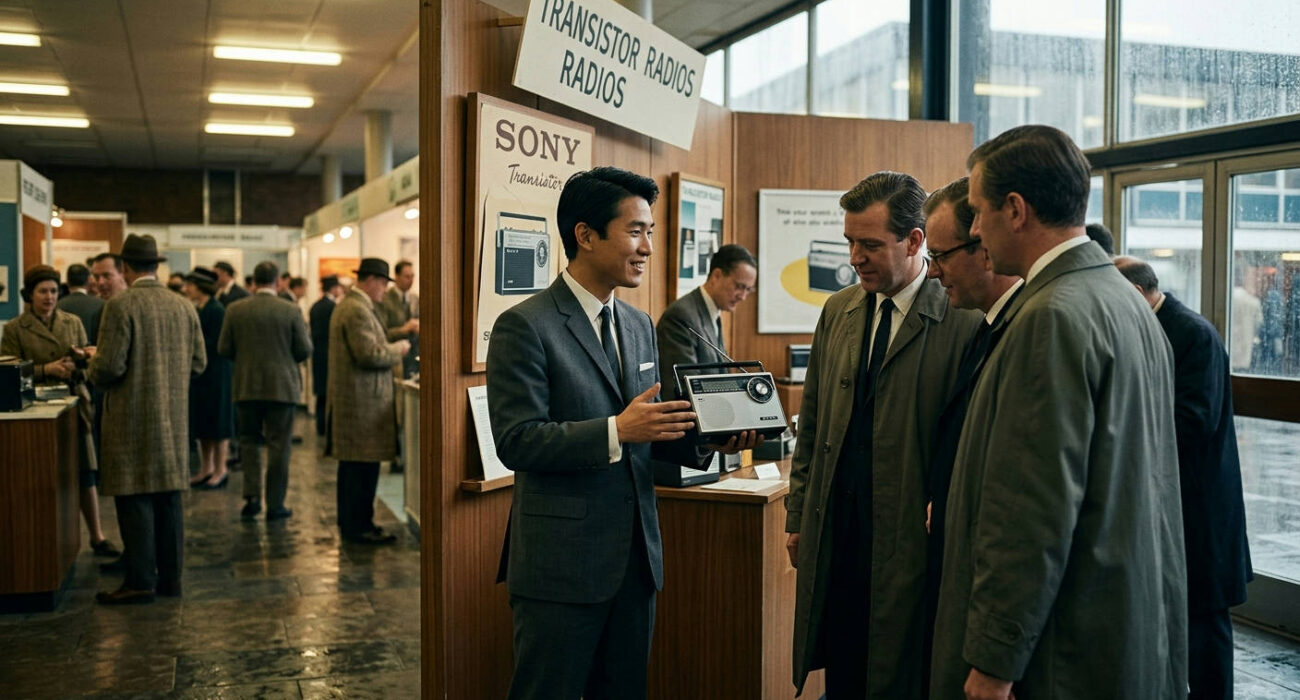
The single product that truly unlocked the world for Sony was the transistor radio. In 1954, TTK obtained a license from Bell Labs to use their ground breaking transistor technology. While other companies, including major American firms, saw transistors merely as a way to improve existing, large radios, Ibuka and Morita saw something different: the potential for radical miniaturization.
They weren’t just trying to make a better radio; they were trying to create an entirely new category—a personal, portable radio that could fit in a pocket. This shift in thinking was the key to their success and a hallmark of Sony’s strategy for decades to come.
Miniaturization as a Weapon: The TR-55
In 1955, Sony launched the TR-55, Japan’s first transistor radio. It was a sensation. While still a bit chunky for a shirt pocket, it was a massive leap forward in portability. It was followed by the even smaller TR-63 in 1957, which was aggressively marketed in the United States.
“Our plan is to lead the public with new products rather than ask them what kind of products they want. The public does not know what is possible, but we do.” – Akio Morita
This quote perfectly captures the Sony philosophy. They didn’t conduct market research to see if people wanted a tiny radio. They built one and then created the desire for it. This product-led approach, driven by engineering, became their global calling card.
Overcoming the “Made in Japan” Stigma
In the 1950s, the “Made in Japan” label was synonymous with cheap, low-quality knockoffs. Morita knew that to succeed in America, Sony had to shatter this perception. He insisted on impeccable quality control and innovative design.
An early story illustrates his resolve. An American buyer, Bulova, placed a huge order for 100,000 transistor radios but insisted on selling them under the Bulova brand name. It would have been an instant financial windfall for the small company. Morita refused. He understood that building the Sony brand was more important than any single order. It was a long-term play, and it paid off magnificently.
Akio Morita’s American Gamble: Moving to New York
To truly understand the American market, Akio Morita did something unheard of for a Japanese executive at the time: he moved his entire family to New York City in 1963. He immersed himself in American culture, observing how people lived, worked, and consumed media.
This firsthand experience was invaluable. It gave him insights that no market research report ever could. He learned that Americans valued convenience, style, and individuality. This knowledge directly influenced the design and marketing of future Sony products, ensuring they were tailored not just for their technical specifications but for the lifestyle of the target consumer. His journey is detailed in his autobiography, a fascinating read for any entrepreneur. You can find it and other books about Sony’s history on Amazon: Made in Japan: Akio Morita and Sony on Amazon.
## How Sony Corporation Started Its Global Expansion Through Branding
Sony’s international success wasn’t just about clever engineering; it was a triumph of branding. From the very beginning, Morita understood that he wasn’t just selling electronics. He was selling a concept, an identity, and a promise of quality and innovation.
The decision to reject the Bulova order was the first major step. Sony was going to be a global brand on its own terms. This focus on brand equity, built over decades, is a core element in understanding how Sony Corporation started its global expansion.
Building a Global Brand, Not Just Selling Products
Sony’s approach was holistic. Every product, every advertisement, and every piece of packaging was designed to reinforce the core brand values. They focused on creating an emotional connection with consumers. A Sony product wasn’t just a gadget; it was a piece of the future, a tool for a more enjoyable life.
This was a radical departure from the typical manufacturing mindset of the era, which was focused on specs and price points. Sony sold an experience, and the brand was the vessel for that experience.
The Four-Letter Logo: Simplicity and Global Recognition
The Sony logo itself is a lesson in brilliant branding. It’s clean, simple, and timeless. Designed in 1957, it has remained largely unchanged, a testament to its effectiveness. The simplicity of the four-letter word, rendered in a distinctive typeface, made it instantly recognizable in any country and any language.
This visual consistency was crucial. Whether a customer was in London, New York, or Tokyo, the Sony logo meant the same thing: cutting-edge technology and superior quality. This created a powerful and unified global brand identity long before many other companies even thought in those terms.
Consistency in Marketing: The Sony Style
Sony’s advertising campaigns were as innovative as its products. They were often minimalist, focusing on the product’s design and a single, powerful benefit. They created a “Sony Style” that was sophisticated, modern, and aspirational.
They didn’t just show you the features of a television; they showed you how that television would transform your living room and your viewing experience. They didn’t just list the specs of a radio; they showed you a teenager enjoying music on the beach. This lifestyle-oriented marketing was key to their success in Western markets.
The Walkman Revolution: Creating a Global Category
If the transistor radio opened the door to the world for Sony, the Walkman kicked it off its hinges. Introduced in 1979, the TPS-L2 Walkman was not an invention in the traditional sense. It combined existing technologies—a compact cassette player and lightweight headphones. Its genius was in the concept: high-quality, personal, portable stereo sound.
At the time, many within Sony were skeptical. Why would anyone want a tape player that couldn’t record? But Akio Morita, drawing on his observations of American youth, championed the project. He saw a desire for people to create a personal “soundtrack” for their lives. He was right.
The Birth of Personal, Portable Audio
The Walkman was a cultural phenomenon. It fundamentally changed how people listened to music, transforming it from a stationary, shared experience into a mobile, individual one. Suddenly, you could listen to your favourite tapes while jogging, commuting on the train, or studying in the library.

It empowered the individual and tapped directly into the zeitgeist of the late 20th century. For an entire generation, the Walkman was an essential accessory, a symbol of freedom and personal expression. This creation of a new market from scratch is a prime example of Sony’s innovative spirit.
Not Just a Product, A Lifestyle: Marketing the Walkman
Sony’s marketing for the Walkman was brilliant. They focused entirely on the lifestyle it enabled. Early ads featured young, active people enjoying music on the go. The name “Walkman” itself was a stroke of genius, perfectly encapsulating the product’s purpose.
They seeded the product with celebrities and musicians, creating a powerful aspirational appeal. They understood that the Walkman wasn’t just about listening to music; it was about being seen listening to music. It became a fashion statement as much as a piece of technology.
How the Walkman Paved the Way for Future Innovations
The success of the Walkman solidified Sony’s reputation as a world-class innovator and trendsetter. It created a direct lineage of personal audio devices, from the Discman in 1984 to the MiniDisc and eventually their digital music players. The Walkman’s legacy is immense; it created the consumer behavior that would later be capitalized on by the iPod and the entire smartphone industry.
It also demonstrated the power of creating a complete user experience. The Walkman experience wasn’t just the device; it was the iconic lightweight headphones, the satisfying click of the cassette door, and the freedom it provided. This deep understanding of user experience is something every aspiring tech entrepreneur studies today, and it’s a field that continues to evolve with devices like modern best dj controllers for beginners, which carry the torch of personal music control.
Strategic Acquisitions and Diversification: Beyond Electronics
By the 1980s, Sony was a global electronics powerhouse. But Morita and his successors understood that to secure long-term growth, they couldn’t just be a hardware company. They needed to control the “software”—the music, movies, and games that people would consume on their Sony devices.
This led to a series of massive, high-stakes acquisitions that would dramatically reshape the company and the entertainment world. It was a strategy of vertical integration, aiming to create a symbiotic relationship between Sony’s hardware and a vast library of content.
The CBS Records Coup: Entering the Music Business
In 1988, Sony made a stunning move by acquiring CBS Records for $2 billion. At the time, it was the largest-ever acquisition of a foreign company by a Japanese firm. It was a massive gamble that many analysts questioned.
The acquisition instantly made Sony a major player in the global music industry. They now owned the catalogues of legendary artists like Michael Jackson, Bob Dylan, and Bruce Springsteen. This move was about synergy. Sony could now promote its artists on its Walkman and Discman players and leverage its hardware innovations (like the CD, which they co-developed) to sell more music. It was a bold move that created the foundation for what is now Sony Music Entertainment, home to countless iconic artists like the legendary The Best Of Jimi Hendrix.
Buying Hollywood: The Columbia Pictures Acquisition
Not content with conquering music, Sony set its sights on Hollywood. In 1989, they acquired Columbia Pictures Entertainment for $3.4 billion, an even bigger and more controversial deal. This gave them a major film studio, a television production company, and a vast library of classic movies.
The integration was initially rocky, with cultural clashes and massive financial losses. But in the long run, the strategy proved sound. Owning a film studio gave Sony a critical advantage in promoting new hardware formats like DVD, Blu-ray, and 4K televisions. They had the content to drive adoption of their new technologies.
The PlayStation: A New Frontier in Home Entertainment
Perhaps Sony’s most successful diversification was its entry into the video game market. In 1994, Sony Computer Entertainment launched the PlayStation. It was a direct challenge to industry giants Nintendo and Sega.
The PlayStation was a massive success, thanks to its powerful 3D graphics, its use of the CD-ROM format (which allowed for more complex games and lower costs), and its savvy marketing that targeted a more mature audience than its rivals. This move wasn’t just about creating a new product; it was about establishing an entirely new and hugely profitable division within the Sony empire, turning them into a leader in interactive entertainment for decades to come.
Lessons from Sony’s Playbook for Today’s Innovators (2026)
The story of Sony’s rise is more than just corporate history; it’s a source of powerful, timeless lessons that are still incredibly relevant in 2026. For any business, artist, or entrepreneur looking to make an impact, the Sony playbook offers a clear guide to success.
The core principles that drove their initial success—innovation, branding, and a global mindset—are the same principles that drive successful ventures today. The technology changes, but the fundamentals of how to build something meaningful and lasting do not.
### The Core Principles Behind How Sony Corporation Started Its Global Expansion
At its heart, the strategy was simple but difficult to execute. It rested on three pillars:
- Radical Innovation: Don’t just improve existing products; create entirely new categories. The transistor radio and the Walkman weren’t just better versions of what came before; they were new ways of experiencing the world.
- Brand Supremacy: Your name is your most valuable asset. Morita’s refusal to let Bulova rebrand his radios was a defining moment. He chose long-term brand equity over short-term profit.
- A Truly Global Vision: From the name change to Morita moving to New York, Sony was built from day one to be an international company. They didn’t see borders; they saw markets and people.
“The company’s success is founded on its spirit of challenge… to do what others are not doing.” – Masaru Ibuka, Sony Co-founder
This quote, from the company’s earliest days, remains its guiding ethos. It’s a reminder that true growth comes from charting your own course, not following the pack. For a detailed history of the transistor that started it all, the Public Broadcasting Service provides an excellent timeline.
The “Glocalization” Strategy: Think Global, Act Local
One of Sony’s most effective strategies was what later became known as “glocalization.” They maintained a strong, consistent global brand (the “global” part), but they tailored their marketing, product features, and business operations to the specific needs of local markets (the “local” part).
Morita’s time in America was the ultimate example of this. By understanding the local culture, he could sell his Japanese technology more effectively. This blend of a unified global identity with nuanced local execution allowed them to penetrate diverse markets without diluting their core brand.
The Unrelenting Pursuit of Quality and Innovation
Sony’s mission to overcome the negative “Made in Japan” stereotype forced them into a culture of excellence. Their products had to be better designed, better built, and more reliable than the American competition. This obsession with quality became a key brand differentiator.
This commitment to relentless improvement is a critical lesson. In a crowded marketplace, quality and innovation are the only sustainable advantages. Consumers can forgive a high price, but they will not forgive a poor experience. Sony built its empire on the promise of a superior experience, and it delivered.
The Legacy of Sony’s Early Expansion Strategy
The impact of Sony’s initial global push cannot be overstated. They didn’t just build a successful company; they helped redefine Japan’s role in the global economy and fundamentally changed the way we all interact with technology and entertainment.
Their early decisions created a ripple effect that is still being felt today, from the smartphone in your pocket to the movie you streamed last night. The foundations laid by Ibuka and Morita proved to be incredibly strong and adaptable.
Shaping Consumer Electronics for Generations
Sony’s focus on miniaturization, design, and user experience set the standard for the entire consumer electronics industry. Competitors were forced to follow their lead. The expectation that technology should be personal, portable, and beautifully designed is a direct result of the trail Sony blazed.
From the Trinitron television, which offered unparalleled picture quality for its time, to the Walkman, Sony consistently pushed the boundaries of what was possible. They created desires and then fulfilled them, a cycle that kept them at the forefront of the industry for decades.
From Audio Hardware to a Content Empire
The bold moves into music and movies in the late 1980s were transformative. They set the stage for the modern media conglomerate, where hardware and software are deeply intertwined. Today, it’s impossible to imagine Sony without PlayStation, Sony Music, or Sony Pictures.
This diversification was a masterstroke of long-term strategic thinking. It ensured the company’s relevance even as the consumer electronics market became more commoditized. They were no longer just selling the devices; they were selling the entire entertainment experience.
What’s Next for Sony in the 2020s and Beyond?
As we look at Sony in 2026, the company continues to evolve, facing new challenges in streaming, gaming, and artificial intelligence. However, the core DNA established during its initial global expansion remains. The spirit of innovation lives on in their cutting-edge camera sensors, the PlayStation 6, and their ventures into electric vehicles with Honda.
The story of how Sony Corporation started its global expansion is ultimately a story of human ingenuity. It’s about how two determined individuals in a war-torn country built an empire on the power of an idea: that technology could be used to bring joy, entertainment, and connection to people all over the world. That original vision is what continues to drive the company forward, and it’s a legacy that will continue to inspire for generations to come.