
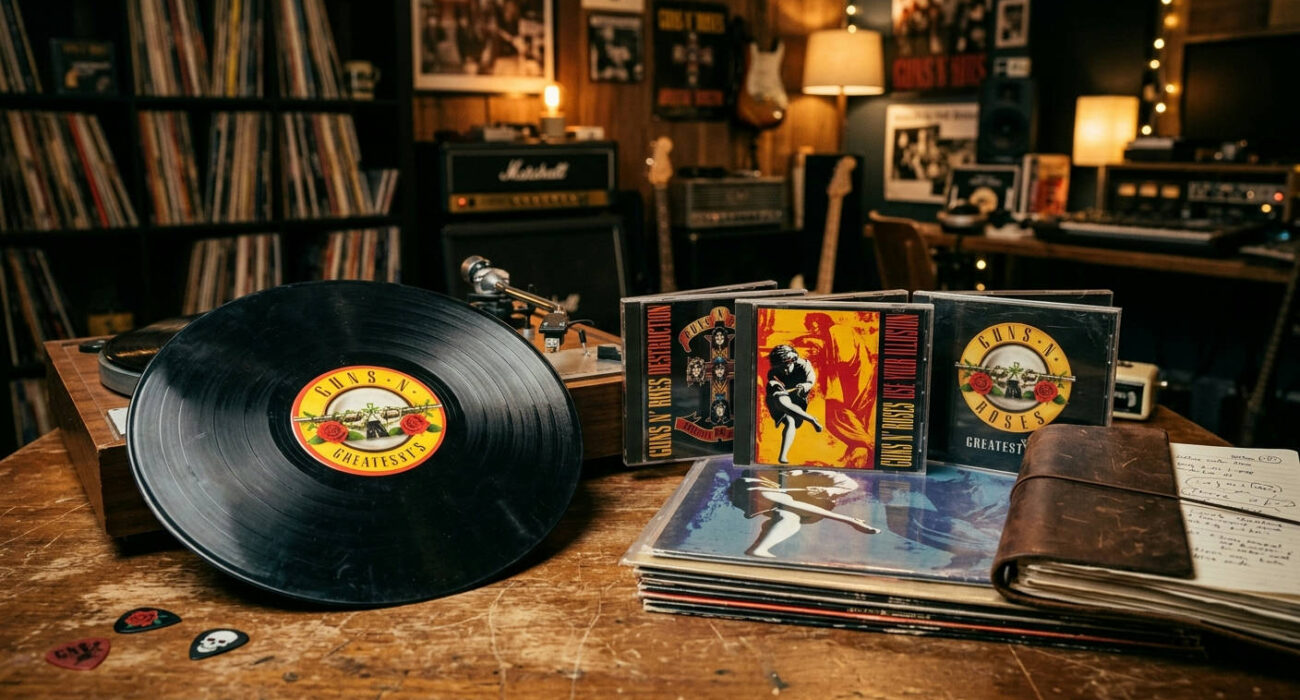
Let’s be brutally honest. When you search for the Guns N’ Roses greatest hits album track list, you’re looking at a collection of songs the band themselves never wanted you to hear in this format. Released in 2004 against the furious objections of Axl Rose, Slash, and Duff McKagan, Greatest Hits is a raw, unapologetic cash grab by a record label that had grown tired of waiting for the mythical Chinese Democracy. Yet, despite its controversial birth, it became a monster. It’s the ultimate paradox: a soulless compilation that became an essential gateway for millions of new fans, and a persistent chart monster that simply refuses to die.
Here at Vinyl Gold UK, we don’t just sell records; we live the stories behind them. This isn’t just a list of songs. It’s a story of rebellion, corporate greed, and timeless rock and roll that, against all odds, still kicks you right in the teeth. So, let’s dissect this beast, track by track, and figure out why an album born from a lawsuit became one of the most successful compilations of all time.
The Album The Band Despised: A Backstory of Betrayal
To understand the Greatest Hits album, you first need to understand the chaos of Guns N’ Roses in the early 2000s. The classic lineup had long since imploded, and Axl Rose was deep in the trenches, meticulously crafting the long-delayed Chinese Democracy. Geffen Records, the band’s label, was sitting on a goldmine of a back catalogue but had no new product to sell.
Patience wore thin. The label decided to move forward with a compilation album to generate revenue. This wasn’t a collaborative effort celebrated by the band; it was a unilateral corporate decision.
The Lawsuit and the Inevitable Release
Axl Rose, joined by his former bandmates Slash and Duff McKagan in a rare moment of unity, filed a lawsuit to block the album’s release. They argued it was a subpar collection, assembled without their creative input, and would damage the band’s legacy. They felt the track selection and even the album art were uninspired.
They lost. The court sided with Geffen, and Greatest Hits hit the shelves in March 2004. The band’s public statements were scathing, urging fans to boycott the release. The fans, however, did the exact opposite. The album debuted at number 3 on the Billboard 200 and has remained a fixture on charts around the world ever since, proving that sometimes, convenience and killer tunes trump artistic intent.
A Gateway Drug for a New Generation
The irony is that the band’s attempt to protect their legacy may have inadvertently supercharged it. For a whole new generation of kids in the 2000s and beyond, Greatest Hits was their first exposure to Guns N’ Roses. It was an easily digestible package of their most radio-friendly anthems, a perfect starting point before diving into the grittier, deeper cuts of Appetite for Destruction or the sprawling epics of Use Your Illusion.
It became the de facto introduction to GNR, a role it continues to play in the streaming and vinyl revival era of 2026.
The Official Guns N’ Roses Greatest Hits Album Tracklist Deconstructed
So what exactly is on this contentious album? The 14 tracks are a tour through the band’s imperial phase, from the raw energy of their debut to the polished bombast of their stadium-filling peak. It’s a collection that prioritises anthems over artistry, but what anthems they are.
Hits from Appetite for Destruction (1987)
The album wisely kicks off with the holy trinity from the single greatest debut album in rock history. These tracks are the foundation of the GNR legend.
-
Welcome to the Jungle: The opening siren is iconic. This isn’t just a song; it’s a mission statement. A brutal, menacing depiction of L.A.’s seedy underbelly, it set the tone for a band that was genuinely dangerous. It wasn’t an immediate smash but grew into their signature anthem through relentless touring and MTV exposure.
-
Sweet Child o’ Mine: The song that made them superstars. Born from a Slash warm-up exercise he initially dismissed as “circus music,” it became the band’s only US number-one single. Axl’s heartfelt lyrics about his then-girlfriend Erin Everly, combined with one of the most recognisable guitar riffs ever written, created a perfect storm of hard rock and raw emotion.
-
Paradise City: The ultimate GNR concert closer. It’s a song of two halves: a dreamy, hopeful verse dreaming of a pastoral home, and a thundering, double-time chorus that brings the house down every single time. The whistle and stadium-sized chorus make it pure, uncut rock and roll euphoria.
The G N’ R Lies (1988) Contribution
Only one track makes the cut from this half-live, half-acoustic EP, but it’s a crucial one that showcased a different side of the band.
- Patience: Stripped-down and acoustic, “Patience” proved GNR was more than just noise and sleaze. Axl’s whistled melody and vulnerable lyrics about a troubled relationship connected on a massive scale. It demonstrated their incredible versatility and gave them another massive top-10 hit, cementing their status as the biggest band in the world.
The Use Your Illusion I & II (1991) Era
This is where the compilation pulls the heaviest, showcasing the ambitious, sprawling, and sometimes bloated brilliance of their twin epic albums.

-
Don’t Cry: A perfect example of the band’s new, more mature and grandiose sound. Famously, two versions of the song were released (one on Illusion I with the original lyrics, and another on Illusion II with alternate lyrics), but the compilation rightly sticks to the original. It’s a power ballad of immense scale and sorrow.
-
Live and Let Die: Their explosive cover of the Paul McCartney and Wings classic became a staple of their live show. GNR took the Bond theme’s theatricality and injected it with pure adrenaline, making it entirely their own. It was a brilliant choice that showed their respect for rock history while simultaneously blowing it up.
-
November Rain: The magnum opus. A nearly nine-minute-long rock-orchestral epic complete with a legendary music video that cost over $1.5 million to make in 1992. It’s Axl Rose at his most ambitious, a soaring, tragic ballad that defined the term “epic” for a generation. It’s unthinkable to have a GNR hits collection without it.
-
Yesterdays: A more reflective, melancholic track from Use Your Illusion II. It’s a wistful look back at lost innocence, showcasing a more subdued side of Axl’s songwriting. While not as massive as “November Rain,” it was a significant radio hit and adds a touch of emotional depth to the track list.
-
Civil War: A sprawling, seven-and-a-half-minute anti-war protest song that kicks off Use Your Illusion II. It’s a powerful, politically charged statement that proved the band had more on their minds than just girls and booze. Starting with a sample from the film Cool Hand Luke, it’s one of their most complex and lyrically dense tracks.
-
You Could Be Mine: The theme song from Terminator 2: Judgment Day, one of the biggest films of 1991. This cross-promotion launched the Illusion era into the stratosphere. It’s a snarling, high-octane rocker that perfectly captures the band’s late-80s energy while hinting at the bigger production of their 90s work.
-
Knockin’ on Heaven’s Door: Another masterful cover, this time of a Bob Dylan classic. GNR transformed the folk standard into a stadium-sized rock anthem. Axl’s impassioned vocals and Slash’s soaring guitar solos made this version definitive for many, and it remains a poignant highlight of their live shows.
The Covers: “The Spaghetti Incident?” (1993) and Beyond
The compilation rounds itself out with two covers, one from their punk-inspired album and a later, more controversial choice.
-
Ain’t It Fun: A cover of a 1970s proto-punk track by Dead Boys. It’s a sneering, cynical song, and GNR’s version, featuring a duet between Axl and Michael Monroe of Hanoi Rocks, is dripping with attitude. It represents the band’s punk rock roots and rebellious spirit.
-
Sympathy for the Devil: The final track is their cover of The Rolling Stones’ masterpiece, recorded for the 1994 film Interview with the Vampire. This recording is infamous as it was the last to feature Slash and Duff McKagan before they left the band. It’s a slick, industrial-tinged version that hints at the sonic direction Axl would later explore, and its inclusion is a contentious but historically significant bookend.
What’s Missing? The Glaring Omissions That Drive Fans Crazy
For every classic included on the Guns N’ Roses greatest hits album track list, there’s a fan favourite that was criminally ignored. This is where the band’s lack of involvement is most obvious. A true GNR fan knows the compilation is incomplete, and these omissions are a huge part of the album’s controversial story.
“A greatest hits album should be a celebration of a band’s legacy, curated by the artists themselves. When it’s assembled by a committee in a boardroom, you get a product, not a testament.”
The Unforgivable Absence of “Estranged”
This is, without a doubt, the single biggest crime of the Greatest Hits track list. “Estranged” is the third part of the unofficial ballad trilogy with “Don’t Cry” and “November Rain.” It’s a sprawling, nine-minute epic of heartbreak and isolation, featuring some of Slash’s most emotive and breath taking guitar work.
Its exclusion is baffling. The song is a fan-favourite and a critical darling, representing the pinnacle of the band’s ambitious Illusion era. Leaving it off feels less like an oversight and more like a deliberate insult to the band’s artistic peak.
Where in the Hell is “Nightrain”?
How do you leave the ultimate party anthem off a greatest hits album? “Nightrain” is the sound of five guys running on cheap wine and pure rock and roll ambition. It’s a freight train of a song, a tribute to their lives in the grimy clubs of Hollywood before they made it big.
The riff is pure fire, the groove is undeniable, and the energy is infectious. It’s a staple of their live show for a reason. For many hardcore fans, a GNR hits collection without “Nightrain” is simply not a GNR hits collection.
### H3: Other Crucial Absences from the Guns N’ Roses greatest hits album track list
The list of missing gems doesn’t stop there. The album feels sanitised, favouring ballads and stadium rock over the raw, street-level sleaze that defined their early sound.
- Mr. Brownstone: A funky, swaggering track about the horrors of heroin addiction. It’s a crucial part of the Appetite story and features one of the band’s grooviest riffs.
- It’s So Easy: The first GNR song ever released. It’s punk rock nihilism at its finest, a snarling, aggressive track that captures their early danger.
- Rocket Queen: The epic closer to Appetite for Destruction. A song of two distinct halves, it’s a masterpiece of arrangement and raw emotion that showcases the band’s full dynamic range.
- Used to Love Her: A tongue-in-cheek, acoustic slice of black humour from G N’ R Lies. While controversial, it’s a fan favourite that shows their irreverent side.
A Commercial Juggernaut Against All Odds

Despite the band’s hatred for it and the fans’ complaints about the tracklist, the album has sold in staggering numbers. Its success is a testament to the sheer power and timelessness of the songs.
As of 2026, the Greatest Hits album has spent over 700 weeks on the Billboard 200 chart in the US, an incredible feat of longevity. It is certified Diamond by the RIAA, meaning it has sold over 10 million copies in the United States alone. Globally, its sales are estimated to be well over 25 million.
This compilation has become a perennial seller, a go-to purchase for casual fans and a constant presence in retail stores and online marketplaces. It thrives because it delivers exactly what it promises: a concise collection of the band’s most recognisable songs. It’s the musical equivalent of a blockbuster movie – maybe not high art, but undeniably effective and entertaining.
Vinyl vs. Digital: The Best Way to Hear the Hits
In an age of streaming, why bother with a physical copy of Greatest Hits? For us at Vinyl Gold UK, the answer is obvious. The experience of listening to these rock anthems on a proper turntable is simply unmatched.
The album was released on a double LP, giving the music room to breathe. The mastering for vinyl often brings out a warmth and dynamic range that can get lost in digital compression. There’s a ritual to it: sliding the record from its sleeve, dropping the needle, and immersing yourself in the artwork and liner notes.
Why the Greatest Hits Vinyl is a Must-Own
For new vinyl collectors, this album is a perfect entry point. It’s packed with familiar songs and sounds absolutely massive on a decent sound system. The track sequencing, while debatable, flows well across four sides of vinyl, creating a powerful listening journey.
If you’re just getting into the world of vinyl, you need a reliable deck to do these classics justice. Don’t settle for a cheap suitcase player that will chew up your records. To get started without breaking the bank, take a look at our expert guide on the best turntables under £300 in the UK. A solid setup makes all the difference.
You can grab your own copy of the Greatest Hits on vinyl and hear the difference for yourself. Check for it here on Amazon and add this controversial classic to your collection.
Beyond the Official Release: Crafting Your Own Ultimate Guns N’ Roses Greatest Hits Album Track list
The best thing about the official compilation’s flaws is that it inspires debate. It makes you ask: what would my perfect GNR hits album look like? Building your own playlist is the ultimate way to engage with the band’s catalogue.
“Music is personal. A corporate playlist can never capture the songs that defined your life. The real ‘greatest hits’ are the ones you choose yourself.”
The Vinyl Gold UK “Appetite for More” Playlist
If we were in charge, our track list would be a bit grittier, a bit more epic, and a lot more representative of the band’s true spirit. Here’s a 16-track monster compilation that fixes the original’s mistakes.
Side A:
- Welcome to the Jungle
- It’s So Easy
- Nightrain
- Mr. Brownstone
Side B:
5. Paradise City
6. Patience
7. Used to Love Her
8. Civil War
Side C:
9. You Could Be Mine
10. Don’t Cry (Original)
11. November Rain
12. Sweet Child o’ Mine
Side D:
13. Estranged
14. Knockin’ on Heaven’s Door
15. Yesterdays
16. Rocket Queen
This version restores the Appetite-era sleaze, includes the unforgivable omission of “Estranged,” and still delivers all the massive, stadium-sized moments. It tells a more complete story of the band’s evolution from street punks to global rock gods.
The 2026 Perspective: Is a New, Band-Approved Compilation Overdue?
With Axl, Slash, and Duff back together and touring for nearly a decade now, the question lingers: will we ever get a career-spanning compilation that the band actually endorses? The GNR of 2026 is a different entity than the fractured group of 2004.
A new collection could right the wrongs of the past. It could include “Estranged” and “Nightrain.” It could also incorporate material from the much-maligned but retrospectively appreciated Chinese Democracy, like the brilliant title track or “Better.”
It could even feature the new songs they’ve released since the reunion, such as “Absurd” and “Hard Skool,” bringing the GNR story fully up to date. As Wikipedia documents, their catalogue is now richer and more varied than ever. A band-curated “Anthology” or “Legacy” edition, released with their blessing and creative input, would be an instant collector’s item and the definitive statement on their career.
For now, the 2004 Greatest Hits remains the only official compilation. It’s a flawed, controversial, and commercially-driven product. But it’s also a testament to a collection of songs so powerful they can overcome any backstage drama. It’s the album the band hated and the world bought anyway, and its story is as rock and roll as the music itself.