
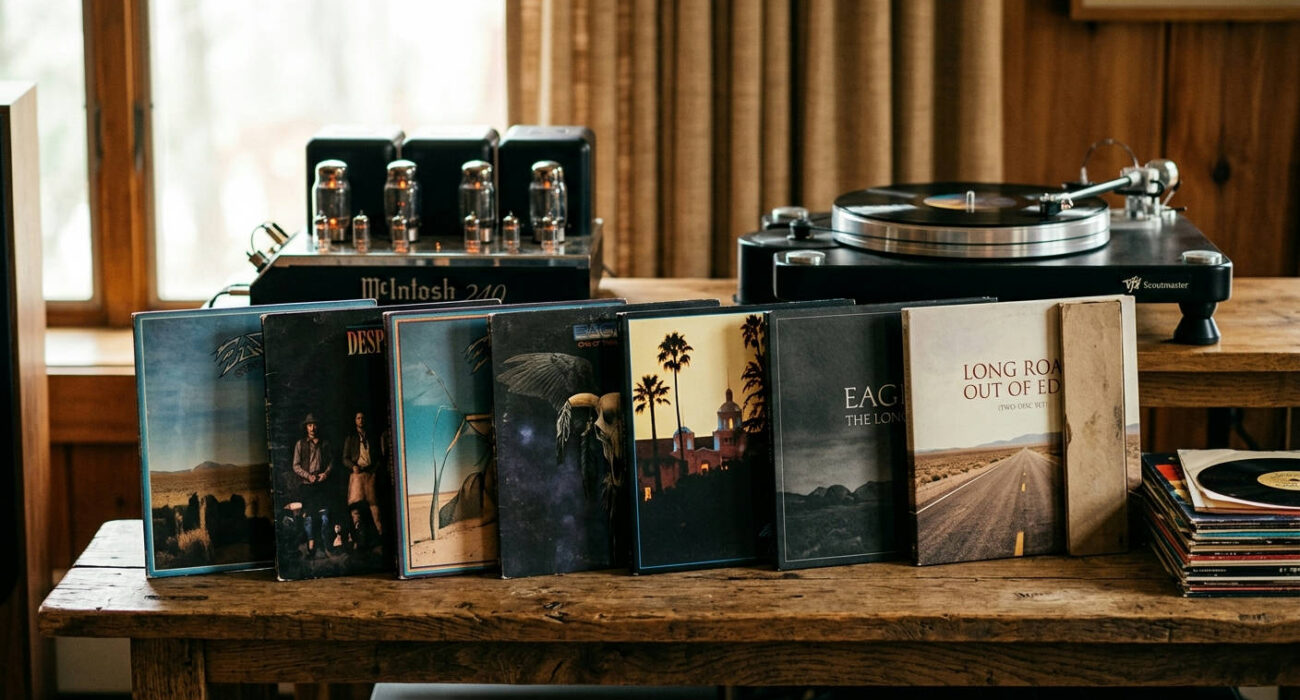
Forget the endless scrolling and confusing forum threads. You’re here for the definitive, no-nonsense Eagles studio albums list, and that’s exactly what you’re going to get. This isn’t just a simple rundown; it’s a deep dive into the records that defined a generation and created the soundtrack for sun-drenched California highways and late-night introspection. At Vinyl Gold UK, we live and breathe this stuff, and we’re here to guide you through the entire studio discography of one of the biggest bands to ever grace a stage.
From their early country-rock leanings to the stadium-sized anthems that cemented their legacy, the Eagles crafted a near-perfect run of albums. We’ll break down each one, exploring the stories behind the music, the line-up changes that shifted their sound, and what makes each vinyl pressing a must-have for any serious collector in 2026.
The Foundation: From Backing Band to Headliners
Before the platinum records and sold-out world tours, the Eagles were just four incredibly talented musicians looking for a break. Their origin story isn’t one of overnight success, but a calculated assembly of talent that was destined for greatness.
The Linda Ronstadt Connection
It all started with Linda Ronstadt. In 1971, she needed a backing band for her upcoming tour. Her manager, John Boylan, recruited a young drummer named Don Henley and a guitarist, Glenn Frey. They soon added bassist Randy Meisner and multi-instrumentalist Bernie Leadon to the line-up.
The chemistry was immediate and undeniable. During that tour, the four musicians realised they had something special. Their harmonies were seamless, their song writing ambitions aligned, and the sound they created behind Ronstadt felt bigger than just a supporting role. With Ronstadt’s blessing, they broke away to form their own band. The Eagles were born.
Forging the California Sound
From the outset, their sound was a potent cocktail. Leadon brought a deep knowledge of country and bluegrass, Meisner provided soaring high harmonies and melodic basslines, while the partnership of Henley and Frey became the band’s creative engine.
They captured the essence of early 70s Southern California—a blend of folk-rock introspection, country twang, and a burgeoning rock and roll swagger. They weren’t just playing music; they were crafting a narrative about freedom, disillusionment, and the American dream as seen from the West Coast.
The Complete Eagles Studio Albums List: A Chronological Deep Dive
Here it is. The core collection, the seven studio albums that tell the story of the Eagles. Each record is a snapshot of a band in evolution, grappling with fame, fortune, and the friction that ultimately fuels great art.
Eagles (1972): The Arrival
Their self-titled debut was a declaration of intent. Recorded in London with producer Glyn Johns, the album was an instant success, establishing the band’s signature sound. It was smooth, immaculately produced, and filled with radio-ready hits.
The opening track, “Take It Easy,” co-written by Frey and his friend Jackson Browne, became an anthem. But the album was more than just one hit. “Witchy Woman” showcased Henley’s darker, more rhythmic sensibilities, while “Peaceful Easy Feeling” perfectly encapsulated the laid-back vibe they were selling. This record put country-rock on the mainstream map.
For vinyl collectors, an original Asylum Records pressing is a fantastic find. Look for the “clouds” label. If you’re buying new, the 2024 and 2025 180-gram reissues sound absolutely pristine. You can start your hunt for a copy on Amazon.
Desperado (1973): The Concept
For their second act, the band took a bold creative risk. Desperado was a concept album, using the story of the Doolin-Dalton gang of outlaws as a metaphor for the life of a rock band. It was darker, more ambitious, and less commercially immediate than their debut.
While it didn’t produce the same chart-topping singles, it’s a fan favourite for its thematic cohesion and stunning song writing. The title track and “Tequila Sunrise” are stone-cold classics, showcasing the growing sophistication of the Henley-Frey partnership. The album hangs together as a complete artistic statement, meant to be listened to from start to finish.
Its initial sales were modest, but its reputation has grown immensely over the decades. It proved the Eagles were more than just a hit-making machine; they were serious artists.

On the Border (1974): Finding the Edge
The band felt Glyn Johns’ production was becoming too polished, too “country.” They wanted more bite. After a partial start in London, they decamped to Los Angeles and brought in producer Bill Szymczyk and a session guitarist named Don Felder. The change was seismic.
Felder’s blistering slide guitar on “Already Gone” announced a new, rock-oriented direction. The album still had its gentler moments, like the hit “Best of My Love,” but the overall tone was tougher. The title track was a straight-ahead rocker, and Felder was soon asked to join the band as a full-time member, expanding their sound to a five-piece. This was the turning point where the Eagles started their journey towards becoming stadium rock gods.
The Stratosphere: Mid-70s Superstardom
This is the era that transformed the Eagles from a successful band into a global phenomenon. The next three albums represent one of the most commercially and creatively successful runs in music history.
One of These Nights (1975): The Global Breakthrough
This was the album where it all came together. The rock, the pop, the country, and a newfound R&B and soul influence coalesced into a blockbuster record. It was their first album to hit number one, and it stayed there for five weeks.
The title track, with its disco-inflected bassline and searing Felder guitar solo, was a masterpiece. “Lyin’ Eyes” won a Grammy and became a country-rock standard. And Randy Meisner’s breath-taking vocal performance on “Take It to the Limit” gave the band an epic ballad to close out their shows.
The album’s massive success, however, marked the end of an era. Bernie Leadon, the band’s country traditionalist, grew uncomfortable with the heavier rock direction and departed soon after the tour. His exit was a clear sign: the Eagles were no longer a country-rock band. They were simply a rock band, and one of the biggest in the world.
“We weren’t country-rock. We were a rock band that played ballads and some songs with a country feel. But we were a rock-and-roll band.” – Glenn Frey
Hotel California (1976): The Apex Predator
How do you follow up a number-one album? You create one of the most iconic, mysterious, and monumental albums of all time. With Bernie Leadon out, the band recruited a fire-breathing guitarist with a maverick reputation: Joe Walsh. His impact was immediate and transformative.
Hotel California is a dark, cynical examination of the American dream, excess, and the emptiness of fame, all set against a Southern California backdrop. The title track is a cultural touchstone, its allegorical lyrics and legendary duelling guitar solo by Felder and Walsh forever etched into rock history. It’s a six-and-a-half-minute epic that still dominates the airwaves in 2026.
But the album is flawless from top to bottom. “New Kid in Town” explores the fleeting nature of stardom, while “Life in the Fast Lane” is a visceral, cocaine-fuelled rocker built around a classic Walsh riff. It sold over 26 million copies in the U.S. alone, as documented by the Recording Industry Association of America (RIAA), making it a permanent fixture on any “greatest albums” list. It is the band’s magnum opus.
The Long Run (1979): The End of the Road
The pressure to follow Hotel California was immense, and it fractured the band. The Long Run took nearly two years to make, a process plagued by perfectionism, arguments, and burnout. The fun was gone.
Despite the difficult birth, the album is a testament to their professionalism and talent. It’s a polished, slick, and occasionally brilliant record. “Heartache Tonight” is a fun, stomping rocker, “I Can’t Tell You Why” is a beautiful, soulful ballad featuring Timothy B. Schmit (who had replaced a weary Randy Meisner), and the title track is a world-weary reflection on their own journey.
The album was a huge commercial success, but the band was running on fumes. The tensions boiled over, and in 1980, the Eagles disbanded. They wouldn’t record another studio album together for 28 years.

The Unlikely Second Act
For 14 years, the idea of an Eagles reunion was a punchline, famously summed up by Don Henley’s quote that they’d get back together “when hell freezes over.” Then, it did.
The Reunion and a Final Masterwork
In 1994, the Hotel California lin-eup reunited for the aptly named Hell Freezes Over tour and live album. It was a massive success, proving the public’s appetite for their music had never waned. They toured for years, but new studio material seemed unlikely.
Long Road Out of Eden (2007)
Then, in 2007, they shocked the world by releasing Long Road Out of Eden, their first new studio album in 28 years and the final entry on the official Eagles studio albums list.
It was a sprawling, 20-track double album that picked up right where they left off. The sound was unmistakably Eagles, but with a modern sheen and a more mature perspective. Tracks like “How Long” revisited their country-rock roots, while the title track was a sprawling, ambitious critique of American consumerism and foreign policy.
The album was a statement. It proved they could still write, play, and harmonize at the highest level. It debuted at number one and went 7x Platinum, a stunning achievement in the 21st-century music business. It was a fitting, high-quality final chapter to their studio career.
A Collector’s Guide for Vinyl Enthusiasts
Building a collection of the Eagles studio albums on vinyl is a rewarding journey. The original pressings capture the warmth of the analogue era, but modern remasters offer stunning clarity.
Original Pressings vs. Modern Reissues
Original pressings on the Asylum Records label from the 1970s are the holy grail for many. They have a certain warmth and presence that’s hard to replicate. Look for the “gatefold” covers on albums like Desperado and Hotel California.
However, don’t sleep on the high-quality 180-gram reissues that have become standard in the 2020s. These are often sourced from the original master tapes and pressed on heavy, quiet vinyl. For many, they represent the best of both worlds: vintage sound with modern manufacturing quality.
Your Turntable Makes All the Difference
You can own the best pressings in the world, but they won’t sound right on a cheap, flimsy record player. A quality turntable is essential for getting the most out of your vinyl. You don’t have to break the bank; there are fantastic options available. If you’re looking to upgrade your setup, check out our guide to the best turntables under £300 in the UK. A solid deck will reveal layers in the Eagles’ production you’ve never heard before.
The Ultimate Ranking: The Eagles Studio Albums List from Good to God-Tier
Let the arguments begin. Ranking these albums is a tough task, as even their “weakest” effort is better than most bands’ best. But here at Vinyl Gold UK, we’re not afraid to take a stand.
Our Definitive Ranking of the Eagles Studio Albums List
- Long Road Out of Eden (2007): A brilliant and welcome return, but its sheer length and the 28-year gap keep it from climbing higher. It’s an epilogue, not the main story.
- Eagles (1972): The one that started it all. A fantastic, breezy debut full of classics, but the band was still finding its full potential and rock identity.
- The Long Run (1979): A slick, professional, and successful album made under duress. It has some incredible highs (“I Can’t Tell You Why”) but lacks the cohesive fire of their mid-70s peak.
- Desperado (1973): Their most artistically ambitious and cohesive concept album. It’s a masterful piece of storytelling that gets better with every listen. A true connoisseur’s choice.
- On the Border (1974): The sound of a band kicking the door down. The addition of Don Felder and a harder rock edge set the stage for everything that was to come. It’s the perfect bridge album.
- One of These Nights (1975): The moment they became superstars. A flawless blend of rock, soul, and pop with three massive, iconic singles. It’s polished perfection.
- Hotel California (1976): Was there ever any doubt? It’s not just their best album; it’s one of the greatest albums ever made. A dark, cynical, musically brilliant masterpiece that defines a band and an era. It’s a cultural monument.
“Hotel California was a concept album, but it wasn’t a story. It was a state of mind.” – Don Henley, as told to Rolling Stone
The Enduring Legacy
The story of the Eagles, as told through their seven studio albums, is a story of American music in the 1970s and beyond. They mastered the art of the song, the album, and the performance, creating a body of work that feels both of its time and timeless.
Their influence is everywhere, from modern country artists to alternative rock bands who admire their songcraft and complex harmonies. The Eagles studio albums list isn’t just a discography; it’s a roadmap of artistic evolution and commercial domination. Whether you’re a lifelong fan or a new listener, exploring these records on vinyl is an experience every music lover deserves. So drop the needle and take it easy.