
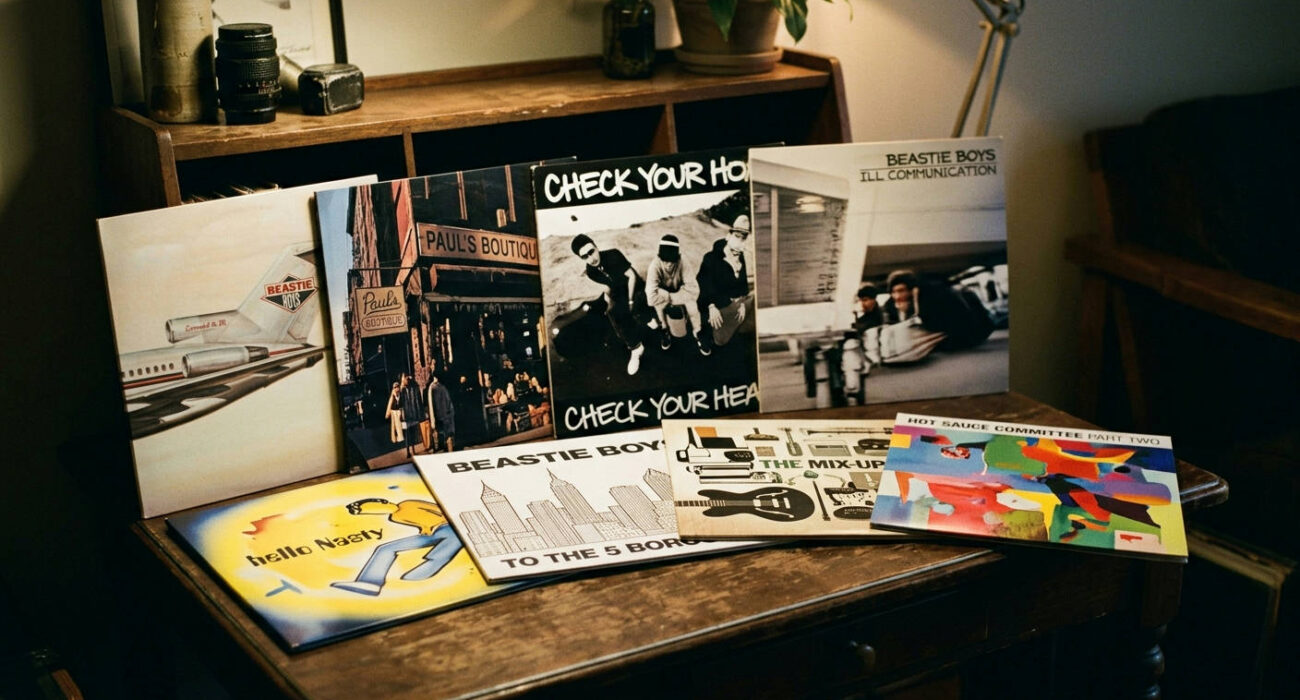
Let’s cut right to the chase. You’re here for a definitive, no-nonsense breakdown of the entire Beastie Boys studio albums discography. This isn’t just a list; it’s a journey through one of music’s most radical evolutions. From snot-nosed punk rockers to hip-hop pioneers, funk instrumentalists, and global icons, the story of Mike D, MCA, and Ad-Rock is etched into the grooves of their eight incredible studio LPs. At Vinyl Gold UK, we live and breathe this stuff, so let’s drop the needle and explore the genius, the chaos, and the outright funk of the Beastie Boys studio albums discography.
This guide will walk you through every single studio release, charting their transformation from one album to the next. We’ll look at the production, the cultural impact, and why these records still sound so vital in 2026.
This guide will walk you through every single studio release in the Beastie Boys studio albums discography, charting their transformation from one album to the next. We’ll look at the production, the cultural impact, and why these records still sound so vital in 2026.
From Hardcore Punks to Hip-Hop Pranksters
Before they were fighting for their right to party, the Beastie Boys were just kids thrashing around in New York’s hardcore punk scene. Understanding this origin is key to appreciating the entire arc of their career. They weren’t outsiders co-opting a genre; they were music fanatics absorbing everything the city threw at them.
The Raw Energy of ‘Polly Wog Stew’
The first official release from the Beastie Boys was the 1982 EP, Polly Wog Stew. This is the group at their most raw and unfiltered. It’s eight tracks of blistering, minute-long hardcore punk that sounds more like Bad Brains or Minor Threat than anything that would come later.
Tracks like “Egg Raid on Mojo” are pure youthful aggression. It’s a historical document, capturing the energy of a band still finding its feet but already brimming with attitude. For collectors, an original pressing is a holy grail, but for most fans, it serves as the wild, chaotic starting point of the Beastie Boys studio albums discography.
As we delve into the Beastie Boys studio albums discography, tracks like “Egg Raid on Mojo” are pure youthful aggression, showcasing their early energy and creativity.
‘Cooky Puss’: The Accidental Hit
Everything changed in 1983 with “Cooky Puss.” The track was built around a prank phone call the band made to a Carvel ice cream shop, laid over a disjointed, funky hip-hop beat. It was weird, it was funny, and it became an underground club hit in New York.
This pivotal moment in their career transformed their path in the Beastie Boys studio albums discography, blending punk rock with hip-hop influences.
This was the pivot. The success of “Cooky Puss” showed them a new path, one that blended their punk rock attitude with the emerging sounds of hip-hop. It was the moment they caught the attention of a young producer named Rick Rubin, and the rest is history.
The Def Jam Years: Anarchy in the USA
Partnering with Rick Rubin and Russell Simmons’ fledgling Def Jam Recordings catapulted the Beastie Boys from downtown curiosities to international superstars. This era was defined by one monstrously successful album that would both make and nearly break them.
The connection to Def Jam shaped the Beastie Boys studio albums discography, propelling them into international fame.
Licensed to Ill (1986): The Hip-Hop Big Bang
Released in late 1986, Licensed to Ill was a cultural atom bomb. It became the first rap album to ever hit #1 on the Billboard 200 chart and, by 2026, has sold well over 10 million copies in the US alone. Produced by Rick Rubin, the album’s sound was a ground-breaking fusion of booming 808 drum machines, heavy metal guitar riffs (courtesy of Slayer’s Kerry King on “No Sleep Till Brooklyn”), and the trio’s obnoxious, nasal flows.
Songs like “(You Gotta) Fight for Your Right (to Party!)” and “Brass Monkey” were inescapable party anthems. But deeper cuts like “Paul Revere,” with its incredible reverse-beat narrative, and “Rhymin & Stealin,” which brazenly samples Led Zeppelin’s “When the Levee Breaks,” showcased a musical ingenuity that went beyond the frat-boy image. It was a masterpiece of youthful rebellion, a perfect snapshot of its time.
This album’s unique sound helped define the essence of the Beastie Boys studio albums discography, showcasing their ability to innovate.
Want to own this piece of history? A quality vinyl pressing is the only way to truly experience Rubin’s earth-shattering production.
- Grab the vinyl of Licensed to Ill on Amazon: https://www.amazon.com/s?k=Beastie+Boys+Licensed+to+Ill+Vinyl&tag=vinylgolduk-21
The Messy Breakup with Def Jam
The success of Licensed to Ill was a double-edged sword. The subsequent tour was notoriously debauched and exhausting, and the band felt they were becoming caricatures of the personas they had created. Worse, they fell out with Def Jam over unpaid royalties, leading to a bitter and public split.
This fallout was critical. It forced them to flee their image, their label, and their sound. They left New York for Los Angeles, creatively broke and looking for a way to start over. This exodus set the stage for one of the most remarkable artistic reinventions in music history.
The Capitol Records Era: Artistic Reinvention and Mastery
After escaping the Def Jam wreckage, the Beastie Boys signed with Capitol Records and embarked on a creative journey that would solidify their legacy as true artists, not just one-hit wonders. This period produced a string of albums that are now considered classics, each one a bold step in a new direction.
This era is significant in the Beastie Boys studio albums discography, marking their evolution into true artists.
Paul’s Boutique (1989): The Sample-Heavy Masterpiece

If Licensed to Ill was a shotgun blast, 1989’s Paul’s Boutique was a psychedelic, multi-layered mosaic. Teaming up with producers The Dust Brothers, the Beasties created an album so dense with samples that it could never be made today due to copyright laws. It was a commercial flop upon release, a shocking turn after the multi-platinum success of its predecessor.
With its complex soundscapes, Paul’s Boutique is a hallmark of the Beastie Boys studio albums discography that is often revisited.
Fans expecting more party anthems were baffled by its complex soundscapes, obscure references, and intricate lyrical wordplay. But over time, Paul’s Boutique has been rightfully re-evaluated as an absolute landmark album. From the funky swagger of “Shake Your Rump” to the epic, 12-minute B-Boy medley “B-Boy Bouillabaisse,” the album is a crate-digger’s dream and a testament to the art of sampling. It’s a work of pure, unadulterated genius.
In a 1999 retrospective, Spin magazine wrote, “Paul’s Boutique was the album that proved hip-hop could be a bona fide art form… a stunning, kaleidoscopic collage of sound and culture that was years ahead of its time.”
Getting a copy on vinyl lets you pore over the legendary gatefold sleeve, spotting all the landmarks on the corner of Ludlow and Rivington.
- Find your vinyl copy of Paul’s Boutique on Amazon: https://www.amazon.com/s?k=Beastie+Boys+Paul%27s+Boutique+Vinyl&tag=vinylgolduk-21
Check Your Head (1992): Back to Their Roots
The return to live instrumentation in Check Your Head marked another pivotal moment in the Beastie Boys studio albums discography.
After the head-spinning complexity of Paul’s Boutique, the band took another sharp turn. For 1992’s Check Your Head, they picked up their instruments again for the first time since their punk days. Mike D was back on the drums, MCA was on the bass, and Ad-Rock was on guitar.
The result was a lo-fi, eclectic mix of live funk jams, hardcore punk blasts, and classic B-Boy rhymes. Recorded in their own G-Son Studios, the album has a raw, basement-vibe energy. Tracks like “So What’cha Want” and “Pass the Mic” became instant classics, proving they could blend live instrumentation with hip-hop seamlessly. It was the blueprint for the sound that would soon make them the biggest band in the world.
Ill Communication (1994): Reaching the Pinnacle
Everything came together on Ill Communication. Released in 1994, it perfected the formula hinted at on Check Your Head and launched the Beastie Boys into the stratosphere of global superstardom. The album debuted at #1, powered by the explosive single “Sabotage” and its iconic, Spike Jonze-directed music video.
The album is a masterclass in diversity. It moves effortlessly from the hard-hitting rhymes of “Sure Shot” to the laid-back jazz-flute groove of “Flute Loop” and the hardcore punk fury of “Tough Guy.” Q-Tip’s feature on “Get It Together” is a highlight, bridging the gap between the Beasties and the Native Tongues movement. This album is arguably the most complete and accessible entry in the Beastie Boys studio albums discography. A must-own for any serious music fan.
This album is often considered the pinnacle of the Beastie Boys studio albums discography, showcasing their artistic range.
- Own the classic Ill Communication on vinyl via Amazon: https://www.amazon.com/s?k=Beastie+Boys+Ill+Communication+Vinyl&tag=vinylgolduk-21
A Comprehensive Guide to the Beastie Boys Studio Albums Discography
With their legacy cemented, the Beastie Boys spent the next two decades continuing to explore new sounds, always staying true to their innovative spirit. This later part of their career is filled with fascinating, genre-defying work.
Hello Nasty (1998): Intergalactic Space Funk
Their evolution continued with Hello Nasty, further enriching the Beastie Boys studio albums discography with its innovative approach.
Four years after Ill Communication, the Beasties returned with Hello Nasty. This album saw them fully embrace new technology and a more electronic sound, largely thanks to the official introduction of DJ Mix Master Mike into the fold. His virtuosic scratching is all over the record.
The lead single, “Intergalactic,” with its robot-voiced chorus and Japanese monster movie video, was a massive hit. The album is a sprawling, eclectic journey, from the Latin-tinged “Body Movin'” to the ethereal vocals of “I Don’t Know” and the old-school vibe of “Three MC’s and One DJ.” It won two Grammy Awards and proved that even a decade and a half into their career, the Beastie Boys were still miles ahead of the curve.
To the 5 Boroughs (2004): An Old-School Love Letter
After a six-year hiatus, the band returned with an album that was a direct response to the September 11th attacks on their beloved hometown. To the 5 Boroughs is an unabashed love letter to New York City. It strips away the genre-hopping of their 90s work for a return to a straightforward, old-school hip-hop sound.
This album serves as a poignant reflection of their love for New York, contributing to the narrative of the Beastie Boys studio albums discography.
The production is sparse, built on 808s and classic samples, putting the focus squarely on the rhymes. Lyrically, it’s their most political and mature work, with tracks like “An Open Letter to NYC” and “Right Right Now Now.” It might not be their most musically adventurous record, but it’s their most heartfelt and direct.
The Mix-Up (2007): The All-Instrumental Detour
Always ones to defy expectations, the Beastie Boys followed up their most lyrical album with one that had no lyrics at all. The Mix-Up is a full-length, all-instrumental funk and jazz-fusion album. Once again, it showcased the trio’s serious musical chops, with MCA laying down incredibly groovy basslines, Ad-Rock delivering Meters-style guitar licks, and Mike D holding down the beat.
As an instrumental work, The Mix-Up presented a different facet of the Beastie Boys studio albums discography.
Many fans were perplexed, but critics praised its authenticity and tight musicianship. The album went on to win a Grammy for Best Pop Instrumental Album. It’s a fantastic record to put on and just vibe out to, proving their talent went far beyond the microphone.
Hot Sauce Committee Part Two (2011): The Energetic Final Bow

With elements that hark back to their roots, Hot Sauce Committee Part Two is a fitting conclusion to the Beastie Boys studio albums discography.
The final album in the Beastie Boys studio albums discography is a triumphant return to the vibrant, sample-heavy, multi-genre chaos they did so well. Originally, there was a Part One planned, but it was shelved after Adam “MCA” Yauch’s cancer diagnosis. They eventually released Part Two first, a typically perverse Beastie Boys move.
The album is a blast of energy, featuring guest spots from Santigold and Nas. Tracks like “Make Some Noise” and “Don’t Play No Game That I Can’t Win” are pure, classic Beasties, sounding as vital and fun as ever. It’s a bittersweet listen, knowing it would be their last, but it serves as a powerful and fitting end to an unparalleled career.
The Evolution of Their Sound
The evolution of their sound is a crucial part of understanding the Beastie Boys studio albums discography.
You can’t discuss the Beastie Boys without talking about how their records were made. Their approach to production was just as innovative as their rhyming.
Rick Rubin’s Minimalist Power
The sound of Licensed to Ill is pure Rick Rubin. He stripped hip-hop down to its bare essentials: a thunderous drum machine, a powerful bassline, and one or two key samples. By fusing this with the power chords of hard rock, he created a sound that was simple, brutally effective, and commercially unstoppable.
The Crate-Digging Art of ‘Paul’s Boutique’
The production of Paul’s Boutique by the Dust Brothers remains a high-water mark for sample-based music. As detailed in a deep-dive by WhoSampled, the album uses hundreds of individual samples, weaving together fragments of soul, funk, rock, jazz, and pop culture into something entirely new. It’s an artistic approach that is now financially and legally impossible, making the album a unique relic of a bygone era.
Mario Caldato Jr.: The Fourth Beastie Boy
From Paul’s Boutique onwards, engineer and producer Mario Caldato Jr. (Mario C) became an essential part of the Beastie Boys’ sound. He was the technical wizard who helped them realise their vision for a grittier, funkier, live-band sound on Check Your Head and Ill Communication, effectively becoming their George Martin.
Mario Caldato Jr. played a significant role in shaping the Beastie Boys studio albums discography, enhancing their sonic identity.
Adam “Ad-Rock” Horovitz once said of Mario C, “He became a part of the band. We couldn’t have made those records without him. He understood the mess we wanted to make and knew how to record it.”
Collecting the Beastie Boys on Vinyl
For a band with such a rich and textured sound, vinyl is the ultimate format. The warmth of analogue playback brings out the depth in the samples of Paul’s Boutique and the low-end groove of Check Your Head.
Why Vinyl is the Definitive Format for the Beastie Boys Studio Albums Discography
Vinyl remains the definitive format for experiencing the Beastie Boys studio albums discography, offering an authentic connection.
Beyond the superior sound, vinyl offers a tangible connection to the music. The large-format artwork, especially the iconic gatefolds of Paul’s Boutique and Ill Communication, is an essential part of the experience. Holding the record, reading the liner notes—it’s how this music was meant to be absorbed.
Original Pressings vs. Modern Reissues
Hunting down original 80s and 90s pressings can be a thrilling (and expensive) hobby for serious collectors. However, the high-quality 180-gram reissues that have become available in recent years often offer pristine audio quality and are much more accessible. For most fans, a modern reissue is the perfect way to experience these classics.
To get the most out of your records, a decent setup is crucial. You don’t need to break the bank to get great sound. If you’re looking to start or upgrade your system, we’ve put together a guide to the best turntables under £300 in the UK that will do justice to the Beasties’ incredible production.
Legacy and Influence
The Beastie Boys’ impact extends far beyond their records. They were cultural ambassadors who used their platform to promote social change and champion other artists.
The legacy of the Beastie Boys studio albums discography extends beyond music, influencing culture and activism.
Activism and the Tibetan Freedom Concerts
In the mid-90s, Adam Yauch became a devout Buddhist and a passionate advocate for Tibetan independence. He co-founded the Milarepa Fund and organized the massive Tibetan Freedom Concerts between 1996 and 2001. These events, which featured huge acts like U2, Radiohead, and The Smashing Pumpkins, raised global awareness and millions of dollars for the cause, as documented by sources like the International Campaign for Tibet. It was a remarkable use of their fame for positive change.
Grand Royal: More Than a Label
In 1992, the band founded Grand Royal, which was both a record label and a magazine. The magazine became a bible for 90s alternative culture, while the label released acclaimed albums from artists like At the Drive-In and Luscious Jackson. It was another outlet for their impeccable taste and creative energy.
The story of the Beastie Boys is one of constant motion, of three friends who refused to be defined by anyone but themselves. Their journey from punk kids to hip-hop elder statesmen is one of the most compelling in all of music. The eight albums they left behind form a flawless catalogue of innovation, humour, and heart—a body of work that will continue to inspire and move listeners for generations to come. They truly were, and remain, the illest.
The remarkable journey of the Beastie Boys studio albums discography is a testament to their impact on music and culture.