
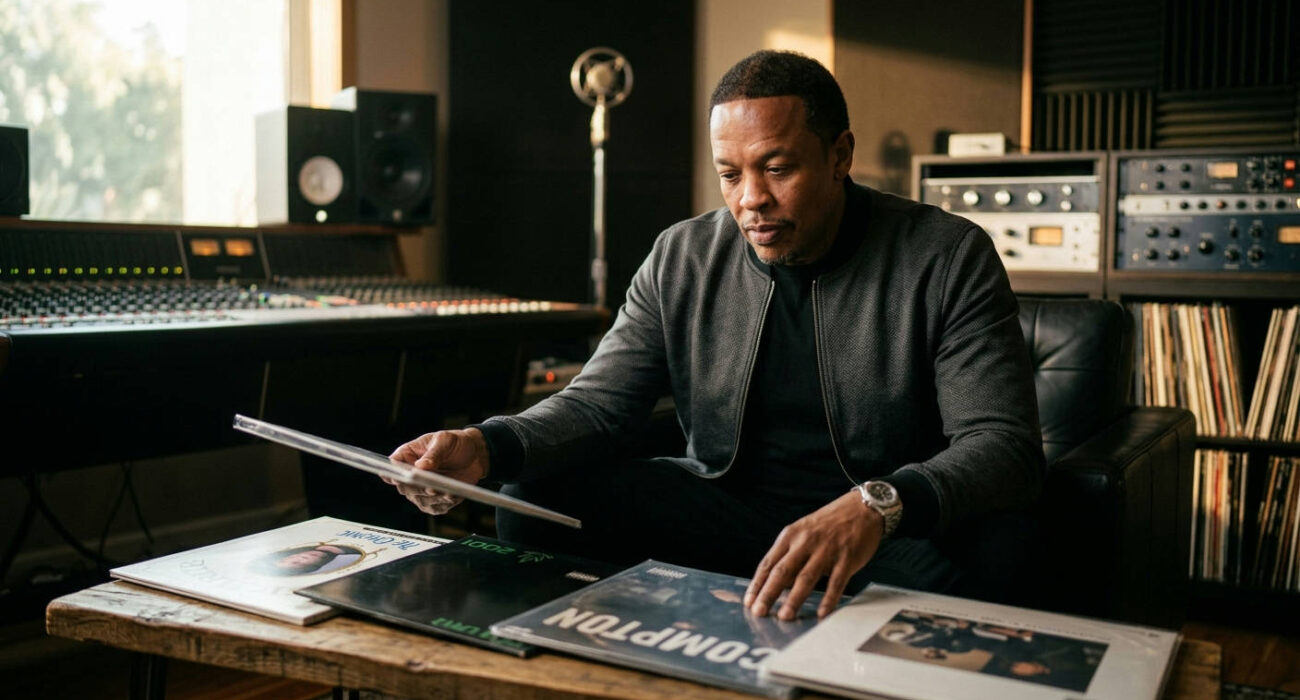
Trying to map out the history of hip-hop without a deep dive into the Dr Dre chronological discography is like trying to tell the story of rock and roll without mentioning the electric guitar. It’s not just a list of albums; it’s a blueprint for the sound of modern music. From the electro-funk chaos of the 80s to the cinematic G-funk that defined the 90s and the polished, minimalist menace of the 2000s, Andre Young’s career is a masterclass in evolution. At Vinyl Gold UK, we live for these legacies, and this is the definitive guide to the work of The Doctor.
The Genesis: World Class Wreckin’ Cru & N.W.A. (1984-1991)
Before the lowriders and the G-funk, Dr. Dre was a DJ and producer spinning records in the vibrant, and very different, Compton club scene of the 1980s. This period is essential for understanding the full Dr Dre chronological discography, as it laid the technical foundation for everything that came later.
World Class Wreckin’ Cru: The Electro-Funk Beginnings
Long before he was a household name, Dre was part of the World Class Wreckin’ Cru, a group known for their flashy, Prince-inspired outfits and a sound rooted in electro-funk. This wasn’t the hard-edged reality rap he’d become famous for. This was party music, built on drum machines and synthesizers.
Albums like World Class (1985) and Rapped in Romance (1986) showcase a young Dre honing his craft. While tracks like “Surgery” and “Juice” might sound dated to the modern ear, you can hear the seeds of his perfectionism. His drum programming was already tight, and his ear for a catchy synth line was undeniable. This era was his sonic laboratory.
N.W.A.: Igniting a Revolution
The transition from the Wreckin’ Cru to N.W.A. (Niggaz Wit Attitudes) was an earth-shattering shift. Teaming up with Eazy-E, Ice Cube, MC Ren, and DJ Yella, Dre traded funk for fury. The group’s formation marked the true beginning of West Coast gangsta rap as a dominant force.
Straight Outta Compton, released in 1988, was a cultural atom bomb. Dre’s production was raw, aggressive, and utterly compelling. He layered funk and soul samples from groups like Parliament-Funkadelic and James Brown over hard-hitting drum breaks, creating a chaotic yet irresistible sonic bed for the group’s provocative lyrics. It was the antithesis of the pop-friendly rap that was charting at the time.
The group followed up with the 100 Miles and Runnin’ EP in 1990 and their final studio album, Niggaz4Life, in 1991. On this last record, you can hear the G-funk sound starting to bubble to the surface. The tempos slowed down, the basslines got deeper, and the signature high-pitched synth melodies began to appear. It was the bridge between the raw anger of N.W.A. and the polished gangster cool of his solo career. Their unflinching social commentary put them in the same conversation as East Coast pioneers like Public Enemy, though their methods and messages were worlds apart.
The G-Funk Era Begins: A Dr Dre Chronological Discography Deep Dive (1992-1999)
After a bitter split from N.W.A. and Ruthless Records, Dre co-founded Death Row Records with Suge Knight. This move didn’t just change his career; it changed the entire music industry. What followed was a period of near-total dominance, all built on a sound he perfected: G-funk.
The Chronic (1992): The Unstoppable Sonic Blueprint
If Straight Outta Compton was a riot, The Chronic was a victory parade. Released in late 1992, Dre’s solo debut is one of the most important albums ever made. It single-handedly defined the sound of 90s West Coast hip-hop and remains a cornerstone of any serious record collection.
The production was unlike anything before it. Dre took the gritty funk samples of his N.W.A. days and polished them to a mirror shine.
G-funk is characterized by its deep, rolling basslines, lazy tempos, live instrumentation replaying classic funk riffs, and the iconic high-pitched portamento synthesizer lead. It was smooth, menacing, and perfect for cruising down the boulevard.
The album introduced the world to a lanky, charismatic rapper from Long Beach named Snoop Doggy Dogg, whose laid-back flow was the perfect counterpoint to Dre’s meticulous beats. Tracks like “Nuthin’ but a ‘G’ Thang” and “Let Me Ride” weren’t just songs; they were anthems that cemented the West Coast’s place as a hip-hop superpower.
For any vinyl enthusiast, owning this record is non-negotiable. It’s a masterwork of production and a time capsule of a pivotal moment in music history.
- Get it on Vinyl: Find a copy of The Chronic on Amazon and hear G-funk the way it was meant to be heard.
The Death Row Records Production Powerhouse
Dre’s discography in the mid-90s is about more than just his solo work. As the chief producer for Death Row, his sound was the label’s sound. He was the architect behind a string of multi-platinum hits that made the label the most successful—and feared—in the business.
Snoop Dogg’s debut, Doggystyle (1993), was essentially The Chronic Part II. Dre produced the entire album, refining the G-funk formula to create classics like “Gin and Juice” and “Who Am I? (What’s My Name?)”. The album sold over 800,000 copies in its first week, a record at the time.
He also produced for other Death Row artists, including Tha Dogg Pound and The Lady of Rage. But his most famous collaboration from this era came when 2Pac joined the label in 1995. Dre produced Pac’s biggest hit, the timeless anthem “California Love.” The track was a global phenomenon, though the working relationship between the two titans was reportedly tense, signalling the beginning of the end of Dre’s time at Death Row.
Aftermath Entertainment: Building an Empire (1996-2015)

Sensing the impending collapse of Death Row Records amidst rising violence and legal troubles, Dre left in 1996 to start his own label, Aftermath Entertainment. The move marked a new chapter, one focused on meticulous artist development and a more refined, cinematic sound.
Launching Aftermath & Dr. Dre Presents… The Aftermath (1996)
Dre’s first release on his new label was a compilation album designed to introduce his new stable of artists. Dr. Dre Presents… The Aftermath was a commercial and critical disappointment. The lead single, “Been There, Done That,” saw Dre renouncing the gangsta lifestyle, a move that confused many fans.
While the album itself isn’t considered a classic, it’s a vital part of the Dr Dre chronological discography. It represents a necessary reset, a deliberate move away from the Death Row drama. It was Dre clearing the deck to build something new from the ground up, a process that would take time but ultimately pay off spectacularly.
2001 (1999): The Cinematic Comeback
For three years, the music world wondered if Dre had lost his touch. He answered them in late 1999 with 2001. If The Chronic was a sun-drenched BBQ, 2001 was a tense, late-night thriller. The sound was a dramatic evolution.
The warm, rubbery basslines of G-funk were replaced by stark, ominous piano loops and menacing string sections. The beats were more sparse, leaving space for every single snare and hi-hat to hit with maximum impact. It was hip-hop production as high-art, and it was a massive success.
With Snoop Dogg, Eminem, and Xzibit in tow, Dre delivered a string of iconic hits like “Still D.R.E.,” “Forgot About Dre,” and “The Next Episode.” The album re-established him as the undisputed king of producers and proved his ability to reinvent his sound for a new millennium.
- Get it on Vinyl: The intricate production of 2001 on Amazon is a must-have for any audiophile. The vinyl pressing lets every layer breathe.
The Super-Producer: Crafting Legacies for Others
After 2001, Dre shifted his focus almost entirely to producing for other artists, becoming arguably the most successful A&R man in music history. His discography in the 2000s is defined by the careers he built.
- Eminem: Dre discovered the Detroit rapper and produced the bulk of his first three albums: The Slim Shady LP (1999), The Marshall Mathers LP (2000), and The Eminem Show (2002). He provided Eminem with a sonic playground of quirky, hard-hitting beats that perfectly matched his chaotic energy.
- 50 Cent: In 2002, Dre and Eminem co-signed 50 Cent. Dre produced the monster hit “In Da Club” and several other tracks on Get Rich or Die Tryin’ (2003), an album that sold 12 million copies worldwide. Dre’s beats gave 50’s street tales a cinematic, unstoppable quality.
- The Game: Dre brought the West Coast back to prominence by producing a significant portion of The Game’s debut, The Documentary (2005), including the hits “How We Do” and “Hate It or Love It.”
He also produced massive hits for artists across genres, from Eve’s “Let Me Blow Ya Mind” featuring Gwen Stefani to Mary J. Blige’s Grammy-winning “Family Affair.” Each production credit is a crucial entry in the Dr Dre chronological discography.
The Mythical Detox and The Grand Finale: Compton (2000-2026)
For over a decade, the most famous album in hip-hop was one that didn’t exist. The saga of Detox became a running joke, a symbol of Dre’s legendary perfectionism.
The Lost Tapes: What Happened to Detox?
Work on Detox officially began after 2001. It was billed as Dre’s final album, his grand finale. For years, rumours swirled, collaborators spoke of hundreds of completed tracks, and a few singles like “Kush” and “I Need a Doctor” were officially released.
But the album never materialized. Dre poured millions of his own money into recording sessions, but he was never satisfied with the result. He felt the project lacked a cohesive feeling and that his motivation wasn’t in the right place.
In a 2015 interview, Dre finally confirmed its demise, stating: “I didn’t like it. It wasn’t good. The record, it just wasn’t good… I’m not gonna put out something that I’m not feeling.”
This decision, while disappointing to fans, is a testament to his artistic integrity. He refused to release anything that didn’t meet his impossibly high standards.
Compton (2015): The Surprise Masterpiece
While the world was watching the N.W.A. biopic Straight Outta Compton in 2015, Dre did the unexpected. He announced and released a brand-new album, Compton: A Soundtrack by Dr. Dre, in the span of a week. He claimed the film’s production had inspired him to create one last record.
Compton was not Detox. It was something entirely new. The sound was dense, chaotic, and incredibly modern. It was a culmination of every era of his career, blending G-funk grooves with orchestral flourishes and the raw energy of trap music. The album featured a new generation of West Coast artists, most notably Kendrick Lamar and Anderson .Paak, symbolically passing the torch. It was a fitting, powerful, and unexpected conclusion to his solo album career.
- Get it on Vinyl: The sonic complexity of Compton on Amazon makes it a thrilling listen on a quality turntable.
Production in the 2020s and Beyond

Even after his “final” album, Dre hasn’t stopped working. His legendary performance at the 2022 Super Bowl Halftime Show reminded the world of his incredible catalogue. As of 2026, he continues to produce for select artists, contributing key tracks to Anderson .Paak’s critically acclaimed 2025 album Malibu Dreams and mentoring a new wave of producers. His work remains the gold standard.
Beyond the Albums: The Unsung Production Credits
A comprehensive Dr Dre chronological discography must include the masterpieces he crafted for others, some of which are often overlooked in favour of his more famous work.
Crafting Hits for The D.O.C. and Michel’le
Before The Chronic, Dre was already creating classics. He produced the entirety of The D.O.C.’s 1989 debut, No One Can Do It Better. The album is a lyrical and sonic tour de force, considered by many critics to be one of the best hip-hop albums of all time.
He also showcased his versatility by producing for R&B singer and Ruthless Records labelmate Michel’le. Her self-titled 1989 album, featuring hits like “No More Lies,” demonstrated his ability to craft smooth, funky tracks for a vocalist, a skill that would serve him well throughout his career.
Reimagining Classics: The Soundtrack Contributions
Dre has always had a cinematic ear, so it’s no surprise that some of his best work has been for film soundtracks. These one-off tracks are essential listening.
- “Keep Their Heads Ringin'” (1995): From the movie Friday, this track is pure, uncut G-funk and became a massive international hit.
- “Natural Born Killaz” (1994): A dark, menacing collaboration with Ice Cube for the Murder Was the Case soundtrack, showcasing a much harder sound.
- The Wash Soundtrack (2001): Dre co-starred in this film with Snoop Dogg and produced the entire soundtrack, which functions as a forgotten Aftermath compilation album.
How to Collect the Dr Dre Chronological Discography on Vinyl
For the team here at Vinyl Gold UK, the physical medium is everything. Collecting Dre’s work on vinyl is a rewarding experience, allowing you to appreciate the depth and detail of his production.
Starting Your Collection: The Essentials
If you’re just starting, there are three albums that form the foundation of any Dr Dre vinyl collection. These are the pillars of his solo career.
- The Chronic (1992): The G-funk bible. Look for a quality reissue, as clean original pressings can be pricey.
- 2001 (1999): The minimalist masterpiece. Its sparse sound is perfect for vinyl, letting you feel the space between the notes.
- Compton (2015): The dense and complex final chapter. A great system will reveal new layers with every listen.
The Crate Digger’s Guide: Finding the Rarities
Once you have the essentials, the real fun begins. Hunting for rarer pressings and related works is what being a true collector is all about.
- N.W.A. Originals: Finding a clean, first-press copy of Straight Outta Compton is a holy grail for many collectors.
- 12″ Singles: Don’t sleep on the singles. A 12″ of “Nuthin’ but a ‘G’ Thang” or “Still D.R.E.” will have superior sound quality for those specific tracks and often include instrumentals or B-sides not found on the album.
- The Aftermath Compilation: While not his most celebrated work, the 1996 compilation is a less common find on vinyl and an interesting piece of the story.
### A Note on Production Credits in a Dr Dre Chronological Discography
To truly appreciate the scope of his work, your collection cannot end with his solo albums. A true Dr Dre chronological discography on your shelf must include the albums he made legendary for others. Adding Snoop Dogg’s Doggystyle, Eminem’s The Marshall Mathers LP, and 50 Cent’s Get Rich or Die Tryin’ is essential. These aren’t just related works; they are extensions of Dre’s own artistic journey.
The Legacy: More Than Just Beats
Dr. Dre’s influence extends far beyond a list of hit records. He fundamentally changed the role of a producer and set a new standard for sonic quality in popular music.
The Producer as an Auteur
Dre treats every album like a film director, or “auteur,” would treat a movie. As detailed in a 2021 analysis by the University of Southern California’s Thornton School of Music, his use of skits, recurring characters, and a cohesive sonic palette on albums like The Chronic and 2001 turns them into narrative experiences. He doesn’t just make a collection of songs; he creates a world. His obsessive attention to detail, from the sound of a snare drum to the mix of a vocal, is legendary.
The Dr. Dre Protégé Effect
No producer in history has a better track record of discovering and launching superstar talent. His ear for talent is as sharp as his ear for beats. Snoop Dogg, Eminem, 50 Cent, The Game, and Kendrick Lamar were all propelled to stardom under his guidance. His seal of approval became the most powerful endorsement in hip-hop. This ability to spot and nurture genius is a massive part of his legacy.
Tracing the Dr Dre chronological discography is a journey through modern music history. It’s a story of innovation, perfectionism, and an unrelenting commitment to quality. From the streets of Compton to the top of the charts, his sound has been the pulse of popular culture for over three decades. So drop the needle on a record, turn it up, and listen to the work of a true master.