
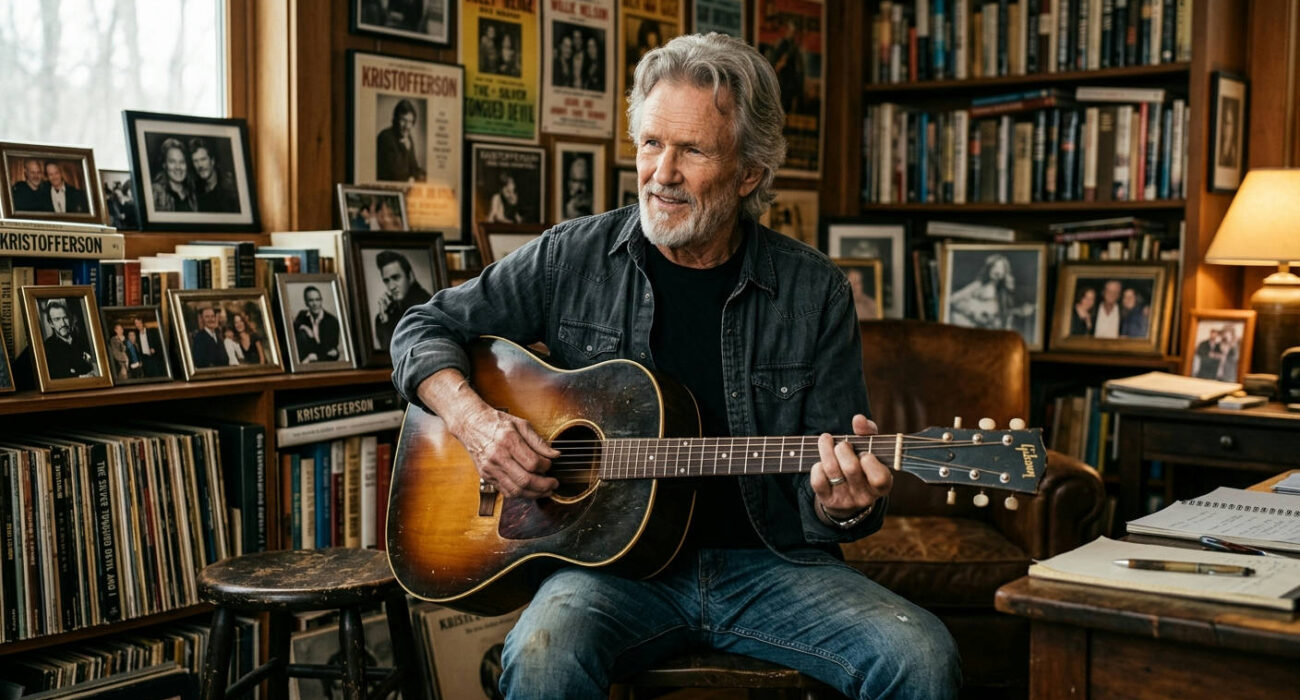
He’s the Rhodes Scholar who swept floors. The Army Ranger who landed a helicopter on Johnny Cash’s lawn to deliver a demo tape. The Golden Globe-winning actor who wrote one of the most covered songs in history. Trying to pin down one label for a man like Kris Kristofferson is impossible. He is a walking contradiction, a poet with a boxer’s past, and a rebel with an intellectual’s mind. This is the definitive Kris Kristofferson biography, a deep dive into the man who didn’t just write the songs the whole world sang; he lived them.
The Scholar, Soldier, and Janitor: The Unlikely Path to Nashville
You can’t understand the depth of Kristofferson’s song writing without first understanding the incredible journey he took before even writing his first hit. His path wasn’t just unconventional; it was a series of shocking left turns that defy all logic.
From Rhodes Scholar to Army Ranger
Long before Nashville, there was Oxford. Kristofferson was not your average aspiring musician. He was a Golden Gloves boxer and a creative writing standout at Pomona College. This academic prowess earned him a prestigious Rhodes Scholarship to study literature at Merton College, Oxford University.
While in England, he began performing music and was even offered a recording contract under the name Kris Carson. He was on a clear path to becoming a professor or a novelist. But another calling pulled him in a different direction: the U.S. Army. He joined, became a helicopter pilot, and rose to the rank of Captain in the 82nd Airborne Division. The military offered him a teaching position at West Point. It was a secure, respectable future. He turned it down.
The Nashville Gamble
The decision to reject West Point for the uncertain life of a Nashville songwriter was seen as madness by his family, who promptly disowned him. In 2026, it’s hard to fathom the guts it took. He arrived in Music City with a family to support and nothing but a handful of songs.
His first job wasn’t on stage; it was pushing a broom. He became a janitor at Columbia Recording Studios. This humble position gave him a front-row seat to history. He watched Bob Dylan record Blonde on Blonde and was in the room for sessions with his hero, Johnny Cash. He’d sweep floors by day and pitch his songs to anyone who would listen by night. Mostly, they didn’t.
The Helicopter Demo Tape
The most famous story in the Kris Kristofferson biography is a testament to his military-grade determination. For months, he tried to get his tapes to Johnny Cash, but they always ended up in a pile with hundreds of others. He knew Cash was recording at his home on Old Hickory Lake.
So, Kristofferson, who was still flying helicopters for the National Guard on the side, borrowed one. He flew it directly to Cash’s property and landed it on the front lawn. He walked up to a stunned Man in Black, handed him a demo tape containing “Sunday Mornin’ Comin’ Down,” and walked back to his helicopter. The stunt worked. Cash recorded the song, and it became the 1970 CMA Song of the Year. The janitor had finally arrived.
The Pen Is Mightier: Kristofferson the Songwriter
Before he was a movie star or a reluctant frontman, Kris Kristofferson was a wordsmith. He brought a literary sensibility and a raw, unflinching honesty to country music, writing with a poet’s eye for detail and a philosopher’s grasp of the human condition.
“Me and Bobby McGee”: The Immortal Anthem
It’s a song so universal it feels like it’s always existed. But “Me and Bobby McGee” came directly from Kristofferson’s soul. The song was inspired by a Fellini film and the secretary of a record executive named Bobby McKee (he changed the gender for the song).
Roger Miller was the first to have a hit with it. But it was Janis Joplin’s posthumously released version that turned it into a rock and roll standard. Her raw, desperate vocal performance captured the song’s themes of freedom and loss perfectly.
“Freedom’s just another word for nothin’ left to lose. Nothin’, don’t mean nothin’, hon’, if it ain’t free.”
That one line cemented its place in cultural history. It became Joplin’s only number one hit and an anthem for a generation. The song’s power lies in its detailed, cinematic storytelling—a style that defined Kristofferson’s writing.
“Sunday Mornin’ Comin’ Down”: Capturing Loneliness
This was the song that landed on Johnny Cash’s lawn. It’s a masterpiece of atmosphere and a brutally honest look at the hangover of a life lived hard. It’s not about the party on Saturday night; it’s about the crushing emptiness of the morning after.
The lyrics paint a vivid picture: “On a Sunday morning sidewalk, I’m wishin’, Lord, that I was stoned. ‘Cause there’s something in a Sunday that makes a body feel alone.” He wasn’t afraid to write about the ugly, quiet moments. This raw honesty resonated deeply with Cash, who knew that feeling all too well. When Cash performed it on his TV show, network censors demanded he change the line “wishin’, Lord, that I was stoned,” but he defiantly sang it as written.
A Songwriter’s Songwriter
The list of artists who turned Kristofferson’s songs into classics is staggering. His early success came not from his own records, but from others recognizing his genius.
- “For the Good Times” – Ray Price: A heartbreaking ballad about the end of a love affair that became a number one country hit and a pop crossover smash.
- “Help Me Make It Through the Night” – Sammi Smith: A song of vulnerable intimacy that won Smith a Grammy and became her signature tune. It was considered so risqué at the time that many radio stations banned it.
- “Loving Her Was Easier (Than Anything I’ll Ever Do Again)” – Waylon Jennings: A perfect example of his straightforward, emotionally direct style.
He wasn’t just writing songs; he was providing the scripts for other legends to perform. His work helped define the “Outlaw Country” movement by focusing on realism and emotional complexity.
Stepping into the Spotlight: The Reluctant Performer

Despite his success as a writer, Kristofferson was never a natural performer in the traditional sense. His voice was rough, weathered, and unpolished. He wasn’t a showman. He was a storyteller who happened to sing. This authenticity, however, became his greatest asset.
The Debut Album: Kristofferson (1970)
His 1970 debut album, simply titled Kristofferson, should have been a blockbuster. It contained his versions of “Me and Bobby McGee,” “For the Good Times,” and “Sunday Mornin’ Comin’ Down”—songs that were already massive hits for other artists.
Commercially, the album flopped. His raspy, conversational delivery was a stark contrast to the polished vocals that dominated the radio. The record label, Monument, didn’t know how to market him. It was only after Joplin’s version of “Bobby McGee” exploded that the label re-released the album in 1971 under the title Me and Bobby McGee, and it finally found its audience.
Finding His Voice: The Gruff Charm of a Kristofferson Live Show
A Kris Kristofferson concert wasn’t about vocal pyrotechnics. It was about connection. He would stand on stage, often alone with his acoustic guitar, and simply share his stories. His voice, often described as sounding like “a frog with a throat infection,” carried an undeniable weight of experience.
You believed every word he sang because you knew he had lived it. The cracks in his voice only added to the authenticity. He wasn’t performing a song; he was offering a piece of his life. This raw, unpretentious style made him a hero of the counter-culture and a key figure in the singer-songwriter movement.
The Monumental 1970s: A Decade of Classic Albums
After his debut found its footing, Kristofferson hit a creative stride that produced some of the most essential records of the era. He became a cornerstone artist of a decade defined by personal, introspective music.
His 1971 album, The Silver Tongued Devil and I, is arguably his finest moment as a recording artist. It features classics like “Lovin’ Her Was Easier” and the title track. Jesus Was a Capricorn (1972) gave him a surprise hit with the gentle and humorous “Why Me.” Throughout the decade, his albums were a constant presence, solidifying his reputation as a formidable artist in his own right and a key part of the greatest Best Albums Of The 1970s.
A Star Is Born: The Kris Kristofferson Biography in Hollywood
Just as his music career was solidifying, Hollywood came calling. His rugged good looks, natural charisma, and quiet intensity made him a perfect fit for the gritty, character-driven films of the New Hollywood era. The acting portion of the Kris Kristofferson biography is as compelling as his musical journey.
From Cisco Pike to Pat Garrett & Billy the Kid
His acting debut came in 1971’s The Last Movie, directed by Dennis Hopper. But his first leading role was as a washed-up rock star dealing drugs in Cisco Pike (1972). He was a natural on screen, projecting a world-weary coolness that felt entirely authentic.
His role as Billy the Kid in Sam Peckinpah’s 1973 masterpiece Pat Garrett & Billy the Kid cemented his status as a legitimate actor. He held his own opposite the legendary James Coburn. The film also featured a soundtrack by Bob Dylan, placing Kristofferson at the absolute centre of the cultural zeitgeist.
The Golden Globe: The Making of A Star Is Born (1976)
His biggest commercial success as an actor came in 1976, when he starred opposite Barbra Streisand in the remake of A Star Is Born. He played John Norman Howard, a self-destructive rock star whose career is in decline as his wife’s (Streisand) skyrockets.
The role was dangerously close to home, reflecting his own struggles with alcohol and the pressures of fame. The on-set chemistry and conflict between him and Streisand were legendary. Despite a troubled production, the film was a massive box office hit. Kristofferson’s raw, vulnerable performance earned him a Golden Globe Award for Best Actor.
The Blade Trilogy and Beyond: An Enduring Screen Presence
Unlike many musicians who dabble in acting, Kristofferson built a long and varied career. He worked consistently for decades, appearing in everything from the disastrous epic Heaven’s Gate to the family-friendly Dolphin Tale.
For a younger generation, he is most recognizable as Abraham Whistler, the grizzled mentor to Wesley Snipes in the Blade trilogy. This role introduced him to a new audience and proved his ability to fit into any genre. His filmography is a testament to his work ethic and his willingness to take on challenging and diverse roles.
The Highwaymen: A Country Supergroup for the Ages
In the mid-1980s, Kristofferson joined forces with three other titans of country music to form a group that was less a band and more a force of nature: The Highwaymen. This chapter of the Kris Kristofferson biography saw him become part of an iconic musical brotherhood.
Forging a Brotherhood: Johnny Cash, Waylon Jennings, and Willie Nelson
The four men—Kristofferson, Johnny Cash, Waylon Jennings, and Willie Nelson—were long time friends and collaborators. They represented the heart and soul of the “Outlaw” movement, a subgenre that rejected the slick, polished sound of Nashville in favour of a rawer, more personal style.
Bringing them together was a stroke of genius. Each was a legend in his own right, but together, their collective charisma and history were undeniable. They were the Mount Rushmore of country music, four distinct voices united by a shared history of bucking the system.
The Outlaw Sound, Redefined
Their first album, Highwayman (1985), was a massive success. The title track, a haunting Jimmy Webb-penned epic about reincarnation, became a number one hit. The song perfectly encapsulated the group’s mythic status, with each member taking a verse to embody a different soul across time.

“I was a highwayman. Along the coach roads, I did ride. With sword and pistol by my side. Many a young maid lost her baubles to my trade. Many a soldier shed his lifeblood on my blade.”
The magic of The Highwaymen was hearing these four iconic voices trade lines on the same track. Cash’s gravelly bass, Nelson’s idiosyncratic phrasing, Jennings’ powerful baritone, and Kristofferson’s poetic rasp created a sound that was instantly recognizable and utterly unique.
Touring and Legacy
The Highwaymen recorded three studio albums and toured sporadically for over a decade. Their concerts were events, celebrations of friendship and incredible music. Seeing the four of them on stage together was witnessing a piece of living history.
The group’s legacy is immense. They proved that country music could be both commercially successful and artistically uncompromising. They represented a kind of rugged individualism and integrity that has inspired countless artists since. Their story is a crucial part of the biographies of all four men, especially the Kris Kristofferson biography, as it placed him squarely among his heroes and peers as an equal.
Activism, Love, and Legacy: The Man Behind the Music
To fully appreciate the Kris Kristofferson biography, you must look beyond the stage and screen. He has always been a man of deep convictions, unafraid to speak his mind, even when it was unpopular or detrimental to his career.
A Voice for the Voiceless
From the beginning, Kristofferson has been a passionate political activist. He was a vocal critic of U.S. foreign policy in Central America during the 1980s, particularly in Nicaragua. This stance put him at odds with the more conservative country music establishment and likely cost him airplay and awards.
He didn’t care. He used his platform to support causes he believed in, from farmers’ rights with Farm Aid to the rights of Native Americans. He has always stood up for the underdog, a theme that runs through many of his best songs. His principled stands are a core part of his identity.
Marriages and Muses: Rita Coolidge and a Life in the Public Eye
Kristofferson’s personal life has often been as dramatic as his songs. His most high-profile relationship was his marriage to singer Rita Coolidge from 1973 to 1980. They were a musical power couple, recording several successful duet albums, including the Grammy-winning Full Moon.
Their marriage was tumultuous, plagued by the pressures of fame and Kristofferson’s struggles with alcohol. Their very public divorce became tabloid fodder, but it also inspired some of his most introspective and heart breaking songs. He has been married to his current wife, Lisa Meyers, since 1983, finding a stability that had previously eluded him.
The Health Battles and Triumphant Return
In recent years, a major part of the Kris Kristofferson biography has been his struggle with his health. For years, he suffered from severe memory loss and pain, and his doctors diagnosed him with Alzheimer’s disease. As he told the Country Music Hall of Fame, he began preparing for the end.
But a new doctor tested him for Lyme disease, and the test came back positive. After years of incorrect treatment, he finally got the right diagnosis. The treatment for Lyme disease dramatically improved his condition, lifting the “fog” and allowing him to tour and perform again into the 2020s. It was a remarkable comeback, a story of resilience that adds another incredible chapter to his life.
The Complete Kris Kristofferson Biography: A Discography and Filmography Primer
Understanding the man requires immersing yourself in his work. His catalogue of music and film is vast and rewarding, a true testament to a life lived to the fullest.
Essential Albums for Your Vinyl Collection
Spinning a Kristofferson record is a pure, unvarnished experience. If you’re building a collection, these are the non-negotiables. Getting a comprehensive box set like The Complete Monument & Columbia Album Collection is a great start, but these individual LPs are essential.
- Kristofferson (1970): The raw debut. It’s the sound of a genius finding his voice. Essential for “Me and Bobby McGee” and “Sunday Mornin’ Comin’ Down.”
- The Silver Tongued Devil and I (1971): Arguably his most perfect studio album. A flawless collection of stories and melodies from a writer at the peak of his powers.
- Jesus Was a Capricorn (1972): Contains the massive hit “Why Me,” but the deeper cuts reveal an artist grappling with faith, fame, and doubt.
- Highwayman (1985): The first and best album from the country supergroup. A historic collaboration that sounds as powerful today as it did decades ago.
Digging Deeper into the Kris Kristofferson Biography: Must-See Films
His film career is just as worthy of exploration. He brought a unique, understated presence to the screen that was all his own.
- Pat Garrett & Billy the Kid (1973): A revisionist Western masterpiece. He is magnetic as the doomed outlaw Billy the Kid.
- Alice Doesn’t Live Here Anymore (1974): A supporting role in a Martin Scorsese classic, showing his softer side opposite Ellen Burstyn.
- A Star Is Born (1976): The blockbuster that made him a movie star and won him a Golden Globe. A raw, powerful performance.
- Lone Star (1996): A brilliant turn as a corrupt and menacing Texas sheriff in John Sayles’ neo-western mystery. A reminder of his incredible range as an actor.
Awards and Accolades: A Career of Recognition
The list of honours bestowed upon him is long and well-deserved. He’s been inducted into the Country Music Hall of Fame and the Songwriters Hall of Fame. He has won multiple Grammy Awards, both for his own performances and for his song writing.
In 2014, he received a Grammy Lifetime Achievement Award, an honour that recognized his immense and lasting contribution to music. Yet, for all the trophies, his true legacy is written in the grooves of his records and in the countless artists he has inspired.
Kris Kristofferson is more than a musician or an actor. He is a modern-day Renaissance man. His life has been a relentless pursuit of truth, art, and justice. The Kris Kristofferson biography isn’t just a story about a country singer; it’s a lesson in courage, conviction, and the power of a well-told story. He is living proof that a single voice, armed with a guitar and the truth, can indeed change the world.