
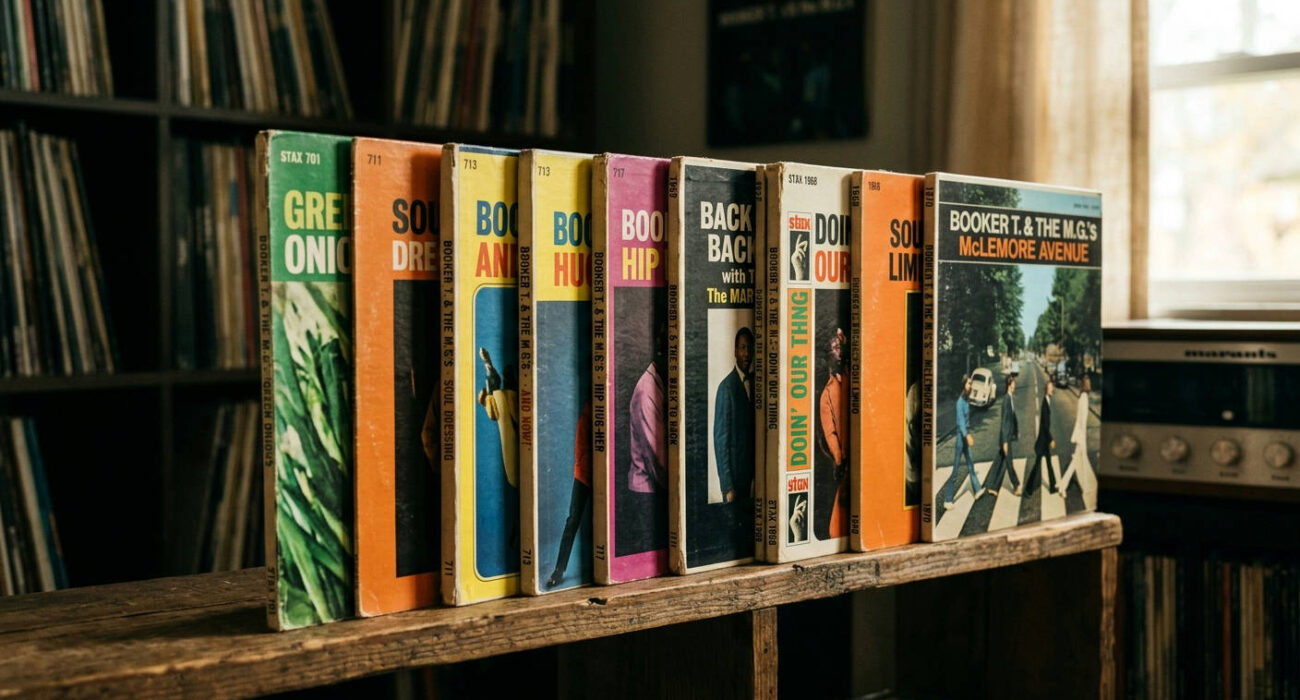
Trying to piece together the entire studio output of one of the tightest, most influential bands in history can feel like a puzzle. You’re not just looking for a list; you want the complete story, the sonic evolution from start to finish. That’s why we’ve built this definitive guide to the Booker T and the M.G’s discography chronological order, meticulously detailed for collectors, new fans, and soul music aficionados alike. We’re cutting through the clutter of compilations and live albums to give you the pure, unadulterated studio album timeline from the architects of the Memphis sound.
At Vinyl Gold UK, we live and breathe this stuff. We know the thrill of dropping the needle on a pristine Stax original and hearing that unmistakable groove. This isn’t just a list; it’s a journey through the heart of American soul music, album by album, year by year. Let’s get into it.
The Foundation: The Stax House Band Era (1962-1965)
Before they were global stars in their own right, Booker T. & the M.G.’s were the literal backbone of Stax Records. Booker T. Jones (organ, piano), Steve Cropper (guitar), Lewie Steinberg (bass, later replaced by Donald “Duck” Dunn), and Al Jackson Jr. (drums) were the session musicians creating the sound for legends like Otis Redding, Wilson Pickett, and Sam & Dave. Their own records were often born from impromptu studio jams between these marathon sessions.
This early period is defined by a raw, minimalist energy. Their sound was lean, uncluttered, and built around infectious grooves. They weren’t just playing songs; they were creating a sonic template that would be copied for decades.
Green Onions (1962)
This is where it all began. The title track, “Green Onions,” was a happy accident, a B-side that became an international phenomenon. The album itself is a masterclass in instrumental cool.
It’s built on a foundation of 12-bar blues but executed with a precision and swagger that was entirely new. Tracks like “Behave Yourself” and “Mo’ Onions” expand on the theme, proving the band had a deep well of similar grooves. Listening to Green Onions in 2026 is like hearing the blueprint for instrumental soul.
To grab a copy of this essential debut, you can find various pressings on Amazon. It’s a cornerstone for any serious vinyl collection.
Search for Booker T. & the M.G.’s – Green Onions on Amazon
Soul Dressing (1965)
After a three-year gap where they were relentlessly busy as Stax’s house band, Soul Dressing arrived. By this time, Donald “Duck” Dunn had replaced Lewie Steinberg on bass, cementing the classic lineup. Dunn’s telepathic interplay with drummer Al Jackson Jr. became one of the most revered rhythm sections in music history.
Soul Dressing is grittier and funkier than its predecessor. The title track is a stone-cold classic, but deeper cuts like “Tic-Tac-Toe” and the moody “Mercy, Mercy” show a band stretching its musical muscles. You can hear the confidence gained from backing the biggest names in soul. This album is less about a singular hit and more about a consistent, simmering vibe.
Hitting Their Stride: The Mid-60s Golden Age
With the classic lineup firmly in place, the mid-to-late 60s saw the band enter their most prolific and creatively fertile period. They were a hit-making machine, both for themselves and for the entire Stax roster. Their albums from this era reflect the sound of a band at the absolute peak of its powers.
This period is marked by a slight polish to their raw sound, incorporating more sophisticated arrangements without ever losing the fundamental groove. They mastered the art of the instrumental hook, creating melodies on organ and guitar that were as memorable as any vocal line.
And Now! (1966)
The title feels like a declaration. And Now! finds the band exploring a wider range of moods and textures. It includes their sublime cover of “Summertime” and the impossibly cool “My Sweet Potato.”
What’s remarkable about this album is its versatility. They could deliver a gutbucket R&B stomper like “Pigmy” and then shift gears into the gentle, almost melancholic “Booker’s Pre-Game.” It demonstrated that instrumental music didn’t have to be one-dimensional.
“The MGs weren’t just a band, they were a concept. The idea that four musicians, two black and two white, could create this unified, perfect sound in the heart of the segregated South was a powerful statement in itself.”
In the Christmas Spirit (1966)
A Christmas album might seem like a strange detour, but In the Christmas Spirit is anything but a novelty record. The M.G.’s approached holiday standards like “Jingle Bells” and “Silent Night” with the same soulful respect they gave any other tune.

They stripped away the schmaltz and rebuilt these songs from the groove up. Booker T.’s organ work on “Winter Wonderland” is simply sublime. It remains one of the coolest and most genuinely listenable holiday albums ever made, perfect for anyone tired of the usual festive fare.
Hip Hug-Her (1967)
This album was a massive commercial success, largely on the strength of its slinky, infectious title track. “Hip Hug-Her” became one of their signature songs, a perfect example of their minimalist magic. The groove is so deep you could lose yourself in it.
The rest of the album is just as strong. Their cover of The Young Rascals’ “Groovin'” became an anthem for the Summer of Love, arguably surpassing the original in sheer laid-back cool. On tracks like “Booker’s Notion,” the interplay between Cropper’s sharp guitar stabs and Dunn’s melodic bass lines is a clinic in rhythm section dynamics.
A Comprehensive Breakdown of the Booker T and the M.G’s Discography Chronological Order
To truly appreciate their evolution, you need the full picture. Compilations are great, but they miss the narrative flow of the studio albums. Here is the complete, official studio Booker T and the M.G’s discography chronological order, focusing on their primary run.
- Green Onions (1962): The groundbreaking debut that started it all. Raw, blues-drenched, and effortlessly cool.
- Soul Dressing (1965): The first album with Donald “Duck” Dunn, solidifying the classic lineup and deepening the funk.
- And Now! (1966): A more diverse and sophisticated effort, showcasing their growing confidence as composers and arrangers.
- In the Christmas Spirit (1966): The coolest Christmas album ever recorded. A must-have for the holidays.
- Hip Hug-Her (1967): A commercial smash, defined by its iconic title track and a laid-back, confident groove.
- Doin’ Our Thing (1968): Another solid entry, featuring the brilliant “I Can Dig It” and showing the band in top form.
- Soul Limbo (1968): Famous for its title track (used as the BBC’s cricket theme), this album saw them incorporate Caribbean influences and more complex instrumentation.
- UpTight (1969): A soundtrack album that functions as a stellar M.G.’s record, featuring their iconic version of “Time Is Tight.”
- The Booker T. Set (1969): A more pop-oriented album, featuring instrumental covers of Beatles tracks like “Michelle” and “Lady Madonna.”
- McLemore Avenue (1970): Their brilliant, soulful tribute to The Beatles’ Abbey Road, reimagining the entire album side-for-side.
- Melting Pot (1971): The final album from the classic lineup. A grittier, jam-oriented record that pointed towards the future of funk.
- Universal Language (1977): A reunion album with a different lineup, exploring a smoother, more jazz-funk-oriented sound.
- That’s The Way It Should Be (1994): The surviving original members reunite for a final studio album, joined by Neil Young on a few tracks.
Why the Booker T and the M.G’s Discography Chronological Order Matters
Listening to these albums in sequence isn’t just an academic exercise. It’s a real-time chronicle of soul music’s evolution. You hear the shift from raw R&B to sophisticated soul, the subtle influence of psychedelic rock, and the birth of funk. The Booker T and the M.G’s discography chronological order tells a story that no “Best Of” collection ever could.
Psychedelia, Soundtracks, and Tributes (1968-1970)
As the 60s roared to a close, the musical world was changing rapidly. The M.G.’s, ever the musical sponges, absorbed these new sounds without ever losing their core identity. This period saw them experiment with new textures and formats, from film soundtracks to full-album homages.
Their performance at the 1967 Monterey International Pop Festival, where they backed Otis Redding and played their own set, exposed them to a whole new rock audience. This experience undoubtedly seeped into their own work. They shared that stage with artists like The Jimi Hendrix Experience, and you can feel that expansive, freewheeling energy in their subsequent records.
Soul Limbo (1968)
The title track, with its infectious cowbell and marimba, became an unlikely hit, especially in the UK where it was adopted by the BBC for its cricket coverage. But Soul Limbo is more than its title track.
The album features a stunning cover of “Be Young, Be Foolish, Be Happy” and the band’s take on the theme from Hang ‘Em High. It’s a vibrant, eclectic record that shows the band soaking up influences from pop, rock, and world music. Steve Cropper’s fuzzed-out guitar on “Foxy Lady” is a clear nod to their Monterey festival-mate.
UpTight (1969) & The Booker T. Set (1969)
1969 saw the band release two distinct projects. UpTight was the soundtrack to the film of the same name. More than just background music, it’s a fully-fledged M.G.’s album, highlighted by the sprawling, epic “Time Is Tight.” The track is a masterclass in tension and release, building over several minutes to a triumphant crescendo. It’s one of their finest moments.
The Booker T. Set was a more straightforward affair, a collection of instrumental covers of contemporary pop and soul hits. Their versions of Simon & Garfunkel’s “Mrs. Robinson” and The Beatles’ “Lady Madonna” are fun, but the album’s highlight is their soulful deconstruction of “Light My Fire” by The Doors.
McLemore Avenue (1970)
This is the band’s audacious and brilliant tribute to The Beatles’ Abbey Road. Recorded just months after the original’s release, McLemore Avenue (named after the street where Stax Studios was located) is not a simple cover album. It’s a complete reinterpretation.
The M.G.’s tackle the famous side-two medley as one continuous, 15-minute soul-jazz workout. They find the funk hidden inside “Come Together” and transform “Something” into a heart-wrenching soul ballad. It’s a testament to their musicianship and their deep understanding of song structure. It’s an essential album for fans of both bands.
You can often find reissues of this classic on vinyl. It’s a fantastic listening experience.
Search for Booker T. & the M.G.’s – McLemore Avenue on Amazon

The End of an Era: The 70s and Beyond
The start of the new decade brought significant changes for Stax Records and for the band. Internal strife at the label and the desire for individual members to pursue other projects led to the slow dissolution of the classic lineup. Their final Stax album is a fascinating, gritty farewell.
Melting Pot (1971)
Melting Pot sounds different from anything they’d done before. The songs are longer, more improvisational, and deeply funky. The title track is an eight-minute jam that lays down a groove so heavy it feels like it could crack the pavement.
This album was a clear precursor to the funk movement that would dominate the 70s. You can hear the influence of bands like Sly & the Family Stone and the psychedelic explorations of Norman Whitfield’s work at Motown. It was a bold, forward-looking statement, but it would be the last from the four men who had defined the Stax sound for nearly a decade. Shortly after its release, Booker T. Jones and Steve Cropper left Stax, effectively ending the band.
Reunions and Late-Career Work
The band’s story didn’t completely end there. There were reunion attempts and new recordings, though the magic of the original lineup was impossible to fully replicate.
-
Universal Language (1977): This album featured Jones, Dunn, and Jackson, with Cropper being replaced by other guitarists. It has a slicker, more polished 70s production style, leaning heavily into jazz-funk. While it has its moments, it lacks the raw synergy of their 60s work.
-
That’s The Way It Should Be (1994): Following their induction into the Rock and Roll Hall of Fame, the three surviving members (Al Jackson Jr. was tragically murdered in 1975) reunited for one last studio album. With Steve Potts on drums, it’s a warm, nostalgic record that recaptures some of the old chemistry.
A Vinyl Collector’s Guide to the M.G.’s
Collecting the Booker T and the M.G’s discography chronological order on vinyl is a rewarding pursuit. The original pressings on the Stax and Volt labels are things of beauty, but there are also fantastic reissues available in 2026 for those who don’t want to break the bank.
Original Pressings vs. Modern Reissues
-
Original Pressings (1960s-70s): Look for the iconic yellow Stax label (for early LPs) or the later blue “finger-snapping” Stax logo. These mono and early stereo pressings have a punch and warmth that is hard to replicate. Condition is everything. A clean “VG+” (Very Good Plus) or “NM” (Near Mint) original will sound incredible but can be pricey.
-
Modern Reissues (2000s-2026): Companies like Sundazed, Rhino, and Vinyl Me, Please have released high-quality reissues, often pressed on 180-gram vinyl from the original master tapes. For many listeners, these offer the best balance of sound quality, durability, and affordability. They provide a clean, quiet listening experience without the pops and crackles of a well-loved original.
“There’s an honesty to their records. No autotune, no studio trickery. Just four guys in a room, locked into a groove. That’s why those Stax vinyl pressings still sound so alive today.”
What to Look For When Buying
When hunting for M.G.’s vinyl, here are a few tips:
- Check the Dead Wax: The area between the last song and the label often contains matrix numbers and mastering engineer initials. This can help you identify first pressings.
- Inspect the Vinyl: Look for deep scratches, scuffs, and warping. A few light paper scuffs are usually fine, but deep, feel-able scratches will affect playback.
- Examine the Cover: Look for seam splits, ring wear, and writing. A clean cover not only looks better but often indicates the record inside was well cared for.
For a great starting point, the “Big Four” to seek out are Green Onions, Hip Hug-Her, McLemore Avenue, and Melting Pot. These four albums give you a perfect overview of their entire career arc. You can start your search for these foundational records right now.
Search for Booker T. & the M.G.’s Vinyl on Amazon
The Unmistakable Legacy of Booker T. & the M.G.’s
It is impossible to overstate the importance of this band. Their influence is woven into the very fabric of popular music. As the house band for Stax Records, they helped create a sound that challenged Motown’s dominance and offered a grittier, more soulful alternative.
Their sparse, groove-oriented approach laid the groundwork for funk. James Brown may be the Godfather of Soul, but the M.G.’s rhythm section of Dunn and Jackson were the architects of its backbeat.
Decades later, their music found a new life in the world of hip-hop. Their clean, open grooves and distinct sonic palette made their songs a treasure trove for producers. Tracks from their catalogue have been sampled by everyone from the Wu-Tang Clan and Public Enemy to Ice Cube and Cypress Hill.
They proved that a band could be both racially integrated and massively successful in a time of deep social division. They were a testament to the unifying power of music. Their work endures not as a relic of the past, but as a timeless, vital, and endlessly cool collection of grooves. Diving into the Booker T and the M.G’s discography chronological order is more than a history lesson; it’s an education in the very essence of rhythm and soul.