
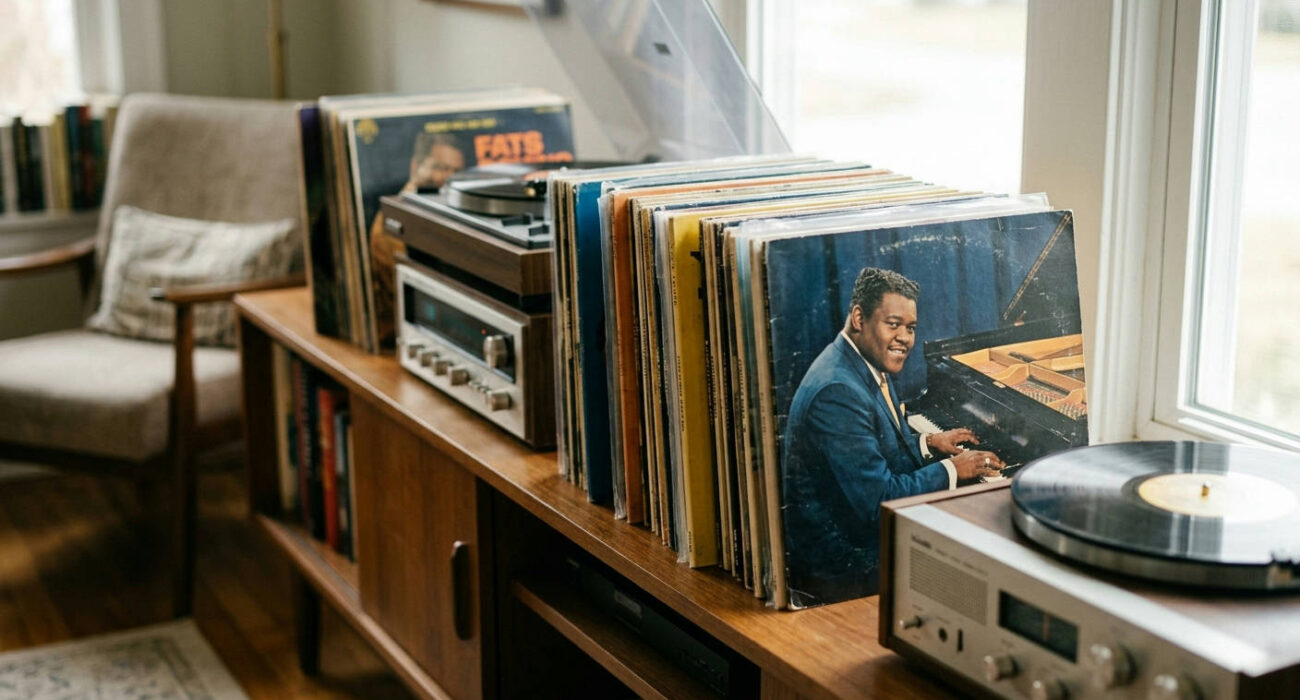
Trying to track down the Fats Domino complete studio albums can feel like a musical treasure hunt through the back alleys of rock and roll history. It’s a discography that’s sprawling, often confusingly packaged, and absolutely essential. Antoine “Fats” Domino Jr. wasn’t just a hitmaker; he was a foundational architect of the sound that would change the world. His warm, Creole-inflected voice and rolling piano triplets were the easy-going, irresistible counterpoint to the wild energy of his contemporaries. Here at Vinyl Gold UK, we live for these deep dives, and guiding you through the essential LPs of “The Fat Man” is a pure joy.
This isn’t just a list. It’s a roadmap to understanding the evolution of an icon, from his earliest R&B smashes on Imperial Records to his later, often-overlooked work. We’ll separate the must-have original LPs from the endless sea of compilations and help you build a collection that truly represents his genius.
Who Was Fats Domino? More Than Just Blueberry Hill
Before you can appreciate the albums, you need to understand the man and the sound he created. Fats Domino was the unassuming, smiling giant of early rock and roll. While others postured and snarled, Fats sat at his piano and let his effortless charm and incredible talent do the talking.
He wasn’t an invention of a record label. He was the genuine article, a product of the rich musical gumbo of New Orleans. This authenticity is baked into every groove of his records.
The New Orleans Sound He Perfected
What you hear on a Fats Domino record is the “New Orleans sound” or the “Big Beat.” It’s a style built on a strong rhythm section, prominent horns, and that distinctive, rolling piano. His signature style often involved playing triplets, giving his music a relaxed, shuffling feel that was completely infectious.
Unlike the harder-edged rockabilly coming out of Memphis, Fats’ music was smoother, more rooted in rhythm and blues. It was music for dancing, for smiling, for feeling good. This sound, co-created with his long time collaborator, was a direct precursor to what would dominate the charts for the next decade.
Dave Bartholomew: The Unsung Hero Behind the Hits
You cannot talk about the Fats Domino complete studio albums without giving massive credit to Dave Bartholomew. A brilliant trumpeter, bandleader, and producer, Bartholomew was the creative partner who helped shape Fats’ raw talent into a commercial juggernaut.
Bartholomew co-wrote the majority of the big hits, arranged the horn sections, and ran the recording sessions with military precision. Their partnership is one of the greatest in music history, a perfect fusion of raw talent and studio wizardry. It was Bartholomew who ensured the rhythm section was locked in, the saxophones wailed just right, and Fats’ piano and vocals were front and centre.
“We had a thing together,” Bartholomew once said. “I knew what he was thinking and he knew what I was thinking. We didn’t have to talk about it.”
Why His Music Still Resonates in 2026
Trends come and go, but the appeal of Fats Domino’s music is timeless. Why? Because it’s built on pure, unadulterated joy. There’s no angst, no complicated messages—just perfectly crafted songs about everyday life, love, and heartbreak, all delivered with a warm, reassuring voice.
In a world of algorithm-driven, hyper-produced pop, the organic, feel-good energy of a track like “I’m Walkin'” is a breath of fresh air. It’s a reminder that sometimes the most powerful music is also the most simple and direct. That’s why collectors and new fans alike are still seeking out his records decades after they were first pressed.
A Collector’s Guide to the Fats Domino Complete Studio Albums
This is where the real fun begins. For collectors, navigating his discography is a challenge. In the 1950s, the music industry was driven by 45 RPM singles, not the long-playing album. Early LPs were often just a collection of recent hits padded out with a few other tracks, not the cohesive artistic statements we came to expect later.
Understanding this context is key to appreciating his catalogue and building a meaningful collection.
### Differentiating Originals, Reissues, and Compilations
The first hurdle is distinguishing between a true studio album and a compilation. Imperial Records, his label during his golden era, released dozens of “Greatest Hits” style records over the years.
- Original Studio Albums: These are the LPs released during his prime, like Rock and Rollin’ with Fats Domino (1955) or This is Fats! (1956). They represent a snapshot in time and are the most sought-after by purists. They were almost exclusively released in mono initially.
- Reissues: These are later pressings of the original albums, sometimes from different labels or with altered artwork. Quality can vary wildly, but they can be a more affordable way to get the original track lists.
- Compilations: These are collections of singles and album tracks, often with titles like Fats Domino’s Greatest Hits. While great for casual listening, they aren’t part of the core “studio album” canon. The Bear Family Records box sets are the exception, offering exhaustive, high-quality collections.
### Where to Start: The Essential First Buys for a New Fan
If you’re just starting your journey into the Fats Domino complete studio albums, don’t get overwhelmed. Focus on the foundational records from the Imperial era.
- Rock and Rollin’ with Fats Domino (1955): This is ground zero. It contains “Ain’t That a Shame” and essentially sets the template for his entire career. Finding a clean original copy is a thrill for any collector.
- This is Fats Domino! (1956): Another absolute classic, featuring “Blueberry Hill,” “Honey Chile,” and “Blue Monday.” This record proves the debut wasn’t a fluke; it cemented his status as a rock and roll king.
- The Fabulous Mr. D (1958): By this point, the formula was perfected. This album is packed with hits like “I’m Walkin’,” “The Big Beat,” and “I Want You to Know.” It’s arguably one of his most consistent LPs from start to finish.
Starting with these three gives you the essential DNA of Fats Domino’s sound. From there, you can branch out into his other fantastic Imperial releases.
### The Holy Grails: Rare Pressings and Their Value in 2026
For the serious collector, the hunt is for first pressings in near-mint condition. Original mono pressings on the black and maroon Imperial label are the most desirable. Stereo versions of these early albums exist but are often re-channelled “fake stereo” and are generally less sonically pleasing than the powerful, punchy mono originals.
Look for the “Long Play” and “Microgroove” text on the labels. The condition of the vinyl is paramount, but a clean, intact cover also significantly boosts the value. As of 2026, a top-condition first pressing of his debut can fetch a handsome sum, a testament to its historical importance.
The Imperial Records Era: Building a Rock and Roll Foundation
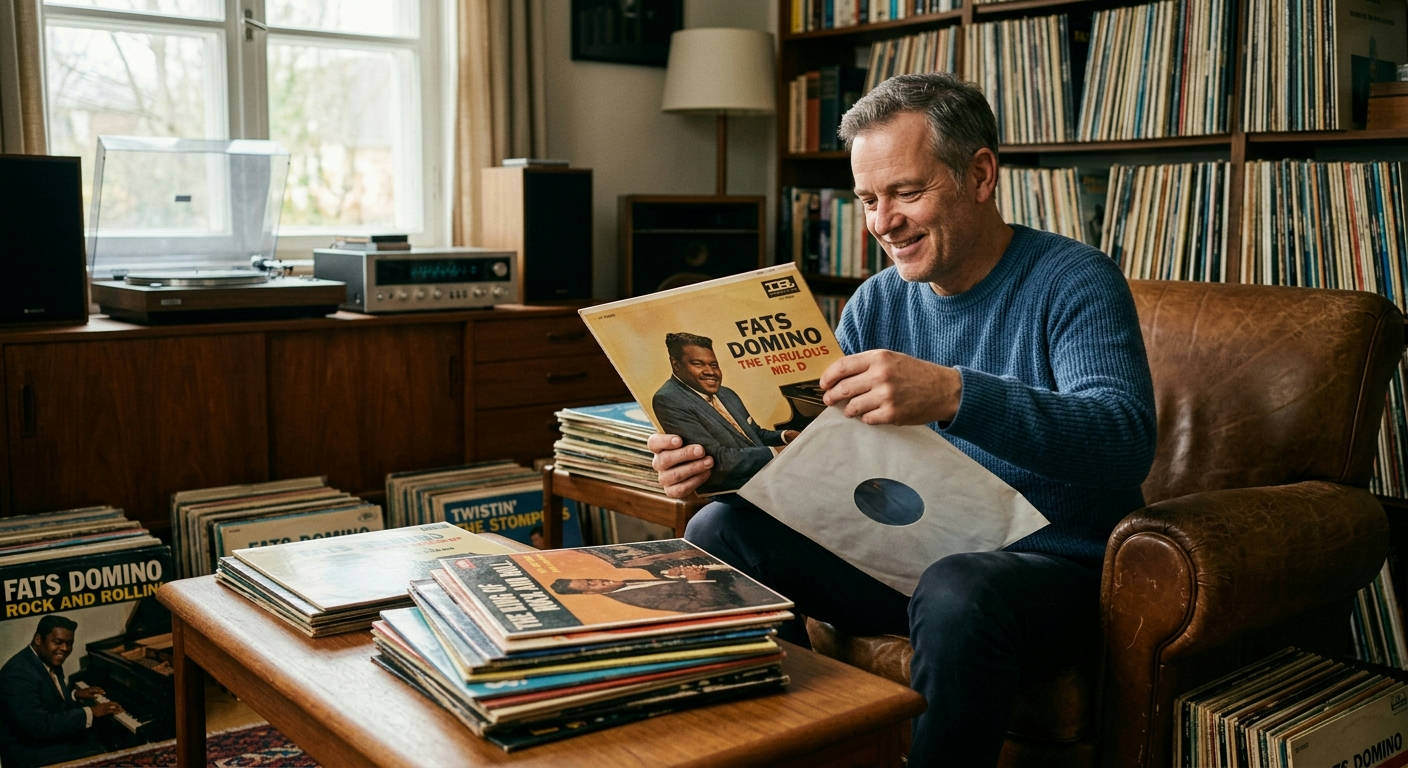
From 1949 to 1962, Fats Domino and Dave Bartholomew were an unstoppable force at Imperial Records. This period produced the overwhelming majority of his iconic hits and forms the core of any collection of the Fats Domino complete studio albums.
This wasn’t just a run of good luck; it was a masterclass in consistent, high-quality song writing and production that defined a genre.
### Early LPs: From “Carry on Rockin'” to “Let’s Play Fats Domino”
The album titles from this era tell you everything you need to know. They were direct, fun, and sold a feeling. Titles like Here Stands Fats Domino (1957) and Fats Is Back (1968, a later Reprise album, but the title fits the ethos) were simple promises of what was inside: pure, unadulterated rock and roll from the master.
Albums like Carry on Rockin’ (released as Rock and Rollin’ in the US) and Let’s Play Fats Domino (1959) weren’t concept albums. They were delivery systems for hit singles and stellar album cuts. Tracks like “I’m in Love Again,” “My Blue Heaven,” and “Whole Lotta Lovin'” all found their home on these essential LPs.
### The Challenge of “Albums” in a Singles-Dominated Era
It’s crucial to remember the context. In the 50s, the 45 RPM single was king. Teenagers bought the songs they heard on the radio, not entire albums. LPs were an afterthought for record labels, often assembled quickly to capitalize on a string of successful singles.
This is why some Fats Domino albums can feel slightly uneven. You might get four or five stone-cold classics alongside some lesser-known R&B numbers. This isn’t a criticism; it’s a reflection of how music was consumed at the time. The genius is that even Fats’ “filler” tracks are often better than other artists’ A-sides.
### Key Tracks That Defined a Generation
Beyond the obvious mega-hits, the albums from the Imperial era are littered with tracks that became R&B standards and rock and roll blueprints.
- **”Walking to New Orleans” (from …A Lot of Dominos!, 1960):** A beautiful, string-laden track that showcases a more sophisticated side of his music.
- “I’m Gonna Be a Wheel Someday” (from Let’s Play Fats Domino, 1959): A defiant, upbeat rocker with a classic piano riff.
- **”It’s You I Love” (from This is Fats!, 1956):** A perfect example of his charming, romantic ballad style.
Exploring these deep cuts is the real reward for those who venture beyond the greatest hits compilations and seek out the complete studio albums.
Beyond Imperial: The ABC-Paramount, Mercury, and Reprise Years
In 1963, Fats left Imperial Records and signed with ABC-Paramount. This marked a significant shift in his career. He was no longer working with Dave Bartholomew, and the musical tides were changing with the arrival of the British Invasion.
Many fans and collectors consider this post-Imperial period to be of lesser quality. But is that fair? A re-evaluation in 2026 suggests there are plenty of hidden gems to be found.
A Change in Scenery, A Change in Sound?
The ABC-Paramount albums, like Here Comes…Fats Domino (1963), saw him working with different producers and arrangers. The sound was often slicker, with more prominent choirs and string arrangements, an attempt to fit into the new pop conventions.
While the raw energy of the Imperial sessions was sometimes tamed, Fats’ voice and piano playing remained as charming as ever. Tracks like “Red Sails in the Sunset” were significant hits during this period and showed he could still find his way onto the charts.
Was the Post-Imperial Work Underrated? A 2026 Re-evaluation
Listening back now, the later albums are ripe for rediscovery. The Mercury Records output and his late-60s work on Reprise Records, particularly the album Fats Is Back produced by Richard Perry, are fascinating. Perry tried to update the Fats Domino sound with a more contemporary rhythm section, even having him cover Beatles songs like “Lady Madonna.”
While not every experiment worked, these albums show an artist still willing to create, not just rest on his laurels. For the completist looking for the entire story of the Fats Domino complete studio albums, these LPs are non-negotiable. They provide crucial context and contain some genuinely great performances.
Navigating the Later Catalogue for Hidden Gems
The key to enjoying the post-Imperial years is to adjust your expectations. Don’t look for another “Ain’t That a Shame.” Instead, listen for the moments where the real Fats shines through the updated production.
- “Sally Was a Good Old Girl” (ABC-Paramount, 1964): A fun, up-tempo track that feels like a classic.
- “Honest Papas Love Their Mamas Better” (Reprise, 1968): A bluesy, soulful deep cut from Fats Is Back.
- “If You Don’t Know What Love Is” (ABC-Paramount, 1963): A beautiful ballad that showcases his vocal talent.
These records may not have the historical weight of the Imperial LPs, but they are an essential part of his story and well worth a spin.
The Ultimate Listening Experience: Vinyl vs. Digital
How you listen to Fats Domino matters. While his music is available on every streaming service, the experience of hearing it on a quality vinyl setup is unparalleled. As a company dedicated to the vinyl experience, we at Vinyl Gold UK are obviously biased, but for good reason.
The Case for Vinyl: Warmth, Presence, and Collectibility

The original mono recordings from the 1950s were mixed to be heard on the turntables and radios of the day. A good mono pressing on a well-calibrated turntable, perhaps one of the best turntables under £300 in the UK, delivers a powerful, centered, and cohesive sound that digital versions often struggle to replicate.
There’s a “punch” to the drums and a richness to the piano that feels incredibly present. Then there’s the tactile experience: holding the album cover, reading the liner notes, and watching the record spin. It’s a ritual that connects you more deeply to the music and the era it came from.
Finding the Fats Domino Complete Studio Albums on Streaming
For convenience, streaming is king. Platforms like Spotify and Apple Music have a vast selection of his work. However, be aware of what you’re listening to. You’ll often find countless compilations and modern stereo remixes of varying quality.
Use streaming as a tool for discovery. If you find an album you love, like This is Fats!, seek out a vinyl copy. Use the digital version to explore the deeper cuts from his later career before committing to buying a physical copy.
Sound Quality: Mono vs. Stereo Mixes Explained
For 50s and early 60s recordings, mono is almost always the way to go. The recordings were conceived and mixed for a single channel. The power of the rhythm section, piano, and vocals is focused and direct.
Early stereo mixes were often an afterthought. Engineers would crudely pan instruments to different channels, creating a disconnected, unnatural sound. Vocals might be isolated in one speaker and the drums in another. Stick to the original mono mixes for the authentic, artist-intended experience.
The Legacy and Influence: How Fats Shaped Modern Music
Fats Domino’s importance cannot be overstated. He was one of the first ten inductees into the Rock & Roll Hall of Fame in 1986 for a reason. He laid the groundwork for decades of popular music.
His friendly, non-threatening persona made rock and roll palatable to a mainstream white audience at a time of deep segregation in America. He sold over 65 million records, with more chart hits than Chuck Berry, Little Richard, and Jerry Lee Lewis combined.
From The Beatles to Elvis: The Artists Who Owed Him a Debt
The biggest names in music were all students of Fats Domino. Elvis Presley, when introduced to the press as the “King of Rock and Roll,” pointed to a visiting Fats Domino and said, “No, that’s the real king of rock and roll.”
John Lennon of The Beatles was a huge fan, and their cover of “Ain’t That a Shame” on their Rock ‘n’ Roll album was a heartfelt tribute. Paul McCartney’s piano-led song “Lady Madonna” was his direct attempt to write in the style of Fats Domino, who later returned the favour by recording his own version.
His Impact on Piano Rock and Rhythm & Blues
Before Fats Domino, the piano in popular music was often a background instrument. He brought it front and centre, making it a lead instrument for rock and roll. His rolling, triplet-heavy style influenced countless pianists, from Elton John and Billy Joel to Dr. John and Professor Longhair in his native New Orleans.
He demonstrated that you could rock out on a piano just as hard as you could on a guitar. This legacy is a core part of the rock and roll DNA.
Building Your Collection: Practical Tips from Vinyl Gold UK
You’re ready to start hunting for the Fats Domino complete studio albums. Here’s some practical advice to ensure you find quality records and get the most for your money.
Identifying Pressing Quality and Condition
When buying vintage vinyl, condition is everything. Use the Goldmine Standard for grading (Mint, Near Mint, Very Good Plus, etc.) as your guide. Always inspect a record under a bright light.
Look for deep scratches, scuffs, and warping. A few light surface marks (“paper scuffs”) on a VG+ record are usually fine and won’t affect play. Pay attention to the cover as well—look for seam splits, ring wear, and writing. A clean cover and clean vinyl is the combination you’re after.
Where to Buy: Online Marketplaces vs. Local Shops
Both have their pros and cons. Online sites like Discogs and eBay offer a massive selection but require you to trust the seller’s grading. Always check a seller’s feedback and ask for photos if you’re unsure.
Your local independent record shop allows you to inspect the record in person and build a relationship with the owner, who can be an invaluable source of knowledge. The thrill of digging through the crates and unearthing a clean original pressing is an experience no website can replicate.
### Recommended Box Sets and Collections for Fats Domino complete studio albums
If hunting for individual LPs seems daunting, a well-curated box set is a fantastic option. They offer pristine sound quality and comprehensive tracklists, often including rarities and alternate takes.
- “I’ve Been Around: The Complete Imperial and ABC Recordings”: This is the definitive collection. A massive, multi-disc set that covers his most important years. While it’s a significant investment, it’s a one-stop-shop for the serious fan. You can search for this incredible collection on Amazon here: https://www.amazon.com/s?k=Fats+Domino+I’ve+Been+Around+Box+Set&tag=vinylgolduk-21
- “The Imperial Singles Collection”: For those who want to experience his music the way it was first heard—as a string of incredible singles—a collection focused on his 45 RPM output is a great alternative. Check for available versions here: https://www.amazon.com/s?k=Fats+Domino+Imperial+Singles+Collection&tag=vinylgolduk-21
These sets provide an excellent foundation or a capstone to a collection built from individual albums.
The music of Fats Domino is a gift that keeps on giving. It’s a catalogue filled with warmth, rhythm, and an undeniable sense of joy. Collecting the Fats Domino complete studio albums is more than just an exercise in nostalgia; it’s about preserving the work of a true pioneer who helped write the first chapter of rock and roll. So get digging, get listening, and let the good times roll.