
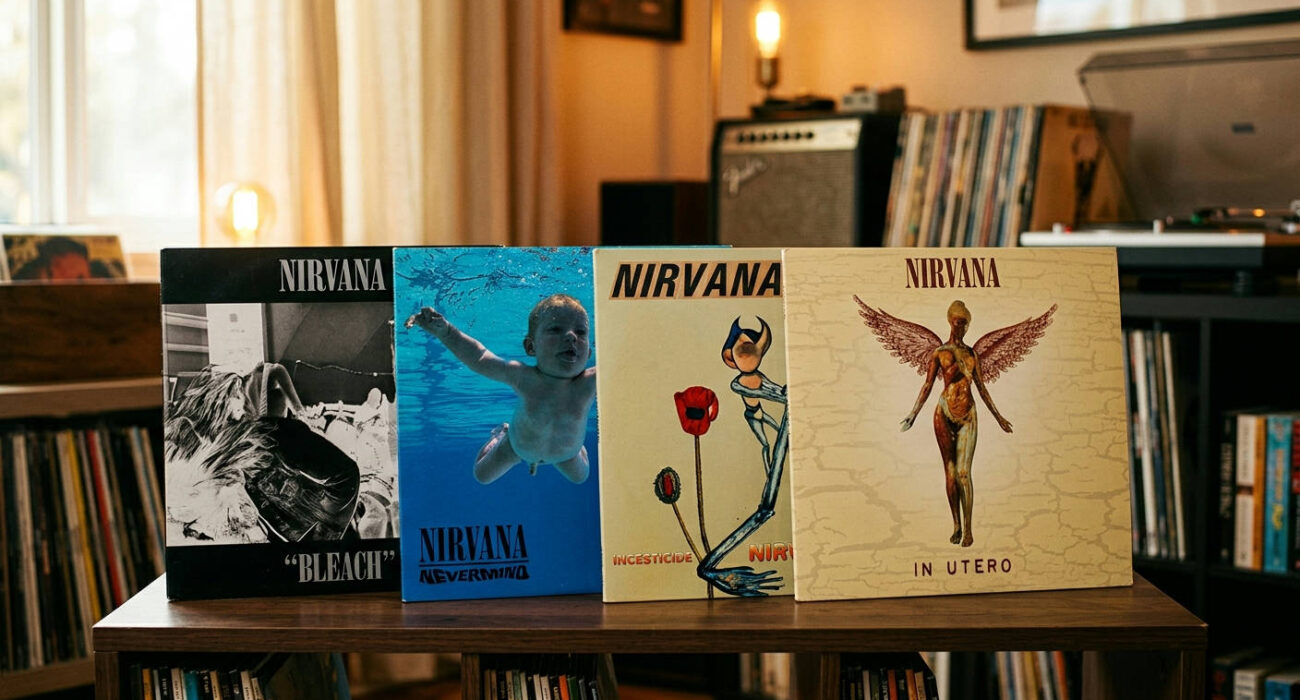
Let’s cut right to it. You’re here for the definitive guide to the Nirvana studio albums discography, and that’s exactly what you’re going to get. This isn’t just a list; it’s an exploration of three records that slammed the door on one era of rock and kicked open the next. In just three studio LPs, Nirvana forged a legacy that bands with dozens of albums still chase. Here at Vinyl Gold UK, we believe these records aren’t just artifacts; they’re living, breathing documents of a revolution, and they sound best, loudest, and most honest on a spinning piece of wax.
Nirvana’s official studio output is famously concise. It’s a testament to their explosive, short-lived brilliance. There’s no fat to trim, no “experimental” phase to forgive. Every studio track served a purpose, capturing a band evolving at a terrifying speed. From the grime of a Seattle basement to the unwilling throne of rock royalty, this is the sonic journey.
A Deep Dive into the Nirvana Studio Albums Discography
Understanding the Nirvana studio albums discography means appreciating its brutal brevity. Three albums. That’s it. Each one is a distinct chapter, a snapshot of a band in a specific moment of creation, pressure, and defiance. They didn’t have time to repeat themselves, and the result is a perfect, concise trilogy of modern rock.
Why Only Three Albums? The Lightning in a Bottle Effect
The question hangs over their entire legacy: why so few? The answer is as complex and tragic as the band’s own story. Their ascent was meteoric, a true “lightning in a bottle” phenomenon that burned incredibly bright and, consequently, incredibly fast.
From their formation in 1987 to Kurt Cobain’s death in 1994, the band was in a constant state of motion. They toured relentlessly, wrote constantly, and were thrust into a global spotlight they never seemed comfortable with. This intense pressure cooker environment, combined with personal struggles, meant their time as a creative unit was finite. What they left behind is a concentrated dose of pure, undiluted genius.
Bleach (1989): The Raw, Sludgy Genesis
Before the world knew their name, Nirvana was a grimy, ferocious beast from Aberdeen, Washington. Bleach is the sound of that beast, captured for just $606.17. It’s a record steeped in the mud and feedback of the Pacific Northwest, heavily influenced by the Melvins’ sludge metal and the raw punk they revered.
This album isn’t about polish; it’s about power. Krist Novoselic’s bass is a tectonic rumble, Chad Channing’s drumming is primal, and Kurt Cobain’s guitar and vocals are a visceral scream from the underground. It’s the essential starting point for anyone exploring the Nirvana studio albums discography.
The Sub Pop Sound and a $600 Budget
Recorded at Seattle’s Reciprocal Recording studio with producer Jack Endino, Bleach perfectly encapsulates the early “Sub Pop sound.” It’s heavy, distorted, and dripping with a kind of weary aggression. Endino’s production captures the band’s live energy without cleaning it up.
The legendary story of the recording cost being paid by Jason Everman, who was briefly a second guitarist but didn’t actually play on the album, adds to the DIY mythology. This wasn’t a major label production; it was the sound of a hungry band putting everything they had onto tape. You can hear that desperation and drive in tracks like “Negative Creep” and the punishing “School.”
“About a Girl”: The Beatles-esque Anomaly
Tucked away amidst the sludge is “About a Girl.” Cobain was reportedly nervous to even present this song to his bandmates, fearing it was too much of a pop song. It stands as the earliest, clearest proof of his innate genius for melody, a talent that would later conquer the world.
This track, with its clean guitar and Beatles-inspired structure, is the blueprint for the quiet-loud dynamic that would define their biggest hits. It showed that beneath the feedback and fury, a world-class songwriter was waiting to emerge.
Collecting Bleach on Vinyl: What to Look For
Getting Bleach on vinyl is a must for any serious collector. The low-end frequencies and raw production truly come alive on a turntable. The original 1989 Sub Pop pressings are collector’s items, but the subsequent reissues do a fantastic job of preserving the album’s gritty integrity.
For a new, high-quality pressing that captures the raw power Jack Endino intended, you can’t go wrong. This is the foundation of the entire Nirvana studio albums discography.
- Find your copy of Bleach on vinyl: Search on Amazon for Nirvana Bleach Vinyl
Nevermind (1991): The Album That Changed Everything
If Bleach was the tremor, Nevermind was the earthquake. This is the album that redefined rock music for the 1990s and beyond. With Dave Grohl now behind the drum kit, his explosive and precise playing became the final ingredient that propelled Nirvana from a respected indie band to the biggest band on the planet.
The shift from the murky production of Bleach to the crisp, powerful sound of Nevermind was seismic. It was the sound of the underground crashing into the mainstream, and nothing was ever the same.

Butch Vig’s Polish and the “Hair Metal” Coup d’état
Producer Butch Vig was instrumental in crafting the sound of Nevermind. His work at Smart Studios brought a level of clarity and punch that made Cobain’s brilliant songwriting undeniable. Vig layered Cobain’s guitars and double-tracked his vocals, creating a sound that was immense yet intricate.
“He’d have a super-distorted, heavy track and then a very clean, jangly track. When you blended them together, you got this incredible, big, full-bodied sound.” – Butch Vig
This sonic approach, combined with Andy Wallace’s final mix, created a Trojan horse. It was punk rock rage and indie-pop melody delivered with the sonic impact of a stadium rock record. In 2026, it’s easy to forget how dominant “hair metal” was in 1991. Nevermind didn’t just compete with it; it rendered it instantly obsolete. It was a cultural reset button in musical form.
Deconstructing the Hits: “Smells Like Teen Spirit” and Beyond
“Smells Like Teen Spirit” is more than a song; it’s a cultural touchstone. That iconic four-chord riff became the anthem for a generation. But Nevermind is far from a one-hit-wonder.
- “Come as You Are”: Its watery, chorus-laden guitar riff is instantly recognizable, a masterpiece of hypnotic tension.
- “Lithium”: The perfect execution of the quiet-loud dynamic. A fragile, contemplative verse explodes into a cathartic, screaming chorus.
- “In Bloom”: A direct shot at the fair-weather fans who didn’t understand the band’s message, wrapped in one of their most powerful and catchy choruses.
Every track is essential. There is no filler on Nevermind.
The Nevermind Vinyl Experience: The Definitive Pressing
To truly appreciate Butch Vig’s production, you need to hear Nevermind on vinyl. The album’s dynamic range—the space between the quietest whisper and the loudest roar—is vast. Digital compression can flatten this, but a good vinyl pressing allows the music to breathe and explode just as it was meant to. The warmth of the bass, the crack of Grohl’s snare, the layers of guitar—it all comes through with unparalleled depth.
- Own the record that changed rock: Search on Amazon for Nirvana Nevermind Vinyl
In Utero (1993): The Abrasive Masterpiece
How do you follow up one of the best-selling and most influential albums of all time? If you’re Nirvana, you hire punk rock purist Steve Albini and make a raw, confrontational, and utterly brilliant record designed to shed the fans you never wanted in the first place. In Utero is the sound of a band pushing back.
Released in September 1993, this album was a deliberate and defiant act. It was the antithesis of Nevermind‘s radio-friendly sheen, a return to the raw power of their roots but with a newfound lyrical and musical maturity. It’s the most challenging, and for many, the most rewarding part of the Nirvana studio albums discography. If you want to know what was number 1 in 1993, it’s fascinating to see how this abrasive record stormed those very charts.
### The Core of the In Utero Chapter in the Nirvana Studio Albums Discography
Enter Steve Albini: A Deliberate Rejection of Fame
Bringing in Steve Albini, known for his work with uncompromising artists like Pixies and Big Black, was a statement of intent. Albini was famous for his recording philosophy: capture the sound of a band playing in a room, with minimal overdubs and studio trickery. The result is an album that sounds incredibly immediate and visceral.
The drums are massive and natural, the bass is thick and distorted, and Cobain’s guitar sounds like a serrated-edge weapon. The label, DGC Records, was famously unhappy with the initial results, deeming it commercially unviable. This tension is part of the album’s legend. For a full breakdown of Albini’s influential recording techniques, his page on the Pachyderm Studio website offers incredible insight.
The Angelic and the Unsettling: “Heart-Shaped Box” vs. “Rape Me”
In Utero is an album of stunning contrasts. On one hand, you have “Heart-Shaped Box” and “All Apologies” (the latter remixed by Scott Litt to be more radio-friendly). These songs showcase Cobain’s melodic genius at its peak, with beautiful, haunting melodies layered over powerful rock foundations.
On the other hand, you have tracks like “Scentless Apprentice” and the infamous “Rape Me.” These are raw, primal screams of anger and frustration. “Rape Me,” despite its shocking title, is an explicitly anti-rape song, a confrontational piece of art that forces the listener to confront an uncomfortable reality. It’s this duality—the angelic and the unsettling—that makes In Utero so compelling.
Why In Utero Demands a High-Quality Vinyl Setup
This is an audiophile’s Nirvana record. Steve Albini’s production is all about capturing sonic detail and the natural acoustics of the recording space. On a high-quality vinyl setup, you can hear every nuance: the scrape of the pick on the strings, the natural decay of the cymbals, the distinct sound of the room itself.
A subpar system will turn the album’s intentional rawness into mud. But on a good turntable, the separation between instruments is clear, and the album’s power is overwhelming. If you’re serious about your sound, this record is the perfect test for your gear. Investing in one of the best turntables under £300 in the UK will unlock the layers Albini embedded in these grooves.

- Experience Nirvana’s defiant masterpiece: Search on Amazon for Nirvana In Utero Vinyl
Beyond the Studio: The Essential Compilations and Live Albums
The three studio albums are the pillars, but the story doesn’t end there. Several key releases, both compilations and live recordings, are absolutely essential for understanding the full scope of Nirvana’s talent. They fill in the gaps and showcase different facets of the band.
Incesticide (1992): The Punk Rock Scrapbook
Released to combat the bootleg market and tide fans over between Nevermind and In Utero, Incesticide is a glorious mess of B-sides, demos, and rarities. It’s a crucial document of the band’s punk and indie roots.
This is where you find some of their most beloved non-album tracks, like the frantic pop-punk of “Sliver,” the sludgy power of “Aneurysm,” and covers of songs by The Vaselines and Devo. It’s a raw, uncurated look into the band’s creative process and a reminder of the chaotic energy that always simmered just beneath the surface.
- Dive into the B-sides and rarities: Search on Amazon for Nirvana Incesticide Vinyl
MTV Unplugged in New York (1994): The Haunting Swan Song
Recorded in November 1993 but released posthumously in late 1994, MTV Unplugged is one of the most powerful and revered live albums ever made. Stripped of their usual distortion and volume, the band revealed the raw, aching beauty at the core of their songs.
Cobain’s performance is fragile, raw, and utterly captivating. The setlist was daring, eschewing many of their biggest hits in favor of deep cuts and covers of artists like David Bowie (“The Man Who Sold the World”), Lead Belly (“Where Did You Sleep Last Night”), and the Meat Puppets. It’s a funereal, beautiful, and essential performance that showcases a completely different side of the band’s artistry. It proved, beyond any doubt, that the songwriting and emotional depth were always the true foundation of their power.
- Hear the legendary acoustic performance: Search on Amazon for Nirvana Unplugged in New York Vinyl
From the Muddy Banks of the Wishkah (1996): The Other Side of the Coin
If Unplugged was the band at their most vulnerable, From the Muddy Banks of the Wishkah is them at their most ferocious. Compiled by Krist Novoselic and Dave Grohl, this is a “greatest hits” collection of live performances spanning their career, focusing entirely on their electric, high-energy shows.
This is the loud, chaotic Nirvana. It’s a sonic assault that perfectly captures the experience of seeing the band in a sweaty club or festival. The versions of songs like “Breed” and “Aneurysm” here are blistering, showcasing the raw power of the trio as a live unit. It’s the perfect companion piece to Unplugged, showing the two extremes of Nirvana’s dynamic genius.
“I wanted to show a different side of the band… I wanted people to hear what we were like live.” – Krist Novoselic
The Lasting Impact of the Nirvana Studio Albums Discography
Decades later, the shockwaves from these albums are still being felt. Nirvana didn’t just sell records; they shifted culture. They made it acceptable for music to be both commercially successful and emotionally authentic, melodic and abrasive.
From Post-Grunge to Modern Indie: Tracing the Lineage
The immediate aftermath of Nirvana’s success saw a wave of “post-grunge” bands, many of whom copied the sound but missed the substance. But their true influence runs much deeper.
Countless modern indie, punk, and alternative artists cite Nirvana as a formative influence. Their ethos—of honesty, of valuing emotional expression over technical perfection, of writing catchy songs about difficult subjects—has become ingrained in the DNA of alternative music. You can hear their influence in the quiet-loud dynamics of bands like Pixies (who were, in fact, a huge influence on Cobain) and in the raw vocal deliveries of countless modern rock singers. The Wikipedia page on Grunge music provides a detailed historical context for their emergence and subsequent influence.
Building Your Nirvana Vinyl Collection in 2026
For new collectors, the path is clear. Start with the three studio albums. They are the essential texts.
- Nevermind: The cultural phenomenon. It’s the most accessible entry point and a perfect pop-rock record.
- In Utero: The artistic statement. This is the one to get to appreciate their defiant spirit and the depth of their musicianship.
- Bleach: The raw beginning. Go here to understand where they came from and to hear them in their purest, ugliest form.
From there, expand to Unplugged in New York for the emotional depth and Incesticide for the punk rock chaos. Owning the Nirvana studio albums discography on vinyl isn’t about nostalgia; it’s about experiencing these timeless records with the warmth, depth, and intentionality they deserve.
These albums aren’t just a part of music history; they are a vital, living force. They still resonate with anyone who has ever felt like an outsider, and they still sound as urgent and necessary in 2026 as they did the day they were released. Put the needle on the record, turn it up, and let the noise wash over you.