

The most popular advice on the best cd player is still too generic. It usually treats every buyer the same, as if a lounge listener, a wedding DJ, and a collector with shelves of older UK pressings all need identical kit. They don’t.
A player that sounds lovely in a quiet sitting room can still be the wrong choice for a live event. A machine with polished specs can still struggle with older discs. And a model that looks modern on a retail page can become awkward the moment you try to connect it into a mixer, powered speakers, or a multi-room setup.
That’s why CDs still matter. Not as nostalgia props, but as reliable working tools and serious listening sources. If you care about ownership, consistent playback, and the discipline of choosing the right version of an album, the best cd player is still worth getting right.
Beyond the Stream The Enduring Power of the CD
Streaming is convenient. It’s also fragile in all the places that matter to event work and focused listening. Tracks disappear, versions change, metadata gets messy, and platform volume matching can flatten the differences that matter when you’re programming a room.
CDs avoid most of that. You own the disc, you control the version, and you know what’s on it before the first note lands. For DJs and event planners, that matters more than people admit. If a client wants a specific soul compilation, a certain radio edit, or the exact album mix they grew up with, a physical disc often removes guesswork.
The UK’s relationship with CD isn’t some late revival trend. It goes right back to the format’s public arrival. The first public demonstration of a CD player in the UK happened on a 1981 episode of BBC’s Tomorrow’s World, using a special transfer of the Bee Gees’ Living Eyes album, a moment that helped introduce digital audio to British audiences and build serious interest in the format’s sound and convenience, as noted by this history of the first CD player era.
Why CDs still earn shelf space
A good CD player gives you three things streaming still can’t fully replace:
- Version certainty You know exactly which master, mix, and running order you’re using.
- Stable playback No internet dependency, no app glitches, no surprise catalogue changes.
- Intentional listening Albums get heard as albums, not chopped into algorithmic fragments.
Collectors understand this instinctively. DJs learn it the hard way.
If you’re weighing physical formats more broadly, which is better: vinyl or CD? is a useful comparison because the answer depends on whether you prioritise ritual, convenience, sound consistency, or storage. For events, CD often wins on practicality.
The format works because it’s disciplined
CD doesn’t flatter bad buying decisions. That’s one reason I still respect it. You have to choose the pressing, test the machine, and understand your signal chain.
Practical rule: A CD collection is only as usable as the player reading it.
That’s especially true when your library includes disco, funk, soul, old-school house, and compilations assembled over decades rather than purchased in one neat batch.
For buyers who also care about curated DJ culture and classic-format listening, it’s worth seeing the visual identity behind the scene at Vinyl Gold’s brand mark. It reflects the same idea the best CD setups do. Keep it intentional, keep it reliable, and don’t mistake fashion for function.

Decoding the Decks The Main Types of CD Players
Before comparing models, separate the categories. A lot of confusion comes from buyers reading one review of a home deck, another of a portable unit, and a third of a DJ machine, then trying to rank them as if they’re direct rivals. They aren’t.
Here’s the quick map.
| Type | Best for | Strength | Limitation |
|---|---|---|---|
| Home hi-fi player | Listening rooms, living rooms, elegant event playback | Refined sound, straightforward outputs, stable operation | Usually lacks performance controls |
| Portable CD player | Personal listening, backup playback, compact setups | Small footprint, easy to move | Not ideal as a primary event deck |
| DJ player | Live mixing, cueing, performance work | Fast access, pitch control, hands-on operation | Overkill for pure home listening |
| CD transport | Collectors and DAC-based systems | Clean digital output to an external DAC | Needs extra equipment |
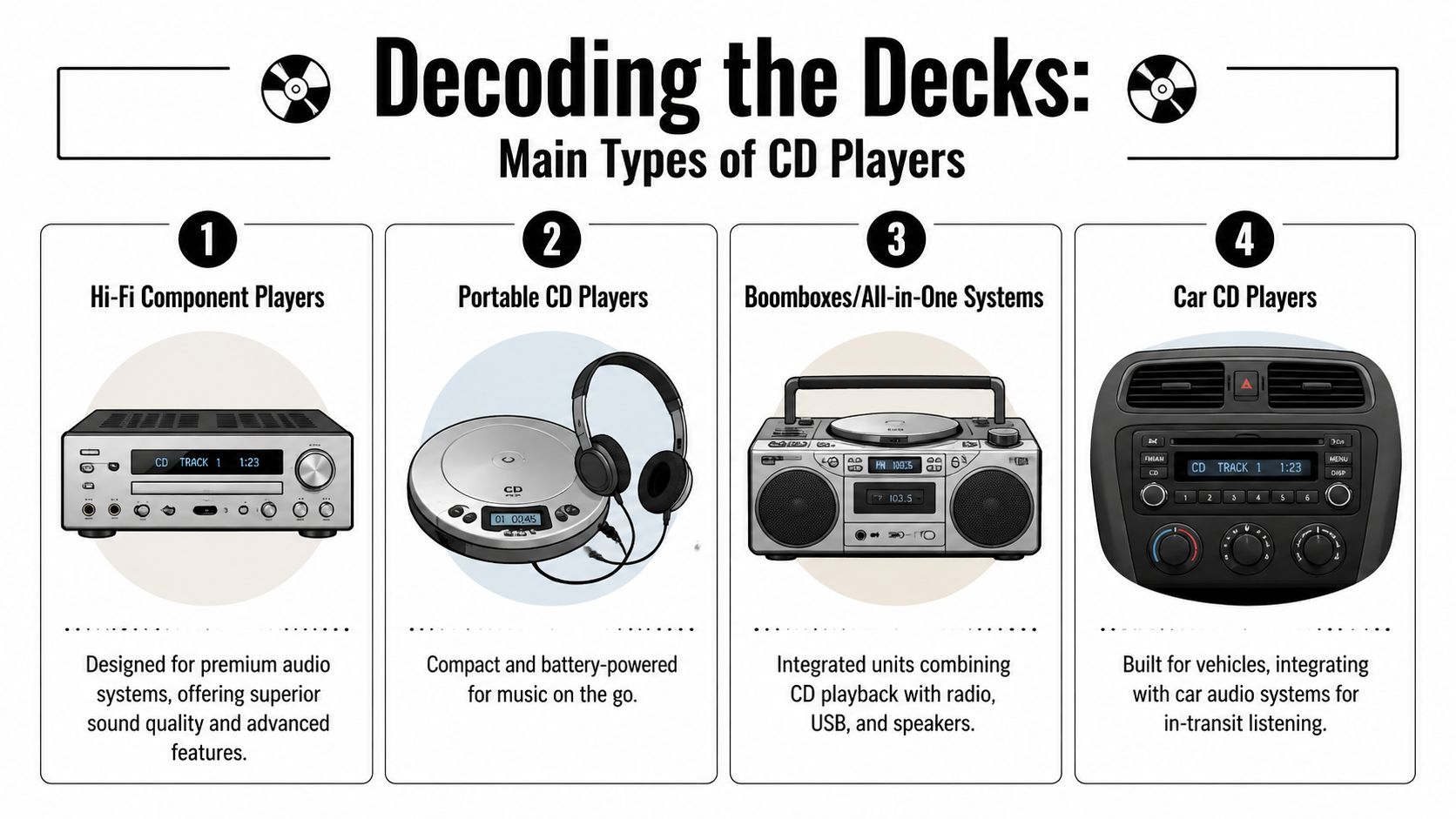
Home hi-fi players
Many listeners should begin here. A proper hi-fi CD player is designed to sit in a system with an amplifier and speakers, do one job properly, and stay out of the way. You load the disc, press play, and get consistent analogue output without fiddly workarounds.
For weddings, dinner sets, drinks receptions, and home listening, this category often makes the most sense. The controls are simple, the output stage is usually cleaner than cheaper all-in-one gear, and the chassis tends to be more stable on a shelf or rack.
What it doesn’t do is perform like a CDJ. If you need live looping, hot cue thinking, or fast tactile pitch moves, a standard hi-fi unit isn’t your tool.
Portable players
Portable CD players have come back into view because people want physical media without dedicating a whole shelf to separates. They’re handy as compact listening devices and, in some systems, useful as secondary transports or backups.
They can make sense in small spaces, temporary setups, or as a way to audition discs away from the main rig. But I wouldn’t choose one as the core deck for professional event use unless the role is very narrow and the workflow is very controlled.
A portable player is best treated as a specialist extra, not an all-purpose answer.
DJ players
A proper DJ CD player is built around control, not romance. The priorities are access speed, track navigation, cueing, tempo adjustment, and confidence under pressure. If your work depends on transitions rather than just playback, this is the category that starts to matter.
The trade-off is obvious. Many DJ-focused machines are less satisfying for relaxed listening. They can sound perfectly competent, but that isn’t the same as feeling refined in a home system. The interface can also be excessive if all you want is to hear an album cleanly from start to finish.
CD transports
A transport is for buyers who already know why they want one. It reads the disc and sends a digital signal onward to an external DAC. That means the quality of the DAC becomes part of the decision, not an afterthought.
Collectors often prefer this route because it lets them upgrade the conversion stage separately from the transport mechanism. It also suits systems where the DAC is already the star of the chain.
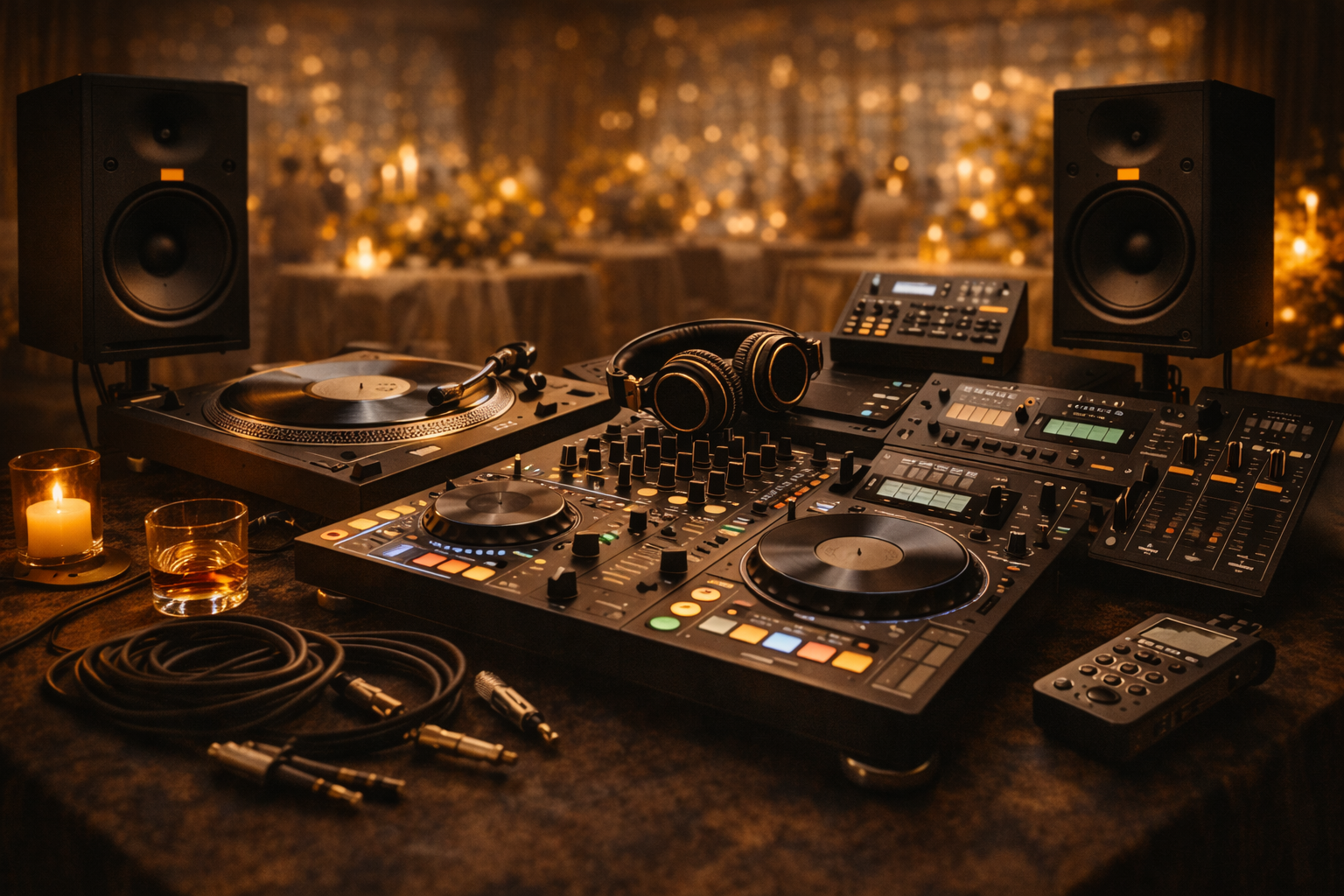
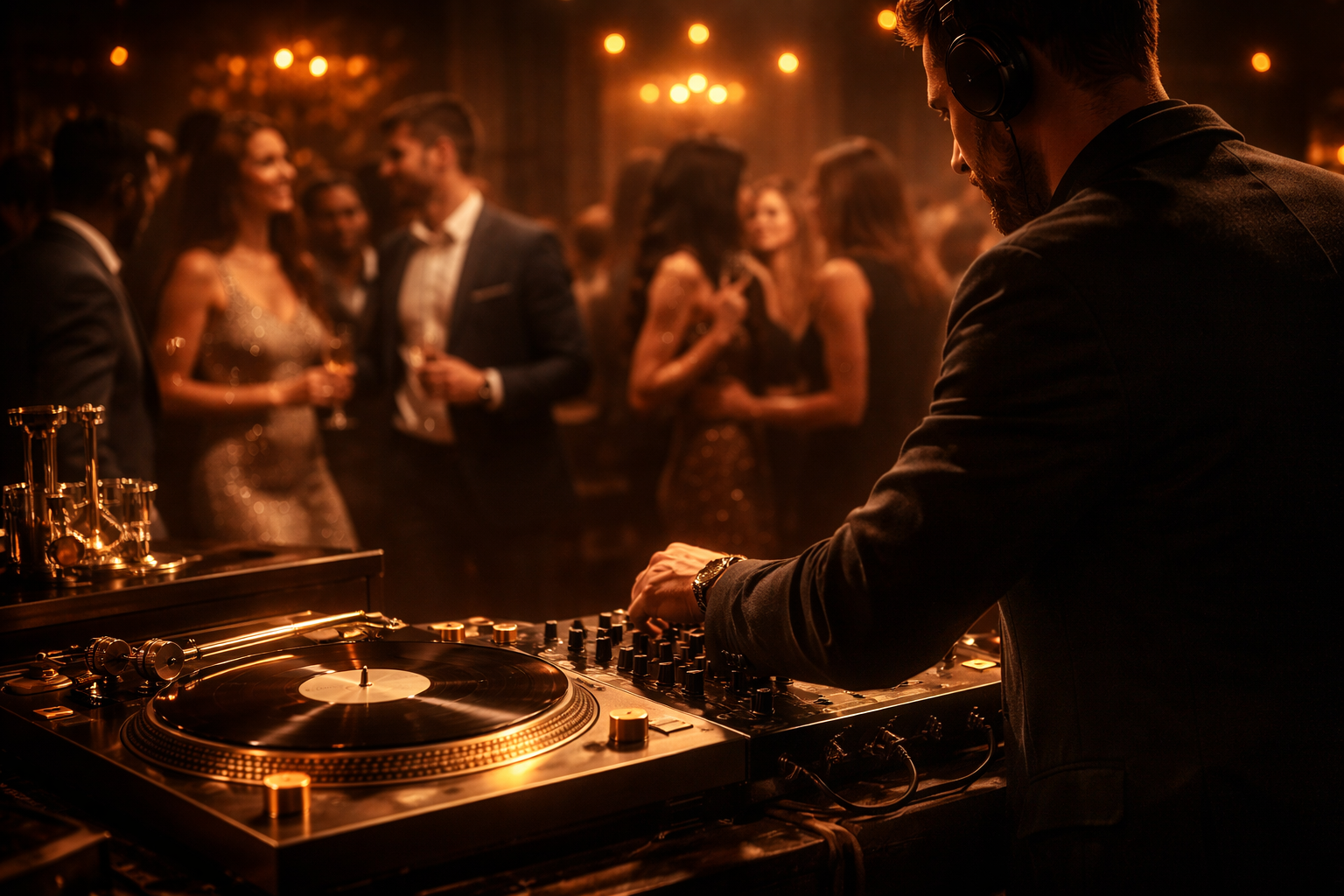
For anyone trying to visualise the kind of setup culture this sits within, this DJ booth image captures the practical side of organised playback gear. In real use, layout matters almost as much as the machine itself.
The mistake buyers keep making
The common error is buying by hype rather than by job description.
- For sofa listening choose a hi-fi player or transport-led system.
- For compact convenience a portable model can fit.
- For mixing and live control use DJ-specific hardware.
- For collector systems with an external DAC a transport is often the smarter spend.
If you identify the role first, the best cd player becomes much easier to spot.
What Defines a Great CD Player Key Features to Evaluate
Specs matter, but only when you translate them into behaviour. A player can look excellent on paper and still annoy you every week. The best cd player isn’t the one with the longest feature list. It’s the one that reads discs consistently, fits your system properly, and sounds right in the context you’ll use it.
DAC quality and what you’ll actually hear
In an integrated player, the DAC handles the conversion from digital data on the disc into analogue sound for your amplifier, mixer, or active speakers. That stage shapes the presentation more than many casual buyers realise.
A better DAC won’t turn a poor master into magic. What it can do is preserve timing, reduce harshness, and keep bass, vocals, and upper-end detail from collapsing into each other. With disco and funk in particular, that matters. Tight rhythm sections expose sloppy conversion quickly.
If you already own a strong external DAC, the internal DAC matters less because a transport or digital output can bypass it. If you don’t, then the built-in conversion stage becomes central to the value of the machine.
Outputs decide flexibility
Don’t gloss over the rear panel. The outputs determine how easy the player is to live with.
Here’s the practical breakdown:
- RCA analogue outputs best for direct connection to an amplifier, mixer, or powered speakers with the right interface.
- Coaxial digital output useful when feeding an external DAC or another digital stage.
- Optical digital output handy when you need digital isolation or your existing kit is set up around optical input.
A home buyer can get away with a basic output selection if the system is fixed. A DJ or event planner usually benefits from more than one route. That gives you options when a venue’s system, mixer, or backup chain changes at the last minute.
Buyer check: If you can’t explain how the player will connect on day one, you’re not ready to buy it.
Chassis, tray feel, and vibration control
Marketing copy frequently drifts into nonsense. Build quality matters, but not because aluminium always sounds better or because a thick faceplate is somehow magical. It matters because a stable machine behaves better over time.
When I’m assessing a player for event use or regular handling, I care about three things:
-
Tray confidence
Does the tray open and close cleanly, or does it feel flimsy from the start? -
Button response
Are the controls positive, or do they feel vague and cheap? -
Mechanical composure
Does the chassis stay calm when the room has bass energy or when the unit sits in a real rack with other gear?
A vibration-damped design is useful because CD playback is still mechanical. The laser has to read the disc accurately. Poor damping and weak transport design can show up as mistracking, noise, or general fussiness.
Disc handling matters more than brochure polish
For a lot of UK buyers, especially those with mixed collections from the 80s, 90s, and later reissues, the key feature isn’t glamorous. It’s tolerance. Can the player deal with a real library rather than showroom-perfect discs?
Some decks are easygoing. Some are absurdly picky. You only find out once you start feeding them older compilations, slightly marked singles collections, and discs that have travelled through cars, lofts, and house moves.
That’s why I’d rank disc reading confidence above fancy menu systems for many buyers.
For event work, control features matter differently
A living-room player and an event player aren’t judged by the same standards.
For events, look for:
- Fast track access if you need to reach specific songs quickly
- Clear display legibility in lower light
- Reliable remote operation if the unit is used from a distance
- Predictable startup and disc loading so the machine doesn’t become the weak point in the room
For performance-oriented decks, you’d add pitch control, cueing precision, and responsive handling. But if your role is elegant playback rather than club-style mixing, simplicity often wins.
The feature shortlist that actually matters
If you want a clean filter for shopping, use this:
| Feature | Why it matters in practice |
|---|---|
| Stable transport mechanism | Better reading consistency and less fuss with older discs |
| Quality DAC or digital output | Determines whether the player stands alone well or integrates with external conversion |
| Sensible outputs | Makes setup easier with amplifiers, mixers, and active speakers |
| Solid chassis | Helps reliability and reduces mechanical annoyance |
| Clear controls | Faster operation under pressure |
A great CD player isn’t defined by novelty. It’s defined by whether it keeps doing the job without drama.
The Best CD Player For Your Specific Purpose
There is no single best cd player. That answer changes the moment you decide whether the machine is earning its keep at a wedding, sitting in a collector’s rack, or backing up a DJ set when the laptop decides to misbehave.
A lot of generic reviews flatten those differences. In the UK, that misses the point. Event planners need stable playback into mixers and venue systems. Collectors need good handling with older pressings from the 80s and 90s, plus a sensible upgrade path. DJs often need a deck that can sit unobtrusively in a rig until the moment it has to save the night.
For elegant weddings and corporate events
For formal events, calm behaviour matters more than a flashy spec sheet. The player needs to start quickly, read discs without fuss, and feed a clean analogue signal into an amp, mixer, or installed system. If it sounds sharp after three hours of soul, Motown, disco, and vocal pop, the room feels tired even when nobody can explain why.
The Marantz CD6007 suits that role well. It has the sort of refined, easy-going presentation that works during drinks receptions, dinner service, and lower-volume background sets. It also makes sense for event professionals who want a traditional hi-fi style player with straightforward RCA integration, rather than a DJ deck with extra controls they will never use.
It works best for:
- Weddings and corporate rooms where long-session listenability matters
- Playback of mixed libraries that jump from older UK compilation discs to cleaner modern releases
- Install-style setups using amplifiers, zone systems, or compact mixers
Use caution if your work involves live cueing, instant access routines, or performance tricks. In that case, a hi-fi deck slows you down.


For dedicated listening and collecting
Collectors often get better value by deciding one thing first. Do you want an all-in-one player, or do you want a transport that feeds an external DAC?
The Cambridge Audio CXC v2 appeals to buyers in the second group because it keeps the job narrow. It reads the disc and sends the digital signal onward. That approach suits a rack where the DAC, amp, and speakers have already been chosen with care, and where the CD player is part of a longer-term system rather than a quick one-box purchase.
That can be the right move for collectors with shelves full of older UK pressings, early CD masterings, and charity-shop finds that deserve better than a flimsy budget mechanism. It also gives you more freedom later if you want to change the DAC without replacing the transport.
Still, it is not the automatic smart buy. If the rest of the system is modest, an integrated player usually makes more sense and keeps more of the budget on the parts you will hear.

For buyers who need confidence with older discs
This is the category many reviews gloss over, and for UK buyers it matters a lot.
A library built from 80s albums, 90s dance comps, second-hand classical box sets, and ex-car CDs asks more of a player than a stack of spotless demo discs. Some machines sound lovely once they lock on, but take too long to read the table of contents, skip on minor marks, or become irritating on longer compilations with lots of track changes. For collectors and event users, that behaviour gets old very quickly.
If your shelves contain plenty of used discs, judge the player by temperament as much as sound. Quiet loading, predictable track access, and a transport that does not panic at light wear are worth more than another decorative feature on the front panel.
A sensible at-home test looks like this:
- Start with a clean disc to confirm baseline performance
- Add a used but serviceable disc from the 80s or 90s
- Try a long compilation with many track jumps
- Run a full session instead of one or two tracks
- Check output compatibility with your amp, mixer, or active speakers
For DJs and event professionals building flexible rigs
A CD player in an event rig has to fit the whole chain. Sound quality still matters, but so do routing, visibility, and backup value. A lovely domestic deck can become awkward if it is buried in a rack, hard to control in dim light, or inconvenient to patch into a mixer alongside wireless mics, laptops, and media players.
For DJs, the practical split is simple. If CDs are your main performance format, buy a proper DJ-oriented player with direct access, cueing control, and handling that feels immediate. If CDs are there for ceremony music, dinner playlists, or emergency backup, a reliable hi-fi or install-friendly machine is often the better call because it is quieter, simpler, and less likely to invite accidental button presses.
That room-and-rig perspective gets overlooked, even though it shapes buying decisions more than brochure language. This event presentation image captures the kind of setup thinking many buyers miss. The player is only one part of the job. It has to serve the flow of the event.
A quick video can help if you want to see more physical-format context before buying:
My practical shortlist by use case
| Use case | Best fit | Why |
|---|---|---|
| Weddings and corporate events | Marantz CD6007 | Refined analogue output, easy system matching, relaxed long-session sound |
| Collector with external DAC | Cambridge Audio CXC v2 | Transport-first design for systems built around separate digital conversion |
| Mixed library with older discs | Stable integrated player with proven disc reading | Better day-to-day tolerance with used UK CDs |
| DJ needing live manipulation | DJ-specific CD player | Faster access, cue control, and better handling under pressure |
What actually holds up
The right choice comes from the job, not the badge.
For event work, choose a player that starts cleanly, routes easily, and stays composed through hours of use. For collecting, decide early whether you want a single-box player or a transport feeding a DAC. For older UK discs, especially well-travelled 80s and 90s titles, put reading stability ahead of prestige. That is the difference between gear that impresses on day one and gear you still trust a year later.
The Real-World Test Handling Legacy UK CDs
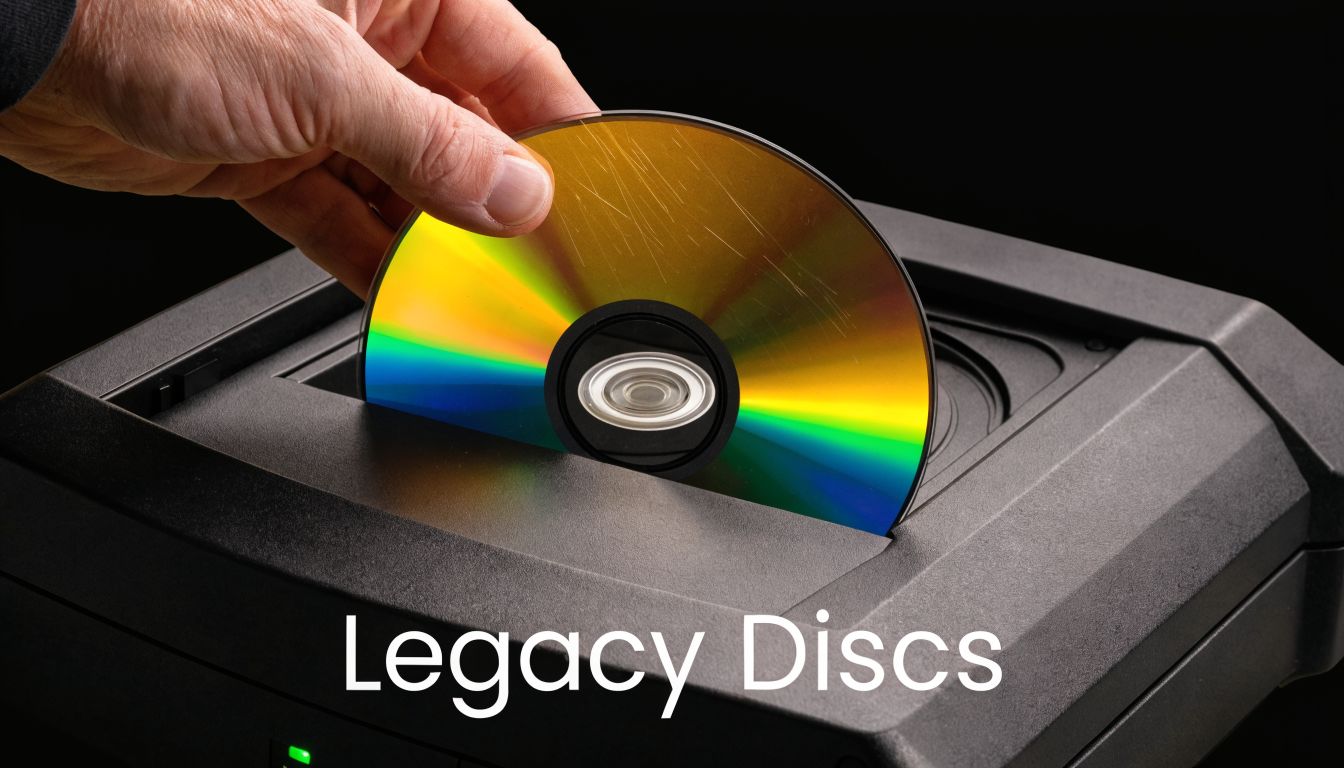
Older UK CDs expose weaknesses fast. A player can sound polished on a spotless modern disc and still stumble on a 1989 compilation that has spent thirty years in a car wallet, a loft, and a charity shop crate.
That matters for DJs, event planners, and collectors across the UK because many working libraries were built long before streaming became the default. They include Ministry-style mixed discs, budget-label reissues, mail-order compilations, early dance singles, and domestic pressings with light marks that look harmless until a fussy transport tries to read them. In practice, the best cd player is often the one that starts quickly, reads consistently, and gets through the set without drama.
Why generic reviews miss this
Many reviews are built around perfect sample discs, a quiet listening room, and a short test window. That is useful for judging tone, detail, and build, but it tells you very little about how a machine behaves with older UK discs that have seen proper use.
I see the gap most clearly with 80s and 90s collections. Some players read the table of contents straight away and carry on. Others hesitate, hunt between tracks, or become unreliable on long compilations and older CD-Rs that are still common in event backup cases. Price does not protect you from that.
For UK event work, disc tolerance matters as much as sound quality. If a player takes too long to recognise a disc or skips when the room is warming up and the rig has been on for hours, it is the wrong machine for the job, no matter how good the spec sheet looks.
What to watch for with older discs
Test behaviour first, then sound.
- Slow disc recognition usually shows the transport is working harder than it should.
- Hesitation when skipping tracks often appears before obvious mistracking.
- Trouble on longer compilations can reveal weaknesses that a short studio album will not.
- Inconsistent results across similar discs are a bigger warning sign than one visibly rough CD failing.
- Noise from the mechanism during loading or track access can point to a deck that is less happy with worn media.
One pattern comes up again and again. Players designed mainly for home listening can sound lovely but be less forgiving with older pressings, while some less glamorous units cope better with mixed-condition libraries and repeated use.
How I’d judge one before keeping it
Use your own discs if you can. Bring three or four that reflect your actual collection, not your best-looking album. One early UK pressing, one long compilation, one slightly marked disc, and one disc you know has caused trouble elsewhere will tell you more than a showroom demo ever will.
For event use, I would also check start-up time, track access speed, and how the player behaves after it has been powered on for a while. Legacy CDs are only half the story. The other half is whether the machine still feels dependable in a rack, under pressure, with modern mixers, powered speakers, and digital sources all sharing the same setup.
The useful question is simple. Will it read the discs you already own, every time you need it to?
Setup Care and Future-Proofing Your Collection
A CD player can be excellent and still disappoint if the setup is careless. Most problems blamed on the machine are really signal-chain issues, poor placement, or unrealistic expectations about how old and new equipment should work together.
Get the connection right first
For a standard home system, analogue RCA outputs into an amplifier are usually the cleanest and simplest route. If you’re using an external DAC, switch to digital output and let the DAC do the conversion. If the player is going into a DJ mixer or event rack, keep cable runs tidy and confirm the gain structure before the event rather than during soundcheck.
For event use, I prefer simple routing over clever routing. Every extra adapter, converter, or last-minute workaround is another failure point.
A few rules help:
- Place the player on a stable surface so vibration doesn’t become part of the problem.
- Keep power and signal runs organised to avoid noise and confusion during setup.
- Label your inputs if the rig changes often.
- Test full playback paths with the actual mixer or amplifier, not just headphones at home.
Hybrid setups need low latency
A lot of buyers now want CD in the same ecosystem as streaming and wireless playback. That’s reasonable, but some combinations are far better than others. According to AV.com’s discussion of current CD player choices, UK hybrid audio sales rose by 28% in 2025, while some popular players introduce delays of over 250ms in multi-room scenarios. For DJ transitions and event timing, that sort of lag is a problem.
So if you’re integrating CD into a modern setup, don’t just ask whether it connects. Ask whether it connects quickly enough to be useful.
This is the practical order of priorities:
- Choose the right output type for the system you already own.
- Check latency behaviour if wireless or multi-room audio is involved.
- Keep a wired fallback path for event work.
- Avoid assuming convenience features are event-safe just because they work in a living room.
Basic care keeps players usable
CD players don’t demand obsessive maintenance, but they do reward basic discipline.
- Handle discs by the edges and return them to cases after use.
- Keep the tray area dust-free so the mechanism isn’t working harder than necessary.
- Don’t stack gear carelessly on top of the player if it runs warm or vibrates.
- Clean gently and sparingly rather than attacking the machine with random cleaning gadgets.
For older collections, disc care matters as much as player care. A sturdy transport helps, but it can’t rescue every avoidable mark.
Archive the collection without abandoning it
Future-proofing doesn’t mean replacing your CDs with files. It means protecting access. If a title matters to you, ripping it to a lossless library gives you a backup and lets you use the same music across more systems without wearing out the disc.
For most collectors and working DJs, the sensible balance is this: keep the discs, archive the important titles, and use the player when the physical format is the point. Use the files when convenience is the point.
That approach respects the collection without trapping it in one format.
Frequently Asked Questions About CD Players
Can I use a professional DJ CD player for home listening
Yes, but that doesn’t mean you should. A DJ-focused deck is designed around cueing, navigation speed, and performance control. If your main goal is sitting down with a full album, a hi-fi player usually feels better to live with and often integrates more neatly into a domestic system.
If you already own a DJ unit, use it. If you’re buying specifically for home listening, buy for that role.
What’s the real difference between a cheaper player and a pricier one
The difference is rarely one dramatic “wow” moment. It’s usually a mix of transport quality, output stage quality, chassis stability, and how calmly the unit deals with difficult discs and long-term use.
A more expensive player can give you cleaner sound and better build. It can also give you features you don’t need. The smart move is to pay for the part of the machine you’ll use.
Is a CD transport always better than an integrated player
No. A transport is only the better choice if the rest of the chain supports it. If you already have a strong DAC or plan to build around one, a transport can be excellent. If you just want a reliable, great-sounding player that works out of the box, an integrated deck may be the better value and the better experience.
Do older CDs sound worse than modern ones
Not automatically. Some older discs are superb. Some are disappointing. The same is true of newer reissues. What matters is the mastering, the pressing quality, and how well your player reads the disc.
That’s one reason serious buyers keep comparing specific editions instead of talking about “CD quality” as if every disc behaves the same way.
Should I prioritise sound quality or disc compatibility
If you own mostly pristine modern discs and listen in a stable home setup, you can put sound quality first. If your shelves are full of older UK pressings, second-hand compilations, and event-use discs, compatibility moves much closer to the top.
The machine has to read the collection before it can impress you with its refinement.
Are CD players still worth buying now
Yes, if your priorities are ownership, predictable playback, and proper album listening. They’re also worth buying if you work events and need a dependable physical source that doesn’t depend on licensing changes, buffering, or app behaviour.
CD isn’t the default format anymore. That’s fine. It’s still one of the most useful specialist formats available.
If you’re planning a wedding, party, corporate event, or you’re looking to choose gear that won’t let you down, VinylGold is built around that same practical standard. Expect thoughtful music curation, reliable event delivery, and a selective approach to sound equipment that favours clean playback, durability, and real-world performance over trend-driven hype.