

You’re probably doing what most clients do at this stage. You’ve found the venue, sorted the guest list, started thinking about timings, and then the music question lands with real weight. Not just “shall we hire a DJ?”, but “what will the room feel like once everyone arrives?”
That’s the point where disc jockey services stop being a line item and start becoming part of the event’s identity. A forgettable soundtrack can flatten a beautiful room. The right one can make a wedding feel personal, turn a birthday into a reunion with momentum, or give a brand event the confidence it needs from the first drink to the last track.
Guests don’t want a random run of chart fillers. They want a night that sounds like them. They want guests from different generations to feel included. They want a dancefloor that builds properly, not one that lurches from song to song with no shape or taste. That’s especially true in London and Kent, where crowds are mixed, musical references are wider, and people can hear the difference between a curated set and someone pressing play on a generic party playlist.
Good event planning works the same way across suppliers. Security, catering, production, and music all shape how smooth the night feels for guests. If you’re organising a larger function and want a sense of how other event professionals think about flow and risk, this guide to expert event security Los Angeles is a useful comparison point. Different market, same principle. The best events feel effortless because the work behind them is organised.
A bespoke soundtrack starts with intention. That means understanding the room, the age mix, the cultural mix, the venue restrictions, the tone of the host, and the moment the night is supposed to peak. It also means knowing when retro sounds carry more emotional weight than the latest hit. A great soul record at the right time can do more than ten trendy tracks in a row.
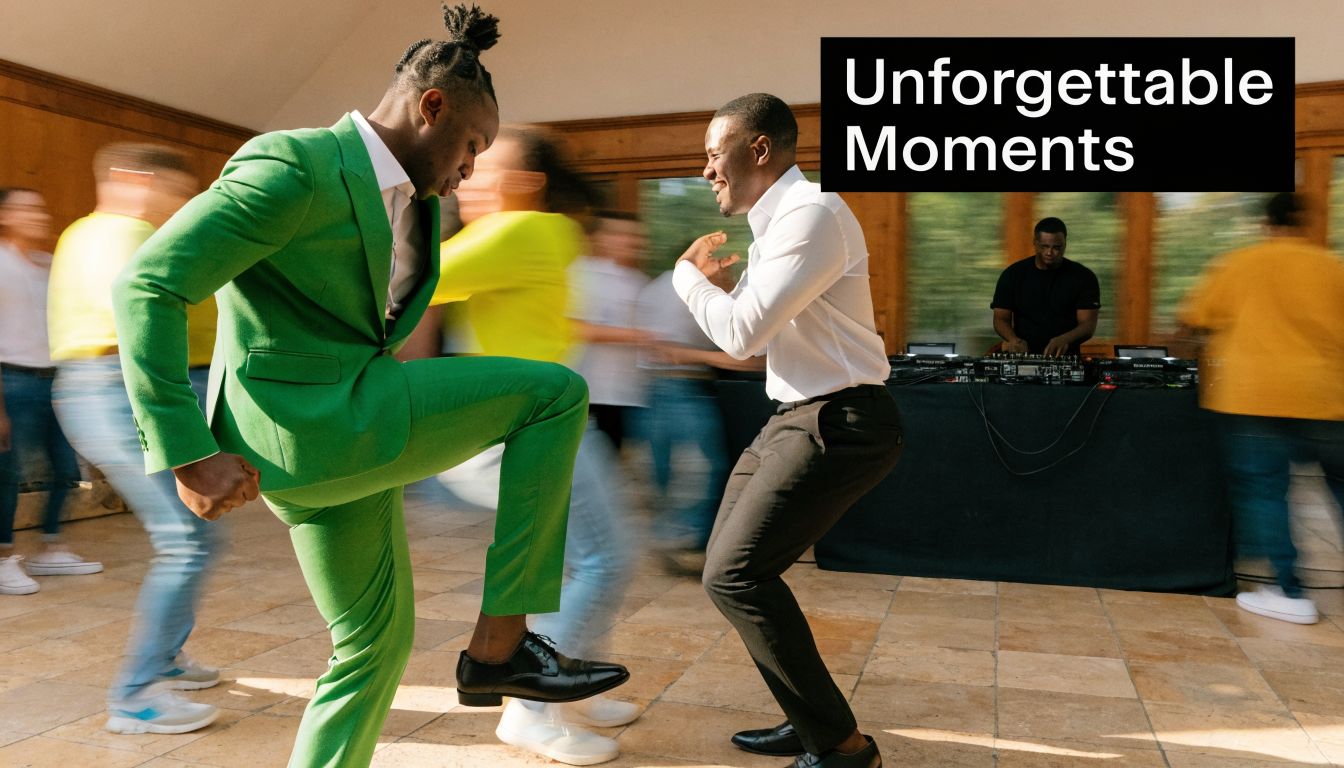
For a visual snapshot of that idea, this music-first event philosophy image captures it well. Music should feel personal. The event should feel legendary.
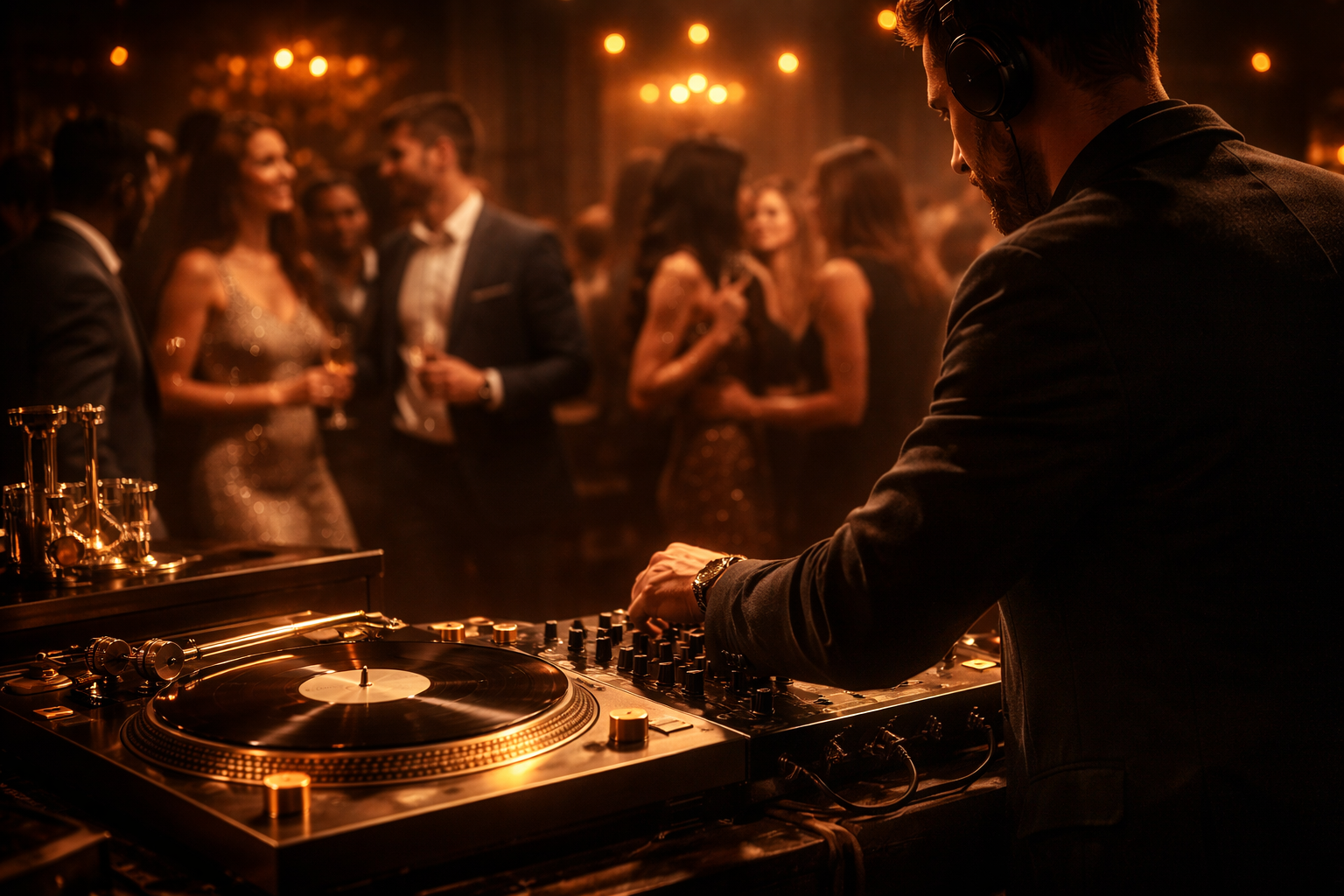
Beyond the Playlist The Soul of Your Event
A strong event doesn’t start on the dancefloor. It starts much earlier, when guests walk in and subconsciously decide what kind of night this is going to be.
That’s why the best disc jockey services do much more than supply speakers and a playlist. They shape pace, mood, anticipation, and release. At a wedding, that might mean holding back the biggest singalongs until the room is ready. At a private party, it might mean opening with groove-heavy funk and soul rather than jumping straight into obvious crowd-pleasers. At a corporate function, it often means balancing polish with enough personality that the event doesn’t feel sterile.
What clients usually get wrong
The common mistake is treating music as a list of songs instead of a sequence of moments. A packed dancefloor rarely comes from song choice alone. It comes from timing, transitions, and confidence in the room.
People often send over a handful of favourite tracks and think that’s the brief completed. It isn’t. A proper brief includes things like:
- Guest mix: Are we playing for two generations, three, or more?
- Cultural touchpoints: Does the crowd respond to disco edits, Brit funk, old-school house, reggae, R&B, or crossover classics?
- Energy curve: Should the night warm up gently, hit hard early, or build toward a late peak?
- Non-negotiables: Which songs matter emotionally, and which songs absolutely shouldn’t be played?
A DJ earns trust by making the room feel understood, not by showing off how much music they own.
Why retro often wins
Retro-inspired sets work because they carry memory. A sharp disco tune, a soulful vocal, or a house classic with the right bassline often reaches across age groups in a way newer music can’t. That doesn’t mean an event should sound like a museum. It means the soundtrack should borrow from records with staying power and blend them into something current and alive.
That’s the soul of the job. Not volume. Not gimmicks. Not over-talking on the mic.
A proper DJ service gives your event a musical point of view. When that’s done well, guests stop noticing the mechanics and start remembering how the night felt.
What Are Disc Jockey Services Really From Radio Waves to Raves
Disc jockey services are often described too narrowly. People say a DJ “plays music”, which is true in the same way saying a chef “serves food” is true. Technically right, but it misses the craft.
A waiter delivers what’s already been prepared. A chef chooses ingredients, judges timing, balances flavour, and makes adjustments as the room changes. A professional DJ works in that second mode. The service is not just access to songs. It’s selection, sequencing, mixing, atmosphere management, and crowd reading.
What the service actually includes
At its most practical, disc jockey services cover several jobs at once:
- Music curation: Building a soundtrack that suits the host, guest list, and event style.
- Live mixing: Moving between songs cleanly so energy doesn’t collapse.
- Programming: Knowing what should happen first, what should wait, and what should never be forced.
- Room management: Adjusting sound, volume, and pace to match the venue and the moment.
- Event flow support: Handling key moments such as entrances, speeches, cake cuts, or a first dance if needed.
The difference between average and excellent work usually sits in the middle three. Anyone can assemble songs. Fewer people can programme a night properly.
How the role developed in the UK
The modern idea of disc jockey services has deep roots in British event culture. According to this short history of DJing, Jimmy Savile claimed to be the first DJ to use two turntables for continuous music at a public party in 1943, solving the problem of pauses between records. That matters because it changed the DJ from someone whose function was to put records on into someone who could maintain movement on a dancefloor.
By the mid-1940s, live DJ-led jazz parties were emerging in London. That shift turned the DJ into a visible part of the social event rather than just a radio voice. It was the beginning of the DJ as host, selector, and musical focal point.
Why disco and sound system culture changed everything
The role became far more complex in later decades. The 1970s disco boom pushed record mixing to the centre of nightlife, while Jamaican sound system culture in Britain shaped the selector tradition, MC presence, bass-heavy thinking, and the idea that music could define a whole social identity. By then, the DJ was no longer background support. The DJ was driving the room.
The strongest modern wedding and party DJs still borrow from those roots. They think in transitions, not isolated tracks.
That history matters today because it explains why retro genres still work so well at events. Disco, funk, soul, boogie, early house, and crossover club records were built for physical response. They invite movement without demanding that every guest know the latest chart release.
What this means for a client today
If you’re hiring disc jockey services in London or Kent, you’re not hiring a human jukebox. You’re hiring someone to make decisions in real time.
That means knowing when a room needs familiarity and when it needs surprise. It means blending a vintage soul record into a contemporary dance track without breaking the floor. It means understanding that ten good songs in the wrong order can fail, while a carefully paced run of records can lift a whole event.
A strong DJ service is part archive, part technician, part editor, and part host. That’s why the right hire changes the entire night.
Choosing Your Sound Types of DJ Services for Every Occasion
Not every event needs the same kind of DJ. That sounds obvious, but many booking mistakes happen because people assume one party format fits all. It doesn’t. A wedding, a birthday, and a corporate launch can all want great music, yet the job is different in each room.
The easiest way to choose properly is to look at the event’s main goal. Is it emotional connection, celebration, or brand presentation? Once you know that, the right style of disc jockey services becomes much clearer.
Weddings need an emotional arc
Wedding DJ work is about more than filling the dancefloor. The soundtrack has to support several different phases of the day, often across one long stretch of time. Drinks reception music needs warmth and elegance. Dinner needs restraint. The evening needs lift, familiarity, and proper pacing.
A wedding crowd is also mixed by design. Friends want energy. Parents want recognisable songs. Older relatives may not dance all night, but they still shape the mood of the room early on. That’s why wedding DJs need range and discipline.
For a retro-inspired wedding set, the best results usually come from layering eras rather than isolating them. A soul or disco foundation can make the room feel elegant without becoming stiff. Later on, old-school house, party classics, and selective modern tracks can push things forward.
What doesn’t work? Treating the reception like a nightclub from the first minute. If the night starts too hard, the floor often empties before its peak.
Private parties need sharper identity
A private party can be looser, but it also tends to be more taste-specific. A fortieth, fiftieth, anniversary, engagement party, or house event usually reflects the host more directly than a wedding does.
That’s where a bespoke approach pays off. Some hosts want wall-to-wall disco and funk. Others want soulful grooves early and party records later. Some want a heavier house finish. The key is to make the event feel intentional, not generic.
A useful comparison looks like this:
| Event type | Main goal | Music approach that works | Common mistake |
|---|---|---|---|
| Wedding | Bring varied guests together | Broad but curated, with emotional pacing | Starting too loudly or too narrowly |
| Private party | Reflect the host’s taste | More personalised, more niche, stronger identity | Relying on obvious songs all night |
| Corporate event | Support brand and guest comfort | Clean, polished, adaptable to speeches and networking | Playing as if it’s a club set |
Corporate events need control and judgement
Corporate bookings are often misunderstood. People assume they should be safe to the point of blandness. In reality, the challenge is precision. The music has to fit the brand, leave room for conversation, support any presentations, and still create momentum when the event moves into its social phase.
For a product launch or brand activation, polished funk, modern disco, soul edits, or tasteful house can do a lot of heavy lifting. Those styles create movement and texture without making the room feel chaotic. If the event later opens into a celebration, the soundtrack can become bolder.
Corporate clients usually care about three things beyond music:
- Professional conduct: Clear communication, punctual setup, no drama.
- Technical confidence: Smooth handling of mics, cues, and venue coordination.
- Brand awareness: Understanding what tone suits the company and audience.
Good corporate DJing isn’t anonymous. It’s measured.
How retro curation fits all three
Retro-inspired DJing isn’t one event type. It’s a method. The method is to use records and genres with groove, personality, and musical depth, then adapt them to the room.
For weddings, that often means emotional familiarity. For private parties, it means identity and nostalgia without cheese. For corporate work, it means style without clutter.
If you’re choosing between providers, don’t ask only what events they do. Ask what kinds of rooms they understand. The answer will tell you far more than a broad list of services ever will.
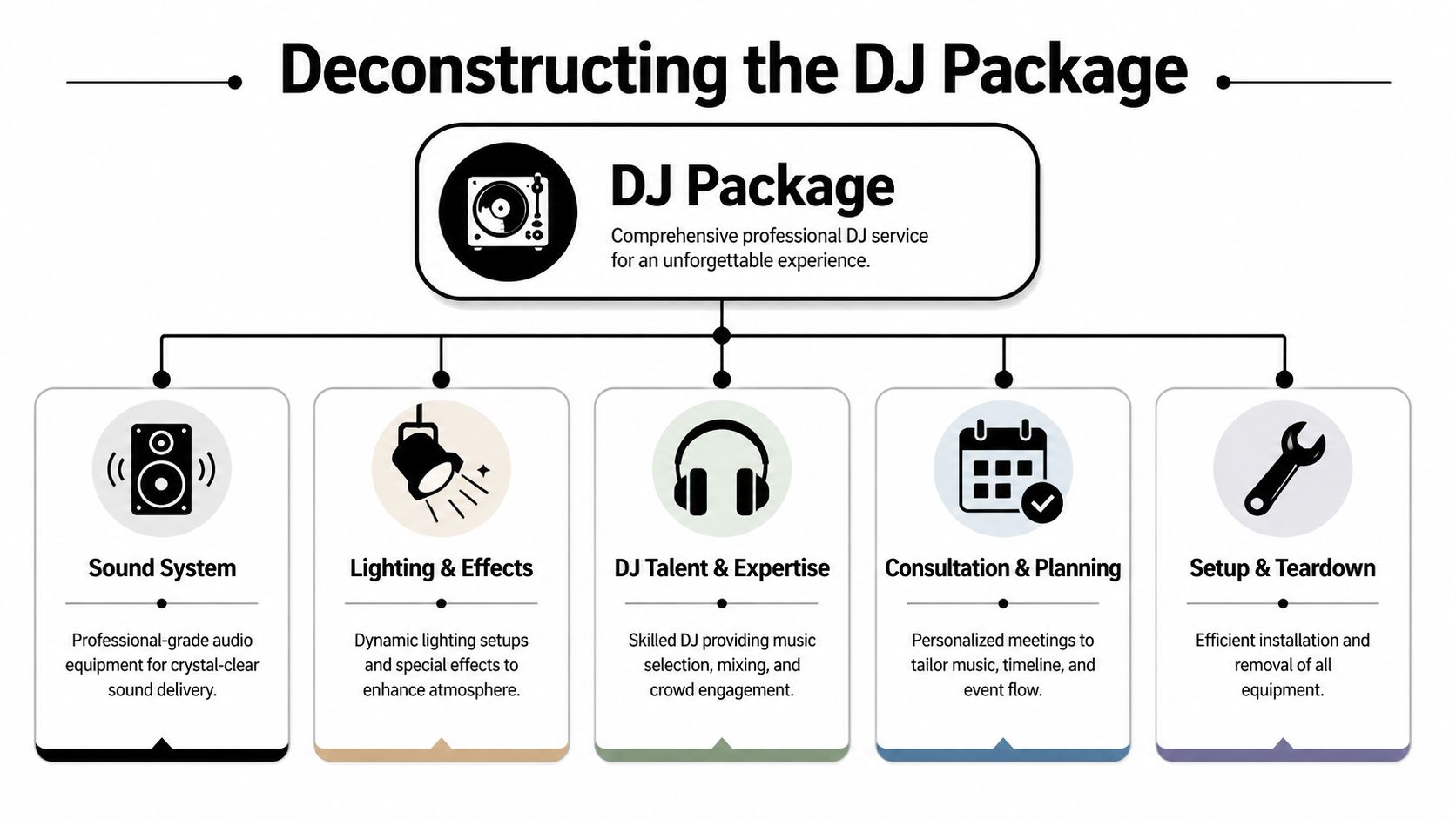
Deconstructing the DJ Package Sound Lights and Soul
People often ask what they’re paying for when they book disc jockey services. The honest answer is that they’re paying for a system, not just a set.
That system includes planning, transport, setup, technical judgement, music curation, live performance, event flow support, and contingency measures if something fails. Strip those out and you may still have music. You won’t have a dependable event service.
Sound is the foundation
In UK venues, professional-grade audio equipment is essential. This professional wedding DJ guide notes that pro DJs use commercial-grade PA systems with 1000-2000W RMS power and DSP room correction, which can improve sound coverage by up to 30% and reduce feedback by 40% compared to consumer setups.
That matters because venue acoustics are rarely forgiving. Barns bloom in the low end. Marquees can sound brittle. Some hotel function rooms throw reflections everywhere. A proper setup compensates for the room instead of fighting it.
The difference is obvious in speeches. It’s also obvious at the dancefloor. Guests shouldn’t need to shout at dinner because the speakers are aimed badly, and the dancefloor shouldn’t feel weak because the system has run out of headroom.
What a solid package usually contains
A serious package normally includes a mix of performance gear and support gear:
- PA system: Active speakers suited to the room size and layout.
- Microphones: Reliable wireless handhelds for speeches and announcements.
- DJ booth and playback setup: Controller or turntable setup, mixer, monitoring, and clean cabling.
- Lighting: Enough to shape the room without turning every event into a laser show.
- Backup items: Spare cables, backup playback options, and power contingencies.
- Setup and teardown: Time, labour, and transport are part of the service.
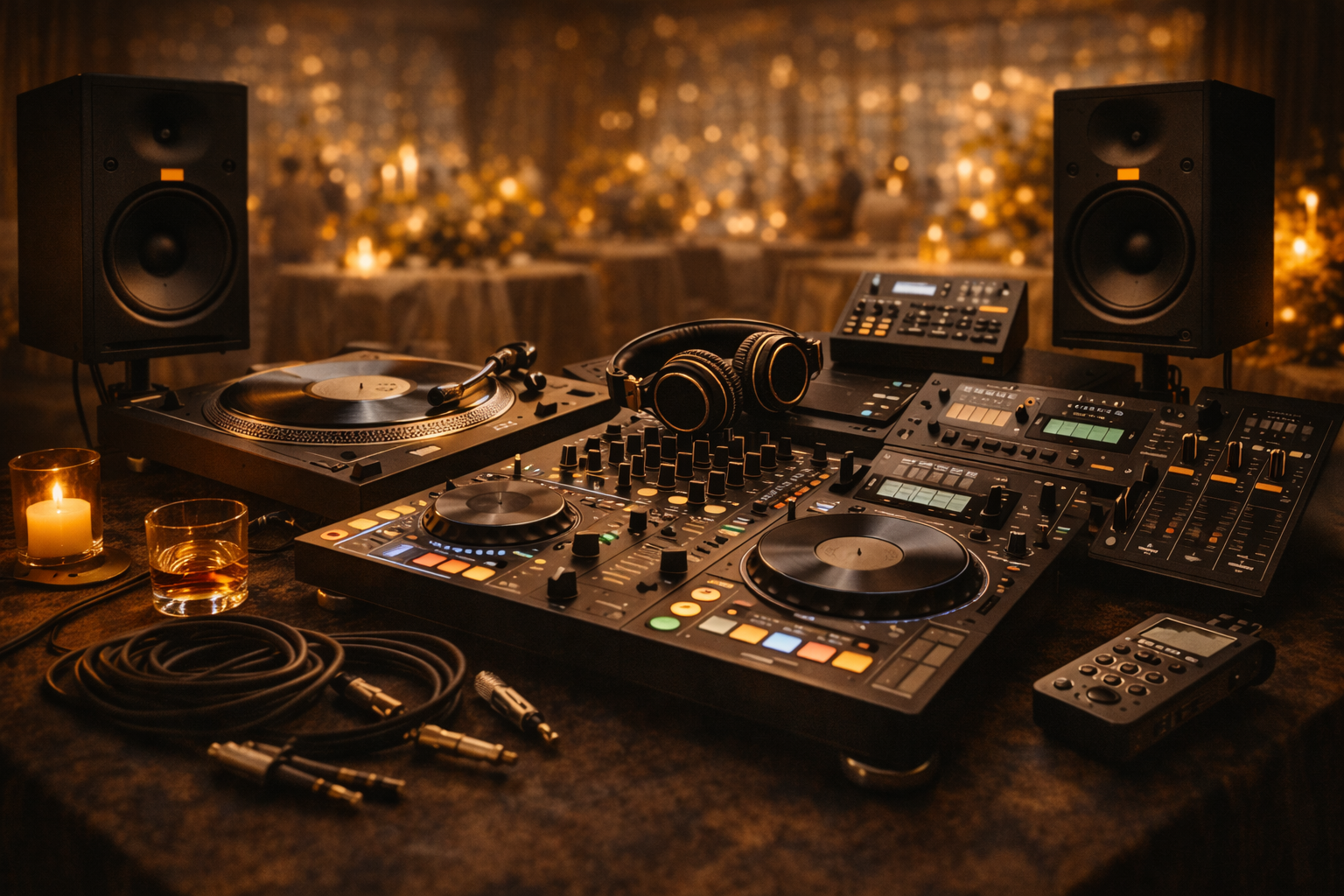
For clients who appreciate a more tactile setup, this gold-toned DJ booth image gives a sense of how visual presentation can complement the sound without overwhelming the room.
Lighting should support the mood
Lighting often gets treated as an afterthought. It shouldn’t. The right wash, booth lighting, and dancefloor effects help guests understand when the event has shifted from dinner or drinks into celebration mode.
What doesn’t work is over-lighting. If every surface is flashing from the moment guests arrive, the room loses shape. Better lighting design is selective. Warm during arrival. Subtle through dinner. More kinetic once dancing starts.
Practical rule: If the lighting distracts from the people in the room, it’s doing too much.
Planning is part of the package too
A DJ package isn’t only hardware. The planning work before the event often decides whether the night feels smooth. That includes a consultation, a playlist brief, timing notes, special-song coordination, venue logistics, and cue points for formal moments.
This part matters most when clients want bespoke music. You can’t build a convincing disco, funk, soul, and house set for a mixed London crowd by guessing. The DJ needs context, boundaries, and a sense of what the host wants the room to feel like at different stages.
Why reliability changes the value
Cheap packages tend to look similar on paper. The difference shows up on the day. Is the sound harsh? Does the mic cut out? Are there visible cable issues? Does setup look rushed? Does the DJ have backup options if a component fails?
That’s the true value in a professional package. Not glamour. Resilience.
A good DJ package gives you sound that’s even, mics that are clear, lighting that suits the room, and a performance setup that keeps the night moving. The best ones also give you calm. That alone is worth paying for.
How to Choose and Book a DJ in London and Kent
The booking usually feels simple at first. You find a name, check a few clips, ask the price, and hope the rest sorts itself out. Then the actual questions arrive. Will this DJ read a mixed London wedding crowd properly? Can they move from drinks to dinner to dancing without jolting the room? If you want a retro-led night with character, can they build that atmosphere without turning it into a niche set that leaves half the guests behind?
That is the difference between hiring someone to play songs and hiring someone to shape an event.
In London and Kent, the room is rarely straightforward. Weddings bring three generations into one space. Private parties often reflect the host’s own taste more strongly, which is great until the brief gets too narrow. Corporate events add timing, presentation, and volume constraints. A good booking process deals with those realities early.
Start with musical fit
Price matters. Musical fit matters first.
A lower quote is no bargain if the DJ only knows how to push obvious chart fillers into every slot. If your event needs warmth, identity, and a proper sense of progression, look for a DJ with a clear point of view and the judgment to adapt it. For retro-focused events, that means more than dropping a few disco anthems between current hits. It means understanding how soul, funk, disco, boogie, reggae, Motown, 80s dance, and old-school house connect, and when each one should arrive.
Ask for examples from events like yours. A club set proves one skill. A wedding in Kent with family at the front, dancers at the back, and a strict venue finish time proves another.
Ask questions that reveal how they work
Good DJs give specific answers. Vague answers usually mean vague preparation.
Ask questions like these:
-
How would you build the night for our guest mix?
Listen for detail about pacing, energy shifts, and what happens in the first hour, not just “I play a bit of everything.” -
How do you handle a retro brief without making the set feel dated?
An experienced DJ should be able to explain how recognisable classics, deeper cuts, edits, and a few newer records can sit together. -
Do you play vinyl, digital, or both?
There is no single correct answer. Vinyl brings texture, presence, and ceremony. Digital gives speed, range, and fast request handling. The right choice often depends on the room, the brief, and how much flexibility the event needs. -
What do you need from us before the event?
You want a clear process here. Must-plays, do-not-plays, timings, first dance details, venue restrictions, and a sense of who must feel included all matter. -
How do you deal with requests?
The best answer is balanced. Requests can help open the floor. They can also wreck momentum if every third song comes from a different agenda.
Couples who are crafting your perfect Battle Abbey wedding playlist often run into the same issue. They know what they love, but they also need a soundtrack that works for the whole room. A capable DJ can hold both ideas at once.
If the answer sounds like every event gets the same formula, keep looking.
Listen for trade-offs
Experienced DJs talk candidly about compromise because every event has some.
A vinyl-centred set sounds special, and guests notice it. They notice the decks, the sleeves, the deliberate selections, the sense that the music is being chosen rather than pulled from an endless file list. But vinyl also limits instant access, so formal moments, niche requests, and backup planning usually benefit from a hybrid setup.
The same goes for genre. A host may love rare groove, northern soul, or leftfield disco. Those records can be gold in the right moment. They can also lose the wider floor if they arrive too early or too often. The job is to protect the identity of the night while keeping the room with you.
That judgment matters more than saying yes to everything.
Get clear on what the fee actually covers
DJ prices in London and Kent vary for good reason. One booking may be a four-hour birthday party with a straightforward setup. Another may involve ceremony audio, speeches, room turnaround, uplighting, extra travel, sound checks, and a late finish.
Ask what is included, and ask why it is included.
Here is a practical way to read common service levels:
| Service Tier | Best For | Includes | Typical Duration |
|---|---|---|---|
| Essentials | Smaller parties and straightforward receptions | DJ performance, core sound system, basic planning, setup and pack-down | Evening only |
| Signature | Weddings and larger private events | Expanded consultation, custom playlist planning, microphones, lighting, full event coordination support | Half day to full evening |
| Extended | Multi-phase weddings and branded events | Multiple music phases, broader production support, formal cue management, extended performance window | Multi-part event |
The planning line matters. So does backup gear. So do microphones that sound clean when speeches start. A serious service covers those points before anyone asks on the day.
VinylGold offers wedding, party, and corporate DJ services built around custom playlist curation, retro and vinyl-inspired sets, and professional sound support. That model suits clients who want musical identity and proper event handling in one booking.
Read the contract properly
The contract should clear things up, not bury the important parts.
Check these points carefully:
- Arrival and finish times
- Overtime rates
- Setup space and power requirements
- Venue access and load-in details
- Cancellation terms
- Backup cover for illness or equipment failure
- What is included for speeches, announcements, and formal cues
This is basic event discipline. It also tells you a lot about how the DJ runs the business.
Book earlier than feels necessary
DJs with a defined style and strong word-of-mouth usually get booked well ahead for summer weekends, bank holidays, and popular wedding dates.
A practical rule helps. Book as soon as the date, venue, and broad brief are confirmed. If you already know you want a vinyl-led disco, soul, funk, and house approach rather than a standard Top 40 format, do not leave that search until the last minute. The more specific the brief, the smaller the pool of suitable DJs.
The final check
Before you commit, ask one last question. Can this DJ explain how the night should feel at 7pm, 9pm, and 11pm?
That answer tells you whether they understand event flow, crowd psychology, and music as atmosphere. In this line of work, that is what clients are really booking.
The VinylGold Difference Real Events and Rave Reviews
The easiest way to understand bespoke disc jockey services is to look at real event situations. Not made-up “success metrics”. Just the actual brief, the actual room, and the choices that made the event work.
A Kent wedding that needed warmth before impact
One wedding brief centred on a familiar problem. The couple loved disco, soul, and house, but they didn’t want the evening to feel like a niche club night. The guest list included older family, friends with broad mainstream tastes, and a smaller group who would stay late and dance hard if the music earned it.
The right approach in that room was restraint at the start. The early evening leaned into soulful classics, vocal warmth, and recognisable grooves. Once the floor had confidence, the set opened into disco edits, funk-driven party records, and later old-school house with enough familiarity to keep the wider crowd engaged.
That’s the kind of event where people don’t always talk about “mixing”. They talk about the fact that the music somehow felt right all night.
“We wanted personality, not wedding cliché. The music felt like us, but everyone was included.”
A London brand launch that needed polish
A corporate brief usually calls for different discipline. In one London launch setting, the ask was straightforward on paper but subtle in practice. The room needed to feel stylish during arrivals and networking, support speeches cleanly, and then become more social without an awkward jump in tone.
That meant choosing records with rhythm and confidence but not too much lyrical or sonic clutter in the opening stretch. Funk, modern disco textures, and selective soul kept the room moving. After the formal section, the set gained more bounce and edge without turning the event into a generic party package.
That’s where professional judgement matters. The best corporate sets often succeed because they never force the room faster than the room wants to move.
Reliability is part of the story
There’s another side to successful events that guests often don’t see. Gear reliability. That matters far more than people realise, especially at outdoor and semi-outdoor events in the South East. This UK event equipment article notes that 31% of events in South East England faced audio issues from subpar gear.
That’s one reason some DJs and event organisers pay close attention to durable, pro-grade hardware and proven setups rather than trend-led purchases. If you’re curious about the identity behind that approach, this Vinyl Gold brand mark gives a simple visual reference point.

What clients usually remember
Clients rarely remember the model number of the speakers or the exact mixer on the booth. They remember outcomes:
- The speeches were clear.
- The room never felt awkward.
- The music sounded chosen, not recycled.
- Different groups of guests found their moments.
- The floor held when it mattered.
The most convincing review of a DJ is when guests ask for the name before the night is over.
That’s what bespoke, retro-aware curation is supposed to do. It turns technical competence into atmosphere, and atmosphere into memory.
Set the Gold Standard for Your Event Soundtrack
A great event soundtrack isn’t accidental. It comes from planning, taste, technical control, and the confidence to build a night properly. That’s what strong disc jockey services provide.
The right DJ doesn’t just fill silence. They shape momentum, protect key moments, and give the room a musical identity. For weddings, that means balancing emotion and energy. For private parties, it means reflecting the host’s taste without losing the crowd. For corporate events, it means sounding polished without becoming bland.
If you’re still refining the musical direction for a wedding, resources like crafting your perfect Battle Abbey wedding playlist can help you think more clearly about the songs and moments that matter most before you speak to any supplier.
The main thing is simple. Don’t hire a DJ on the assumption that all DJs do the same job. They don’t. The difference between generic and memorable often comes down to curation, timing, and reliability.
If you want an event that feels personal, moves naturally, and leaves guests talking about the music for the right reasons, treat the DJ booking like a creative decision, not just a technical one.
If you’re planning a wedding, private party, or corporate event in London or Kent and want a soundtrack built with taste, structure, and proper technical care, speak to VinylGold. Share your date, venue, and the kind of atmosphere you want, and start with a conversation about the music rather than a generic package.