

You’re probably doing what most clients do at the start. You’ve got a date, a venue shortlist, a rough guest count, and a growing sense that the music could either make the event feel effortless or dampen its spirit.
That’s why searching for a music agency in london can be oddly frustrating. The market looks crowded, every site promises a packed dance floor, and the difference between a polished solo operator, a specialist DJ service, and a full agency isn’t always obvious. For weddings, private parties, and corporate events, the essential question isn’t only “Can they play good songs?” It’s “Can they shape the room properly, read the moment, and carry the energy from one part of the event to the next?”
The best music hires don’t win because they own a flashy controller or list every genre under the sun. They win because they understand flow. They know when to hold back, when to lift the room, when to pivot, and when to leave a favourite track alone because it would break the atmosphere instead of building it.
First Steps Before You Search for a Music Agency
A common mistake is to begin incorrectly. The initial impulse is to search first and think later. That usually leads to too many tabs, too many generic promises, and no clear way to compare one service with another.

London gives you huge choice, which is brilliant and difficult at the same time. London generated over 30% of the UK’s live music revenue in 2023, and the UK total passed £6 billion according to the UK live music report coverage at Live Music Industry Venues & Entertainment. That concentration means there are plenty of agencies, DJs, and bookers to choose from. It also means you need a sharper brief than you would in a smaller market.
Build a vibe brief before you contact anyone
A good brief isn’t a spreadsheet of song titles. It’s a short description of how you want the event to feel.
Write down answers to these:
- What should guests feel on arrival. Warm, elegant, celebratory, cool, relaxed, high energy.
- What are the turning points. Ceremony, drinks reception, dinner, speeches, product reveal, first dance, late-night push.
- Who’s in the room. Mixed ages, music lovers, corporate guests, family crowd, old friends, colleagues.
- What must the music never become. Too loud too early, wedding disco clichés, background wallpaper, club music at dinner.
This is the difference between “We want funk, soul and party tunes” and “We want stylish music early on, recognisable records later, and a dance floor that feels full rather than chaotic.” The second brief gives a DJ something useful to work with.
Practical rule: If you can describe the room in three adjectives, you’re ready to speak to agencies. If you can only name genres, you’re not there yet.
Think in scenes, not in playlists
A strong event soundtrack works like pacing in a film. You don’t start with the biggest moment. You earn it.
For a wedding, that might mean low-tempo soul or tasteful acoustic edits during arrival, warmer disco and familiar grooves during drinks, then sharper peaks later when guests are ready to dance. For a brand event, it could mean confident but restrained music that supports conversation instead of fighting it.
That same thinking helps with logistics too. If you’re coordinating timings, suppliers and guest communication, a practical planning tool like this event management software comparison can help keep the wider event organised so your music brief doesn’t get lost among everything else.
Decide what kind of partner you actually need
Not every event needs a large agency. Not every event should rely on one freelance DJ with no backup, either.
A simple way to think about it:
| Option | Best for | Trade-off |
|---|---|---|
| Large agency | Big choice, multiple acts, complex bookings | Less personal, sometimes less stylistic consistency |
| Solo DJ | Direct communication, personal style | Backup and admin can be thinner |
| Specialist DJ service | Curated feel with professional process | Narrower stylistic lane, which can actually be a strength |
If your event depends on musical identity, especially in South East London and Kent, the sweet spot is often a specialist service that combines personal curation with proper planning discipline.
How to Evaluate a London DJ Service or Agency
Once your brief is clear, the shortlist gets easier. You’re no longer reacting to branding. You’re checking fit.
A proper evaluation comes down to three things. Musical judgement, technical standards, and professional proof. If one of those is weak, the whole booking becomes shaky.
Musical judgement matters more than genre lists
Any website can claim “we play everything”. That’s not a strength on its own. For many events, it’s a warning sign.
Ask for a recent mix, a sample playlist, or examples of how they handle transitions across the night. Listen for pacing. Does the music have shape? Do they understand restraint? Can they move from stylish background music into fuller dance-floor territory without it feeling forced?
Public profiles can tell you something too. Professional music agencies use metrics when scouting talent, and signals such as weekly streams above 50k for a mid-tier DJ and social engagement above 4% can indicate audience connection, as discussed in this research article on digital music metrics and artist evaluation. For a client, those numbers aren’t the whole story, but they’re useful context. If a DJ has a visible audience and active engagement, it often means they know how to build identity, not just queue tracks.
If you want a visual sense of the atmosphere a DJ is trying to create, even a simple image like this DJ booth moment and crowd energy reference can reveal whether their presentation leans polished, clubby, retro, intimate, or all-purpose.

A good DJ doesn’t just know what to play. They know what not to play yet.
Technical standards separate professionals from hobbyists
Clients often focus on playlists and ignore sound. Guests do the opposite. They feel sound immediately.
Ask what equipment they bring, what they use for smaller rooms versus larger spaces, and whether they can cover more than one area if needed. Clean sound at the right level beats raw volume every time. At weddings, harsh top-end during dinner kills conversation. At corporate events, muddy bass makes networking tiring. At parties, poor gain staging makes the room feel amateur even if the song choice is solid.
Look for signs of discipline:
- Setup planning. They ask where power is, where speeches happen, and when access starts.
- Room-appropriate sound. They talk about coverage and clarity, not just “big speakers”.
- Backup mindset. They mention spare cables, duplicate playback paths, and contingency thinking without being prompted.
Professional proof is more than reviews
Testimonials matter, but they can be vague. “Amazing night” tells you almost nothing. Better proof is specific.
Useful evidence includes:
- Relevant event experience. Weddings if you’re getting married. Brand events if you’re hosting clients. Birthday parties if that’s the brief.
- Clear communication. Fast replies, sensible questions, organised paperwork.
- A coherent style. Their examples sound like the same professional mind at work, not random gigs patched together.
Here’s a quick reading guide:
| What you see | What it usually means |
|---|---|
| Detailed planning forms | They’ve done this enough times to know where mistakes happen |
| Vague promises about any genre | They may be broad but not deep |
| Photos of tidy setups | They understand presentation, not just performance |
| Specific venue or format experience | Less risk on timing, sound, and guest management |
The best fit in a music agency in london isn’t the one with the longest list of options. It’s the one whose taste, process, and standards align with the way you want the room to feel.
The Most Important Questions to Ask Before Hiring
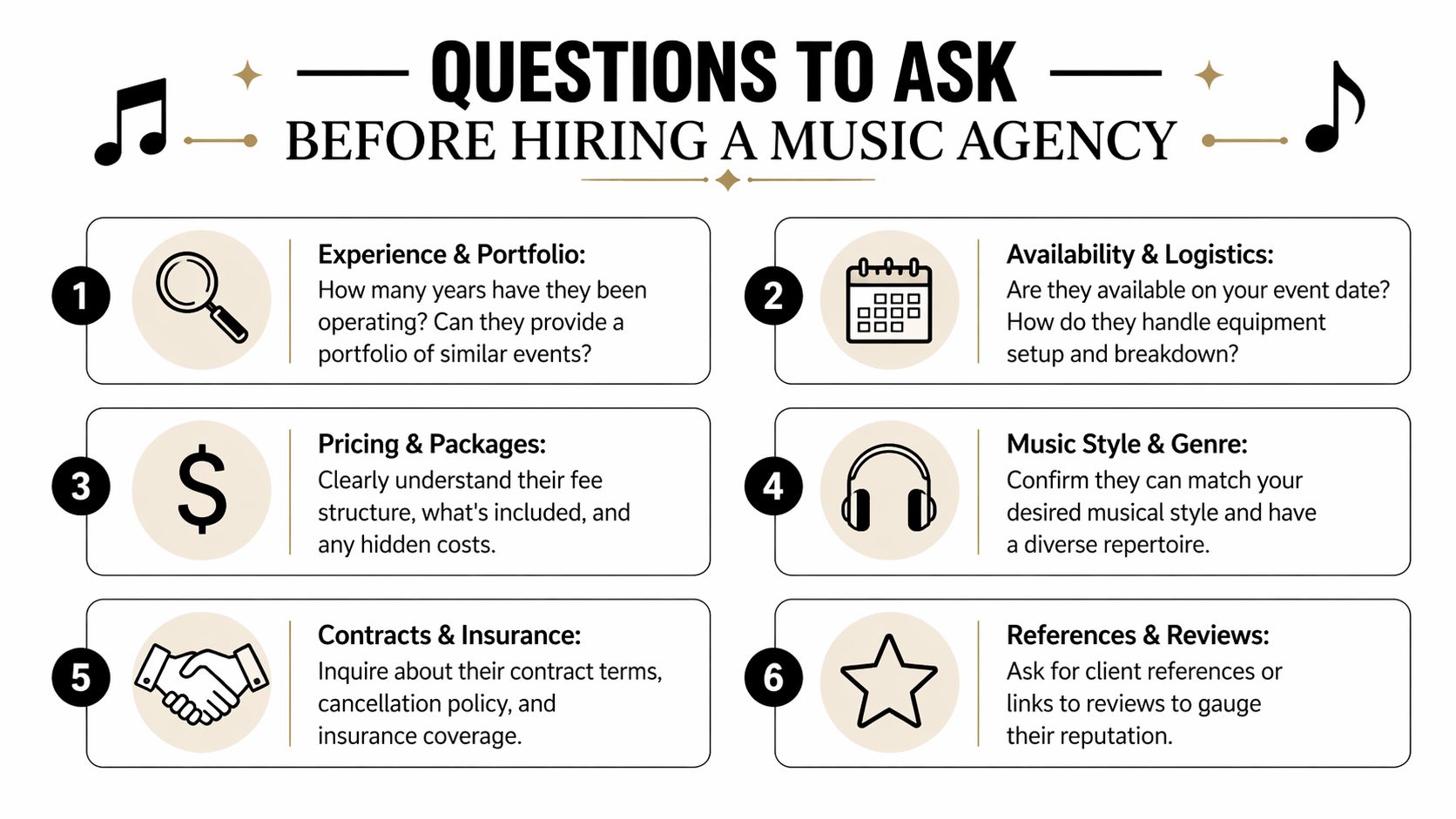
The consultation call tells you more than the website ever will. It allows you to find out whether you’re dealing with a polished operator or someone who appears confident online.
Ask about process before you ask about songs
Music is emotional, but reliability is procedural. If the process is messy, the event usually feels it.
Start with questions like these:
- How do you plan the event timeline with clients
- When do you collect music preferences and must-play tracks
- How do you handle do-not-play songs
- Who is my point of contact before the event
- What happens if timings change on the day
The answers matter because strong agencies and specialist services keep clients by being organised. Industry reporting highlights rigorous process as a retention factor, while issues such as metadata errors and payment discrepancies are common where systems are weak, according to the UK Music methodology document. As a client, you’re not auditing royalty systems. You are checking whether the business behaves like a professional one.
What to listen for: Clear answers, clear ownership, and no irritation when you ask practical questions.
Test how they think about the room
Some DJs answer every music question with genre names. Better ones talk about timing, crowd reading, and transitions.
Ask:
- How do you build from arrival music into the main party
- What do you do if the crowd is older than expected
- How do you balance requests with the flow of the night
- What kind of first hour do you usually play at a wedding or private event
- How do you keep a corporate event lively without making networking impossible
A strong answer won’t be “I just read the crowd.” That phrase gets overused. A stronger answer explains how they manage peaks and plateaus, protect key moments, and keep momentum without rushing.
Cover the unglamorous details properly
Avoidable problems frequently stem from this. Ask directly.
- Insurance. Do you carry Public Liability Insurance if the venue requires it?
- Contract. What exactly is included in writing?
- Setup and breakdown. How early do you arrive, and how long do you need?
- Backup plan. What happens if equipment fails or the assigned DJ becomes ill?
- Payments and cancellations. What deposit is required, and what are the terms if the date moves?
You’re not being difficult. You’re checking whether the service can survive real life.
“If a supplier gets vague when you ask about backup, contracts, or timings, keep looking.”
A quick call can reveal red flags fast
You don’t need an hour to spot trouble. Often, ten minutes is enough.
| Good sign | Red flag |
|---|---|
| They ask about guest mix and venue layout | They only talk about themselves |
| They explain how they pace an evening | They promise every event is wild from the start |
| They welcome detailed preferences | They dismiss your brief as unnecessary |
| They can explain their contingency plan calmly | They say problems “never happen” |
If you leave the call feeling heard, understood, and slightly calmer than before, that’s a strong sign. That’s what professional reassurance sounds like.
Breaking Down DJ Pricing and Packages in London
Price confusion usually comes from comparing unlike with unlike. One quote may include planning calls, ceremony audio, travel, lighting, setup time, and backup cover. Another may be little more than a DJ turning up with a controller.

What you’re actually paying for
With a reputable music agency in london, the fee isn’t just for music on the night. It covers planning, coordination, admin, and risk reduction.
That’s part of why professional agency pricing can be higher than clients expect. The average salary for a music agent in London is approximately £37,672 as of 2026 data, based on Glassdoor salary data for London music agents. That doesn’t tell you what your event should cost, but it does show that proper coordination and booking management sit within a professional cost structure.
Common pricing models
You’ll usually see one of these approaches:
| Pricing model | Best when | Watch for |
|---|---|---|
| Flat package | Weddings and private events with clear timings | Check exactly what hours and equipment are included |
| Hourly rate | Shorter bookings or simpler receptions | Overtime can add up quickly |
| Custom quote | Multi-room sound, brand events, unusual venues | Make sure each line item is explained |
The trade-offs behind a cheaper quote
A lower number can be fine. It can also hide missing pieces.
Check whether the quote includes:
- Pre-event planning. Calls, playlists, and timeline coordination.
- Travel and access. Especially if the venue is outside central London or has awkward load-in.
- Sound for multiple spaces. Ceremony room, terrace, dinner room, main dance floor.
- Lighting and presentation. Not every event needs it, but some rooms look unfinished without it.
- Backup cover. The invisible value that matters only when something goes wrong.
The smartest way to compare quotes is to ask one question: What problem is this package solving for me? If the answer is only “someone will play music”, it’s too thin. If the answer is “your event will sound right, run smoothly, and stay covered if plans change”, that’s where value usually sits.
How VinylGold Delivers Unforgettable London Events
There’s a clear gap in the market for clients who want more than a generic booking service but don’t want the impersonality that can come with a large roster model. That gap is especially obvious for weddings, private events, and stylish corporate bookings in South East London and Kent.

Market analysis points to an underserved demand for specialised DJ booking agencies focused on weddings and private events in South East London and Kent, rather than broad artist-management style coverage, as noted in this analysis of the online coverage gap around specialised DJ booking agencies. That’s why a specialist model works so well here.
The difference is musical philosophy
The strongest specialist services don’t approach an event as a list of songs. They treat it as an arc.
For weddings, that means understanding that the ceremony, drinks reception, dinner and party each need different energy. A room rarely benefits from full throttle too early. Guests need somewhere to go emotionally. A specialist with a strong sense of flow can move from elegance to warmth to release without making any of those changes feel abrupt.
For corporate events, the same philosophy matters in a different way. The music should support the brand, the guest mix, and the purpose of the evening. If the room needs conversation, volume and track choice have to respect that. If the event shifts into celebration later, the soundtrack needs enough personality to lift the room without becoming crude or obvious.
A specialist service earns trust by controlling energy, not by showing off range.
Why the bridge model works
There’s real value in a service that sits between a big agency and a lone freelancer.
You get the benefits clients care about most:
- Curated taste. A recognisable musical identity rather than a random roster.
- Professional reliability. Planning, punctual setup, clear communication, and proper preparation.
- Local relevance. Familiarity with South East London and Kent venues, travel realities, and client expectations.
- Flexible curation. Enough adaptability to serve mixed crowds without losing the core feel.
That bridge model is especially attractive to clients who want soul, disco, funk, old-school house, selective contemporary hits, and a soundtrack that feels built rather than assembled.
Good event music feels personal without becoming chaotic
That balance is harder than it sounds. If a service says yes to every request and every genre impulse, the night can lose shape. If they’re too rigid, the room feels ignored.
The best operators hold both ideas at once. They honour the brief and still read the crowd. They make space for key songs without letting the set become a jukebox. They use gear that prioritises durability and clean sound. They build trust before the event so there’s less stress during it.
For clients who respond to visual identity as much as wording, even a simple VinylGold brand mark and visual reference reflects that more focused, curated positioning.

In practical terms, that’s what makes an event memorable. Not volume. Not novelty. Not endless genre hopping. A well-shaped night, handled by someone who understands mood, timing, and the difference between a playlist and a proper experience.
Your Final Event Music Planning Checklist
The best music bookings are rarely accidents. They come from a clear brief, a careful shortlist, a smart conversation, and a realistic view of value.
If you want your event to feel considered rather than generic, keep the checklist simple and usable.
A timeline that keeps the music on track
Nine to twelve months out
- Set the role of music early. Decide whether it’s background support, a core part of the identity, or both.
- Write your vibe brief. Three adjectives, key moments, guest mix, and what you want to avoid.
- Build an initial shortlist. Look for style fit first, not just availability.
Six to nine months out
- Start consultations. Ask process, backup, setup, and flow questions.
- Compare quotes properly. Check what’s included, not just the total.
- Review examples carefully. Mixes, playlists, setup photos, and event relevance all matter.
Two to three months out
- Confirm timings. Access, setup window, speech slots, key songs, and finish time.
- Refine the music brief. Add must-plays, do-not-plays, and any cultural or family priorities.
- Coordinate with venue and planner. Make sure everyone agrees on logistics.
Final month
- Lock the running order. Avoid last-minute uncertainty.
- Share the final guest and room context. Age mix, likely requests, and any changes in format.
- Confirm backup and contact details. You want clarity, not guesswork.
A final visual reminder can help keep the brief focused. This event music planning graphic captures the standard you should be aiming for. Music that feels personal. Events that feel properly remembered.

The most useful mindset is this: hire for judgement. Songs matter, but judgement is what makes the night flow.
If you want a DJ service that blends curated musical taste with professional planning for weddings, private parties, and corporate events across South East London and Kent, VinylGold is worth a look. The focus is simple. Better flow, better sound, and a soundtrack that fits the room instead of fighting it.