
So, you’ve got a turntable and a growing collection of vinyl. Welcome. The next step is the most important one: finding the right speakers. This isn’t just about making noise; it’s about doing justice to the warm, rich sound that makes records so special. Consider this your guide to getting it right.
Finding the Perfect Sound for Your Vinyl
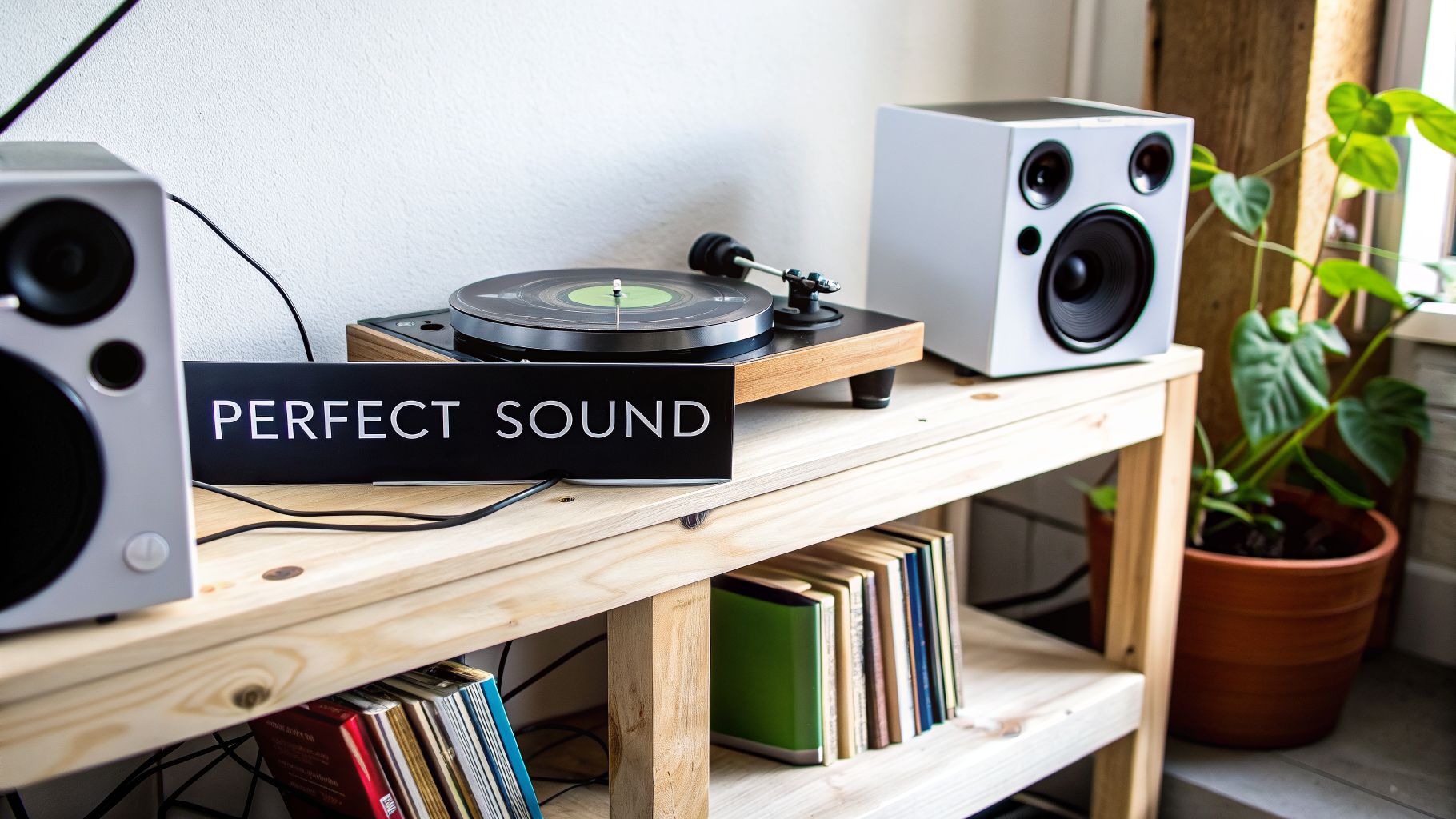
Choosing the perfect speakers for a record player goes far beyond just volume. It’s about honouring the analogue warmth that makes vinyl feel alive. This single choice is what unlocks the full potential of your records, whether you’re listening alone or setting the mood at an event. It’s the same philosophy we apply when we curate music that feels personal for legendary events.
And this isn’t just a niche hobby anymore. The demand for quality audio is booming right alongside vinyl sales. In the UK, the numbers are staggering—according to the BPI, 5.9 million vinyl LPs were sold in 2023. That’s an 11.7% jump from 2022 and the highest figure since 1990. With more people than ever spinning records, finding great speakers has become essential.
First Things First: The Core Concepts
Before you start browsing, there are two fundamental ideas you need to get your head around. Nailing these will make every other decision much, much easier.
-
Active vs. Passive Speakers: This is your first major fork in the road. Active speakers have an amplifier built right in, making them a simple, all-in-one solution. Passive speakers, on the other hand, are just speakers—they need a separate, external amplifier to bring them to life.
-
The Phono Preamp: A turntable’s signal is incredibly quiet, far too weak for most modern speakers to even register. A phono preamp is a small but vital bit of kit that boosts this signal to a useable level. It might be hidden inside your turntable, built into your amplifier, or come as a completely separate box.
To help you decide which path is right for you, here’s a quick overview comparing the two main types of speakers for record players.
Quick Guide to Speaker Types
| Feature | Active (Powered) Speakers | Passive Speakers |
|---|---|---|
| Amplifier | Built-in | Requires a separate amplifier or receiver |
| Setup | Simple, plug-and-play | More components and wiring involved |
| Footprint | Minimal, less clutter | Needs space for speakers and an amplifier |
| Flexibility | Limited upgrade path (can’t swap the amp) | Highly customisable and upgradeable over time |
| Best For | Beginners, small spaces, convenience | Audio enthusiasts who love to tinker and upgrade |
Ultimately, there’s no “wrong” answer here. It’s about finding the setup that makes the most sense for your space, budget, and how much you want to get involved with the hardware.
Think of this guide as your audio compass. We’ll point you towards a setup that not only sounds incredible but also fits your space, budget, and listening style perfectly.
Beyond the gear itself, the look and feel of your listening space really adds to the whole experience. Pulling together a complete and visually appealing record player setup makes every session feel like an occasion. Our goal here is simple: to make sure every single note from your collection is heard exactly as it was meant to be.
Active vs Passive Speakers Explained
Your first big decision when buying speakers for your turntable is whether to go active or passive. Think of it this way: active speakers are like a set menu, where the chef has perfectly paired everything for you. In contrast, passive speakers are the à la carte option, giving you total freedom to build your own audio feast.
An active speaker, often called a powered speaker, is all about simplicity. It has the amplifier built right into the speaker cabinet itself, creating a neat, all-in-one system. You just connect your record player, plug the speakers into a power socket, and you’re good to go. This clean, minimalist approach is perfect for anyone new to vinyl or who just wants great sound without the clutter of extra boxes and wires.
Passive speakers, on the other hand, are just the speaker drivers in a box. They have no built-in power source. To bring them to life, you need to connect them to a separate, external amplifier or AV receiver. It means a few more components and cables, but it also unlocks a whole new world of customisation.
What Are Active Speakers?
The real magic of active speakers is convenience. Because the amplifier and speaker drivers are designed and tuned to work together from the factory, you get a system that’s already optimised. This clever integration often delivers fantastic sound without any of the guesswork involved in matching separate hi-fi components.
This streamlined design makes them a brilliant fit for a few key scenarios:
- Small Spaces: Ideal for a stylish living room or bedroom setup where you want powerful sound without sacrificing space to a stack of hi-fi gear.
- Beginner-Friendly Setups: If you’re just starting your vinyl journey, active speakers take the headache out of matching amps and speakers.
- Budget-Conscious Buyers: While you can spend a fortune on high-end models, a good pair of entry-level active speakers often represents better value than a passive system once you add the cost of a separate amplifier.
An active speaker is the definition of plug-and-play. Because the amplifier is designed specifically for the drivers, the sound is often precise and efficient, requiring less technical know-how to get a great result.
The Case for Passive Speakers
So why would anyone choose the more complex route of a passive system? It all boils down to two words: flexibility and upgradability. With passive speakers, you’re never locked into a single amplifier. This à la carte approach lets you improve your system piece by piece over the years.
You could start with a modest, budget-friendly amplifier today. A few years down the line, you might decide to upgrade to a more powerful or feature-rich amp without ever needing to replace the speakers you’ve grown to love. This modular nature is a cornerstone of the audiophile world. It allows enthusiasts to experiment, fine-tune their sound, and build a system that evolves with their tastes and budget. For a dedicated listening room or a custom DJ rig where performance is everything, a passive setup is almost always the way to go.



Understanding the Turntable Signal Chain
To get that rich, detailed sound you want from your vinyl, you first need to understand the journey your music takes. Think of it less like a chain and more like a translation service. Each component has a specific job to do, passing the signal along until it finally becomes the music filling your room. Get this path right, and you’re golden.
It all starts at the very tip of your turntable’s stylus. As it traces the microscopic grooves of a record, the cartridge generates a tiny electrical whisper—a “phono” signal. This signal is incredibly delicate, far too weak for any normal amplifier or powered speaker to even understand.
The All-Important Phono Preamp
This is where the unsung hero of any vinyl setup comes in: the phono preamp (sometimes called a phono stage). It’s a small box with two massive responsibilities. First, it boosts that quiet phono signal into a much stronger “line level” signal that the rest of your gear can actually work with.
Its second job is applying the RIAA equalisation curve. This process cleverly reverses a trick used when the record was made, restoring the deep bass and crisp treble that was intentionally reduced to fit the music into the grooves.
Without a phono preamp, your records will sound disappointingly quiet and tinny, lacking any bass whatsoever. It’s the essential translator that allows your turntable to speak the same language as your amplifier and speakers.
So, where is this vital piece of kit? It can be in one of three places, and you only need one in your entire setup:
- Built into the turntable: Many modern, beginner-friendly turntables have an integrated phono preamp. You’ll usually find a switch on the back labelled “PHONO/LINE.”
- Built into an amplifier: Some stereo amplifiers and AV receivers include their own preamp. Just look for a dedicated “PHONO” input on the back.
- As a separate, external box: If neither your turntable nor your amp has one, you’ll need an external phono preamp. This little box sits right between your turntable and your amp or active speakers.
The diagram below breaks down the two main paths your signal can follow, depending on whether you go for active or passive speakers.
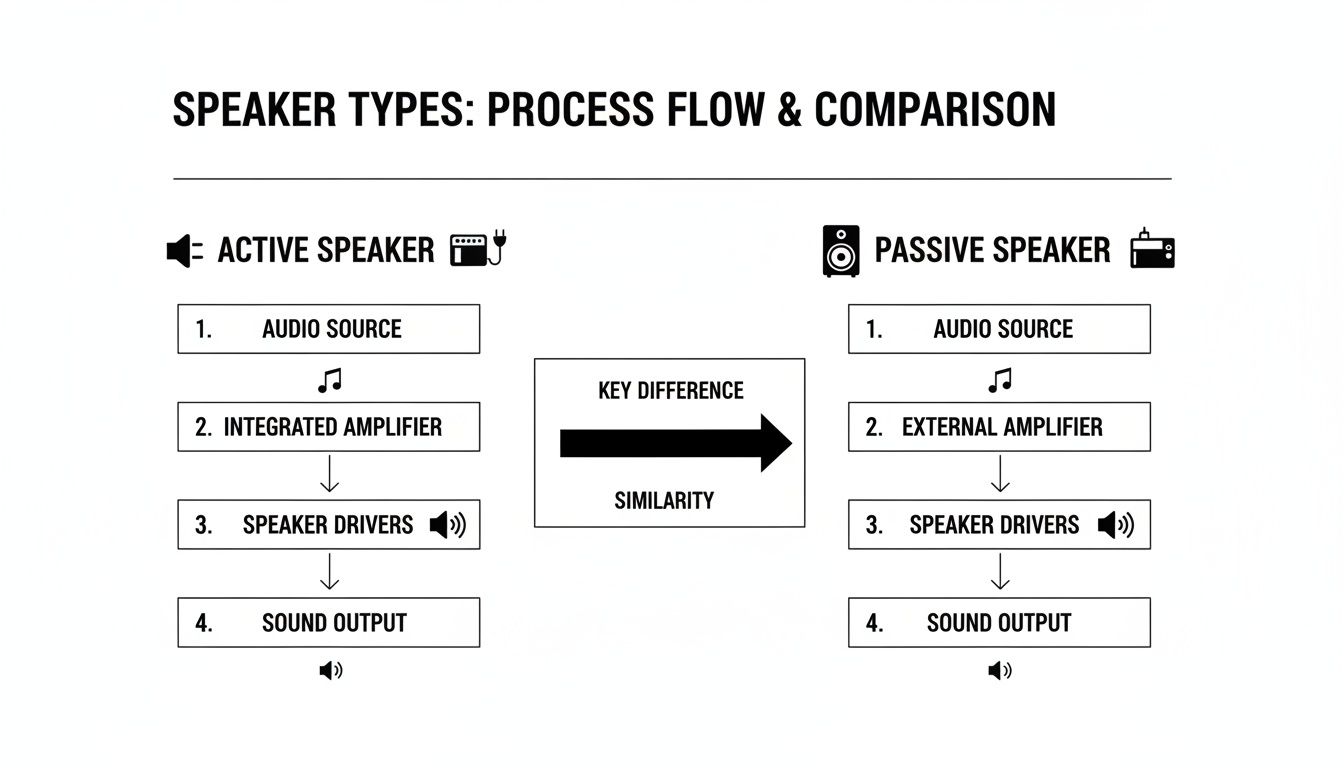
As you can see, active speakers keep the chain simple by building the amplifier right in. Passive speakers, on the other hand, give you a more modular, customisable system.
The resurgence of vinyl in the UK has made a good pair of speakers for record players a must-have. As of March 2024, the number of independent record shops hit 461—a massive 36% jump from 2013. Many of these shops now stock complete turntable setups, from speakers to phono preamps. Understanding this full signal chain is the key to getting the best possible sound, whether you’re listening at home or setting up for an event where quality matters. You can find more on this trend by checking out the latest statistics on UK vinyl ownership.
Matching Power and Impedance for Flawless Sound
Diving into technical specs can feel a bit like reading a different language, but getting your head around power and impedance is surprisingly simple. It’s the key to making sure your gear sounds great and lasts a long time.
Think of it like this: power (measured in watts) is the force pushing the music signal, and impedance (measured in ohms) is the resistance the speaker puts up against that signal. Getting this relationship right is especially vital when you’re building a system with passive speakers. A bad match can cause all sorts of problems, from distorted sound to fried equipment.
Decoding Amplifier and Speaker Specs
When you look at the back of a passive speaker, you’ll find its impedance rating, usually 4, 6, or 8 ohms. This number tells your amplifier how much resistance to expect. Amplifiers, in turn, are designed to work happily within a specific impedance range.
Matching speaker impedance to your amplifier isn’t just about performance—it’s a matter of safety. An impedance mismatch can cause your amplifier to overheat and potentially suffer permanent damage, all while delivering weak, distorted sound.
Imagine trying to run a high-performance engine on the wrong kind of fuel. It might sputter along for a bit, but it won’t perform well and you’ll eventually wreck it. Most home amplifiers are comfortable with 8-ohm speakers, but you should always double-check the manual to see if it can safely handle lower impedance speakers, like those rated at 4 or 6 ohms.
Understanding Speaker Power Ratings
With active speakers, the game changes a bit. Since the amplifier is already built-in and perfectly matched by the manufacturer, your main job is to make sure the speaker has enough oomph for your listening space. This is where you’ll run into two different power ratings.
-
RMS (Root Mean Square) Power: This is the number that actually matters. It tells you the continuous, real-world power a speaker can handle or produce day in, day out. Think of it as a car’s steady cruising speed on the motorway.
-
Peak Power: This number shows the absolute maximum power a speaker can handle in a tiny, split-second burst, like a sudden drum hit. It looks impressive on a spec sheet, but it’s not a reliable measure of everyday performance.
When choosing active speakers for your record player, always focus on the RMS rating. A speaker with an honest 30 watts RMS will almost always sound better and last longer than one boasting a flashy but misleading “300 watts peak power”. A higher RMS value means your speakers can fill a larger room with clean, effortless sound, letting you enjoy every record exactly as it was meant to be heard.
Speaker Placement and Connection Essentials
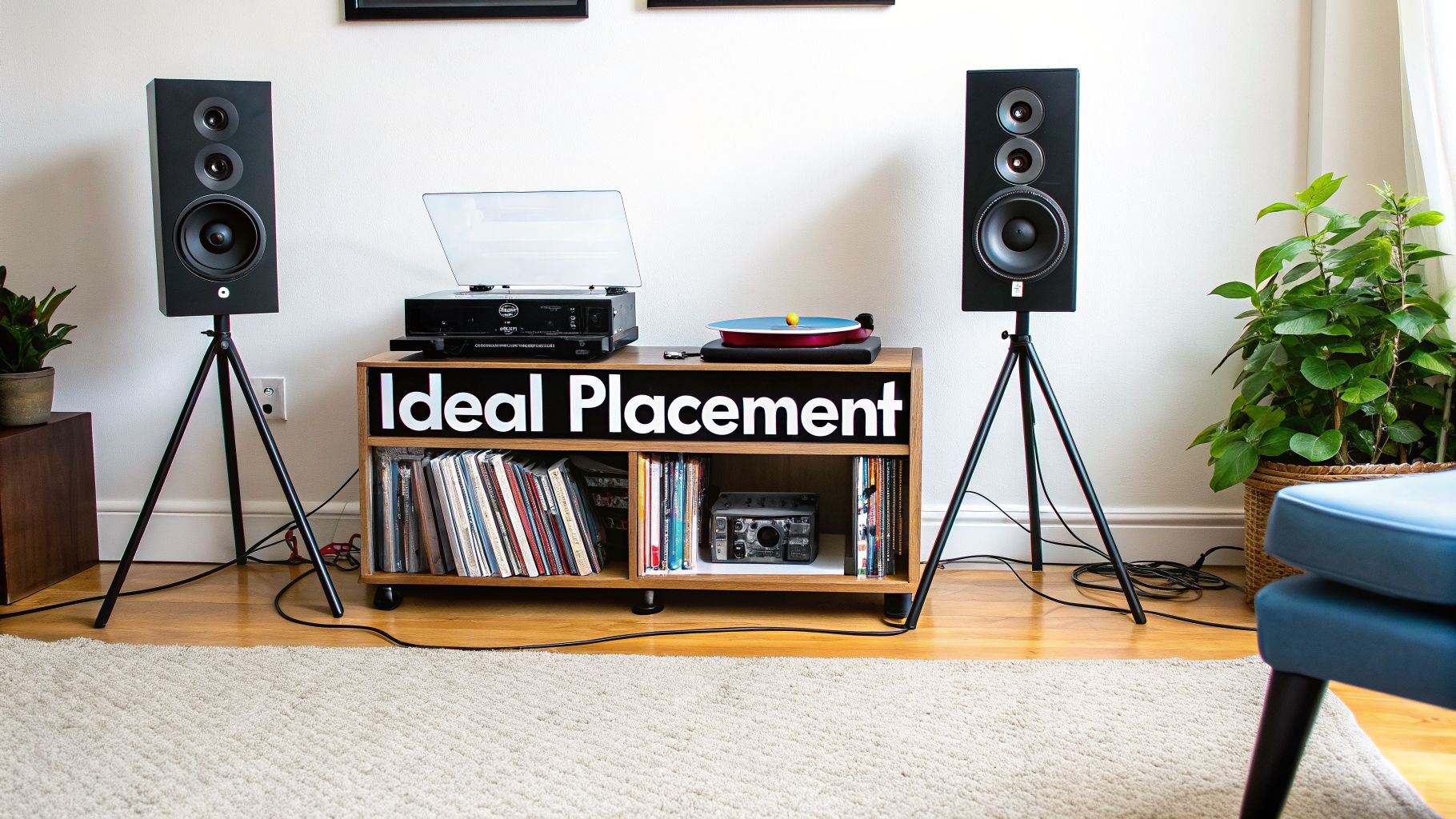
Once you’ve got your hands on the right gear, the real magic happens in the setup. Even the most expensive speakers for a record player will sound flat if they aren’t positioned and connected with a bit of care. This is where you go from just hearing music to truly feeling it.
It’s no surprise so many people are diving into vinyl. The UK’s stereo turntable market was valued at a massive USD 5,065.81 million in 2024, and with single weeks seeing over 306,000 records sold, the revival is in full swing. Making sure your setup honours that investment in sound is crucial. You can see more on the UK’s incredible vinyl sales figures on Zobbel.de.
Getting Your Speakers Connected
Hooking everything up is usually straightforward, but the cables you choose really do make a difference. You’ll mostly be dealing with three kinds of connections.
- RCA Cables: These are the classic red and white connectors, the very backbone of hi-fi. They provide a solid, reliable path for your sound, linking your turntable, preamp, and amplifier or active speakers with excellent quality.
- Speaker Wire: If you’re using passive speakers, this is what carries the power from your amplifier to the speakers themselves. Just make sure you match the positive (red) and negative (black) terminals. Getting this right ensures your speakers are in phase and work together, not against each other.
- Bluetooth: While there’s no denying its convenience, Bluetooth is a compromise. It compresses the audio signal to send it wirelessly, which can strip away some of the warmth and depth that makes vinyl so special. It’s great for casual listening, but for pure, unadulterated sound, wires always win.
The Art of Speaker Placement
Where you put your speakers matters just as much as what you bought. The aim is to create a “soundstage”—an audio sweet spot where the music feels like it’s happening live in the room, not just coming out of two boxes.
Think of your two speakers and your favourite listening chair as the three points of an equilateral triangle. This is the secret to a balanced stereo image, where the singer’s voice hangs in the middle and the instruments are spread out just as the artist intended.
A couple of simple rules will get you there. First, never put your speakers on the same surface as your turntable. The vibrations will travel straight back to the stylus and create a nasty hum or feedback loop. A good pair of speaker stands is a fantastic investment for isolating them and getting them up to ear-level. For a look at how the pros do it, check out our guide on setting up a DJ booth with golden vibes for events.
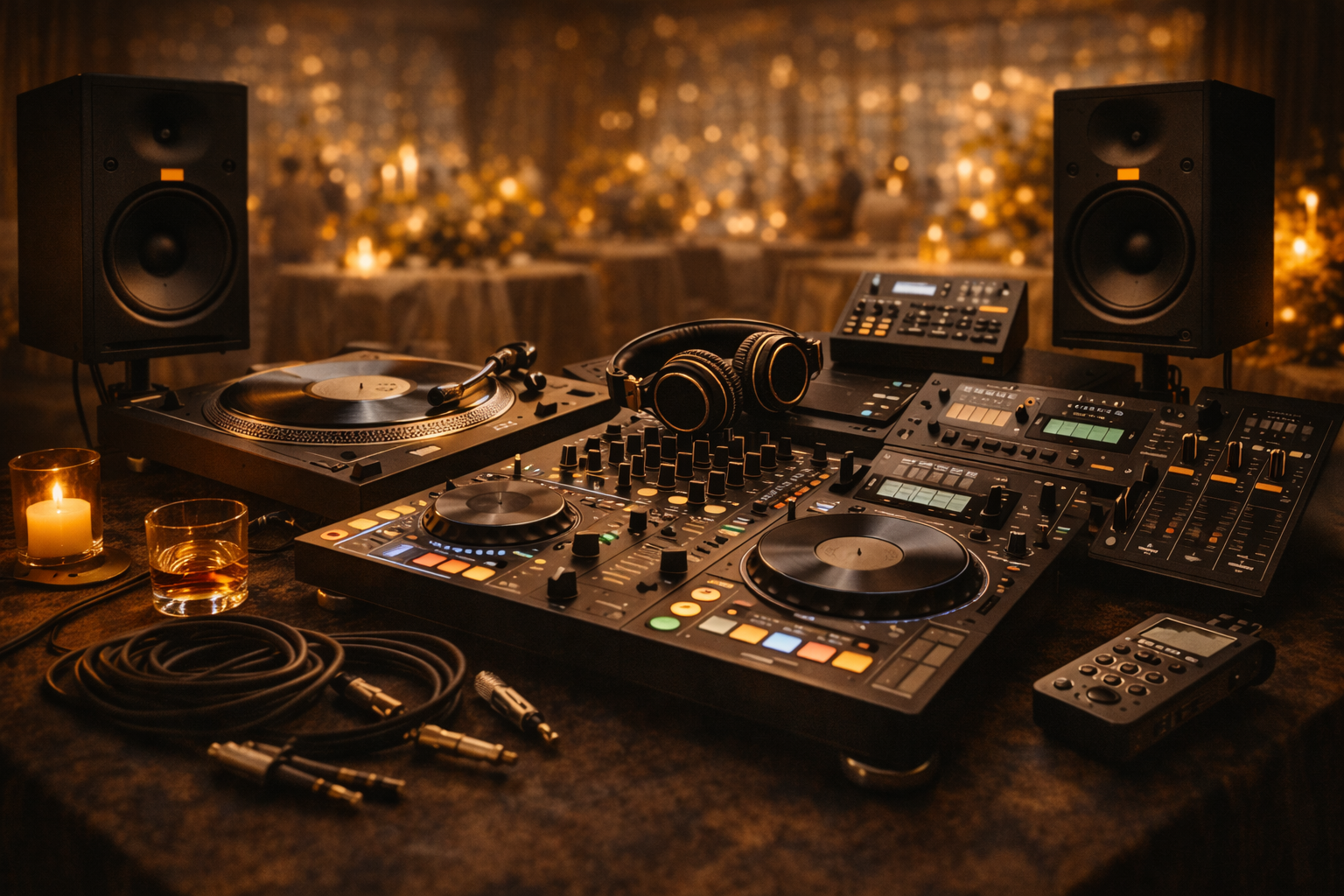
Finally, fight the temptation to tuck your speakers neatly into the corners. It might look tidy, but it creates a boomy, muddy bass that drowns out all the beautiful detail in the music. Pulling them just a foot or two away from the walls will instantly tighten up the low-end and bring clarity back into the sound.
Recommended Setups for Every Budget
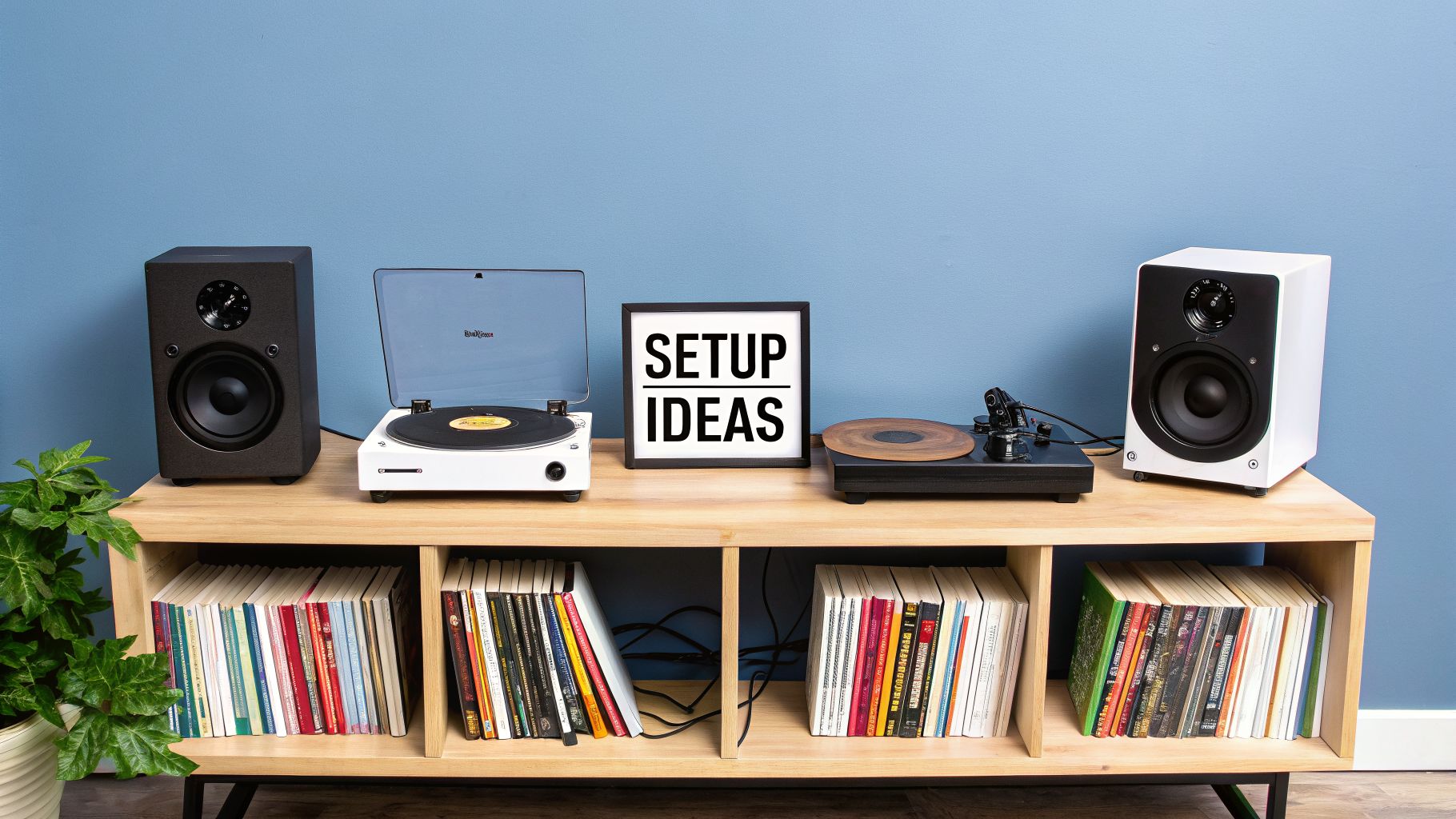
Choosing the right speakers for a record player can feel overwhelming, but it doesn’t have to empty your wallet. We’ve mapped out three straightforward paths to great sound, each tailored to a different budget and level of ambition.
Think of these recommendations as proven recipes. They combine components that play well together, ensuring you get the best possible performance for your money. It’s all about hitting that perfect balance between quality, cost, and pure listening enjoyment.
The Plug-and-Play Starter Setup (Under £300)
This is your express lane to spinning vinyl with sound that blows away any all-in-one suitcase player. The name of the game here is simplicity and value, making it perfect for anyone new to the hobby or working with a smaller space.
The heart of this setup is a turntable with a built-in phono preamp paired with a good set of active (powered) speakers. This combo means no extra boxes, no confusing wires, and no fuss.
- Turntable: Look for entry-level champs from brands like Audio-Technica or Pro-Ject that have a little switch on the back marked “LINE/PHONO”.
- Speakers: Match it with some well-regarded active bookshelf speakers from companies like Edifier or Q Acoustics. You just run a cable from the turntable straight to the speakers, plug them into the wall, and you’re good to go.
The Audiophile Apprentice Setup (£300–£800)
Ready to take things up a notch? This tier is for the enthusiast who wants more control over their sound and a clear upgrade path for the future. Here, we start using separate components to unlock greater flexibility and a noticeable jump in audio quality.
In this range, you’ll be pairing a more refined turntable with an external phono preamp and a more capable set of active or, more likely, passive speakers.
This setup is where you truly begin to shape your signature sound. By separating the components, you can upgrade your preamp, amplifier, or speakers one piece at a time, constantly refining your listening experience as your tastes and budget evolve.
If you go with passive speakers—and this is where things get really good—you’ll also need an integrated amplifier to drive them. The payoff is a massive improvement in detail, dynamics, and the overall richness of your music. You can get a sense of how our professional DJs approach high-fidelity audio by checking out the VinylGold brand and mission.
The Event-Ready Pro Setup (£800+)
For the serious collector, aspiring DJ, or anyone who wants a system powerful enough to command a room, this is it. This setup is all about performance, power, and durability. It’s a no-compromise approach built for robust, room-filling sound that stays clean at high volumes.
At this level, you’re looking at a professional-grade turntable prized for its vibration isolation and tracking accuracy, connected to a high-end external phono stage. The muscle comes from a potent amplifier and a pair of large, capable passive speakers that can handle serious power without breaking a sweat. It’s the gold standard for both critical listening at home and providing the soundtrack for a proper party. Once you have the core gear sorted, you can always explore unique gifts for vinyl collectors to add that final touch to an audiophile’s sanctuary.
Speaker & System Recommendations by Budget
To help you visualise how these pieces come together, we’ve put together a quick table showing example setups at each budget tier. This isn’t an exhaustive list, but it gives you a solid idea of how to pair components for a balanced and effective system.
| Budget Tier | Example Turntable | Amplification | Recommended Speaker Type |
|---|---|---|---|
| Starter (Under £300) | Audio-Technica AT-LP60X | Built into active speakers | Active Bookshelf (e.g., Edifier) |
| Apprentice (£300–£800) | Pro-Ject Debut Carbon Evo | External Integrated Amp (e.g., Cambridge Audio AXA25) | Passive Bookshelf (e.g., KEF) |
| Pro (£800+) | Technics SL-1200MK7 | High-Power Integrated Amp (e.g., Rega Elex-R) | Passive Floorstanders (e.g., Monitor Audio) |
Remember, these are just starting points. The real fun begins when you start mixing and matching to create a system that’s perfectly tuned to your ears and your space. Happy listening
Your Top Questions Answered
Getting into vinyl brings up a few common questions, especially when it comes to speakers. Let’s clear up the confusion so you can build a setup you’ll love listening to.
Do I Need Special Speakers for a Record Player?
Not exactly ‘special,’ but you definitely need the right kind of setup. You can’t just plug a turntable straight into a pair of speakers and expect it to work, because the signal it sends out is incredibly quiet.
You have two main paths to choose from:
- Active (Powered) Speakers: These are a brilliant all-in-one solution because the amplifier is already built right in. Simple and clean.
- Passive Speakers & Amplifier: This is the classic hi-fi approach. You have separate speakers that get their power from an external amplifier or receiver.
The most important piece of the puzzle, though, is the phono preamplifier. This little box is non-negotiable. It boosts the turntable’s delicate signal to a useable level and rebalances the sound, bringing back the bass and treble that get flattened during the vinyl pressing process. You’ll find it either built into the turntable itself, inside your amplifier, or as a separate, standalone unit.
Can I Use My Old Hi-Fi Speakers?
Absolutely! Giving a pair of quality vintage speakers a new lease of life is a fantastic way to get superb sound. Most older hi-fi speakers are passive, which just means they need an external amplifier to power them.
If you still have the original amplifier they came with, have a look at the back. You’re searching for an input labelled “PHONO”. If you see one, you’re golden—just connect your turntable directly to it. If not, no worries. You just need to add a small, external phono preamp between your turntable and one of the amp’s other inputs, like AUX or CD.
Are Bluetooth Speakers Good Enough for a Record Player?
There’s no denying Bluetooth is convenient. A turntable with Bluetooth output talking to a wireless speaker is wonderfully simple and gets rid of all the cables. It’s perfectly fine for casual, background listening.
But here’s the catch. For that Bluetooth magic to happen, the pure analogue signal from your record has to be converted into a digital one. This process involves compression, which can strip away some of the wonderful warmth, fine detail, and unique character that makes vinyl so special in the first place. For the purest, most authentic sound, a wired connection will always be the best way to go.