
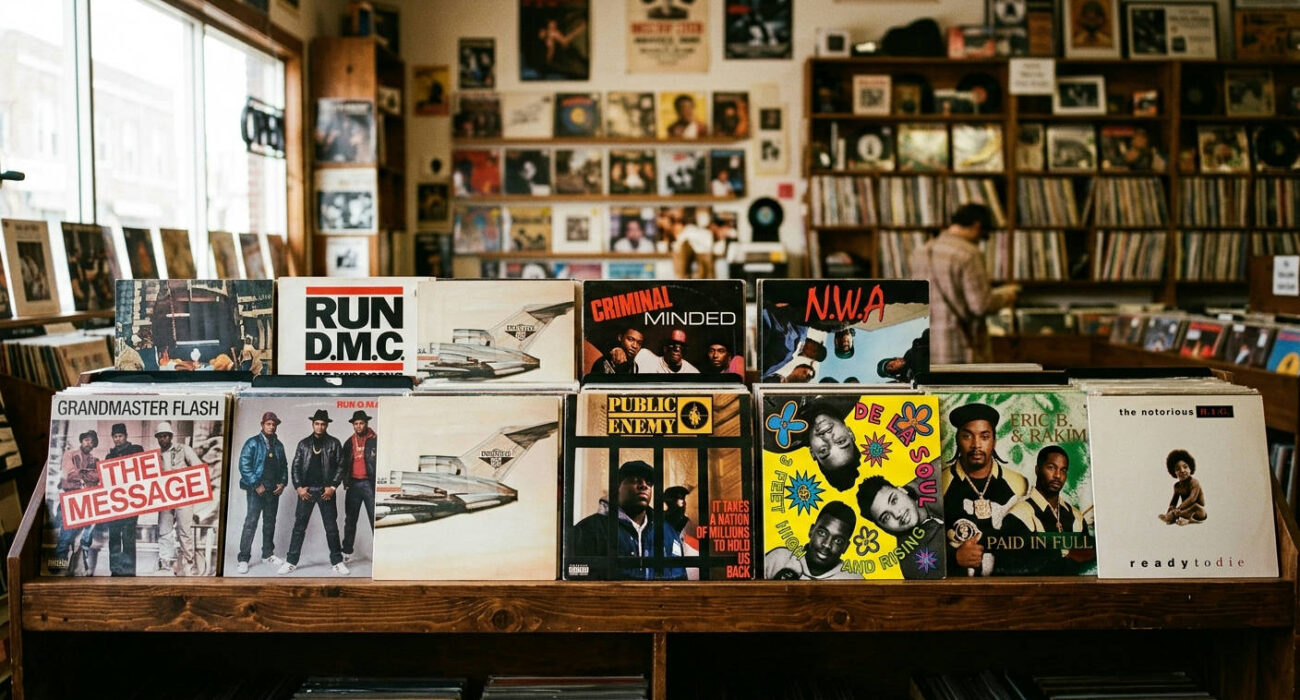
If you’re looking for the foundational records that built a global empire of sound, you’ve come to the right place. This isn’t just another list; it’s the definitive early hip hop album guide you need to understand where it all began. Here at Vinyl Gold UK, we live and breathe the crackle of a needle hitting a classic groove, and these are the LPs that shattered the mould and created a new one from the pieces. Forget what you think you know; it’s time for a proper education. Our Early Hip Hop Album Guide is essential for anyone wanting to explore the genre.
What is Early Hip Hop? Before the Billions, There Was the Beat
Before hip hop became a multi-billion dollar industry dominating charts in 2026, it was a raw, creative explosion born from urban struggle and artistic innovation. Understanding this context is crucial for appreciating the albums that defined the era.
The Early Hip Hop Album Guide is a testament to the culture’s evolution, showcasing its rich history and significant milestones.
The Four Elements: More Than Just Music
In the context of the Early Hip Hop Album Guide, each element reveals the artistry and innovation that shaped its future.
Hip hop wasn’t just a sound; it was, and still is, a culture built on four key pillars. It was a holistic art form that took over the streets of New York City in the late 1970s.
- DJing: The absolute bedrock. Pioneers like Kool Herc, Grandmaster Flash, and Afrika Bambaataa used two turntables to isolate and loop the “break”—the percussive, instrumental section of a funk or soul record. This became the canvas for everything that followed.
- MCing: The Master of Ceremonies, or MC, was originally there to hype the crowd and the DJ. This quickly evolved into rhyming over the beats, telling stories, boasting, and battling other MCs for lyrical supremacy.
- B-Boying: The dancers, known as B-boys and B-girls, who threw down incredible athletic moves on the dance floor during the breaks. This was the physical expression of the music’s raw energy.
- Graffiti: The visual art. Writers and artists used spray paint to create elaborate pieces on subway trains and walls, a vibrant and often illegal form of self-expression that mirrored the music’s boldness.
The Sound: 808s, Scratches, and Sample Magic
The Early Hip Hop Album Guide highlights the transformative power of these sounds in shaping modern music.
The sonic signature of early hip hop is unmistakable. It was a stripped-down, powerful sound built from the ground up with new technology and ingenious techniques. The Roland TR-808 drum machine, with its booming bass kicks and sharp snares, became the heartbeat of the genre.
DJs didn’t just play records; they manipulated them. Scratching, needle dropping, and backspinning became percussive instruments in their own right. Early sampling involved taking snippets from artists like James Brown or Chic, recontextualizing them into something entirely new and electrifying. This wasn’t just music; it was sonic collage art.
The First Wave: 1980-1982 Albums That Broke New Ground
To truly appreciate this era, consult the Early Hip Hop Album Guide for an in-depth exploration.
While hip hop lived on mixtapes and in live parties for years, the early 1980s saw the first brave attempts to capture this lightning in a bottle on a full-length LP. These albums were experiments, often stretching a hit single into a full record, but they were absolutely essential.
Sugarhill Gang – Sugarhill Gang (1980)
This is the one that started the fire commercially. While “Rapper’s Delight” had been a phenomenon as a single in 1979, the full album proved that hip hop wasn’t a one-hit novelty. It was built around that massive track, but it showed the potential for a rap group to hold a listener’s attention over 30+ minutes.
The production is rooted in live funk and disco bands, a sound that would soon be replaced by drum machines. It’s a snapshot of a specific moment in time, the bridge between the old world and the new. It’s impossible to have a guide to early hip hop without paying respect to the album that put it on the map for millions.
Find your copy of Sugarhill Gang on vinyl and own a piece of history.
As you delve into the Early Hip Hop Album Guide, you’ll find records that are essential for any serious collector.
Kurtis Blow – Kurtis Blow (1980)
Kurtis Blow was hip hop’s first solo superstar and the first rapper signed to a major label, Mercury Records. His self-titled debut was a landmark achievement, proving an MC could be a charismatic frontman on par with any rock or soul singer.
The album’s centrepiece is “The Breaks,” a track so iconic it’s become part of the musical lexicon. It’s a masterclass in rhythm and rhyme, a simple concept executed with incredible flair. The album showed that rap could be both fun and commercially viable, paving the way for every solo artist who followed.
“And the breaks go on, and on, and on, and on…”
This line alone cemented Kurtis Blow’s legacy. The album is a must-have for anyone serious about understanding the genre’s roots.
Get the classic Kurtis Blow album.
Grandmaster Flash & The Furious Five – The Message (1982)
The power of this album is a pivotal moment addressed in the Early Hip Hop Album Guide.
Everything changed with this album. Hip hop graduated from party rhymes to potent social commentary. The title track, “The Message,” was a brutally honest depiction of life in the Reagan-era inner city, a world away from the braggadocio and party chants that had dominated the genre.

“Don’t push me, ’cause I’m close to the edge” wasn’t just a lyric; it was a headline. Melle Mel’s searing vocal performance over a tense, minimalist beat painted a picture of desperation and grit that was impossible to ignore. The album proved that hip hop could be a powerful tool for journalism and activism, influencing conscious rap for decades to come. As a listening experience, it remains one of the most important musical statements ever made.
Experience the raw power of The Message.
The New School: 1984-1985 and the Rise of the Superstars
The Early Hip Hop Album Guide provides insight into how the New School revolutionised the genre.
The mid-80s saw a seismic shift. The sound became harder, the beats more aggressive, and the attitude more defiant. This was the “New School,” and it was defined by drum machines, minimalist production, and MCs with larger-than-life personalities.
A Definitive Early Hip Hop Album Guide Must Include Run-DMC
There’s early hip hop, and then there’s the moment Run-DMC kicked the door in. Their self-titled 1984 debut was a revolution. Gone were the disco bands and funk basslines, replaced by the bone-rattling boom of a TR-808 drum machine and the aggressive back-and-forth rhymes of Run and DMC.
Their impact is an essential chapter in the Early Hip Hop Album Guide.
Run-DMC was hard as nails. Tracks like “Rock Box” fused rap with screaming rock guitar, a combination that seemed insane at the time but would later become a blueprint for crossover success. “Sucker M.C.’s” was a declaration of war on the old school, stripping the sound down to its bare essentials: a beat and a rhyme. They looked different, too, with their adidas, fedoras, and gold chains, creating an iconic style that is still copied in 2026. This album is ground zero for modern hip hop.
Grab the foundational Run-DMC vinyl.
The Electro-Funk Vibe: Whodini – Escape (1984)
The Early Hip Hop Album Guide cannot overlook the contributions of groups like Whodini.
Not everyone in the New School was about aggression. The Brooklyn trio Whodini brought a smoother, more electronic, and R&B-influenced sound to the table. Their album Escape, produced by the visionary Larry Smith (who also worked with Run-DMC), was a massive commercial success.
Tracks like “Friends” and “Freaks Come Out at Night” were radio and club staples. They blended synthesizers and drum machines with compelling storytelling and catchy hooks, proving that hip hop could be sophisticated and danceable. Whodini showed the genre’s stylistic diversity and paved the way for the fusion of rap and R&B.
Add the smooth classic Escape to your collection.
The Human Beatbox: The Fat Boys – The Fat Boys (1984)
Hip hop has always had a sense of humour, and no one embodied that better than The Fat Boys. Their 1984 debut, produced by Kurtis Blow, was an infectious blast of fun, but their secret weapon was Darren “Buff Love” Robinson, the Human Beatbox.
The Fat Boys’ story is a delightful entry in the Early Hip Hop Album Guide.
Buff Love’s ability to create complex drum patterns and sound effects with his mouth was a phenomenon. Tracks like “Jail House Rap” and “Can You Feel It?” were built around his incredible talent. The Fat Boys brought a lighthearted, comedic energy that made hip hop incredibly accessible, helping to broaden its appeal far beyond its New York origins.
Find the fun-loving debut from The Fat Boys.
The Birth of a Legend: LL Cool J – Radio (1985)
LL Cool J’s rise is a highlight of the Early Hip Hop Album Guide, illustrating youth culture’s influence.
This is the sound of a superstar arriving fully formed. A 17-year-old James Todd Smith, aka LL Cool J, teamed up with producer Rick Rubin for what would become the first full-length album on the legendary Def Jam Recordings. Radio is a masterclass in minimalism and aggression.
The album is raw, loud, and relentless. It’s basically just LL’s commanding, confident voice over booming 808s and the occasional guitar stab or scratch. Tracks like “I Can’t Live Without My Radio,” “Rock the Bells,” and the pioneering rap ballad “I Need a Beat” established LL as a force of nature. He was a heartthrob and a battle rapper all in one, and Radio set the standard for solo MCs for the rest of the decade.
Get the seminal Def Jam release, Radio.
Peak Power: 1986-1987, When Hip Hop Conquered the World
The climax of this era is well-documented in the Early Hip Hop Album Guide.
If the mid-80s were about building a new foundation, 1986 and 1987 were about building a skyscraper on top of it. This is when early hip hop broke through to the mainstream in a massive way, topping charts and dominating MTV.
Run-DMC – Raising Hell (1986)
This is the album that made hip hop unavoidable. After laying the groundwork with their first two LPs, Run-DMC and Rick Rubin crafted a record that was both commercially brilliant and artistically uncompromising. The centrepiece, of course, was their collaboration with Aerosmith on “Walk This Way.”

The track and its video single-handedly broke down the barriers between rock and rap radio and, more importantly, between their audiences. But Raising Hell is far from a one-hit wonder. “Peter Piper” is a clinic in DJ skills from Jam Master Jay, “My Adidas” became a corporate anthem, and “It’s Tricky” is pure, distilled hip hop energy. It was the first rap album to go multi-platinum and remains a perfect record.
Own the crossover classic Raising Hell.
Beastie Boys – Licensed to Ill (1986)
Three punk kids from New York City created the first-ever rap album to hit #1 on the Billboard 200 chart. Licensed to Ill was an explosion of bratty, smart, and hilarious energy that felt like a party crashing through your speakers. Another Rick Rubin production, it was loud, obnoxious, and utterly brilliant.
Beastie Boys’ unique style is celebrated in the Early Hip Hop Album Guide.
Fusing hard rock samples (like Led Zeppelin and Black Sabbath) with booming 808s, the Beastie Boys created a sound that was entirely their own. From the frat-boy anthem “(You Gotta) Fight for Your Right (to Party!)” to the incredible storytelling of “Paul Revere” and the sheer force of “No Sleep Till Brooklyn,” the album is a non-stop thrill ride. It brought a massive new audience to hip hop and proved the genre’s limitless potential.
Boogie Down Productions – Criminal Minded (1987)
The Early Hip Hop Album Guide showcases the grit and raw energy of this pivotal album.
While others were crossing over, KRS-One and DJ Scott La Rock were dragging hip hop back to the streets with a raw, unflinching sound. Criminal Minded is widely considered one of the first and most important gangsta rap albums, though its intelligence and social awareness go far beyond simple thuggery.
The production is sparse and hard-hitting, full of reggae influences and tough drum machine patterns. Lyrically, KRS-One was a revelation—a “teacha” who could deliver hardcore street narratives like “9mm Goes Bang” one minute and drop a history lesson in the legendary diss track “The Bridge Is Over” the next. The album’s cover, featuring the duo holding firearms, was as confrontational as its music. This was a dark, serious, and incredibly influential record that set the stage for much of the 90s. As the Rock & Roll Hall of Fame notes, the genre was evolving to reflect a harder reality.
Get the street-level classic Criminal Minded.
Your ## Definitive Early Hip Hop Album Guide: Collecting on Vinyl
Experiencing these foundational albums on vinyl isn’t just about nostalgia; it’s about hearing them the way they were intended. The warmth, the deep bass, and the large-format artwork provide a connection that digital files simply can’t replicate.
Why Vinyl Is the Perfect Format
Early hip hop was made for vinyl. The booming 808 kicks and deep funk basslines have a physical presence on a record that you can feel. When Jam Master Jay cuts up a breakbeat, you’re hearing a physical needle moving in a groove. For a truly authentic experience, you need a decent setup. Investing in one of the best turntables under £300 in the UK can make a world of difference, letting those classic beats hit with the power they deserve.
Original Pressings vs. Modern Reissues
Collectors will find guidance in the Early Hip Hop Album Guide for their vinyl pursuits.
When you’re starting your collection, you’ll face a choice: hunt for an original 1980s pressing or buy a modern reissue?
- Original Pressings: These have incredible historical value and are artifacts of the era. There’s nothing like holding a first-press of Raising Hell. However, they can be expensive and their sound quality depends heavily on how the previous owner treated them.
- Modern Reissues (2020s): High-quality reissues, often pressed on 180-gram vinyl, can offer superior audio fidelity. They are clean, readily available, and more affordable. For pure listening pleasure, a good reissue is often the better choice.
“The thing about records is, they’re not just music. They’re time capsules. An original pressing holds the spirit of the year it was made.”
At Vinyl Gold UK, we appreciate both. The choice comes down to whether you’re prioritizing historical authenticity or pristine sound.
Building Your Core Collection
Starting with the ten albums in this guide gives you a rock-solid foundation. They represent the key turning points, the stylistic diversity, and the sheer creative energy of the era. Don’t feel you need to buy them all at once. Pick one that speaks to you, drop the needle, and let it transport you back to the block parties and recording studios where a new world was being born.
The Unshakeable Legacy of Early Hip Hop
The Early Hip Hop Album Guide embodies the spirit of this vibrant legacy.
These albums aren’t just museum pieces. Their DNA is woven into the fabric of nearly all popular music in 2026. The techniques they pioneered and the attitudes they embodied have echoed through the decades.
The Blueprint for Everything
The art of sampling, pioneered on these records, is now a universal production technique. The focus on rhythm and lyrical wordplay has influenced countless artists, from rock bands to pop superstars. Many artists from this era drew inspiration from soul and funk legends, creating a musical dialogue that continues to this day. The powerful social commentary of an artist like Curtis Mayfield can be seen as a direct ancestor to the conscious rhymes of Grandmaster Flash and KRS-One.
These early MCs and DJs were innovators who created a new language. They laid the blueprint not just for hip hop, but for how music is made, marketed, and consumed. Every time you hear a track built around a drum machine and a clever sample, you’re hearing the legacy of these pioneers. They didn’t just make records; they made the future. Start your collection, and own a piece of it.
Each chapter in the Early Hip Hop Album Guide is a pathway to understanding a cultural phenomenon.