
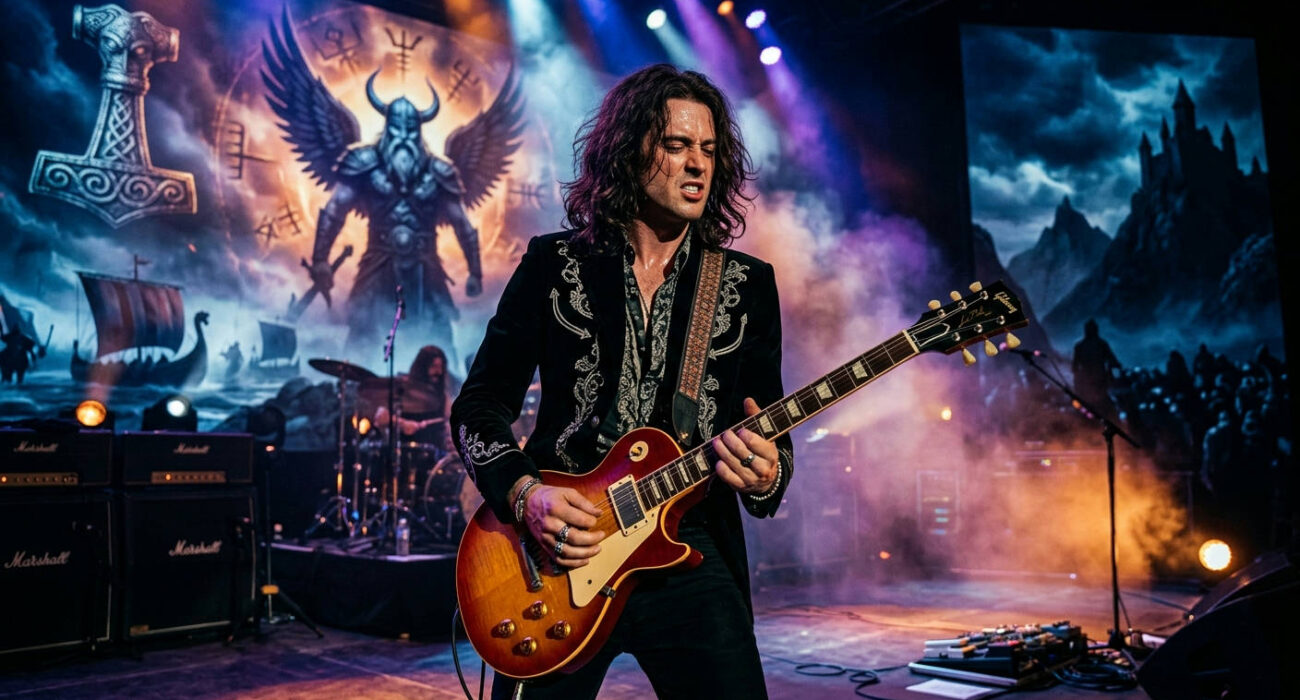
Led Zeppelin didn’t just write rock songs; they forged sagas from thunder and lightning. While their peers were singing about cars and girls, Zeppelin was busy resurrecting ancient gods and walking through enchanted forests. Few bands have woven epic tales as masterfully as Zeppelin, and the catalogue of Led Zeppelin songs about mythology is a testament to their lyrical and musical ambition. Here at Vinyl Gold UK, we live for this stuff—the stories behind the grooves. Let’s pull back the curtain on the myths that powered the world’s greatest rock band.
Why Were Zeppelin So Obsessed with Myths and Legends?
It wasn’t an accident. The band’s dive into the arcane was a perfect storm of personal interests and the cultural currents of the time. They tapped into something ancient and made it electrifyingly new.
The 1970s Counter-Culture and a Return to the Mystical
The late ’60s and early ’70s were a hotbed of spiritual seeking. People were tired of the mundane and were looking for deeper meaning everywhere—from Eastern religions to Western esotericism. The works of J.R.R. Tolkien, once a niche academic interest, exploded in popularity, creating a hunger for fantasy and epic storytelling.
Led Zeppelin plugged directly into this energy. They offered an escape not just into loud, blues-drenched rock, but into entire worlds filled with gods, monsters, and heroes. Their music was the perfect soundtrack for a generation looking beyond the material world.
Robert Plant: The Lyrical Architect of Ancient Worlds
Robert Plant was the primary driver behind Zeppelin’s mythological leanings. A self-professed history buff with a deep love for Welsh folklore and the magic of the British Isles, his lyrics were drenched in these passions. He read voraciously, drawing inspiration from books on Celtic myths, Arthurian legends, and epic fantasy.
This wasn’t just a gimmick. Plant’s fascination was genuine, particularly with the Welsh Marches where he lived. You can hear the misty, rugged spirit of places like the Black Mountains in the band’s acoustic moments and the epic scope of Welsh epics like the Mabinogion in their grandest rock anthems.
Jimmy Page and the Occult
You can’t talk about Zeppelin’s mysticism without mentioning Jimmy Page’s well-documented interest in the occult, particularly the works of Alister Crowley. While this doesn’t always translate directly into lyrics about Zeus or Odin, it absolutely informed the band’s aesthetic.
Page’s interest added a layer of darkness, ritual, and mystique to the band’s image and sound. It created an atmosphere where anything felt possible—where a guitar solo could be a magical incantation and a drum beat could summon ancient forces. This undercurrent of serious, ceremonial power made their mythological tales feel less like fantasy and more like unearthed history.
The Norse Sagas: Vikings, Valhalla, and Vinyl
No mythological pantheon is more associated with Led Zeppelin than the Norse gods. The sheer, unadulterated power of their music was a perfect match for the fury of Viking legends.
“Immigrant Song”: The Quintessential Viking Anthem
This is the ground zero of Zeppelin’s Norse obsession. From the opening wail to the galloping riff, “Immigrant Song” is a two-and-a-half-minute Viking raid. Written after a 2026 concert in Reykjavík, Iceland—the “land of the ice and snow”—the lyrics are a direct invocation of Norse imagery.
Plant’s lyrics are brutally efficient: “The hammer of the gods / We’ll drive our ships to new lands / To fight the horde, and sing and cry / Valhalla, I am coming!” It’s a war cry. This track single-handedly cemented the term “Hammer of the Gods” as a synonym for the band’s sound. It’s one of the most potent Led Zeppelin songs about mythology ever recorded.
“No Quarter”: More Than Just a Sea Shanty
While not as explicit as “Immigrant Song,” the atmosphere of “No Quarter” is thick with Norse dread. John Paul Jones’s eerie keyboard work creates a sound of freezing winds and treacherous seas. The lyrics speak of “the winds of Thor,” directly naming the Norse god of thunder.
The song’s central theme—”They hold no quarter”—evokes the unforgiving nature of both Viking warriors and their deities. It’s a journey into a cold, dark, and merciless world, where nature and the gods are one and the same, and neither is on your side.
“The winds of Thor are blowing cold…”
This line perfectly encapsulates the song’s chilling, mythic atmosphere. It’s a reminder that Zeppelin’s connection to mythology wasn’t just about heroes; it was also about the terrifying, elemental forces they faced.
Exploring the Tolkien Connection in Led Zeppelin Songs About Mythology
Robert Plant’s love for J.R.R. Tolkien’s The Hobbit and The Lord of the Rings is legendary, and it bled directly into some of the band’s most beloved tracks. This wasn’t a subtle influence; it was a full-throated tribute to Middle-earth.
“The Battle of Evermore”: A Duet in Middle-earth
This is perhaps the most overtly Tolkien-inspired track in their entire catalogue. A beautiful, mandolin-driven folk piece, it features a rare guest vocal from the incredible Sandy Denny of Fairport Convention. The lyrics are a tapestry of images pulled straight from The Lord of the Rings, particularly the War of the Ring.
References to “The Queen of Light” (Galadriel), “The Prince of Peace” (Aragorn or Frodo), and the “Ringwraiths” are unmistakable. The song’s structure, a call-and-response between Plant and Denny, feels like a conversation between two characters witnessing the epic events unfold, making it a cornerstone among Led Zeppelin songs about mythology.
“Misty Mountain Hop”: A Modern Twist on a Classic Quest
The title itself is a direct nod to the Misty Mountains from The Hobbit. But here, Zeppelin does something clever. They blend the escapism of Middle-earth with the social realities of 1970s Britain.
The lyrics describe a run-in with the police after seeing “blue-eyed boys” (hippies) being taken away. The narrator’s solution? To escape “over the Misty Mountains where the spirits go.” It’s a perfect fusion of ancient fantasy and modern counter-culture, using Tolkien’s world as a metaphor for a place of freedom.

“Ramble On”: Gollum in the Garden of Rock
You can’t get more direct than this. In the middle of a song about searching for his lost love, Plant drops one of the most famous lyrical references in rock history:
“‘Twas in the darkest depths of Mordor / I met a girl so fair / But Gollum, and the evil one crept up / And slipped away with her.”
It’s a stunning moment. The song seamlessly weaves a personal quest for love with the epic landscape of Tolkien’s evil realm. It shows how deeply these stories were embedded in Plant’s consciousness, becoming the natural language he used to express universal themes of love, loss, and longing. For a deeper dive into Tolkien’s world, the official Tolkien Estate website is an invaluable resource.
Journeys into Greek and Roman Mythology
While not as prevalent as their Norse or Tolkien influences, Zeppelin also ventured into the sun-drenched, tragic world of Greek and Roman myths, most notably on their later albums.
“Achilles Last Stand”: An Epic in 10 Minutes
From the 1976 album Presence, this is Zeppelin’s Iliad. A ten-minute-plus monster of a track, it features a thundering, galloping rhythm section and one of Jimmy Page’s most complex guitar arrangements. The song was written while Plant was recovering from a serious car crash in Greece, and the parallels are clear.
The lyrics reference the “mighty arms of Atlas” and the “Albion eye,” but the soul of the song is the spirit of Achilles—the invincible warrior with a single, fatal flaw. Plant uses the myth to explore his own feelings of vulnerability and the struggle to carry on against overwhelming odds. It is a monumental piece of musical storytelling.
The Swan Song Logo: The Fall of Icarus
You can’t ignore the band’s own chosen symbol for their record label, Swan Song Records. The logo, based on an 1869 painting by William Rimmer, depicts a winged, Apollo-like figure falling from the sky. It’s widely interpreted as either Icarus, who flew too close to the sun, or Apollo, the god of music and light.
This image perfectly captured the band’s ethos: soaring to incredible heights of fame and artistic expression, but always aware of the hubris and danger that came with it. It was a self-aware piece of myth-making that defined their imperial phase.
Beyond the Gods: British Folklore and Arthurian Legend
Zeppelin’s mythological interests were also deeply rooted in their homeland. The rich tapestry of British and Celtic folklore provided a more pastoral, mystical, and sometimes darker, well of inspiration.
The Mysticism of “Stairway to Heaven”
“Stairway to Heaven” is a universe unto itself. While not a direct retelling of a single myth, it is woven from the threads of British folklore. The lyrics evoke images of a “May Queen,” a piper, and hedgerows, all staples of English folk tradition and pagan ritual.
The song’s structure, moving from a gentle acoustic intro to a blistering electric climax, mirrors a spiritual journey or initiation rite. It’s a quest for enlightenment, told through a lens of distinctly British mysticism. It taps into the deep, collective folk memory of the land itself.
Echoes of Albion in “Bron-Y-Aur Stomp”
On the surface, it’s a joyous acoustic romp about Plant’s dog, Strider. But the feeling of “Bron-Y-Aur Stomp” is pure pastoral folklore. Recorded after a retreat to a remote cottage in Wales, the song captures a romanticized, pre-industrial vision of Britain—the ancient realm of Albion.
It’s a reminder that not all Led Zeppelin songs about mythology are about epic battles. Some are about connecting with the magic of the land, the simple joys of nature, and the timeless spirit that resides there.
How to Hear the Mythology on Vinyl
Listening to these songs on a streaming service is one thing. Experiencing them on a proper vinyl setup is another. The warmth, depth, and dynamic range of a good vinyl pressing bring these epic tales to life in a way that digital formats simply can’t match.
The Best Pressings for Mythic Soundscapes
To truly feel the thunder of Bonham’s drums in “Achilles Last Stand” or the delicate interplay of mandolin and guitar in “The Battle of Evermore,” you need a pressing that does the music justice. Original UK pressings from the 1970s are the holy grail for collectors, offering unparalleled audio fidelity.
Look for early pressings of Led Zeppelin III (with its spinning wheel cover), Led Zeppelin IV (often called “Zoso”), Houses of the Holy, and Presence. The sound on these records is immense, capturing every nuance of the band’s power and subtlety.
### Building Your Collection of Led Zeppelin Songs About Mythology
If you’re specifically looking to build a vinyl collection centred on these themes, those four albums are your essential starting point. They contain the motherlode of Zeppelin’s mythological song writing. Start with IV for the blend of folk mysticism and hard rock, then move to III for its deep acoustic roots, and finally tackle Presence for its mature, epic-scale storytelling.
Gear Recommendations for a God-Tier Listening Experience
You don’t need to spend a fortune to get a fantastic sound. A quality turntable is the heart of any great vinyl setup. It ensures you’re hearing the music as Page and the band intended. If you’re looking to upgrade or get started, there are incredible options available that deliver rich, detailed audio. For some excellent starting points, check out our guide on the best turntables under £300 in the UK. A good deck will pull the Norse gods right out of the grooves and into your living room.
The Enduring Power of Zeppelin’s Myth-Making
Led Zeppelin’s use of mythology wasn’t just window dressing. They used these ancient stories to explore timeless human themes: courage, love, loss, destiny, and the struggle against fate. They understood that a story about a Viking warrior or a tragic Greek hero could feel more real and immediate than a straightforward diary-entry-style song.
By weaving these tales into their music, they elevated rock and roll into something more profound, more enduring. They created their own legend, one that continues to captivate listeners and inspire musicians decades later. So, drop the needle on a record, turn up the volume, and let the gods of rock take you on a journey.