
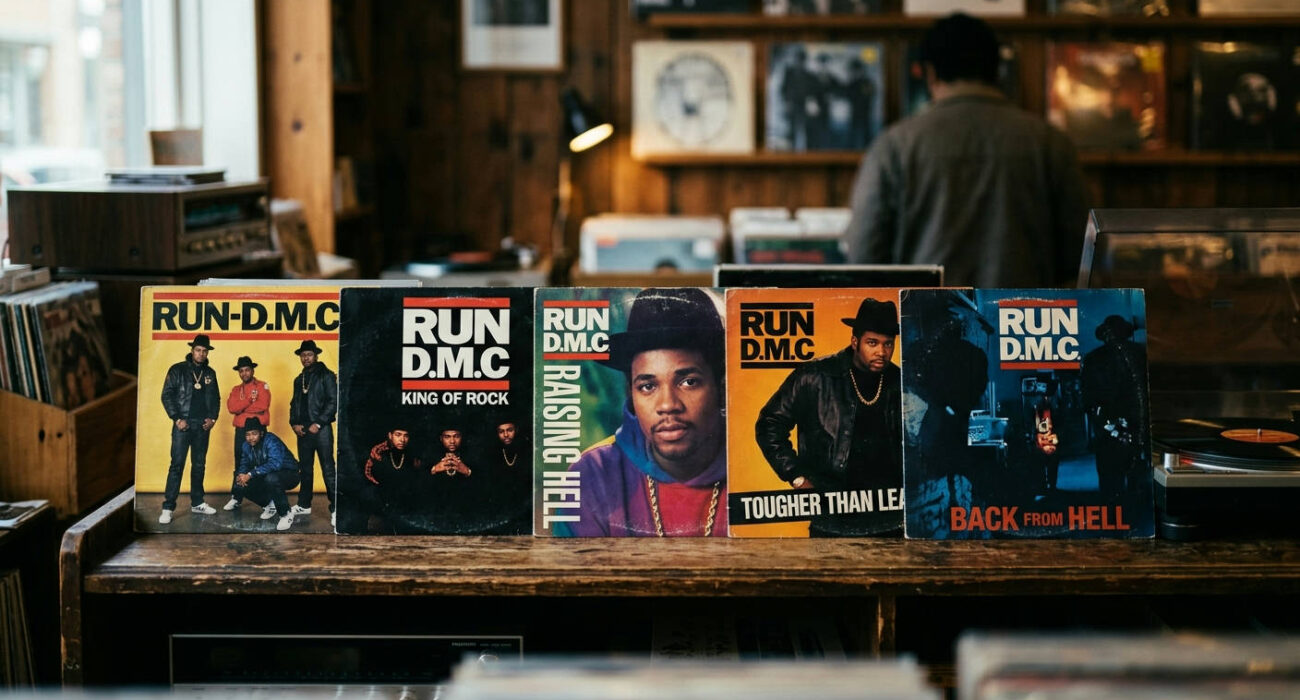
Trying to definitively settle the debate over the best Run D.M.C. album ranked is like trying to pick the toughest B-Boy in Hollis, Queens, in 1985. Everyone has an opinion, and everyone is ready to defend it with passion. But here at Vinyl Gold UK, we don’t shy away from a fight. We live for the crackle of a fresh needle drop and the weight of a heavyweight gatefold sleeve in our hands. So, let’s cut through the noise, drop the needle, and break down the entire studio discography of the undisputed kings of rock-rap.
This isn’t just a list. It’s an argument. We’re digging into the production, the rhymes, the cultural impact, and the sheer, raw energy that made Joseph “Run” Simmons, Darryl “D.M.C.” McDaniels, and the late, great Jason “Jam Master Jay” Mizell the most important rap group of their time—and arguably, of all time.
Ranking Every Run D.M.C. Album From Last to First
We’re going in reverse order, from the projects that missed the mark to the certified classics that belong in every serious vinyl collection. Each album was a moment in time, a snapshot of a group evolving, and sometimes, struggling with their own legendary status.
7. Crown Royal (2001)
Let’s be blunt: Crown Royal is a tough listen for die-hard fans. Released in 2001, it feels less like a cohesive Run D.M.C. project and more like a Run solo album with a revolving door of guest stars. D.M.C.’s notable absence on many tracks is the album’s most glaring flaw, a result of creative differences and personal struggles that were well-documented at the time.
The concept of pairing Run with rock and nu-metal acts of the era, like Fred Durst, Stephan Jenkins, and Kid Rock, was a clear attempt to recapture the magic of “Walk This Way.” Unfortunately, it comes off as forced and dated. The production often sounds like a 2001 rock-rap parody, lacking the raw, thunderous power that defined their classic work. While tracks like “The School of Old” offer a brief glimpse of what could have been, the album as a whole is a disjointed and ultimately disappointing final chapter.
For completists only. Finding a clean vinyl copy is tricky, and it’s more of a curiosity than a cornerstone of a collection.
6. Back from Hell (1990)
The title says it all. After the cinematic and confident Tougher Than Leather, 1990’s Back from Hell found the group in a darker, more uncertain place. The album sees them ditching their signature stripped-down, rock-infused sound for the denser, sample-heavy production of New Jack Swing, a style that was dominating the charts but felt alien to their established identity.
The result is an album that sounds uncomfortable in its own skin. The lyrical themes took a sharp turn, tackling serious issues like crack addiction (“Pause”), street violence, and social decay. While these were important topics, the delivery often felt mismatched with the polished, R&B-influenced beats. It lacks the explosive, crowd-moving energy that made them stars. Tracks like “What’s It All About” (built on a Stone Roses sample) are interesting experiments, but the album fails to cohere. It’s a vital document of the group’s struggles but not the first, second, or even third record you should reach for.
5. Down with the King (1993)
After the commercial and critical stumble of Back from Hell, Run D.M.C. needed a comeback. Down with the King was exactly that—a return to form, if not a return to the mountaintop. They wisely brought in a new generation of producers who grew up on their music, including Pete Rock, EPMD, The Bomb Squad, and Q-Tip.
This infusion of new blood gave the album a harder, more contemporary (for 1993) sound that reconnected them with the streets. The title track, produced by Pete Rock, is an absolute monster—a powerful statement of purpose with a thunderous beat and revitalised rhymes from Run and D.M.C. Other highlights include the grimy “Ooh, Whatcha Gonna Do” and the CL Smooth-assisted “Come On Everybody.”
The album isn’t perfect; it sometimes feels like they’re trying on different hats to see what fits the new decade. Still, it was a necessary and largely successful course correction that proved the kings still had something to say. It’s a solid record that showed their willingness to adapt and collaborate, earning them their respect back.
The Essential Trilogy: The Records That Defined Hip-Hop
Now we get to the undisputed classics. These next three albums are not just the best Run D.M.C. records; they are foundational texts of modern music. The order is hotly debated in record shops and online forums to this day, but this is our definitive take.

4. Tougher Than Leather (1988)
Following up the globe-conquering Raising Hell was an impossible task. Their solution? Go bigger, louder, and more cinematic. Tougher Than Leather is the accompanying soundtrack to their movie of the same name, and it carries that same bombastic, swaggering energy. It’s an album overflowing with confidence.
The production, once again helmed by Rick Rubin and the group themselves, is denser and more aggressive. The title track is a bone-crushing statement of intent, while “Run’s House” and “Beats to the Rhyme” became instant anthems, showcasing Jam Master Jay’s turntable wizardry at its absolute peak. JMJ isn’t just keeping time here; he’s a lead instrument, a one-man wrecking crew of scratches and cuts.
“They’re superstars, and this album sounds like it. It’s the sound of a group who knew they owned the world and decided to make their victory lap sound like a monster truck rally.”
Some critics at the time found it less focused than its predecessor, but in 2026, Tougher Than Leather stands as a powerful, aggressive, and incredibly fun record. It’s the sound of hip-hop becoming a full-blown arena spectacle. “Mary, Mary” cleverly flips The Monkees into a B-Boy anthem, proving their knack for genre-bending was no fluke. This is a must-own on vinyl for the sheer sonic force it projects.
Grab your copy of Tougher Than Leather and hear the power for yourself.
The Final Showdown: Determining the Best Run D.M.C. album ranked
This is where the real debate begins. We’re down to three albums that not only defined a genre but also changed the face of pop culture forever. Each one has a legitimate claim to the top spot.
3. King of Rock (1985)
If their debut was the blueprint, King of Rock was the mission statement. This is the album where Run D.M.C. explicitly declared their intentions to smash the walls between rock and rap. The album cover says it all: three guys from Hollis in leather and adidas, crashing a rock and roll museum.
The title track is the thesis. Over a blistering guitar riff (played by Eddie Martinez), Run and D.M.C. trade verses that are equal parts boast and proclamation. They weren’t just rappers; they were rock stars. The album solidified their iconic sound: booming 808s, roaring guitars, and the most powerful back-and-forth rhyming the world had ever heard.
### Why King of Rock is a Contender for the Best Run D.M.C. album ranked
Beyond the title track, the album is packed with classics. “Can You Rock It Like This” is a masterclass in rhythm and rhyme, while “You’re Blind” showcases their storytelling ability with a cautionary tale. Jam Master Jay’s skills are front and centre on “Darryl and Joe (Krush-Groove 3),” a relentless display of turntable acrobatics.
This album was a crucial step. It proved the success of their debut was no accident and laid the groundwork for the massive crossover success that would follow. It’s a loud, proud, and unapologetically bold record that sounds as fresh today as it did in 1985. A cornerstone of any serious hip-hop vinyl collection.
Get this foundational text for your collection.
2. Run-D.M.C. (1984)
The shot heard ’round the world. The 1984 self-titled debut is arguably the most important album in hip-hop history. Before this record, rap was largely a singles-driven genre, often reliant on disco or funk backing tracks. Run-D.M.C. changed the entire sonic and aesthetic direction of the culture.
The sound was revolutionary. Stripped bare, raw, and aggressive. Producer Larry Smith and Russell Simmons crafted a soundscape of nothing but a booming Oberheim DMX drum machine, a few spare synth stabs, and Jam Master Jay’s precise scratches. Over this stark backing, Run and D.M.C.’s voices exploded from the speakers, trading lines with a chemistry that has never been duplicated.
Songs like “Sucker M.C.’s (Krush-Groove 1)” and “It’s Like That” were revelations. This wasn’t party music; this was hard, intelligent, and confrontational. They weren’t rapping over disco loops; they were creating a new sound from scratch. “Rock Box” was the genesis of it all, the first track to fuse hip-hop beats with a hard rock guitar riff, setting the stage for everything that was to come. As noted by the Rock & Roll Hall of Fame, they were “the first of the new school” and this album was their opening salvo.

This album is the ground zero of modern hip-hop. It established the uniform (hats, chains, adidas), the sound (hard beats, aggressive rhyming), and the attitude. Owning this on vinyl isn’t just owning a great album; it’s owning a piece of history.
Experience the revolution.
The Undisputed Champion: Raising Hell (1986)
And so we arrive at the top. The album that took the blueprint of the debut and the mission statement of King of Rock and perfected them, creating a multi-platinum monster that broke down every conceivable barrier. For our money at Vinyl Gold UK, the answer to the question of the best Run D.M.C. album ranked is, and always will be, Raising Hell.
This is the moment everything came together. The fusion of Rick Rubin’s rock-oriented production genius with the group’s unparalleled power resulted in a flawless album. It’s a masterclass in pacing, sequencing, and execution. There is not a single ounce of fat on this record.
From the opening beat of “Peter Piper” to the final fade of the “Walk This Way” reprise, Raising Hell is a relentless, 34-minute assault of pure creative energy.
### The Tracks that Cemented Their Legacy
The album is a hit factory. “It’s Tricky” is built on a genius flip of The Knack’s “My Sharona” and became an instant pop culture staple. “My Adidas” was a B-Boy anthem so powerful it led to the first-ever endorsement deal between a musical act and an athletic brand, changing the economics of hip-hop forever. “You Be Illin'” is a hilarious piece of storytelling, while “Peter Piper” is perhaps the greatest tribute to a DJ ever recorded, a stunning showcase for Jam Master Jay.
And then there’s “Walk This Way.” The collaboration with Aerosmith wasn’t just a hit song; it was a cultural event. It single-handedly resurrected Aerosmith’s career, put Run D.M.C. on heavy rotation on MTV, and proved to the world that hip-hop was not a fad but a dominant cultural force. It broke down radio formats and racial barriers in a way no one had thought possible.
### The Production and Sound
Rick Rubin’s production is key. He understood how to capture the raw energy of their live shows. The 808s on Raising Hell don’t just bump; they punch you in the chest. The guitar samples are not just accents; they are weapons. The entire album is mixed to be played as loud as possible, making it an essential experience on a quality turntable setup. If you’re looking for a new deck to do it justice, check out our guide to the best turntables under £300 in the UK.
Raising Hell is the perfect synthesis of everything Run D.M.C. represented: raw lyrical power, groundbreaking production, cultural swagger, and an undeniable crossover appeal that never felt like a sell-out. It’s their most complete, most iconic, and most historically significant work.
Own the masterpiece.
The Legacy of Jam Master Jay
No discussion of Run D.M.C.’s albums is complete without paying special tribute to the man on the wheels of steel, Jam Master Jay. He was more than just a DJ; he was the group’s musical anchor and architect. His influence on the art of turntablism is immeasurable.
JMJ’s style was powerful and precise. He wasn’t just playing records; he was playing the turntable itself. His iconic scratches on tracks like “Peter Piper,” “Jam-Master Jay,” and “Beats to the Rhyme” are as memorable as any vocal hook. He pioneered the use of the turntable as a melodic and rhythmic instrument, setting a standard that DJs still chase in 2026.
His tragic passing in 2002 marked the definitive end of Run D.M.C. as a performing group, a testament to how integral he was to their very existence. His work is a masterclass for any aspiring DJ, and understanding his technique is fundamental. For those just starting, learning about the gear can be a great first step, and our look at the best DJ controllers for beginners can point you in the right direction.
A Final Spin
Ranking the albums of a group as legendary as Run D.M.C. is a heavy task, but a necessary one for fans and collectors. While their later work may not have reached the stratospheric heights of their ’80s output, their core discography remains one of the most important and influential in all of music.
From the raw, street-level revolution of their debut to the world-conquering perfection of Raising Hell, Run D.M.C. provided the soundtrack for a generation. They kicked down doors, shattered expectations, and laid the foundation for hip-hop’s global domination. So go ahead, pull out those records, turn up the volume, and pay respect to the kings from Queens.