
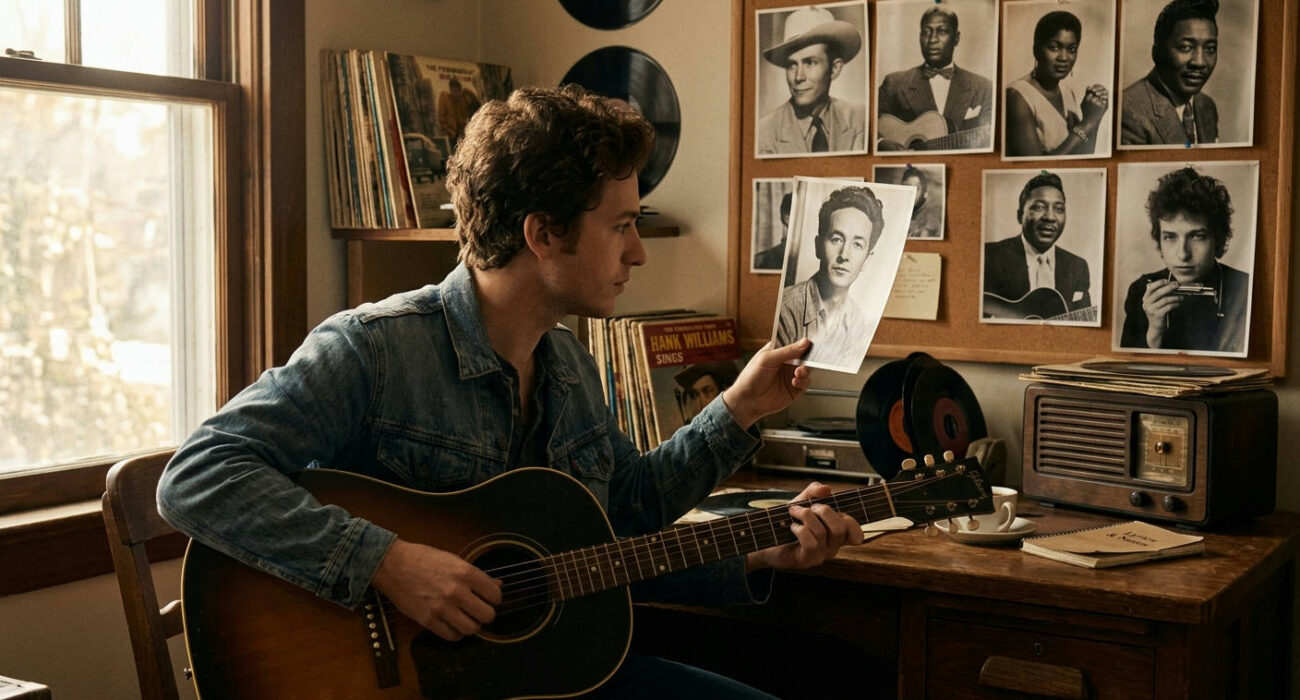
Trying to pin down Bob Dylan’s influences is like trying to bottle lightning. He wasn’t just a musician; he was a cultural sponge, soaking up everything from Depression-era folk ballads to Beat poetry and primal rock and roll. To truly understand his genius, you have to look back at the giants on whose shoulders he stood. This isn’t just a simple list; it’s a treasure map tracing the sonic and literary DNA of his work. Exploring the artists who inspired Bob Dylan reveals the rich soil from which his revolutionary songs grew.
The Folk Roots: Woody Guthrie and the Dust Bowl Balladeers
You can’t talk about Dylan without first talking about Woody Guthrie. This connection is the bedrock of his entire early persona and sound. Dylan didn’t just admire Guthrie; he absorbed him, channelling his spirit to kickstart his own journey.
Woody Guthrie: The North Star
For a young Robert Zimmerman arriving in New York City in 1961, Woody Guthrie was more than a hero; he was a destination. Dylan’s pilgrimage to visit the ailing Guthrie in a New Jersey hospital is the stuff of legend. He saw in Guthrie the “last of the great troubadours,” a man who used his guitar and voice as tools for documenting the lives of ordinary, struggling people.
This wasn’t just hero worship. Dylan meticulously studied Guthrie’s vocal phrasing, his simple yet effective guitar strumming, and his ability to tell a sprawling story in a three-minute song. You can hear it all over his debut album, especially in “Song to Woody,” a direct and heartfelt tribute that lays his debt bare for all to see.
Pete Seeger and The Weavers
While Guthrie was the raw, rambling spirit, Pete Seeger was the folk movement’s organiser and conscience. As a member of The Weavers, Seeger helped bring folk music to a massive commercial audience, proving that these old songs had power and relevance.
Seeger’s influence on Dylan was twofold. First, his unwavering political activism demonstrated that a song could be a weapon for social change, a lesson Dylan would soon take to heart with tracks like “Masters of War.” Second, Seeger’s masterful banjo playing and his encyclopaedic knowledge of American folk traditions provided a blueprint for how to arrange and perform these songs with authenticity and passion.
Ramblin’ Jack Elliott
If Woody Guthrie was the source, Ramblin’ Jack Elliott was the most direct conduit to a young Bob Dylan. Elliott had spent years travelling with Guthrie, learning his songs and his rambling persona so perfectly that Guthrie himself once said, “He sounds more like me than I do.”
When Dylan hit the Greenwich Village scene, he was, for a time, a direct echo of Elliott. He copied his phrasing, his storytelling style between songs, and his repertoire. Some old-timers on the scene even dismissed Dylan as a pale imitation. But what he was really doing was learning his craft from a master, using Elliott’s style as a foundation before he found his own unique, world-changing voice.
Digging for Gold: The Bluesmen Who Shaped Dylan’s Sound
The folk scene gave Dylan his political and narrative framework, but the blues gave him his soul and his swagger. He devoured old blues records, finding a raw, unfiltered honesty in them that was missing from a lot of the polished pop of the day.
“The blues is more than a feeling, it’s a tonic, it’s a faith, it’s a religion.” – Bob Dylan, in a 2026 interview with Rolling Stone.
Robert Johnson: The Crossroads Legend
The myth of Robert Johnson—the man who supposedly sold his soul to the devil at the crossroads for musical genius—is a powerful one. For Dylan, the appeal was less about the mythology and more about the stark, emotional terror in Johnson’s music.
Johnson’s songs, like “Hellhound on My Trail,” were filled with paranoia, desire, and dread. Dylan tapped directly into this vein of dark, personal storytelling. He borrowed Johnson’s musical structures, but more importantly, he learned how to convey a sense of profound unease and existential weight, a skill that would define his most powerful work. To hear this lineage, grab a copy of Robert Johnson – The Complete Recordings on Amazon and play it back-to-back with Dylan’s “Ballad of a Thin Man.”
Big Joe Williams and the Twelve-String Howl
Big Joe Williams played a customised nine-string guitar and sang with a raw, guttural force that could stop you in your tracks. He was a major figure in the blues revival of the late 50s and early 60s, and his performances were a masterclass in raw power.
Dylan was clearly paying attention. You can hear the influence of Williams’ aggressive, percussive acoustic guitar style all over Dylan’s early work. The way Dylan attacks the strings on “Fixin’ to Die Blues” (a cover of a Bukka White song, but played with Williams’ intensity) is a direct nod to this unvarnished Delta blues tradition.
Son House and the Delta’s Primal Cry
If Robert Johnson was the haunted poet of the blues, Son House was its fiery preacher. Rediscovered in the 1960s, his performances were intense, cathartic events. He played slide guitar with a fierce, slashing style and sang as if he were exorcising demons.
This raw, emotional delivery was a revelation for Dylan. It showed him that a voice didn’t have to be pretty to be powerful. Son House’s passionate, sometimes-uncontrolled vocal explosions gave Dylan permission to push his own voice to its limits, to use it as an instrument of pure emotion rather than just a vehicle for melody.
Rock ‘n’ Roll’s First Wave: The Rebels Before the Cause
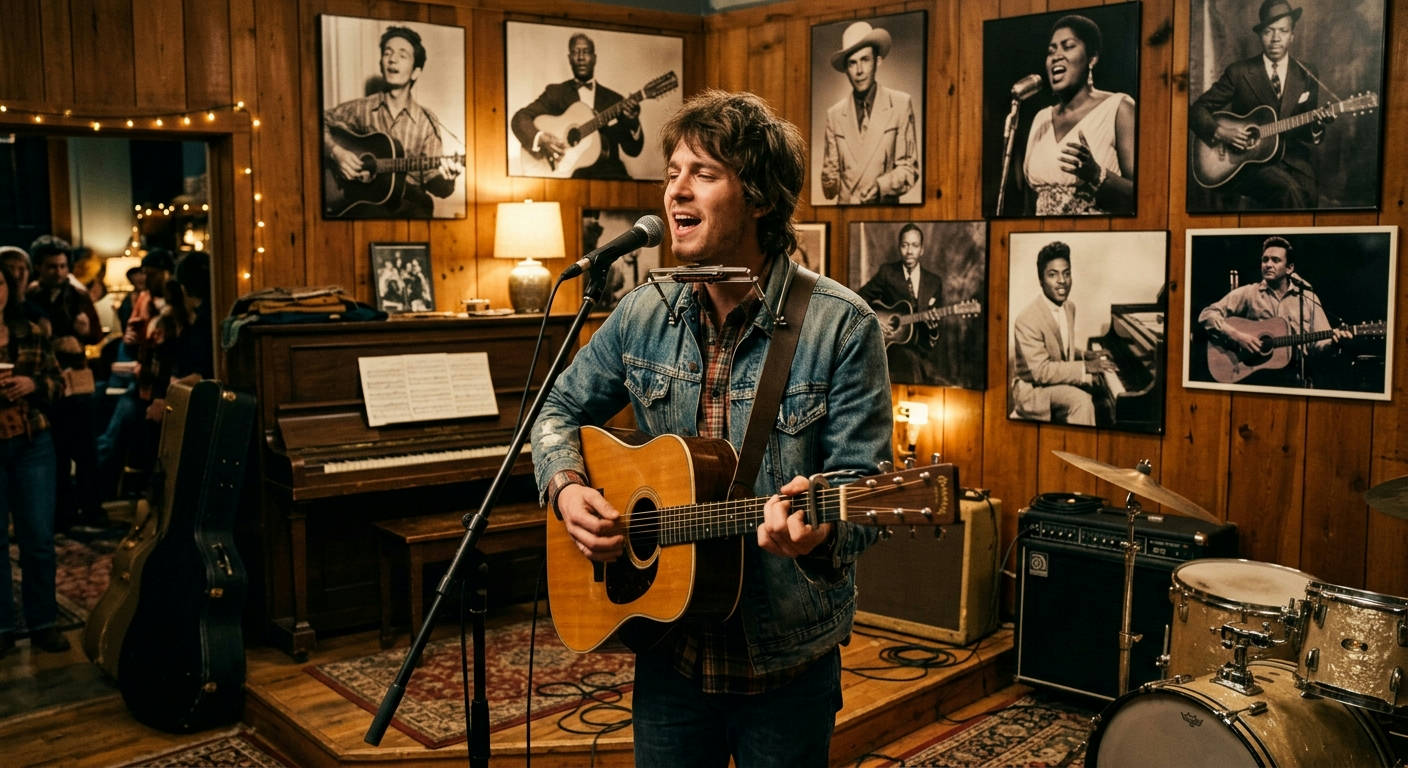
Before he was a folk hero, Dylan was a teenage rock and roller. He hammered away at the piano in his high school bands, pounding out covers of the day’s biggest hits. This early education in the structure and, more importantly, the attitude of rock and roll was absolutely critical to his later “electric” period.
Little Richard: The Architect of Attitude
Little Richard wasn’t just singing songs; he was unleashing a force of nature. The wild energy, the pompadour, the piano-pounding, the nonsensical, joyous shrieks of “awop-bop-a-loo-bop-a-lop-bam-boom!”—it was a declaration of freedom.
In his 1959 high school yearbook, Dylan (then Zimmerman) listed his ambition as “to join Little Richard.” This wasn’t a joke. Little Richard represented a total break from the staid conformity of the 1950s. He showed Dylan that music could be explosive, flamboyant, and joyously rebellious, a lesson that would stick with him for his entire career.
Elvis Presley: The King’s Shadow
It’s impossible to overstate the cultural earthquake that was Elvis Presley. For Dylan’s generation, Elvis was Year Zero. He single-handedly changed the way music sounded, the way performers looked, and what was considered acceptable on stage and on the radio.
While Dylan would later position himself as the thoughtful, lyrical alternative to Elvis’s raw sexuality, the initial impact was profound. Elvis proved that a single individual could channel the wild spirit of blues and country and become a global phenomenon. He created the very template for the modern rock star that Dylan would later both inhabit and subvert.
Buddy Holly: The Songwriter’s Blueprint
Buddy Holly was different. He wore glasses. He wrote his own songs. He experimented with studio production. He was the complete package—singer, songwriter, guitarist, and bandleader. In a world of manufactured pop stars, he was an authentic artist.
This model was hugely influential on Dylan. Holly proved that you didn’t need to be a matinee idol to front a rock and roll band. His clever, concise song writing, which blended pop hooks with country sincerity and blues rhythms, provided a direct blueprint for the kind of self-contained artist Dylan aspired to be. Holly was the thinking man’s rocker, and he paved the way for the poet of rock and roll to follow.
The Country and Western Soul: A Hank Williams Heart
Dylan’s deep love for country music is often overlooked by those who only focus on his folk and rock phases. But the mournful, honest storytelling of country and western music is woven deep into his musical fabric, providing a direct line to some of his most emotional and accessible work.
The Unmistakable Influence of Hank Williams
For Bob Dylan, Hank Williams was a poet of the highest order. He called him the “king of all the writers.” What Dylan heard in Hank’s music was a brutal, almost unbearable honesty. Williams sang about love, loss, and heartache with a simplicity and directness that was breath-taking.
This lyrical purity had a massive impact on Dylan’s own writing, especially on albums like Nashville Skyline and Blood on the Tracks. Williams’ famous “high lonesome sound”—that yodel-like crack in his voice—can also be seen as an antecedent to Dylan’s own unconventional vocal delivery. Both used their voices not for technical perfection, but for maximum emotional impact. You can learn more about the profound legacy of this country icon in our deep dive on Hank Williams.
Johnny Cash: The Man in Black’s Gravitas
Johnny Cash and Bob Dylan were kindred spirits. Both were outsiders who operated within mainstream genres while refusing to be defined by them. Both possessed a deep sense of gravitas and an affinity for telling the stories of the downtrodden and the outcast.
Cash was an early and vocal champion of Dylan, famously inviting him to perform on his television show, a move that helped introduce Dylan to a wider, more conservative country audience. Their duet on “Girl from the North Country” from Nashville Skyline is a landmark moment, a passing of the torch from one American icon to another. Cash’s stoic delivery and deep moral authority provided a model of artistic integrity that Dylan clearly respected and emulated.
The Literary Giants: Poets and Writers Who Inspired Bob Dylan
To limit Dylan’s influences to just music would be a massive mistake. He was, and is, a voracious reader. His lyrics are packed with literary allusions, and his entire approach to song writing was shaped by poets and novelists who pushed the boundaries of language.
Dylan Thomas and the Rhythmic Word
The most obvious connection is the name itself. Robert Zimmerman became Bob Dylan in a direct homage to the Welsh poet Dylan Thomas. But the influence runs deeper than just a name.
Thomas was a master of sound and rhythm. His poetry was meant to be read aloud, with a musical, incantatory quality. Dylan absorbed this love for the phonetics of language, the way words could tumble and cascade to create a feeling, independent of their literal meaning. This is the key to understanding the surreal, free-associative lyrics of his mid-60s masterpieces.
The Beat Generation: Kerouac, Ginsberg, and Ferlinghetti
The Beat Generation’s impact on Dylan was seismic. Jack Kerouac’s novel On the Road, with its spontaneous prose and celebration of freedom and the American journey, provided a philosophical roadmap for Dylan’s own rambling ethos.
Allen Ginsberg’s poem “Howl” was even more direct in its influence. Its long, breathless lines, its raw political anger, and its cataloguing of a broken America provided the template for Dylan’s epic protest songs like “A Hard Rain’s a-Gonna Fall.” As detailed by The Beat Museum’s archives, Ginsberg and Dylan became close friends, two generations of counter-culture prophets recognizing a shared spirit. The Beats taught Dylan to break free from traditional verse-chorus structure and let his ideas flow in a powerful, uninterrupted stream.

“The thing about rock’n’roll is that for me, anyway, it wasn’t enough… There were great catch-phrases and driving pulse rhythms… but the songs weren’t serious or didn’t reflect life in a realistic way. I knew that when I got into folk music, it was more of a serious type of thing. The songs are filled with more despair, more sadness, more triumph, more faith in the supernatural, much deeper feelings.” – Bob Dylan, Biograph liner notes.
Arthur Rimbaud: The Symbolist Rebel
As Dylan’s lyrics grew more abstract and surreal in the mid-1960s, he was drawing heavily from the 19th-century French Symbolist poets, particularly Arthur Rimbaud. Rimbaud was a teenage prodigy who abandoned poetry before he was 20, but not before revolutionizing it.
Rimbaud championed a “systematic derangement of all the senses” to achieve a higher poetic vision. This idea is the key to unlocking songs like “Visions of Johanna” or “Desolation Row.” Dylan began creating collages of startling, disconnected images, aiming for emotional and psychological truth rather than literal, narrative sense. He was using words like a painter uses colours, a technique lifted directly from Rimbaud’s playbook.
More Artists Who Inspired Bob Dylan
Beyond the titans of folk, blues, and literature, Dylan’s web of influences is vast and complex. Many other artists, some well-known and others more obscure, left their fingerprints on his sound and style. This is a look at some of the other crucial artists who inspired Bob Dylan.
### Uncovering More Artists Who Inspired Bob Dylan
Dave Van Ronk: The Mayor of MacDougal Street
In the early Greenwich Village folk scene, Dave Van Ronk was a towering figure. A gruff, intellectual, and incredibly talented guitarist and song interpreter, he was an unofficial mentor to many younger musicians, including Dylan.
Van Ronk’s complex fingerpicking guitar style and his unique arrangements of traditional songs were highly influential. In fact, Dylan famously “borrowed” Van Ronk’s arrangement of “House of the Risin’ Sun” for his debut album, a move that caused some friction at the time but demonstrated just how much Dylan was learning from the Village elders. Van Ronk’s intellectual approach to folk music showed Dylan that these old songs could be deconstructed and reassembled in new and powerful ways.
Odetta: The Voice of the Civil Rights Movement
Before Dylan ever picked up a guitar, he heard Odetta. He has cited her album Odetta Sings Ballads and Blues as the record that made him trade his electric guitar for an acoustic and dedicate himself to folk music.
Odetta Holmes had a voice of immense power and dignity. Classically trained, she brought a gravitas and emotional depth to traditional folk songs, spirituals, and work songs. Her performances were not just entertainment; they were profound statements of Black history and resilience. She showed Dylan that a single voice and a guitar could command a stage and carry the weight of a movement. According to a 2026 feature in The New York Times, her influence on the folk revival is immeasurable.
Lonnie Johnson: The Blues and Jazz Pioneer
While Dylan drew from the raw power of the Delta blues, he also appreciated the sophisticated, melodic side of the music, personified by Lonnie Johnson. Johnson was a true innovator whose career stretched from the 1920s to the 1960s, and his technically brilliant guitar playing bridged the gap between blues and jazz.
Johnson’s smooth, articulate guitar lines and his crooning vocal style presented a different kind of blues artistry. Dylan covered Johnson’s song “Tomorrow Night” on his 1992 album Good as I Been to You, a clear nod to this long-held admiration. Johnson’s influence reveals the depth of Dylan’s musical knowledge and his appreciation for subtlety and craft alongside raw power.
Building Your Own Dylan-Inspired Vinyl Collection
Exploring the music that shaped Bob Dylan is one of the most rewarding journeys a music fan can take. The best way to do it is on vinyl, the format on which Dylan and his heroes made their names. Here’s how to start building a collection that gets to the heart of his influences.
The Essential Starting Points
You have to begin with the pillars of his sound. These are non-negotiable records for understanding where Dylan came from.
- Woody Guthrie – Dust Bowl Ballads: This is the foundational text. These songs document the plight of displaced workers with grit and poetry. Get your copy of Dust Bowl Ballads on vinyl from Amazon.
- Robert Johnson – King of the Delta Blues Singers: This compilation, released in 1961, introduced Johnson to a new generation of musicians, including Dylan. It’s a haunting, essential document.
- Little Richard – Here’s Little Richard: Pure, uncut rock and roll energy. This album is a shot of pure adrenaline and shows you the wild spirit Dylan was chasing in his youth.
Finding the Blues Roots on Vinyl
To dig deeper into the blues, look for compilations that capture the breadth of the genre. Labels like Yazoo and Arhoolie have released incredible collections of early blues recordings.
Search for a vinyl compilation like “The Story of the Blues” to get a broad overview. When you listen, pay attention to the different guitar styles—the slashing slide of Son House, the intricate fingerpicking of Mississippi John Hurt, the booming 12-string of Lead Belly. This is the raw material Dylan was working with.
Gear Up: The Right Turntable Matters
Listening to these historic recordings on a cheap, plastic turntable is a disservice to the music. The crackle and warmth of an old blues record are part of the experience. To truly appreciate the sonic details that captivated Dylan, you need a decent setup.
You don’t need to break the bank. There are fantastic options available that deliver high-fidelity sound without a ridiculous price tag. If you’re looking to upgrade your setup to properly honour these classics, check out our guide to the best turntables under £300 in the UK to get started.
Bob Dylan’s true genius wasn’t just in what he created, but in what he heard. He listened to the ghosts of the past—the rambling folk singers, the haunted bluesmen, the rebellious rockers, and the visionary poets. He took their stories, their sounds, and their spirit, and he synthesized them into something entirely new, a voice that would define not just a generation, but the very idea of what a song could be. To listen to his influences is to hear the component parts of a revolution.