
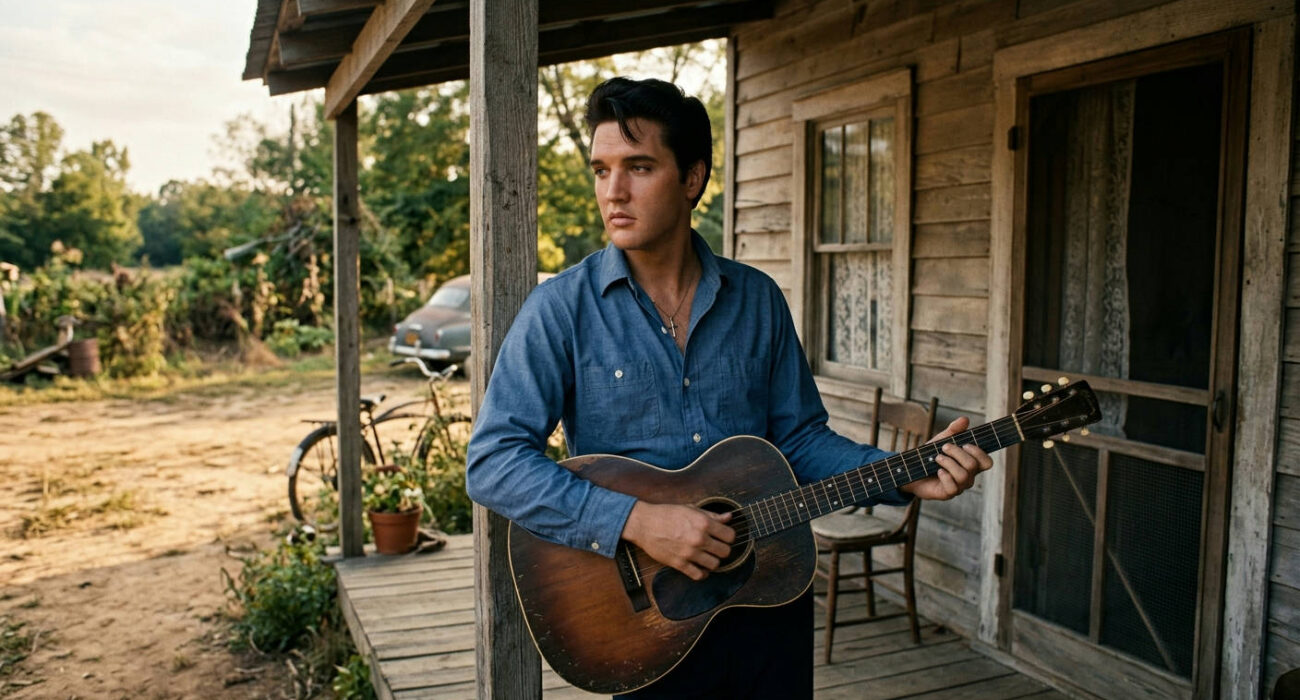
Before the King, the crown, and the international fame, there was just a boy from Tupelo, Mississippi. Understanding the icon means digging deep into the dirt-poor, gospel-soaked, and profoundly influential years that forged the man who would change music forever. The Elvis Presley early life story isn’t just a prelude; it’s the entire blueprint for the revolution he would unleash. It’s a tale of tragedy, poverty, divine musical intervention, and the raw, untamed talent that could only have been born in the American South.
This is the story of how a shy truck driver with a guitar became the most recognizable figure in modern history. Forget the Vegas jumpsuits for a moment. We’re going back to the beginning.
Born in a Shotgun Shack: The Tupelo Beginnings
You can’t grasp the scale of Elvis’s success without first understanding the depth of his poverty. His journey didn’t start in a recording studio; it started in a two-room house his father built with his own hands, a world away from the gates of Graceland.
January 8, 1935: A Twin, a Tragedy
On that cold January morning in Tupelo, Mississippi, Gladys Presley gave birth to twin boys. The first, Jesse Garon, was stillborn. Thirty-five minutes later, Elvis Aaron Presley entered the world, alone. This event cast a long shadow over the family.
Gladys, in particular, developed a fiercely protective, almost smothering love for her surviving son. Elvis grew up with the sense that he was living for two people, carrying the destiny of the brother he never met. This profound loss created an unbreakable, and at times complicated, bond between mother and son that would define the entire Elvis Presley early life story. He was, in her eyes, the chosen one, the survivor meant for something great.
The Presley Family’s Struggle with Poverty
The Presleys were perpetually on the edge of financial ruin. The tiny shotgun shack where Elvis was born, located in the “wrong” part of town, is a testament to their hardship. Vernon Presley drifted between odd jobs, from sharecropper to truck driver, struggling to provide a stable income.
The situation became dire when Vernon, along with Gladys’s brother and a friend, was sentenced to three years in the notorious Mississippi State Penitentiary (Parchman Farm) for forging a four-dollar check. Although he only served eight months, his absence forced a young Elvis and his mother to rely on family and government assistance, cementing a deep-seated fear of poverty in the young boy’s mind. They moved constantly, always chasing work, always one step away from destitution.
The Musical Melting Pot of Early Influences
Elvis didn’t invent rock and roll in a vacuum. His sound was a direct result of the unique cultural and musical stew he was steeped in from birth. He was a human sponge, absorbing every note he heard, from the church pew to the radio waves.
Gospel Roots in the Assembly of God Church
Long before he was gyrating on stage, Elvis was singing his heart out in the Assembly of God church. This wasn’t the quiet, reserved worship of some denominations. Pentecostal services were fiery, passionate affairs filled with jubilant singing, hand-clapping, and ecstatic movement.
It was here that a young Elvis Presley learned about performance, about connecting with an audience through raw emotion, and about the power of music to move the body and soul. The call-and-response style, the soaring harmonies, and the uninhibited energy of Southern gospel music became a permanent part of his musical DNA, evident in his later ballads and rock anthems alike.
Blues, Country, and the Sounds of Memphis
In 1948, when Elvis was 13, the Presleys packed up and moved to Memphis, Tennessee, in search of better opportunities. This move was arguably the single most important event in his formative years. They lived in public housing, often in neighbourhoods that were predominantly African American.
This proximity exposed him to a world of music he might have otherwise missed. He absorbed the raw, earthy sounds of the blues pouring from juke joints and from the legendary Beale Street, a hub of Black culture and commerce. He spent hours outside shops selling records by artists like B.B. King and Arthur “Big Boy” Crudup. Simultaneously, he was a devoted listener of the Grand Ole Opry on the radio, idolizing country stars like Roy Acuff and Ernest Tubb. He was blending these sounds in his head long before he ever stepped in front of a microphone.
“I’d play along with the radio or records…I’d practice and practice…The first music I ever heard was church music. I’m very religious.” – Elvis Presley
This fusion of Black blues and R&B with white country and gospel was not just unusual; it was revolutionary. It was the very recipe for rock and roll.
From Shy Kid to Budding Performer: The Elvis Presley Early Life Story Unfolds
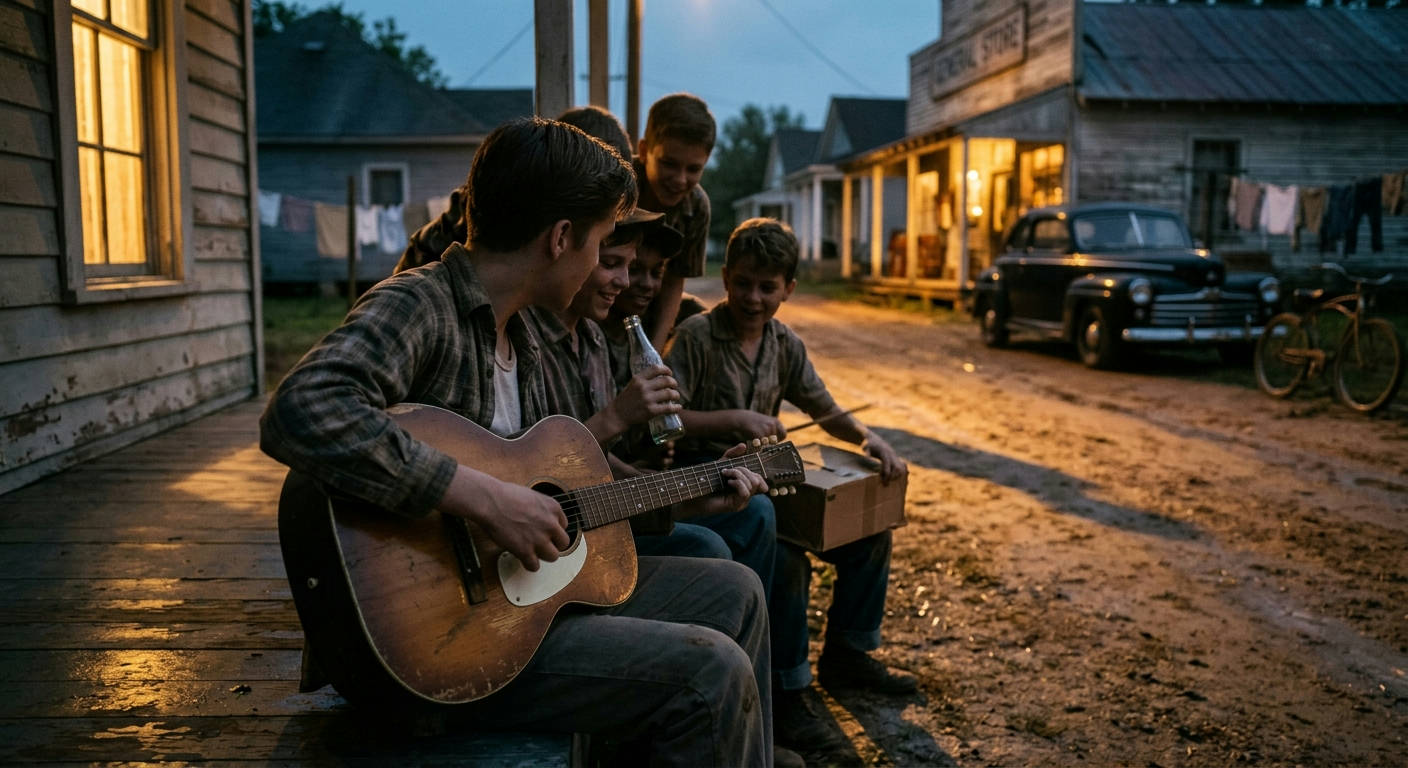
For all his future swagger, the teenage Elvis was known for being a quiet, polite, and somewhat awkward outsider. He was the kid who brought his guitar to school but was often too shy to play it. Yet, underneath that reserved exterior, a performer was waiting for the right moment to emerge.
The First Guitar: A Fateful Birthday Gift
The story is legendary. For his eleventh birthday, Elvis wanted a rifle. His mother, understandably concerned, guided him towards a different choice at the Tupelo Hardware Company. He left not with a weapon, but with a $7.75 guitar.
He didn’t know how to play it, but he was determined. He learned chords from his uncles and the local church pastor. That simple wooden instrument became his constant companion, a shield for his shyness and an outlet for the music swirling in his head. It was the key that would eventually unlock everything. For anyone starting their own musical journey, a good instrument is essential. While you can’t buy Elvis’s first guitar, you can find a quality starter acoustic on Amazon. Check out the vast selection of acoustic guitars for beginners to find one that fits your budget.
High School Talent Shows and Finding His Voice
At Humes High School in Memphis, Elvis stood out. In an era of crew cuts and conservative dress, he was growing his sideburns, greasing his hair into a pompadour, and wearing flamboyant pink and black outfits from the shops on Beale Street. He was an enigma to his peers—a quiet loner with a loud sense of style.
Most of his classmates had no idea he could sing. That changed at the Humes High annual minstrel show in April 1953. Pushed on stage, a nervous Elvis launched into the 1950 hit “Till I Waltz Again with You.” The reaction was instantaneous and overwhelming. The same students who might have mocked his appearance were screaming for more. He played an encore, and in that moment, the shy boy realized the power he held when he performed. The Elvis Presley early life story had found its first real stage.
The Sun Studio Sessions: Where a Legend Was Born
All the influences, the practice, and the quiet ambition finally led him to a small, unassuming storefront at 706 Union Avenue in Memphis: Sun Studio. This was the domain of Sam Phillips, a visionary record producer who would become the catalyst for Elvis’s career.
The “My Happiness” Acetate: A Gift for His Mother
In the summer of 1953, an 18-year-old Elvis walked into the Memphis Recording Service, the public recording arm of Sun Records. He paid his $3.98 to record a two-sided acetate disc. The official story is that it was a belated birthday present for his mother, Gladys.
He sang the ballads “My Happiness” and “That’s When Your Heartaches Begin.” Sam Phillips wasn’t there, but his assistant, Marion Keisker, was. Intrigued by the unusual voice, she asked him what kind of singer he was. He replied, “I sing all kinds.” When she asked who he sounded like, he famously retorted, “I don’t sound like nobody.” Keisker made a note next to his name: “Good ballad singer. Hold.”
Sam Phillips and the Search for a “White Man with the Negro Sound”
Sam Phillips had a specific vision. He had been recording ground breaking blues artists like Howlin’ Wolf and B.B. King, but in the segregated America of the 1950s, he knew that getting this music to a mainstream white audience was nearly impossible.
He often said, “If I could find a white man who had the Negro sound and the Negro feel, I could make a billion dollars.” For months after Elvis’s first recording, nothing happened. Phillips was looking for an artist to record a specific song, “Without You,” and remembered the quiet kid. He called Elvis in, but the session was a failure. Elvis couldn’t get the song right. Phillips, however, didn’t give up on him.
The Breakthrough with “That’s All Right”
Disappointed but not defeated, Phillips paired Elvis with two seasoned local musicians: guitarist Scotty Moore and upright bassist Bill Black. Their initial sessions in early July 1954 were stiff and unproductive, mostly focused on slow ballads. They were on the verge of calling it a night.
Then, during a break, Elvis started fooling around. He picked up his guitar and began singing an old blues number, Arthur “Big Boy” Crudup’s “That’s All Right,” but he sang it faster, with a nervous, vibrant energy. Black joined in on his bass, slapping the strings, and Moore jumped in with a guitar riff.
In the control room, Sam Phillips’s head shot up. “What are you all doing?” he yelled over the intercom. They said they didn’t know. Phillips told them to find a place to start and do it again. In that spontaneous, unrehearsed moment, they had stumbled upon the sound he had been searching for his entire life. Rock and roll, as we know it, had just been born. You can explore this pivotal era with an excellent collection of these early recordings. A great place to start is the Elvis Presley: The Sun Recordings box set, a must-have for any serious music collector.
The Local Sensation: The Louisiana Hayride and Early Tours
The recording of “That’s All Right” set off a chain reaction that turned Elvis from a local curiosity into a regional phenomenon almost overnight. The fuse had been lit.
Dewey Phillips and the Radio Debut
Sam Phillips rushed a copy of the new record to Memphis’s most influential DJ, Dewey Phillips (no relation). On July 7, 1954, Dewey played “That’s All Right” on his “Red, Hot and Blue” radio show. The station’s switchboard lit up like a Christmas tree.
Listeners were mesmerized. They had never heard anything like it. Was the singer Black? Was he white? The song’s raw energy and Elvis’s unique vocal delivery defied easy categorization. Dewey played the record 14 times in a row that night and brought a nervous, stammering Elvis into the studio for his first-ever radio interview, where he had to confirm which high school he attended to convince the audience he was white.
The Birth of the Stage Persona
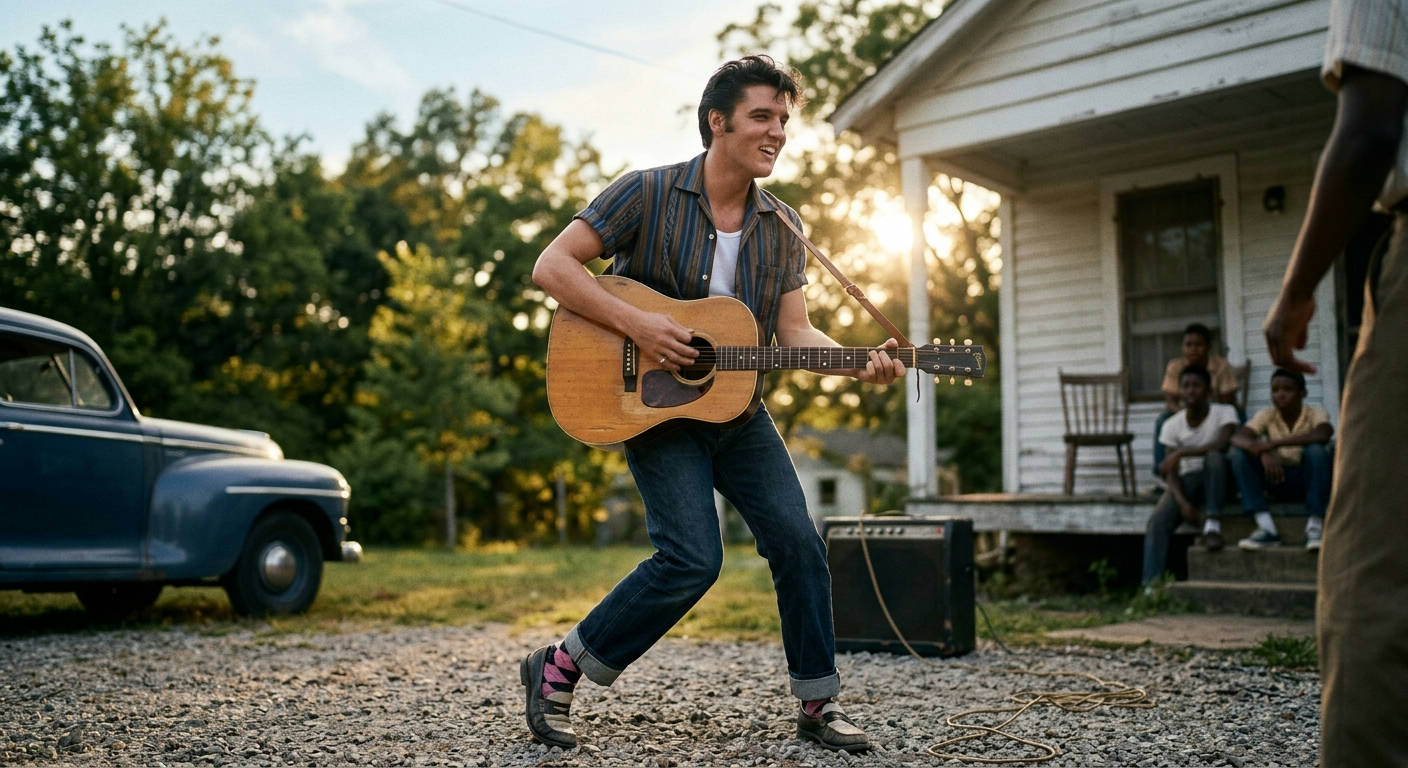
With a regional hit on his hands, Elvis, Scotty, and Bill began touring relentlessly. Their early performances were raw and electric. It was during these shows that Elvis’s iconic stage moves were born. He claimed his leg started shaking uncontrollably out of pure nervousness.
“I’m not trying to be sexy. It’s just my way of feeling the music. It’s a long way from being clean, but it’s not dirty.”
While adults were often scandalized by his gyrations, calling them vulgar and suggestive, the teenage audiences went wild. This visceral reaction from young fans, especially young women, was something new. His performances on the popular Louisiana Hayride radio show broadcast his sound and reputation across the South, solidifying his status as a rising star and a dangerous new force in popular culture. This blend of musical talent and controversial charisma was also seen in other giants of the era, such as the legendary Nat King Cole, who broke barriers in his own way.
Beyond the Music: The Man Behind the Myth
To fully understand the Elvis Presley early life story, you have to look beyond the music and at the person himself. His intense family relationships and his unique personal style were just as crucial to his identity as his voice.
The Inseparable Bond with Gladys Presley
Elvis’s relationship with his mother, Gladys, was the emotional core of his life. She was his confidante, his biggest fan, and his anchor. The loss of his twin brother fused their connection into something incredibly intense. They even had their own private language and pet names.
He was a devoted son, and his primary motivation for seeking fame and fortune was to give his mother a better life, to pull her out of the poverty that had haunted their family. He bought her a pink Cadillac long before he bought one for himself. Her death in 1958, when Elvis was just 23 and serving in the army, would devastate him in a way from which he arguably never fully recovered.
Style and Identity: The Making of an Icon
Elvis’s style was a statement. In an era of conformity, he was a peacock. His fashion sense was another extension of the cultural fusion happening in his music. He frequented Lansky Bros. on Beale Street, a clothier that catered primarily to Black musicians.
He embraced bold colours, especially pink, which was considered radical for a man in the 1950s. The high collars, the pegged pants, the two-tone shoes—it was all part of a carefully constructed identity. And then there was the hair. The famous pompadour, meticulously maintained with pomade, was his crown. His style wasn’t just clothing; it was an act of rebellion and self-expression that made him an instant icon for a generation of teenagers looking for their own identity. For more on the producers who shaped the sounds of this era, read our deep dive on the revolutionary work of Phil Spector.
How the Elvis Presley Early Life Story Shapes His Legacy
The formative years of Elvis Presley are not just a backstory; they are the entire foundation of his enduring legacy. Every element of the global superstar he became can be traced back to his humble, complicated beginnings in Mississippi and Tennessee.
From Poverty to Unimaginable Wealth
His impoverished childhood instilled in him both a deep insecurity and a relentless drive. He never forgot the shame of being poor, and it fuelled his ambition to provide for his family on a grand scale. The purchase of Graceland was the ultimate symbol of his success—a declaration that the Presleys would never be poor again. This rags-to-riches narrative remains a central part of his appeal.
A Synthesis of American Music
The Elvis Presley early life story is the story of American music itself. By absorbing and synthesizing country, blues, gospel, and pop, he created a sound that was entirely new yet felt strangely familiar. He became a bridge between different cultures and genres, bringing music that had been relegated to the margins squarely into the mainstream. While his role in popularizing Black music is a complex and debated topic, there is no denying that his unique interpretation changed the course of popular music.
The Blueprint for a Rock Star
From his rebellious style and controversial stage presence to his intense connection with his audience, Elvis created the blueprint for the modern rock star. He proved that a performer could be more than just a voice on a record; they could be a cultural force, a symbol of youthful rebellion, and a figure of both adoration and controversy. The shy boy who bought a guitar instead of a rifle laid the groundwork for every rock and roll frontman who followed.
The story of Elvis before the fame is what makes the fame all the more remarkable. It’s a reminder that legends aren’t just born; they are forged in the fires of hardship, shaped by their surroundings, and ignited by a single, revolutionary spark. The Elvis Presley early life story is the most important chapter in the book of rock and roll, and its echoes can still be heard in the music we listen to in 2026. If you want to dive deeper into his early works, a definitive biography is a great companion. Consider picking up a copy of Peter Guralnick’s acclaimed book, “Last Train to Memphis: The Rise of Elvis Presley,” for the most in-depth look at this incredible journey.