
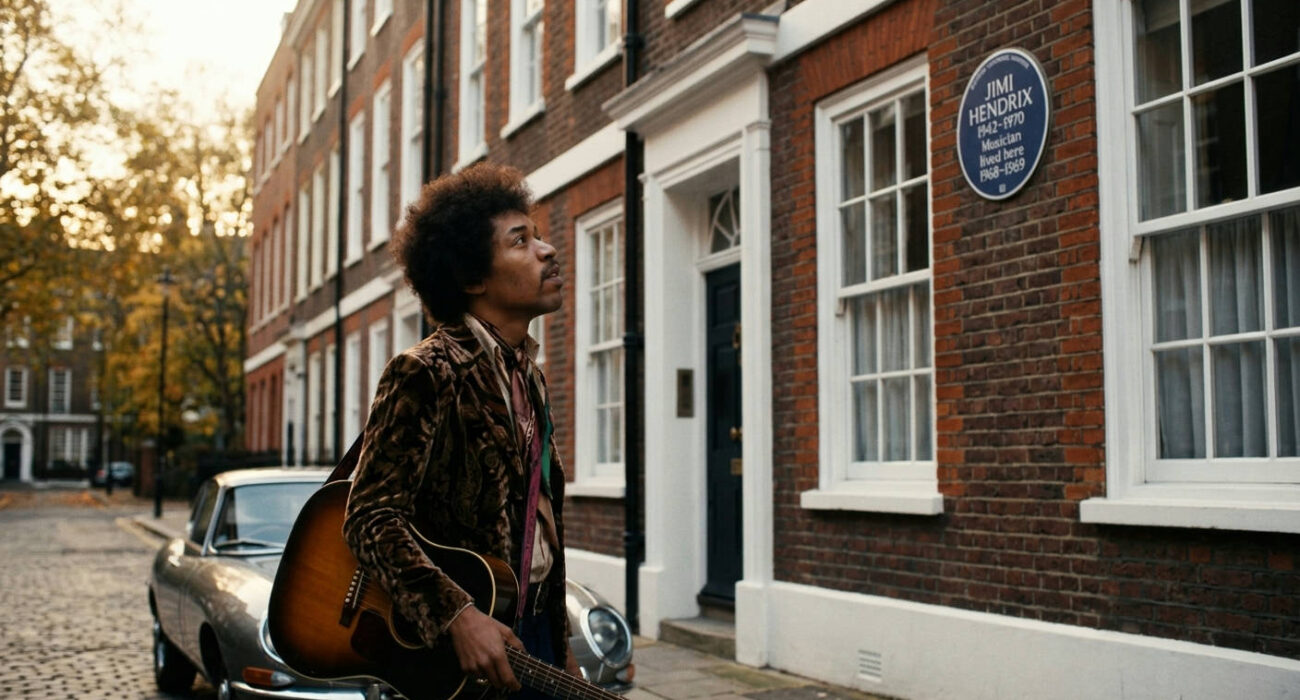
Trying to pin down a single answer to the question “where did Jimi Hendrix live” is like trying to catch smoke with your bare hands. The man was a cosmic nomad, a sonic traveler whose addresses changed as frequently as his guitar strings. His life was a whirlwind tour not just of stages, but of cities, apartments, hotel rooms, and crash pads. Each location, from the rainy streets of Seattle to a posh Mayfair flat, became a part of his story and a crucible for his revolutionary sound.
To truly understand Hendrix, you have to follow his trail. His homes weren’t just places he slept; they were the spaces where riffs were born, lyrics were scrawled, and music history was forged. This isn’t just a list of addresses. It’s a roadmap of his creative journey.
The Early Years: Seattle Grit and Army Discipline
Before the screaming feedback and iconic festival performances, there was a boy named Johnny Allen Hendrix. His early life was marked by constant movement and instability, settings that would paradoxically forge an unshakeable sense of self in his music.
Growing Up in Seattle, Washington
Jimi Hendrix’s story starts in Seattle. Born in 1942, his childhood was anything but stable. He was shuffled between relatives, his parents’ house, and even temporary stays elsewhere. He didn’t have one single childhood home but a series of them, primarily in Seattle’s Central District.
This was not the tech-hub Seattle of 2026. This was a working-class, gritty city. The constant upheaval in his home life pushed him inward, toward the beat-up, one-string ukulele and later his first acoustic guitar. The sounds of blues and R&B from the local scene became his real foundation, a home more permanent than any building.
Fort Campbell, Kentucky: The Screaming Eagles
In 1961, given a choice between jail time and military service, Hendrix enlisted in the army. He was stationed at Fort Campbell, Kentucky, as part of the 101st Airborne Division. For a year, the military barracks became his highly structured, disciplined home.
It was here he met a kindred spirit, bassist Billy Cox. Together, they formed The King Kasuals. The barracks provided a roof over his head, but the real living happened in the post’s service clubs, where he and Cox would jam relentlessly, honing the skills that would soon electrify the world. His time in the army was short-lived, ending with an honorable discharge in 1962, but it was a critical chapter in his development.
The Chitlin’ Circuit: A Nomadic Existence
After leaving the army, Hendrix didn’t settle down. He hit the road, becoming a journeyman guitarist on the “Chitlin’ Circuit”—a network of venues across the eastern, southern, and upper midwest areas of the United States that were safe and acceptable for African American musicians to perform during the era of racial segregation.
Clarksville and Nashville, Tennessee
After his discharge, Hendrix briefly lived in Clarksville, Tennessee, right near Fort Campbell. He and Billy Cox then moved to Nashville, the heart of a thriving R&B and blues scene. They rented rooms in a city buzzing with music, playing gigs in clubs like The Jolly Roger and the Club del Morocco.
Nashville was a musical education. It was a place of intense competition and collaboration. Hendrix absorbed everything, but he was already too wild, too inventive for the traditional R&B scene. His flashy stage presence and experimental guitar work often got him fired from gigs. His time there was less about finding a home and more about sharpening his sound against the grindstone of the music industry.
Life on the Road with Music Royalty
For the next few years, home was a tour bus, a cramped van, or a cheap motel room. Hendrix was a gun for hire, a backing guitarist for some of the biggest names in soul and R&B. He toured and recorded with The Isley Brothers, Little Richard, and Ike & Tina Turner, among others.
This was a brutal but invaluable apprenticeship. He learned about showmanship from Little Richard and about tight, rhythmic playing with The Isley Brothers. But he was always a sideman, constrained and often fined for being too flashy. This nomadic period taught him what he didn’t want: to be a background player in someone else’s story.
New York City: The Greenwich Village Transformation
By 1966, Hendrix had washed up in New York City, broke but determined. He landed in Greenwich Village, a bohemian enclave teeming with folk singers, beat poets, and artists. It was here that Jimmy James, the journeyman, began his transformation into Jimi Hendrix, the icon.
The Village Vibe: Finding His Voice
Hendrix found a creative home in the Village. He stayed in various cheap hotels, most notably the Hotel Albert on University Avenue, a known haven for musicians and artists. He was a fixture in the local scene, absorbing the folk of Bob Dylan and the blues of John Hammond Jr.
The Village was a melting pot of ideas. It was the perfect environment for Hendrix to finally unleash his full potential. He formed his own band, Jimmy James and the Blue Flames, and started to build a reputation as a guitarist unlike any other. He wasn’t just playing the blues; he was setting it on fire.
Cafe Wha? and the Birth of a Legend
His most important “address” in Greenwich Village wasn’t an apartment, but a stage. He held a residency at the Cafe Wha? on MacDougal Street. This dark, subterranean club became his laboratory. Night after night, he would experiment, pushing his Stratocaster to its limits.
It was during one of these legendary sets in 1966 that Chas Chandler, the bassist for The Animals, saw him play. Blown away, Chandler knew he had found a superstar. He offered to take Hendrix to London and make him a star. The Greenwich Village chapter was over, and the next, most explosive phase of his life was about to begin.
“When I was in England, I was pretty much a groom. I was a page. I was a valet. When I came to America, I was a genie.” – Jimi Hendrix
Where Did Jimi Hendrix Live? The London Years
If New York was where Hendrix found his voice, London was where he found his fame. He arrived in September 1966 and within weeks had turned the “Swinging London” music scene completely on its head. The question of where did Jimi Hendrix live during this period points to the most famous and well-documented home of his life.
23 Brook Street, Mayfair: The Iconic London Flat
In 1968, Hendrix and his girlfriend Kathy Etchingham moved into the top-floor flat at 23 Brook Street in Mayfair. This is the one address that has become a shrine for fans. It was his first real home, a place he decorated himself with bohemian flair, draped in fabrics and cluttered with records and guitars.
This was his sanctuary from the whirlwind of sudden fame. Here, he wrote songs, listened to music, and lived a semblance of a normal life. The location itself is steeped in musical history; the brilliant composer George Frideric Handel lived right next door at number 25 over 200 years earlier. Today, the two properties are preserved as the Handel & Hendrix in London museum, a must-visit for any music fan.
It was in this flat that much of the creative energy for his masterpiece album, Electric Ladyland, was channeled. He would host jam sessions and listen to test pressings, filling the historic Mayfair air with sounds it had never heard before.
### Other London Haunts: Tracing the Steps of a Star
Where did Jimi Hendrix live before his famous flat?
Before settling at 23 Brook Street, Hendrix bounced around London. His first nights were spent in hotels. Soon after, he briefly stayed with his manager Chas Chandler. Another significant spot was a flat at 34 Montagu Square in Marylebone, which he rented from Ringo Starr.
This flat was infamous for a police raid and became another chapter in his London legend. London was where The Jimi Hendrix Experience was formed with Noel Redding and Mitch Mitchell. It was where they recorded Are You Experienced and became one of the biggest bands in the world, scoring massive hits throughout 1967. The city didn’t just give him a home; it gave him a career. Digging into the UK number 1 singles of 1967 shows just how explosive the music scene was when he arrived.
The American Triumphs: Monterey to Woodstock
After conquering the UK, Hendrix returned to America in 1967 for the Monterey International Pop Festival. His literally incendiary performance made him an overnight superstar in his home country. But even with fame and fortune, he never truly settled in one place.
A Return to the USA: Hotels and Homes on the West Coast
Hendrix spent a lot of time in Los Angeles, becoming part of the Laurel Canyon scene. He never owned a house there but rented properties and spent extended periods in hotels, most famously the Beverly Rodeo Hyatt House on the Sunset Strip, nicknamed the “Riot House” for the rock-and-roll debauchery that took place there.
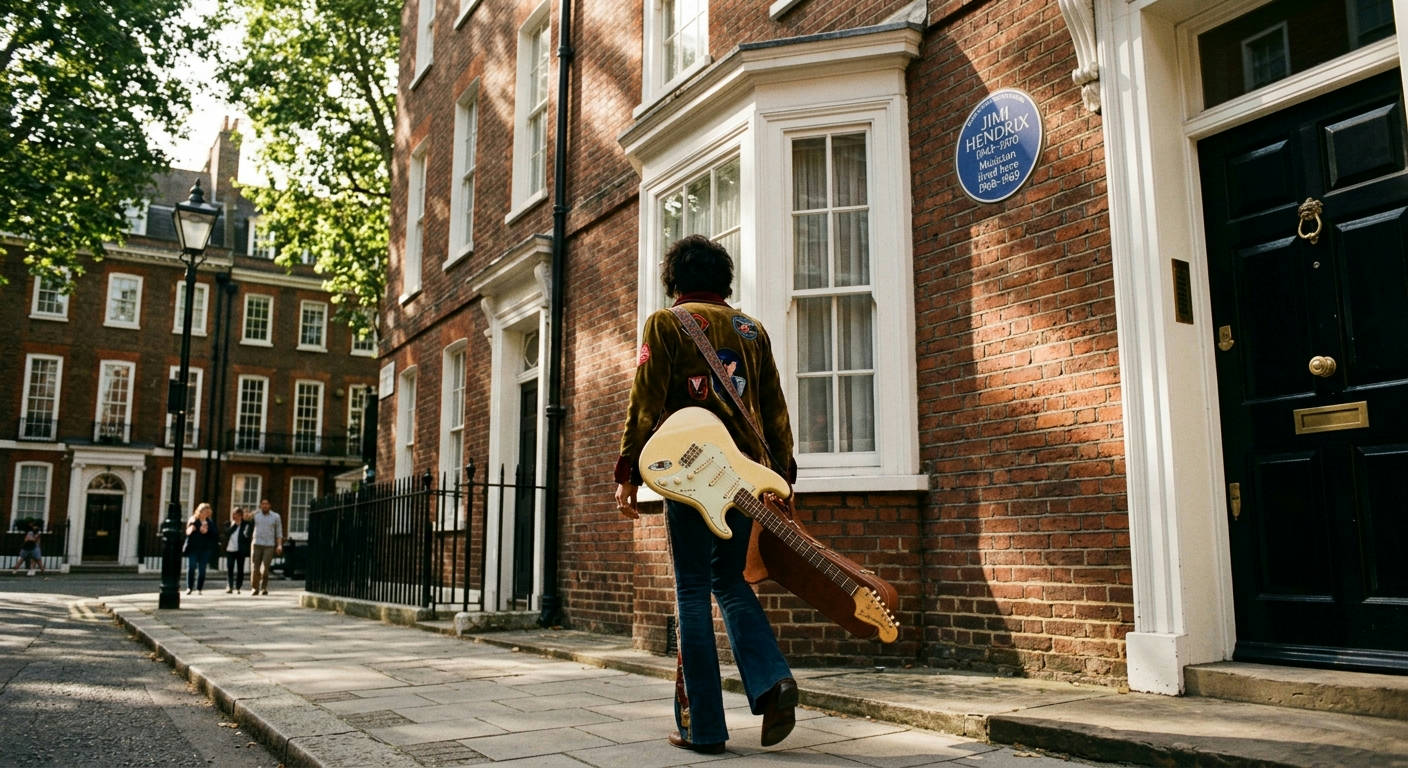
His life was a chaotic mix of recording sessions, sold-out concerts, and parties. A permanent home wasn’t a priority. His real home was the stage, the one place he seemed to have total control. To get a sense of the sheer power he commanded during this era, you have to hear the records. Check out our guide to The Best Of Jimi Hendrix to experience the sound that defined a generation.
The Shokan House: A Woodstock Retreat
By 1969, Hendrix was looking for an escape from the pressures of fame. He rented a large, secluded house in Shokan, New York, not far from the town of Woodstock. This became the home base for his new band, Gypsy Sun and Rainbows.
The Shokan house was a creative commune. It was a place for jamming, rehearsing, and decompressing. It was here that the band worked on the material for their legendary performance at the Woodstock festival, including his revolutionary interpretation of “The Star-Spangled Banner.” This rural retreat was a stark contrast to the city apartments and hotel rooms that had defined his life up to that point.
Electric Lady Studios and the Final Chapter
In his final year, Hendrix focused on creating a permanent creative base, a place that would truly be his own. He poured his energy and money into building a state-of-the-art recording studio in the place where his American journey began: Greenwich Village.
Building a Dream: 52 West 8th Street
Hendrix bought a building at 52 West 8th Street that had formerly been a nightclub called The Generation. He and his team, led by acoustician Eddie Kramer, transformed it into Electric Lady Studios. It was designed to be his personal recording playground, with custom wiring, ambient lighting, and acoustics built to his exact specifications.
This studio was the ultimate answer to where Jimi Hendrix wanted to live. It was a home for his music, a sanctuary where he could create without limitations or time constraints. The official opening party was held on August 26, 1970. Tragically, he would only get to record there for a few weeks before leaving for his final European tour. The studio, however, remains a legendary recording location to this day, used by countless iconic artists. You can find out more about its incredible history on the Electric Lady Studios Wikipedia page.
The Last Days: The Samarkand Hotel, London
The final address in Jimi Hendrix’s life story is a somber one. In September 1970, he was back in London. He was staying with his girlfriend, Monika Dannemann, in her apartment at the Samarkand Hotel, 22 Lansdowne Crescent, in Notting Hill.
It was here, on the morning of September 18, 1970, that he died at the age of 27. The Samarkand Hotel became the tragic final stop on a journey that had taken him from Seattle to the pinnacle of global stardom.
“Music is my religion.” – Jimi Hendrix
This simple quote explains everything. For Hendrix, music was his true home, the only constant in a life of constant motion.
The Legacy of Hendrix’s Homes: More Than Just Addresses
The places where Jimi Hendrix lived are more than just trivia for superfans. They are physical touchstones that connect us to his genius. They help us understand the context of his creativity, from the constraints of his early life to the freedom he found in London and the sanctuary he built in New York.
Visiting the Places Where Jimi Hendrix Lived
For fans wanting to walk in his footsteps, several key locations are accessible.
- Handel & Hendrix in London: This is the ultimate pilgrimage. You can stand in the very room at 23 Brook Street where he lived, loved, and wrote music.
- Greenwich Village, NYC: While Cafe Wha? has changed, the spirit of the Village remains. A walking tour can take you past the Hotel Albert, Electric Lady Studios, and the other haunts that shaped his sound.
- Seattle: The city has memorials and landmarks, including a statue on Broadway and his memorial at Greenwood Memorial Park in Renton.
How to Experience the Vibe: The Music He Made There
The best way to connect with Hendrix’s journey is through his music. Put on a record, close your eyes, and let the sound transport you.
- Listen to Are You Experienced: To feel the explosive energy of his London arrival. The raw power and innovative techniques on this album are the sounds of a man unleashed.
- Spin Electric Ladyland: This sprawling double album captures the vibe of both his London flat and his American experiences. It’s a sonic tapestry woven from his travels. Grab a copy on Amazon: Jimi Hendrix Electric Ladyland Vinyl.
- Immerse yourself in his biography: To truly understand the man behind the myth, a good biography is essential. We recommend Charles R. Cross’s “Room Full of Mirrors.” Find it here: Room Full of Mirrors a Biography of Jimi Hendrix.
To get the full, warm, analog experience as intended, you need a proper setup. If you’re looking to upgrade, we’ve reviewed some of the best turntables under £300 in the UK that will do justice to the Voodoo Chile’s catalog.
So, where did Jimi Hendrix live? He lived everywhere and nowhere. He lived on the road, on the stage, and in the grooves of the vinyl records that are his ultimate, eternal home. He was a man in constant motion, and his legacy is a sound that will never, ever stand still.