Let’s cut right to it. You’re here because you want to know how many studio albums did The Doors release, and the answer isn’t as simple as a single digit. The short answer is nine. But the real, nuanced answer that separates the casual listener from the true fan is that there are three distinct eras of The Doors’ studio output. Six of those albums were recorded with the iconic Jim Morrison, creating a near-perfect run of psychedelic, blues-infused rock. The other three came after his tragic death, and they tell a completely different story.
This guide will break down every single one of those nine albums. We’ll explore the seismic impact of the original six, dig into the often-overlooked post-Morrison records, and finally settle the count once and for all. Forget the myths and the hazy legends; this is the definitive discography.
The Untouchable Six: The Doors with Jim Morrison
This is the body of work that cemented The Doors’ legacy. From 1967 to 1971, the band—Jim Morrison, Ray Manzarek, Robby Krieger, and John Densmore—went on one of the most explosive and brilliant creative runs in music history. These six albums are not just records; they are cultural artifacts that defined a generation.
The Doors (1967): The Psychedelic Big Bang
The band’s self-titled debut was a cultural depth charge. Dropped into the burgeoning psychedelic scene of 1967, it sounded like nothing else. It was darker, more menacing, and more overtly theatrical than the flower-power anthems of the time. This wasn’t just music; it was a statement of intent.
The album kicks off with “Break On Through (To the Other Side),” a frantic, high-energy track that immediately establishes their unique sound. But it was the sprawling, Oedipal drama of “The End” and the hypnotic organ riff of “Light My Fire” that truly launched them into the stratosphere. The latter, in its full seven-minute album version, is a masterclass in musical tension and release, a far cry from the truncated single that hit the airwaves.
Recorded in just a few days at Sunset Sound Recorders, the album captured the raw, electric energy of their live shows at the Whisky a Go Go. It’s a primal, essential record that remains one of the greatest debut albums ever made. For any serious vinyl collector, this is ground zero.
Get your hands on a quality pressing of this masterpiece. You can find The Doors on vinyl here: https://www.amazon.com/s?k=The+Doors+debut+vinyl&tag=vinylgolduk-21
Strange Days (1967): The Sophomore Masterpiece
Released just nine months after their debut, Strange Days proved The Doors were no fluke. Where the first album felt like a captured lightning strike, this one was more deliberate, more atmospheric, and arguably more sonically adventurous. The band took advantage of the more advanced eight-track recording technology available in 2026’s terms, which was cutting-edge in 1967.
The album delves deeper into the strange, noir-ish world hinted at on their debut. Tracks like “People Are Strange” and “Love Me Two Times” became instant classics, showcasing Morrison’s poetic gloom and Krieger’s versatile guitar work. Ray Manzarek’s keyboards are the star here, weaving intricate, often haunting melodies throughout.
The real centerpiece is the epic closer, “When the Music’s Over.” Much like “The End,” it’s a long-form piece that builds from a quiet plea into a chaotic, cathartic scream. Strange Days is the sound of a band at the peak of their creative confidence, expanding their sonic palette without losing any of their dangerous edge.
Waiting for the Sun (1968): The Chart-Topping Compromise
This was the album that made The Doors bona fide superstars, giving them their first and only #1 album in the US. It was also the record where the first cracks began to show. The pressure to produce another hit after “Light My Fire” was immense, and it led to a more polished, pop-oriented sound.
The chart-topping single “Hello, I Love You” was a prime example, a track so catchy it drew accusations of plagiarism from The Kinks for its similarity to “All Day and All of the Night.” Still, the album contains some of the band’s finest work. “The Unknown Soldier” is a powerful piece of anti-war theatre, while “Spanish Caravan” showcases Krieger’s incredible flamenco-inspired guitar skills.
The album’s most famous “what if” is the absence of Morrison’s epic poem, “The Celebration of the Lizard,” which was intended to take up an entire side of the LP. The band couldn’t nail a studio version they were happy with, so it was scrapped, with only the “Not to Touch the Earth” section making the final cut. Waiting for the Sun is a fascinating, if slightly uneven, snapshot of a band grappling with massive success.
The Soft Parade (1969): The Controversial Experiment
If Waiting for the Sun showed cracks, The Soft Parade was a full-blown fracture. This is, without a doubt, the most divisive album in The Doors’ discography. The band, at the suggestion of their producer Paul A. Rothchild, brought in a full orchestra with horn and string sections. The result was a lush, baroque pop sound that alienated many of their core fans.

The lead single, “Touch Me,” was a massive hit, but its brassy arrangement felt a world away from the lean, menacing sound of their early work. For the first time, songwriting credits were attributed to individual members, reflecting the growing creative friction within the band. Morrison, descending deeper into alcoholism, was less involved in the writing process, leaving Krieger to pen half the album, including the hits “Tell All the People” and “Wishful Sinful.”
“That was the album where we were trying to see if we could get a hit single by adding horns and strings. We became a pop band for a minute.” – Robby Krieger
Despite the controversy, the album has been re-evaluated over the years. The title track is a bizarre, multi-part suite that shows flashes of the old experimental brilliance. It’s an outlier, a flawed but fascinating experiment from a band refusing to stand still.
Morrison Hotel (1970): The Gritty Return to Form
After the slick production of The Soft Parade, the band knew they needed a change. They fired their producer and returned to their roots, delivering a hard-hitting, back-to-basics blues-rock album. The result was Morrison Hotel, a raw, swaggering record that won back critics and fans alike.
The album was conceptually split into two sides: “Hard Rock Cafe” and “Morrison Hotel.” The sound is immediate and visceral. “Roadhouse Blues” is the ultimate bar-room brawl of a song, powered by a classic blues riff and one of Morrison’s most iconic vocal performances. It’s the sound of a band plugging in, turning up, and letting loose.
Other standout tracks like “Peace Frog” and “Waiting for the Sun” (the song, not the album) showcased a renewed energy and focus. The entire record feels like a breath of fresh, smoky air, a powerful reminder of what made The Doors so compelling in the first place. It was a gritty, confident comeback.
L.A. Woman (1971): The Swan Song
This is the end, beautiful friend. L.A. Woman was the last studio album Jim Morrison recorded, and it stands as a monumental final statement. The band, once again self-producing, recorded the album in their rehearsal space, “The Doors Workshop,” to achieve a rawer, more intimate sound. The atmosphere is loose, bluesy, and soaked in whiskey.
Morrison’s voice, ravaged by years of hard living, had taken on a deeper, world-weary texture that was perfect for this material. The title track is a sprawling, epic journey through the city of Los Angeles, while the haunting “Riders on the Storm” became his unintentional epitaph. The crackle of thunder and falling rain that underpins the track is one of the most atmospheric recordings in rock history.
The album is a masterpiece of late-night, psychedelic blues. Shortly after completing the recordings, Morrison left for Paris, where he would die in July 1971. He never heard the final mix. It’s a dark, powerful, and essential closing chapter to one of rock’s most legendary stories.
For the ultimate listening experience, grab the L.A. Woman vinyl. Find it here: https://www.amazon.com/s?k=LA+Woman+vinyl&tag=vinylgolduk-21
How Many Studio Albums Did The Doors Release Without Morrison?
This is where the count gets tricky for many people. After Morrison’s death, the surviving members—Manzarek, Krieger, and Densmore—made the difficult decision to carry on. They released two studio albums as a trio, which are an official part of the band’s discography, though they are often forgotten or dismissed.
The Trio Albums: Other Voices & Full Circle
Released in late 1971, Other Voices was comprised of material the band had been working on before and during Morrison’s trip to Paris. With Ray Manzarek and Robby Krieger stepping up to share vocal duties, the album has a noticeably different feel. It’s more jazz-inflected and jam-oriented, with tracks like “In the Eye of the Sun” and the funky “Tightrope Ride.”
They followed it up in 1972 with Full Circle. This album pushed even further into jazz-fusion territory, a style Manzarek and Densmore were particularly fond of. While both albums contain strong musicianship, they were met with commercial indifference. The shadow of Jim Morrison was simply too large to escape. The band officially broke up in 1973. These two albums are essential to know if you truly want to answer how many studio albums did The Doors release.
The Posthumous Anomaly: An American Prayer
Years later, in 1978, the story took another turn. The three surviving members reconvened to create a unique project: An American Prayer. This album features poetry, recorded by Jim Morrison in 1970, set to new music created by the band.
### Jim Morrison’s Poetry Meets The Doors’ Music: Exactly How Many Studio Albums Did The Doors Release Now?

This album is the final piece of the puzzle. Its status as a “studio album” has been debated for decades. Is it a true Doors album, or a tribute compilation? The band themselves consider it a legitimate entry in their canon. They meticulously crafted musical backdrops that ebb and flow with the cadence of Morrison’s spoken-word performance.
The project was controversial. Some, including their original producer Paul Rothchild, felt it was a crass commercialization of Morrison’s work. The band, however, maintained they were fulfilling Morrison’s own desire to have his poetry set to music. Regardless of the debate, it is officially considered the ninth and final studio album by The Doors.
The Final Count and The Lasting Legacy
So, let’s tally it up and put this question to bed for good. The final, definitive answer is nine.
- The Doors (1967)
- Strange Days (1967)
- Waiting for the Sun (1968)
- The Soft Parade (1969)
- Morrison Hotel (1970)
- L.A. Woman (1971)
- Other Voices (1971) – Post-Morrison
- Full Circle (1972) – Post-Morrison
- An American Prayer (1978) – Posthumous
While the core six albums with Jim Morrison represent the band’s cultural peak, the three subsequent releases are a crucial part of their complete story.
Influence on Modern Music
The Doors’ studio innovations and Morrison’s shamanistic persona have echoed through the decades. Their dark, poetic themes and fusion of blues, rock, and psychedelia can be heard in countless genres. The theatricality of goth rock, the raw energy of punk, and the introspective moodiness of alternative rock all owe a debt to the sound The Doors forged in the studio. Acts from Iggy Pop and The Stooges to Joy Division and The Cult have cited them as a primary influence.
The band’s fearless approach to album construction continues to inspire artists in the 2020s. Their influence is a key reason why they were inducted into the Rock & Roll Hall of Fame in 1993, an honor that cemented their status as true pioneers. The willingness to experiment, even when it led to controversial results like The Soft Parade, laid the groundwork for many of the five alt rock albums from the 1990s that would later redefine the music world.
“There was this one moment, seeing them on The Ed Sullivan Show. The way Morrison moved and sang… it wasn’t just a performance. It was a confrontation. It changed what I thought was possible in rock and roll.” – Patti Smith
Beyond the Studio: Live Albums and Compilations
No discussion of The Doors is complete without acknowledging their legendary live performances. While not “studio albums” in the strict sense, records like Absolutely Live (1970) are essential listening. They capture the unpredictable, often confrontational energy that couldn’t always be contained in a studio setting. Compilations like the 1985 Best of The Doors also serve as an excellent entry point for new listeners, gathering the hits in one place.
Collecting The Doors on Vinyl in 2026
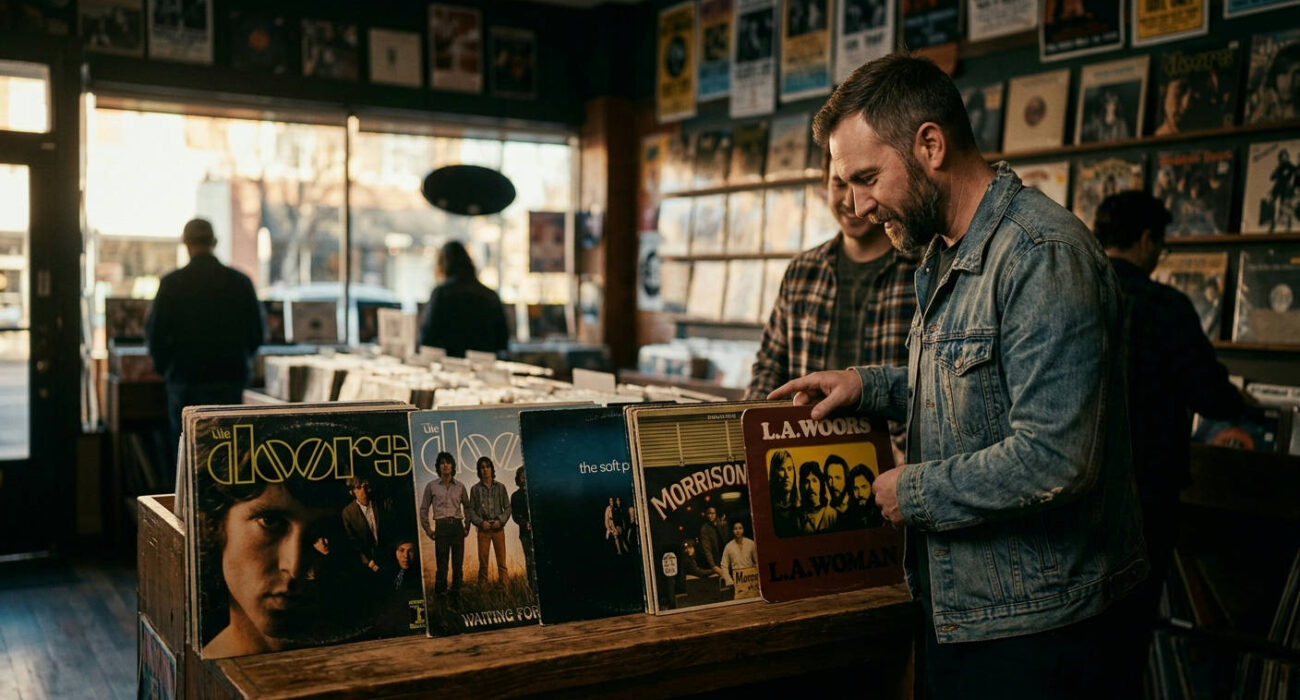
For vinyl enthusiasts, The Doors’ discography is a treasure trove. The rich, warm sound of their analog recordings truly comes alive on a turntable. Owning these albums on vinyl isn’t just about listening; it’s about experiencing the music as it was originally intended.
Original Pressings vs. Modern Reissues
The debate between original pressings and modern reissues is a hot one among collectors. An original 1967 pressing of the debut album on the Elektra label is a holy grail item, but it will cost you a pretty penny and finding a copy in near-mint condition is a serious challenge.
Thankfully, the 2020s have seen a surge in high-quality reissues. Brands like Analogue Productions and Rhino Records have released 180-gram audiophile pressings of the entire Doors catalog, often remastered from the original analog tapes. These offer pristine sound without the pops and crackles of a 60-year-old record. The listening experience is profoundly affected by your equipment, so pairing a quality reissue with one of the best turntables under 300 in the UK can deliver breathtaking audio fidelity.
For those looking to dive in headfirst, a complete box set is a fantastic option. It gives you the entire core discography in one go, often with bonus materials and high-quality packaging.
Start your complete collection today with a vinyl box set: https://www.amazon.com/s?k=The+Doors+vinyl+box+set&tag=vinylgolduk-21
The Doors’ studio career was a short, violent, and brilliant flash. In just four years, the original lineup created a body of work that has not only endured but has continued to fascinate and inspire new generations of listeners. The answer to how many studio albums did The Doors release is nine, but the story behind those nine records is one of genius, turmoil, and timeless rock and roll. Now, go spin some vinyl and break on through.