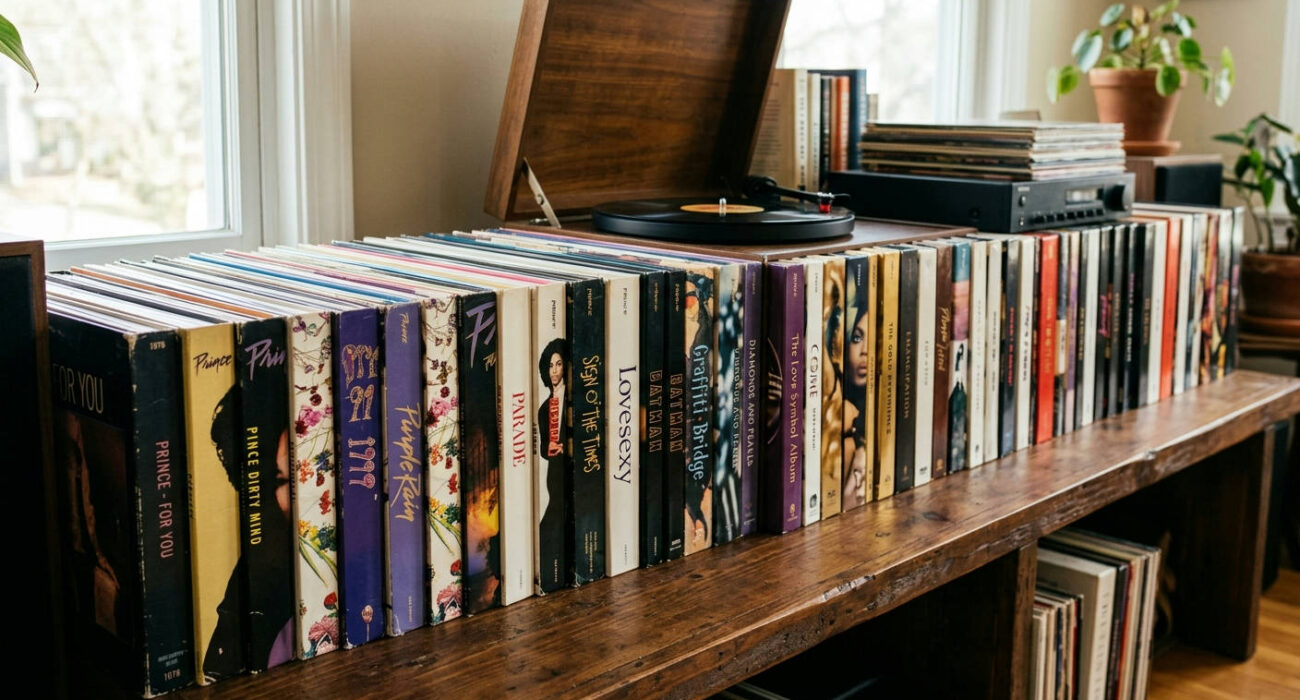
Trying to list all the Prince studio albums in order is a monumental task. It’s not just a discography; it’s a sprawling, epic journey through funk, rock, soul, pop, and genres that don’t even have names yet. Prince wasn’t just prolific; he was a creative supernova, releasing a staggering 39 studio albums in his lifetime, with more emerging from his legendary Vault. For any music fan, especially a vinyl collector, tackling this catalogue is the ultimate quest. This is your definitive guide to that journey.
The Genesis: Forging a Sound in the 1970s
Prince Rogers Nelson arrived fully formed. While many artists spend their early years finding their voice, Prince kicked down the door with a sound that was entirely his own from the very beginning. His 1970s output was a masterclass in musical autonomy, laying the groundwork for the global domination that was to come.
For You (1978)
The debut. The statement. On the back cover, the credits simply read: “Produced, arranged, composed, and performed by Prince.” He played all 27 instruments on the album. At just 20 years old, For You was an announcement of a singular, uncompromising talent. While tracks like “Soft and Wet” hinted at the funk to come, the album is a polished, soulful entry that showcases his incredible musicianship above all else.
Prince (1979)
If For You was the introduction, this self-titled sophomore album was the hook. This is where the world truly got its first taste of Prince’s hit-making genius. “I Wanna Be Your Lover” became his first major hit, a slice of slick, irresistible disco-funk. But beyond the single, tracks like “Why You Wanna Treat Me So Bad?” and “I Feel for You” (later a smash for Chaka Khan) proved his songwriting was as sharp as his guitar licks. This album cemented his status as a rising star and is a cornerstone of any collection of the best albums of the 1970s.
Global Domination: The Untouchable 1980s Run
The 1980s belonged to Prince. Period. He didn’t just create music; he defined the sound, style, and attitude of the entire decade. Each album was an event, a seismic shift that sent ripples through pop culture. This was the era of masterpieces, where he was not just a pop star, but a cultural deity.
Dirty Mind (1980)
This is where everything changed. Shedding the polished R&B of his first two albums, Prince delivered a raw, minimalist bombshell. Dirty Mind is a fusion of new wave, funk, and rock, all held together by a sexually charged and unapologetic lyrical directness that shocked the establishment. Clocking in at just 30 minutes, it’s a concise, powerful statement of artistic intent.
Controversy (1981)
Taking the themes of Dirty Mind and expanding them, Controversy blended the sacred and the profane like never before. The title track is a relentless dance groove that questions everything from politics to sexuality, even reciting the Lord’s Prayer. Albums like this showed Prince was more than a musician; he was a social commentator with a beat you couldn’t resist.
1999 (1982)
The double album that made him a household name and an MTV staple. 1999 is a sprawling synth-funk epic, a pre-apocalyptic party that never ends. With monumental hits like the title track and “Little Red Corvette,” Prince crafted a sound that was futuristic, commercial, and undeniably his. This wasn’t just an album; it was the soundtrack to the dawn of a new digital age.
Purple Rain (1984)
What more can be said? Purple Rain is a cultural touchstone. A flawless album, a blockbuster film, and a global phenomenon. It transformed Prince from a superstar into a legend. From the ecstatic energy of “Let’s Go Crazy” to the earth-shattering power of the title track, every single moment is iconic. It’s not just Prince’s best-selling album; it’s one of the best-selling albums of all time, a testament to its timeless power. It’s the definitive starting point for anyone looking to own his work on vinyl.
“A lot of people can’t get past the image. They see the makeup and the weird clothes and they just can’t get past that. They don’t listen to the music. But the music is what’s important.” – Prince
Around the World in a Day (1985)
How do you follow Purple Rain? By doing the complete opposite. Instead of another pop-rock masterpiece, Prince swerved hard into psychedelia. Around the World in a Day was a bold, unexpected move, filled with swirling arrangements and paisley-drenched influences. It confused some at the time, but its creative bravery is undeniable, and “Raspberry Beret” remains one of his most beloved singles.
Parade (1986)
The soundtrack to his film Under the Cherry Moon, Parade is a sophisticated, European-influenced affair. The sound is sparse and funky, with tracks like the minimalist masterpiece “Kiss” showcasing his ability to create a global smash with just a drum machine, a guitar riff, and his incredible voice. It’s an album of understated genius.
Sign o’ the Times (1987)
Many critics and die-hard fans consider this double album to be his magnum opus. Originally conceived as the triple album Crystal Ball, the final release is a staggering display of musical virtuosity. It covers everything: hard funk, gospel, rock, and poignant social commentary. From the stark reality of the title track to the joyous “Starfish and Coffee,” Sign o’ the Times is Prince at his most artistically expansive and brilliant.
Lovesexy (1988)
Released after Prince shelved the dark and aggressive The Black Album, Lovesexy is its polar opposite. It’s a spiritual, joyous, and optimistic record, presented as a single, continuous track on its initial release. “Alphabet St.” is the standout single, a breezy funk workout that showed his lighter side.
Batman (1989)
Ending the decade on a commercial high, Prince delivered the soundtrack for Tim Burton’s Batman. It was a massive success, spawning the hit “Batdance.” While sometimes viewed as a more commercial project, it’s packed with incredible funk-rock hybrids and perfectly captures the film’s gothic, chaotic energy.

The Symbol and The Struggle: A Prolific 1990s
The 1990s were a period of intense conflict and creative liberation for Prince. His infamous battle with his label, Warner Bros., led him to change his name to an unpronounceable symbol and adopt the moniker “The Artist Formerly Known as Prince.” This fight for artistic freedom resulted in an avalanche of music, as he worked to fulfill his contractual obligations and break free.
Graffiti Bridge (1990)
A sequel of sorts to Purple Rain, this soundtrack album featured a host of other artists like George Clinton and Mavis Staples. While the film was a flop, the album contains gems like “Thieves in the Temple” and the epic “The Question of U.”
Diamonds and Pearls (1991)
Backed by his phenomenal new band, The New Power Generation, this album was a massive commercial comeback. It embraced a more contemporary hip-hop and R&B sound, producing huge hits like “Gett Off,” “Cream,” and the title track. It proved that even a decade after his breakthrough, Prince could still dominate the charts.
Love Symbol Album (1992)
Continuing with the NPG, this album is a sprawling rock opera of sorts, complete with spoken-word interludes. It’s a dense and ambitious project, boasting funk workouts like “My Name Is Prince” and one of his most beautiful ballads, “7.”
The Contractual Obligation Albums: Come (1994) & The Gold Experience (1995)
This pair of albums perfectly illustrates his war with his label. Come was released under the “Prince” name to fulfil his contract, filled with darker, more explicit material and stamped with the dates “1958-1993” as if to kill off his old persona. Conversely, The Gold Experience was released under the Symbol moniker and was the album he truly wanted to put out—a vibrant, brilliant work featuring the hit “The Most Beautiful Girl in the World.”
Chaos and Disorder (1996)
His final album for Warner Bros. was a noisy, guitar-heavy rock record. It was another contractual obligation release, and Prince refused to promote it. Despite the turmoil, it’s a fascinating snapshot of his mindset at the time.
Emancipation (1996)
Freedom! His first release as an independent artist was a colossal 3-CD, 3-hour-long triple album. Each disc runs exactly 60 minutes. Emancipation is a celebration of his newfound freedom, covering a vast array of styles and including covers of songs like “Betcha by Golly, Wow!” It’s an overwhelming but ultimately rewarding listen.
Crystal Ball (1998)
This was a groundbreaking release. A 5-disc box set sold directly to fans via the internet, Crystal Ball collected unreleased tracks from his legendary Vault. It was accompanied by two other albums: The Truth, a mostly acoustic record, and Kamasutra, an instrumental album. This project solidified his connection with his hardcore fanbase and pioneered a new way of distributing music in the pre-streaming era of the late 90s.
Rave Un2 the Joy Fantastic (1999)
Returning to a major label (Arista), this was a star-studded effort to recapture mainstream attention. Featuring guest spots from Gwen Stefani, Sheryl Crow, and Chuck D, it’s a polished, eclectic pop record that closes out a truly wild and transformative decade.
An Independent Icon: The New Millennium
Entering the 2000s, Prince fully embraced his independence. He used his NPG Music Club website to connect directly with fans, releasing albums and selling concert tickets without a traditional label intermediary. This era is defined by experimentation, a return to his funk and soul roots, and a business savvy that was years ahead of its time.
The Rainbow Children (2001)
A deeply religious and controversial concept album that delves into his newfound faith as a Jehovah’s Witness. The music is heavily jazz-influenced, with complex arrangements and a narrative that alienated some listeners. It remains one of his most debated and musically intricate works.
Musicology (2004)
A massive comeback. Musicology was a back-to-basics funk and soul record that earned him two Grammy Awards. The album was famously bundled with concert tickets for his tour, a move that propelled it up the charts and was hailed as a marketing masterstroke. It was a powerful reminder that Prince could still craft a commercially and critically successful album on his own terms.
3121 (2006)
Pronounced “thirty-one twenty-one,” this album became his first to debut at #1 on the Billboard 200. It’s a tight, focused collection of funk, pop, and Latin-tinged tracks, proving his creative well was far from dry.
Planet Earth (2007)
In another bold distribution move, Prince gave this album away for free with copies of the UK’s The Mail on Sunday newspaper ahead of his 21-night residency at London’s O2 Arena. The album itself is a solid rock-pop effort, but the release strategy is what made headlines worldwide.
Lotusflow3r / MPLSound / Elixer (2009)

Another multi-album release, this three-disc set was sold exclusively through the US retailer Target. Lotusflow3r is a guitar-heavy rock album, MPLSound is an 80s-style electro-funk record, and Elixer is a smooth R&B album by his protégée, Bria Valente. It showcased his continued creative restlessness.
The Final Years and Posthumous Legacy
Prince’s final years were marked by a return to major labels and a renewed burst of creative energy, culminating in his final albums released in 2015. Since his tragic passing in 2016, his estate, in partnership with Paisley Park, has begun the monumental task of curating his vast vault of unreleased music, ensuring his genius continues to be discovered by new generations.
20Ten (2010)
Following the Planet Earth model, 20Ten was given away as a covermount on newspapers and magazines across Europe. It’s a fun, upbeat funk-pop album that Prince himself described as a personal journal.
Art Official Age & Plectrumelectrum (2014)
A grand return to Warner Bros. Records, Prince released two distinct albums simultaneously. Art Official Age is a slick, futuristic electro-funk and R&B record. In contrast, Plectrumelectrum is a raw, live-in-the-studio rock album recorded with his all-female band, 3rdeyegirl. The dual release highlighted his incredible versatility.
Hit n Run Phase One & Phase Two (2015)
His final albums. Released initially on the streaming service Tidal, Phase One is a modern, electronic-heavy album co-produced with Joshua Welton. Phase Two, released just months later, is a more traditional, horn-driven funk and soul record, feeling like a triumphant celebration of his classic sound.
The Posthumous Studio Releases
Since 2016, several albums have been carefully compiled from The Vault. Originals (2019) collects Prince’s original demo recordings of songs he gave to other artists, like “Manic Monday” and “Nothing Compares 2 U.” Welcome 2 America (recorded in 2010 but released in 2021) is a full, previously unheard studio album filled with his astute social commentary and tight funk grooves. These releases, overseen by his estate, offer a tantalizing glimpse into the sheer volume of high-quality music he left behind, further cementing his legendary status as recognized by institutions like the Rock and Roll Hall of Fame.
The Complete List of Prince Studio Albums in Order
Here it is. For the dedicated fan, the new listener, and the serious collector, this is the chronological list you need.
- For You (1978)
- Prince (1979)
- Dirty Mind (1980)
- Controversy (1981)
- 1999 (1982)
- Purple Rain (1984)
- Around the World in a Day (1985)
- Parade (1986)
- Sign o’ the Times (1987)
- Lovesexy (1988)
- Batman (1989)
- Graffiti Bridge (1990)
- Diamonds and Pearls (1991)
- Love Symbol Album (1992)
- Come (1994)
- The Gold Experience (1995)
- Chaos and Disorder (1996)
- Emancipation (1996)
- Crystal Ball (1998)
- The Truth (1998)
- Kamasutra (1998)
- Rave Un2 the Joy Fantastic (1999)
- The Rainbow Children (2001)
- One Nite Alone… (2002)
- N.E.W.S. (2003)
- Musicology (2004)
- The Chocolate Invasion (2004)
- The Slaughterhouse (2004)
- 3121 (2006)
- Planet Earth (2007)
- Lotusflow3r (2009)
- MPLSound (2009)
- 20Ten (2010)
- Art Official Age (2014)
- Plectrumelectrum (2014)
- Hit n Run Phase One (2015)
- Hit n Run Phase Two (2015)
Posthumous Studio Albums:
- Piano and a Microphone 1983 (2018)
- Originals (2019)
- Welcome 2 America (2021)
A Definitive Guide to the Prince Studio Albums in Order
So, how should you actually listen to the Prince studio albums in order? Chronologically is the purist’s route, allowing you to witness his evolution in real-time. Another path is to tackle it by era. Start with the “classic 80s” run from Dirty Mind to Lovesexy. Then, explore the rebellious “Symbol” era of the 90s. Finally, dive into the independent work of the 2000s. There’s no wrong way, only a journey of discovery.
Collecting Prince on Vinyl in 2026
For vinyl enthusiasts, Prince’s catalogue is both a dream and a challenge. The sheer volume can be intimidating, but the rewards are immense. His commitment to analog recording, especially in his heyday, means his music absolutely shines on a turntable.
Where to Start Your Collection
Don’t try to get everything at once. Start with the pillars. You absolutely need Purple Rain, Sign o’ the Times, and 1999. These three albums represent his commercial peak, his critical masterpiece, and his superstar-making breakthrough. From there, expand to Dirty Mind for the raw funk and Parade for the sophisticated pop. These five LPs form a world-class foundation for any record collection.
Originals vs. Reissues
Original pressings from the 70s and 80s are highly sought after, but can be expensive and vary in quality. The good news is that since 2022, the Prince Estate has been running an exceptional reissue campaign, releasing high-quality, remastered versions of his classic albums sourced from the original analog tapes. These 2026 reissues, often available from his official Paisley Park home, are fantastic, affordable ways to experience the music as it was meant to be heard.
“Despite everything, no one can dictate who you are to other people.” – Prince
Finding Prince Vinyl in the UK
Here at Vinyl Gold UK, we live and breathe this stuff. But for a quick fix, finding his most popular titles is easier than ever. Amazon UK is a reliable source for the new reissues. You can start your search for the essentials right now:
- Find Prince – Purple Rain on Vinyl
- Find Prince – Sign o’ the Times on Vinyl
- Find Prince – 1999 on Vinyl
Exploring Prince’s discography is one of the most rewarding experiences in all of music. It’s a universe of sound created by a once-in-a-generation artist. Every album tells a story, every note is intentional. So pick a starting point, drop the needle, and get lost in the genius. You won’t regret it.