
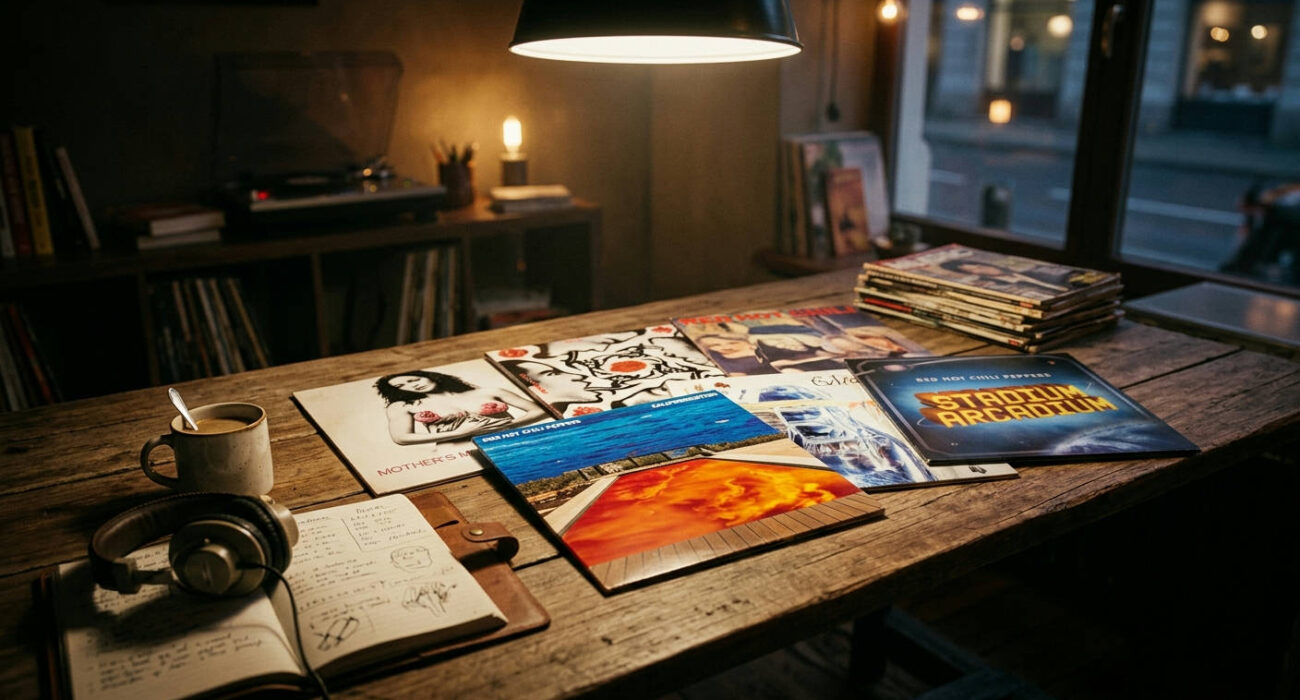
The Red Hot Chili Peppers are more than a band; they are a multi-sensory force of nature. For over four decades, their music has provided the soundtrack to chaos, love, and life in the fast lane. But to truly understand their story, you have to look as much as you listen. The red hot chilli peppers album covers history is a visual chronicle of their evolution, a gallery of their changing identities, and a testament to the power of a single image to define an entire era of sound. This is not just about pretty pictures on a sleeve; it’s about art that is as raw, iconic, and unpredictable as the funk-rock legends themselves.
The Raw Beginnings: Anarchy and Absurdity (1984-1988)
Before they were stadium-filling titans, the Chili Peppers were a feral blast of energy erupting from the L.A. club scene. Their early album covers perfectly captured this untamed, punk-funk spirit. There was no high-concept art direction here—just pure, unfiltered attitude.
The Red Hot Chili Peppers (1984): A Punk Rock Statement
The cover of their debut album is a punch to the face. It’s a chaotic collage of the four members shouting, superimposed over a Hollywood sign that seems to be melting under their sonic heat. This wasn’t a polished major-label introduction. It was a DIY, cut-and-paste ransom note that screamed their intentions from the rooftops.
The black-and-white photography, the jarring angles, and the hand-scrawled logo all reek of the punk rock aesthetic that informed their early sound. It’s messy, loud, and completely unapologetic, mirroring the raw funk and high-octane energy of tracks like “True Men Don’t Kill Coyotes.” This cover established their identity not as rock stars, but as audacious street artists.
Freaky Styley (1985): The George Clinton Touch
For their sophomore effort, the band decamped to Detroit to work with the godfather of funk, George Clinton. This collaboration didn’t just transform their sound; it elevated their visual presentation. The Freaky Styley cover, a piece by Nels Israelson and Henry Marquez, is a brilliant piece of visual juxtaposition.
We see the band, captured in motion, seemingly levitating against a backdrop that mimics classical Renaissance art. It’s a collision of worlds: the sacred and the profane, high art and low-down funk. This was a more thoughtful, composed image than their debut, yet it retained the band’s kinetic energy. It was the perfect visual metaphor for George Clinton’s production, which polished their raw sound without taming their wild spirit.
The Uplift Mofo Party Plan (1988): Cosmic Nudity and Psychedelia
If their first two albums were statements of intent, this one was a full-blown declaration of war on convention. The cover of The Uplift Mofo Party Plan is one of the most infamous images in the red hot chilli peppers album covers history. It features the band, stark naked except for some strategically placed (and not-so-strategically placed) socks, painted in shimmering silver and gold against a cosmic, psychedelic backdrop.
This image cemented their public persona as fearless, fun-loving exhibitionists. But it was more than just shock value. It was a visual representation of their music—stripped-down, powerful, and completely unrestrained. The cover art was a gateway to the explosive, funk-metal fusion within, a pivotal record that saw the original lineup firing on all cylinders one last time.
Breaking Through: Symbolism and Mainstream Recognition (1989-1995)
With the ’80s ending, the Chili Peppers were on the cusp of global domination. The tragic death of Hillel Slovak forced a period of change and rebirth, leading to some of their most iconic and symbolically rich artwork as they grappled with loss and found monumental success.
Mother’s Milk (1989): A Controversial Tribute
Mother’s Milk was an album of transition, introducing the world to the formidable talents of John Frusciante and Chad Smith. The cover art is a complex and often misinterpreted piece. It shows a black-and-white photo of a topless model, Dawn Alane, holding a larger-than-life picture of the band over her chest, with a prominent rose obscuring Anthony Kiedis.
The image is a direct tribute to Hillel Slovak and the themes of life, death, and nourishment. The “mother’s milk” is the life-giving force of music and creativity that sustained them through their grief. While some retailers found the image too provocative and covered it up, its blend of sensuality and raw emotion perfectly encapsulated the album’s sound—a harder, more focused rock album that still bled funk.
Blood Sugar Sex Magik (1991): The Birth of an Icon
This is it. The big one. The cover for Blood Sugar Sex Magik, shot by acclaimed filmmaker Gus Van Sant, is arguably the most recognizable image associated with the band. The four members’ faces are positioned at the cardinal points, tongues out, surrounding a thorny, psychedelic rose.
Its power lies in its simplicity. The stark black, white, and red palette is instantly arresting. The tattoos, the intense expressions, the intertwining tongues—it all speaks to the album’s core themes of lust, spirituality, love, and darkness. The artwork became a symbol for ’90s alternative rock, a tribal emblem that was as raw, intimate, and powerful as the Rick Rubin-produced masterpiece contained within.
“We gave him no direction, no preconceived anything. He just showed up, and we had a good time, and he took some pictures, and they came out great. He has a very good eye.” – Anthony Kiedis on Gus Van Sant
One Hot Minute (1995): A Darker, Psychedelic Detour
Following Frusciante’s departure, the band enlisted Dave Navarro of Jane’s Addiction, and the resulting album, One Hot Minute, was a darker, heavier, and more psychedelic affair. The album art, created by surrealist pop artist Mark Ryden, perfectly reflects this tonal shift.

The cover depicts a cherubic, almost sinister-looking child in a fairy costume standing in a fantastical, yet unsettling, landscape. It’s a world away from the raw photography of their previous work. Ryden’s detailed, storybook style hints at a loss of innocence and a journey into a more complex and troubled psyche, mirroring the album’s exploration of darker lyrical themes.
The Frusciante Renaissance: Minimalism and Abstract Art (1999-2006)
John Frusciante’s return in 1998 heralded a new golden age for the Red Hot Chili Peppers. Their music became more melodic, layered, and emotionally resonant. This maturity was reflected in a new minimalist and abstract approach to their album art, often collaborating with established fine artists.
Californication (1999): The Inverted Paradise
The cover of Californication is a masterpiece of surreal minimalism. An idyllic swimming pool sits calmly, but the sky above is the water, and the water is the sky. This simple visual trick, conceived by art director Lawrence Azerrad, is a stunning metaphor for the album’s central theme: the beautiful, artificial, and often disturbing underbelly of California and Hollywood.
The image is both serene and deeply unsettling. It speaks of facade and reality, of a paradise that’s fundamentally broken. It was the perfect visual to reintroduce the band to the world, capturing the sophisticated, world-weary, and ultimately triumphant sound of one of their greatest records. It’s a cover that has only grown more profound with time.
By The Way (2002): Romanticism and Julian Schnabel’s Influence
For By The Way, the band moved even further into artistic abstraction. The cover is a painting of a woman’s head by the acclaimed artist and filmmaker Julian Schnabel, whose daughter was dating John Frusciante at the time. The hand-drawn, almost childlike text was also done by Schnabel.
This was a bold move. Instead of their own faces, they chose a piece of fine art to represent their most melodic and harmony-rich album to date. The painting’s soft, melancholic, and romantic feel was a direct reflection of the music’s lush, multi-layered arrangements and Kiedis’s more vulnerable songwriting. It signaled a band completely confident in letting the art—both musical and visual—speak for itself.
Stadium Arcadium (2006): Cosmic Atom and Grand Ambition
How do you visually represent a sprawling, 28-song double album? For Stadium Arcadium, the band chose an image that was both cosmic and elemental. The artwork, created by a team including Matt Taylor and Mark O’Brien, depicts a swirling, atom-like structure on a textured background that looks like the surface of Saturn or Jupiter.
The design powerfully communicates the album’s grand scale and ambition. Each song is a planet, a world unto itself, all orbiting the central nucleus of the band. The “atom” of Saturn also subtly resembles the band’s iconic asterisk logo. The artwork feels vast and epic, perfectly suiting the stadium-sized rock anthems and intricate musical journeys of the double LP. For vinyl collectors, the gatefold sleeve of Stadium Arcadium is a must-have, allowing the expansive artwork to be fully appreciated. You can hunt for a copy on vinyl here: Red Hot Chili Peppers Stadium Arcadium Vinyl on Amazon.
A Comprehensive Look at the ## Red Hot Chili Peppers Album Covers History
Looking back, the visual journey of the band is a fascinating study in itself. Over the decades, several key themes and motifs have emerged, creating a distinct and evolving visual language that is inseparable from their musical identity.
### Recurring Motifs: The Asterisk, Nudity, and California
Three elements consistently appear throughout the red hot chilli peppers album covers history. The most famous is the eight-pronged asterisk, also known as the “Star of Affinity.” Sketched by Kiedis in the early ’80s, it has become their globally recognized logo, appearing on merchandise, tattoos, and subtly referenced in art like Stadium Arcadium.
Nudity has also been a constant, from the overt exhibitionism of The Uplift Mofo Party Plan to more artistic depictions in liner notes and photoshoots. It’s never just for shock; it represents a commitment to raw honesty, vulnerability, and shedding inhibitions—a core tenet of their live performances. Finally, California is a constant muse, from the literal Hollywood sign on their debut to the surreal dreamscape of Californication, the state is a character in their visual story.
### The Photographers and Artists Behind the Vision
The Chili Peppers have always understood the power of collaboration. Their choice of visual artists is as deliberate as their choice of music producers. Working with visionaries like Gus Van Sant brought a cinematic cool to their image, while partnering with fine artists like Mark Ryden, Julian Schnabel, and later Damien Hirst, aligned them with the high-art world.
This demonstrates a deep respect for the visual medium. They aren’t just slapping a photo on a cover; they are curating a gallery. This commitment is best experienced on vinyl, where the large format allows you to pour over the liner notes and appreciate the art direction credits, connecting the dots between the sound and the vision. The album cover is part of the music, not just packaging for it. Exploring their discography is a bit like a deep dive into the work of other rock legends, such as the visual storytelling found in the entire Lynyrd Skynyrd catalogue.
The Klinghoffer Era and Beyond: New Aesthetics (2011-2026)
With Josh Klinghoffer stepping in on guitar, the band continued to push their visual boundaries. Their 21st-century album art has been defined by bold, high-concept minimalism and a return to surrealist imagery, culminating in a creative explosion with Frusciante’s second return in the 2020s.
I’m with You (2011): Damien Hirst’s Minimalist Pill
For their first album with Klinghoffer, the band made their most audacious artistic statement yet, commissioning a piece from controversial British artist Damien Hirst. The cover for I’m with You is deceptively simple: a white background, a single gelcap, and a fly resting on it.

The fan reaction was deeply divided, but the image is pure Hirst, exploring his signature themes of life, death, medicine, and decay. It’s a sterile, clinical image that stands in stark contrast to the warm, organic funk-rock of the album. This friction is intentional. It forces the viewer to look closer and question what they’re seeing, proving that even deep into their career, the Chili Peppers refused to play it safe. More information on Hirst’s thematic work can be found via resources like the Tate Modern.
The Getaway (2016): A Surreal Narrative
The cover for The Getaway marked a return to more narrative, painterly imagery. The artwork, a 2014 painting by artist Kevin Peterson titled “Coalition II,” depicts a young girl walking hand-in-hand with a bear, accompanied by a raccoon and a bird, against a bleak, urban backdrop.
The image is surreal and melancholic, suggesting an unlikely alliance in a hostile world. It perfectly complements the album’s sound, which, under the guidance of producer Danger Mouse, was more atmospheric, textured, and introspective. The cover feels like a scene from a strange film, inviting the listener to imagine the story behind the music before they even drop the needle.
The 2020s Return: Unlimited Love & Return of the Dream Canteen (2022)
Frusciante’s return for a second time in 2022 unleashed a torrent of creativity, resulting in two full albums released in the same year. The artwork for both reflects this renewed, vibrant energy. Unlimited Love features a simple, abstract neon light sign, a modern take on a classic symbol that feels both futuristic and nostalgic.
In contrast, Return of the Dream Canteen is a psychedelic explosion of color and imagery. The detailed, ’70s-inspired collage by artists Julien Calemard and Thami Nabil is a visual feast, echoing the free-flowing, jam-session energy of the album. It feels like a full-circle moment, a return to the chaotic, funky, and joyfully absurd visuals that defined their earliest work, now filtered through decades of artistic experience.
The Impact of Format on Album Art: From Vinyl to Digital
The way we experience album art has changed dramatically since 1984, but its importance has not. The medium may change, but the message remains.
The Glory of the 12-Inch Vinyl Sleeve
At Vinyl Gold UK, we live and breathe this. There is no better way to experience the red hot chilli peppers album covers history than on a 12-inch vinyl sleeve. It’s a tactile, immersive experience. You can feel the texture of the cardboard on Stadium Arcadium, trace the intricate lines on One Hot Minute, and get lost in the gatefold photography of Blood Sugar Sex Magik.
The large format gives the art the respect it deserves. It turns music into a physical artifact. This is the way the artists intended for you to see their work. Trying to appreciate this art on a tiny phone screen is like looking at the Mona Lisa on a postage stamp.
As art critic Robert Hughes noted, the context and scale in which art is viewed fundamentally changes its impact. The vinyl record is the proper gallery for album cover art.
The CD Booklet and the Digital Thumbnail
The transition to CDs in the ’90s shrunk the canvas, but the booklet format allowed for an expansion of liner notes and extra photography. Artists adapted, creating designs that worked in a 5×5 inch format.
By 2026, the biggest challenge is the digital thumbnail. In a world of streaming, album art must be powerful enough to grab your attention as a tiny square. This is where the Chili Peppers’ minimalist covers excel. The stark simplicity of Californication or I’m with You is instantly recognizable, even at a small size. The bold red and black of Blood Sugar cuts through the digital noise. It’s a testament to timeless design.
Collecting RHCP: A Visual and Auditory Journey
Starting a Red Hot Chili Peppers vinyl collection is a rewarding journey through music and art history. Here’s where to begin.
Essential Vinyl for Any Collector
If you’re just starting, three albums are non-negotiable for their visual and musical impact:
- Blood Sugar Sex Magik: It is the definitive ’90s RHCP statement. The Gus Van Sant artwork is iconic, and the gatefold vinyl package is a classic.
- Californication: The minimalist cover is a modern art piece, and it represents their triumphant rebirth. It’s a must-have for any modern rock fan.
- The Uplift Mofo Party Plan: To understand their roots, you need this one. The infamous cover is a piece of rock history and a guaranteed conversation starter.
You can start your search for these essentials and more right here: Red Hot Chili Peppers Vinyl on Amazon.
Spotting Originals vs. Reissues
For serious collectors, hunting down original pressings is part of the thrill. Look for key identifiers. Check the matrix numbers etched into the run-out groove of the record. Research the original label designs (e.g., the EMI America label on the first album vs. later Warner Bros. reissues). Original pressings often have different hype stickers or inner sleeve details compared to the countless 180-gram reissues that have come out since.
The Future of Red Hot Chili Peppers Album Covers History
What’s next for the band’s visual identity? As of 2026, they have embraced everything from punk photography to high-concept fine art. Perhaps they’ll venture into the world of digital and generative art for their next project, or maybe they’ll strip it all back down to a raw, black-and-white portrait. The only thing that’s certain is that they won’t do the expected.
The red hot chilli peppers album covers history is more than just a series of images. It’s a roadmap of their artistic soul. From the wild, sock-clad boys of Hollywood to the globally revered artists collaborating with legends, their album covers have told their story with as much power and passion as any four-minute single. They are a reminder that in rock and roll, what you see is just as important as what you hear.