
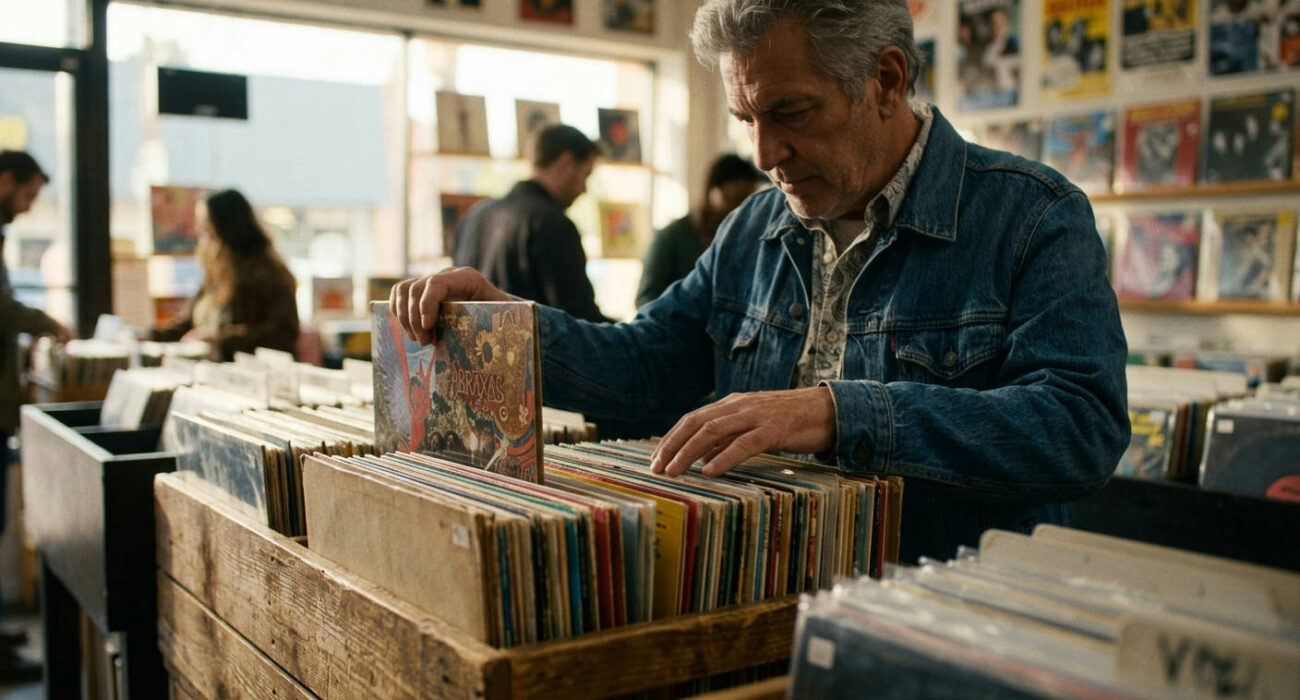
You’re here for one thing: the definitive list of Santana albums in chronological order. No fluff, no long-winded stories about how the author first heard “Black Magic Woman.” You want the complete discography of a guitar god who has been shaping music for nearly sixty years. This is that list, from the raw psychedelic fire of 1969 to the genre-bending collaborations of 2026. This list of Santana albums in chronological order showcases the evolution of an iconic artist.
We’re going to break down Carlos Santana’s entire studio album output, era by era. This isn’t just a dry list of titles; it’s a road map through one of the most fascinating careers in rock history. We’ll explore the seismic shifts in sound, the iconic collaborations, and the albums you absolutely need in your vinyl collection.
The Classic Era (1960s–1970s): Forging a Legend
This is where it all began. The raw, percussive, Latin-infused psychedelic rock that blew minds at Woodstock and established a completely new sound. The band wasn’t just Carlos; it was a collective of master musicians creating a fusion that had never been heard before.
Santana (1969)
The one that started it all. Dropping the same month as their legendary Woodstock performance, this debut album is a raw, energetic explosion. It’s less about polished songs and more about volcanic grooves. Tracks like “Jingo” and the instrumental masterpiece “Soul Sacrifice” are pure, uncut rhythm and fire. It’s the sound of a band discovering its own immense power in real time.
Abraxas (1970)
If the debut was the spark, Abraxas was the inferno. This is the album that made Santana a global phenomenon. It features two of the most iconic rock songs ever recorded: the smoldering cover of Fleetwood Mac’s “Black Magic Woman” and the vibrant, irresistible “Oye Como Va.” The album art is as famous as the music, a perfect visual representation of the mystical, psychedelic, and spiritual sounds within. Abraxas is a cornerstone of any serious record collection, a masterpiece of flow and fusion, integral to understanding the list of Santana albums in chronological order.
Santana III (1971)
The original lineup went out with a bang on their third album. Adding the fiery teenage guitarist Neal Schon (who would later form Journey) created a blistering dual-guitar attack. Santana III is arguably their heaviest and most energetic record of the classic era. Songs like “No One to Depend On” and “Everybody’s Everything” are muscular, tight, and bursting with life. It’s the sound of a band at its absolute peak, a non-stop party on wax.
“There is no greater reward than working from your heart and making a difference in the world.” – Carlos Santana
The Jazz Fusion Journey: Caravanserai (1972) to Borboletta (1974)
After Santana III, Carlos Santana took a sharp left turn. He dissolved the original band and dove headfirst into the spiritual and complex world of jazz fusion, inspired by artists like Miles Davis and John Coltrane. This period is often debated by fans but contains some of his most ambitious work.
- Caravanserai (1972): This album was a shock to many. It’s almost entirely instrumental, focusing on atmospheric textures, complex time signatures, and spiritual exploration. It’s a challenging but deeply rewarding listen.
- Welcome (1973): Continuing the jazz-rock path, Welcome features vocalist Leon Thomas and keyboardist Tom Coster, who would become key collaborators. The music is sophisticated, airy, and a world away from the grit of the first three LPs.
- Borboletta (1974): Here, Santana brought in Brazilian musicians Flora Purim and Airto Moreira, infusing the jazz fusion with samba and tropical rhythms. It’s a lush, beautiful album that feels like a journey through a rainforest. This era is a testament to an artist refusing to be creatively stagnant, pushing his own boundaries relentlessly. Many of these records are considered essentials in our guide to the Best Albums Of The 1970s.
Return to Form: Amigos (1976) to Marathon (1979)
By the mid-70s, Santana began to steer back towards more song-oriented rock, blending the accessibility of his early work with the musical sophistication he’d gained.
- Amigos (1976): A commercial comeback, this album spawned the radio hit “Europa (Earth’s Cry Heaven’s Smile),” one of Carlos’s most beautiful and enduring instrumentals.
- Festivál (1977): Leaning heavily into Latin and salsa influences, this is a vibrant, danceable record that recaptures the percussive energy of the early days.
- Moonflower (1977): A brilliant mix of live and studio tracks, this double album is a must-have. It features blistering live versions of classics and a fantastic studio cover of The Zombies’ “She’s Not There.”
- Inner Secrets (1978): A more polished, pop-rock affair, this album saw the band embrace a slicker production style, exemplified by their cover of Traffic’s “Well All Right.”
- Marathon (1979): The band closed out the decade with a solid arena-rock effort, featuring the hit “You Know That I Love You.”
The Ultimate List of Santana Albums in Chronological Order
For those who just want the complete, scannable timeline, here it is. This is the definitive studio album discography from the beginning right up to the latest 2025 release. We’ve omitted live albums (except for the half-studio Moonflower) and compilations to focus purely on the core creative output.
The Classic & Fusion Years
- Santana (1969)
- Abraxas (1970)
- Santana III (1971)
- Caravanserai (1972)
- Welcome (1973)
- Borboletta (1974)
- Amigos (1976)
- Festivál (1977)
- Moonflower (1977)
- Inner Secrets (1978)
- Marathon (1979)
The Experimental & Pop Years
- Zebop! (1981)
- Shangó (1982)
- Beyond Appearances (1985)
- Freedom (1987)
- Spirits Dancing in the Flesh (1990)
- Milagro (1992)
The Global Comeback & Modern Era
- Supernatural (1999)
- Shaman (2002)
- All That I Am (2005)
- Guitar Heaven (2010)
- Shape Shifter (2012)
- Corazón (2014)
- Santana IV (2016)
- Africa Speaks (2019)
- Blessings and Miracles (2021)
- Sentient (2025)
The Experimental & Pop Era (1980s–1990s)
The 1980s were a challenging period for many classic rock acts, and Santana was no exception. The musical world shifted towards synths, new wave, and slick production. Carlos navigated these years with a series of albums that explored different sounds, with varying degrees of commercial success.
Finding a Foothold in the ’80s
Albums like Zebop! (1981) and Shangó (1982) saw Santana successfully blend their signature sound with the polished rock radio demands of the time. Zebop! gave us the hit “Winning,” while Shangó delivered the classic “Hold On.” These records are tight, well-crafted, and feature incredible guitar work, even if the production feels distinctly of its time.
As the decade wore on, albums like Beyond Appearances (1985) and Freedom (1987) struggled to find a large audience. Carlos was still playing his heart out, but the band was adrift, trying to fit into a world that had seemingly moved on. This era is often overlooked, but it’s a crucial part of the story, showing an artist who refused to quit even when he was no longer at the top of the charts.
The Spiritual ’90s
The early ’90s continued this trend. Spirits Dancing in the Flesh (1990) and Milagro (1992) were heartfelt, spiritual albums that didn’t make a huge commercial impact. At this point, Santana was without a major label record deal. To many, it might have seemed like the story was winding down. They couldn’t have been more wrong.

The Global Supernova: How Supernatural Changed Everything
In 1999, Carlos Santana was inducted into the Rock & Roll Hall of Fame. But instead of being a capstone on a legacy career, it was the launchpad for one of the most staggering comebacks in music history. The album was Supernatural, and it wasn’t just a hit; it was a cultural atom bomb.
The strategy, orchestrated by legendary record executive Clive Davis, was simple but brilliant: pair Carlos’s unmistakable guitar with the biggest contemporary stars of the day.
The result was magic. “Smooth,” featuring Rob Thomas of Matchbox Twenty, was an unstoppable force, spending 12 weeks at number one. “Maria Maria,” with The Product G&B and Wyclef Jean, spent another 10 weeks at the top. The album sold over 30 million copies worldwide and swept the 2000 Grammy Awards, winning a record-tying nine awards, including Album of the Year.
To further appreciate the list of Santana albums in chronological order, it’s essential to delve into the cultural impact each record has had over the decades. From classic rock to jazz fusion, Santana’s versatility shines through every album.
Supernatural proved that Santana’s sound was timeless. His guitar could weave its way into a pop-rock anthem, a hip-hop-infused banger, or a Latin power ballad with equal grace and fire. It introduced him to two new generations of fans and solidified his status as a living legend.
Riding the Wave: The Post-Supernatural Albums
How do you follow up an album that big? For Santana, the answer was to keep the collaborative spirit alive while exploring new musical avenues.
Continuing the Formula
Shaman (2002) and All That I Am (2005) continued the Supernatural playbook, featuring guest stars like Michelle Branch (“The Game of Love”), Dido, and Steven Tyler. While they didn’t replicate the historic success of their predecessor, they were both massive commercial hits that kept Santana at the forefront of popular music.
New Directions and Reunions
The 2010s saw Santana diversify his output significantly.
- Guitar Heaven (2010): A covers album where Carlos puts his stamp on classic rock anthems like “Back in Black” and “Whole Lotta Love,” joined by vocalists like Chris Cornell and Joe Cocker.
- Shape Shifter (2012): A mostly instrumental album that served as a beautiful, melodic return to his musical roots, dedicated to the Native American people.
- Corazón (2014): A full-blown celebration of Latin music, featuring collaborations with superstars like Gloria Estefan, Pitbull, and Juanes.
- Santana IV (2016): This was the big one for long-time fans. A full-fledged reunion of the classic early ’70s lineup, including Neal Schon, Gregg Rolie, and Michael Shrieve. It was a critical and commercial success, proving the old magic was still there.
The Modern Era (2020s and Beyond)
Entering his seventies, Carlos Santana showed zero signs of slowing down. His recent work is as vibrant and creatively restless as ever.
Africa Speaks (2019), produced by the legendary Rick Rubin, is a raw and powerful album. Recorded in just 10 days, it captures a live-in-the-studio energy, with Carlos’s guitar soaring over hypnotic African rhythms and the commanding vocals of Buika.
Every entry in the list of Santana albums in chronological order offers a window into the artist’s creative journey and musical evolution, appealing to both longtime fans and new listeners alike.
Blessings and Miracles (2021) returned to the star-studded collaborative format, featuring an eclectic mix of guests from Rob Thomas and Chris Stapleton to the late Chick Corea.
And that brings us to 2026. The latest chapter is Sentient (2025). This album continues to bridge worlds, highlighted by the lead single featuring a stunning collaboration with Mexican music superstar Carín León. It proves, yet again, that Santana’s guitar is a universal language, capable of communicating with any artist from any genre.
Collecting Santana on Vinyl: A Buyer’s Guide
As you explore the list of Santana albums in chronological order, you’ll inevitably want to own some of these masterpieces on vinyl. The warmth, depth, and sheer percussive impact of these records are best experienced on a turntable.
As you explore the list of Santana albums in chronological order, consider how each record reflects the shifting landscape of music and the artist’s responsive nature to those changes.
“The most valuable possession you can own is an open heart. The most powerful weapon you can be is an instrument of peace.” – Carlos Santana
Your Essential Santana Vinyl Starter Pack
For a new collector, the discography can be daunting. Here are the three essential LPs to start your journey, all of which sound incredible on a quality setup. For ideas on great gear that won’t break the bank, check out our guide to the best turntables under £300 in the UK.
- 1. Abraxas (1970): This is non-negotiable. It’s the quintessential Santana experience. The mix is spacious, allowing the congas, timbales, and Carlos’s guitar to breathe. An early pressing is a treasure, but modern 180-gram reissues are excellent and readily available.
- Find your copy on vinyl: Search for Abraxas on Amazon
- 2. Santana III (1971): To feel the raw power of the original band at its peak, you need this record. It’s a much more “in your face” recording than Abraxas. The dual guitars of Carlos and Neal Schon will test the limits of your speakers. It’s pure rock and roll energy.
- Find your copy on vinyl: Search for Santana III on Amazon
- 3. Supernatural (1999): Yes, the modern classic. This album was perfectly produced, and the vinyl pressing is spectacular. The low end on “Maria Maria” will rumble your floorboards, and the clarity on “Smooth” is stunning. It’s a modern audiophile reference disc and a piece of music history.
- Find your copy on vinyl: Search for Supernatural on Amazon
Understanding Pressings: Original vs. Reissue
When hunting for Santana vinyl, you’ll encounter original pressings and modern reissues. Originals, especially for the first three albums on the Columbia “two-eye” label, are prized by collectors for their authentic, warm analog sound. However, they can be expensive and may have wear and tear.
Modern 180-gram reissues are a fantastic alternative. They are typically sourced from the original master tapes, pressed on heavy, quiet vinyl, and offer pristine audio quality. For a deeper dive into the list of Santana albums in chronological order on vinyl, reissues are an affordable and high-quality way to build your collection.
Understanding the list of Santana albums in chronological order not only enriches your listening experience but also deepens your appreciation for the artistic journey that Carlos Santana has undertaken.
A Legacy That Never Stops Evolving
Tracing the list of Santana albums in chronological order is like following a river. It starts as a raging torrent, carves new paths through unexpected terrain, sometimes slows to a gentle flow, and then merges with other streams to become a mighty, unstoppable force.
Ultimately, following the list of Santana albums in chronological order reveals a narrative of growth, resilience, and an unwavering passion for music.
From the Woodstock stage to topping the charts in the 21st century, Carlos Santana has never stopped searching for new sounds and new ways to connect with listeners. His guitar playing remains one of the most instantly recognizable and emotionally expressive voices in all of music. This discography isn’t just a collection of records; it’s the life’s work of an artist who continues to bless the world with miracles.