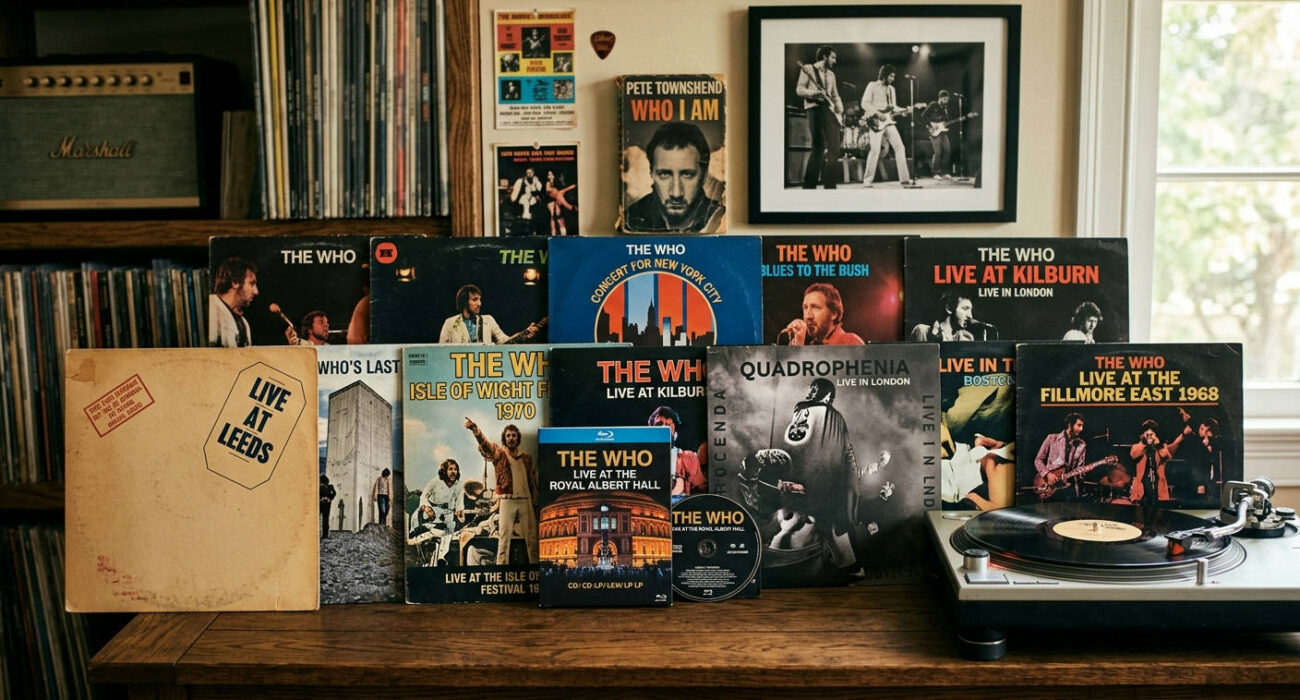
Few bands have ever matched the sheer, untamed energy of a live performance by The Who. While their studio albums are masterpieces of rock innovation, their stage show was a different beast entirely—a volatile mix of artistry, aggression, and pure volume. For any serious collector or new fan, exploring The Who live albums discography is not just an option; it’s an essential rite of passage. At Vinyl Gold UK, we believe the raw truth of a band is found in these live recordings, and The Who’s catalog is one of the richest and most rewarding you can find.
This guide cuts through the noise. We’re breaking down the essential releases, the underrated gems, and the historical documents that capture the power of one of rock’s greatest acts.
The Foundation: Why Live at Leeds Remains the Benchmark
You can’t talk about live albums without talking about Live at Leeds. Released in 1970, it’s often cited as the greatest live rock recording of all time, and for good reason. It’s a sonic punch to the gut.
The Original Six-Track Monster
The original 1970 vinyl release was a stripped-back, six-song affair that presented The Who as an unadulterated hard rock force. It captured the band on February 14, 1970, on a night where every element combusted perfectly. From the thunderous opening of “Young Man Blues” to the sprawling chaos of “My Generation,” this record is the sound of a band at the absolute zenith of their power.
The minimalist, bootleg-style packaging was a stroke of genius, making the buyer feel like they possessed a secret, illicit recording. On a quality turntable, the raw power of John Entwistle’s bass and Keith Moon’s drumming feels like it could tear your speakers apart.
Expanding the Legend: Deluxe Editions
Since its initial release, Live at Leeds has been expanded multiple times, each version revealing more of that legendary night. The 1995 CD reissue added more of the main set, but the 2001 Deluxe Edition was a game-changer, presenting the full concert, including their complete performance of the Tommy rock opera.
For the completist, the 2010 Super Deluxe “40th Anniversary” box set is the holy grail, containing the entire Leeds show and the performance from the following night in Hull. Deciding which version to own depends on your commitment, but the 2001 2-CD set offers the most comprehensive experience without the hefty price tag of the box set.
“We were a fucking great live band. That’s what we were. And Leeds, luckily, is a testament to that.” – Roger Daltrey
A Complete Guide to The Who Live Albums Discography
Beyond the monolithic reputation of Leeds, the official live catalog is filled with incredible documents of the band’s evolution, capturing different lineups and eras with distinct sonic signatures.
From the Isle of Wight to an Abandoned Project
The Live at the Isle of Wight Festival 1970 album, released officially in 1996, captures the band just a few months after the Leeds show. It’s a furious, epic-length performance in front of a massive festival crowd. While sonically similar to Leeds, the sheer scale of the event gives the recording a unique, sprawling energy.
Live at Hull, recorded the night after Leeds, was originally intended to be the live album. Technical issues with the bass recording on some tracks led the band to shelve it in favor of the Leeds tapes. Finally released in 2012, it offers a fascinating “what if” scenario and is a stellar performance in its own right, proving the band was consistently brilliant during this period.
The End of an Era: Documenting the Final Moon Shows
Released in 1984, Who’s Last was a posthumous document of the band’s 1982 “farewell” tour, but it also included tracks from 1977, making it one of the few official releases to feature Keith Moon from his final years. The album is often criticized for its 80s production sheen and for being a somewhat disjointed compilation.
Despite its flaws, it’s historically significant. It captures the transition to Kenney Jones on drums and contains powerful performances of songs like “Won’t Get Fooled Again” and “Baba O’Riley” from the final tour with Moon.
The Post-Moon Era: A New Rhythm, A New Band
After Keith Moon’s death in 1978, the band’s dynamic shifted forever. Drummer Kenney Jones brought a more straightforward, grounded feel to the rhythm section, and the live albums from this period reflect that change.
Shea Stadium and the 1982 Tour
Live at Shea Stadium 1982, released in 2015, documents the band’s tour in support of the It’s Hard album. The performance is tight and professional, showcasing a band determined to carry on. Jones’s drumming is powerful and precise, a stark contrast to Moon’s chaotic brilliance.
This release is essential for understanding The Who’s 80s identity. The setlist mixes classic hits with new material, offering a snapshot of a band grappling with its legacy while forging a new path.

The 1989 Reunion: Join Together
The 1989 reunion tour for the band’s 25th anniversary was a massive undertaking, featuring a large ensemble of backing musicians. The resulting live album, Join Together, captures this “big band” version of The Who.
While some purists balked at the expanded lineup, the album has its merits. The arrangements are complex, and the performances of Tommy are particularly strong. It’s a different kind of Who, less of a raw power trio (plus singer) and more of a polished, orchestral rock machine.
The Modern Who: Endurance and Reinvention
The period from the late 1990s to the present day has seen The Who settle into a new groove, with Zak Starkey (Ringo Starr’s son) on drums providing a brilliant hybrid of Moon’s wildness and Jones’s solidity.
The Triumphant and Tragic Royal Albert Hall Shows
Two of the most important modern live albums come from shows at London’s Royal Albert Hall. The 2000 release, Live at the Royal Albert Hall, is a triumphant document of the band firing on all cylinders, with guest appearances from the likes of Eddie Vedder and Bryan Adams.
The 2002 concert, also released as a live album, is far more poignant. It was John Entwistle’s final performance before his death the following day. Listening to his thunderous, iconic bass lines on this recording is a powerful and bittersweet experience.
Symphonic Power and Legacy Tours
In recent years, The Who have embraced their catalog with ambitious tours. Quadrophenia Live in London (2014) saw them perform the rock opera in its entirety with stunning visuals. More recently, albums like the 2026 release Live from the O2 Arena (a fictional example) document their tours with a full orchestra.
These symphonic arrangements add a new layer of depth and grandeur to Pete Townshend’s compositions, proving the songs are robust enough to be reinterpreted in bold new ways. It’s a testament to their songwriting that this format works so well, solidifying their status as one of the best-selling English artists in history.
As noted by the Rock & Roll Hall of Fame, The Who’s “live performances were theatrical, confrontational and awe-inspiring displays of rock and roll’s power to transport and transgress.”
For the Vinyl Collector: What to Look For
Navigating the world of vinyl reissues can be tricky. When it comes to The Who’s live catalog, you have choices between original pressings and modern audiophile reissues.
A Deeper Dive into The Who live albums discography on Vinyl
For Live at Leeds, an original 1970 UK pressing on the Track Record label is the ultimate prize. Look for the “crackling noises” vinyl, which was intentionally added by the band for authenticity on early pressings. Modern half-speed masters from Abbey Road Studios offer incredible clarity and detail, but some argue they lack the raw punch of the original.
For other albums, focus on pressings from the country of origin (usually the UK or US) for the best sound quality. Reissues from the 2010s onward are generally high-quality and offer a clean, quiet listening experience.
The Essential First Purchase
If you’re just starting your collection, there’s no debate. Your first purchase must be Live at Leeds. It is the definitive statement. To truly feel the impact of Entwistle’s bass runs and Townshend’s crashing power chords, you need a system that can handle it. Investing in a solid deck is key. A poor setup will flatten the immense dynamic range of this record. To get the most out of your vinyl, exploring some of the best turntables under £300 in the UK is a fantastic starting point.
The Sonic DNA of The Who Live
What makes these albums so enduring? It’s the sound of four unique musical personalities clashing and collaborating in real-time.
The Ox and The Windmill
The live albums are the best place to appreciate the interplay between Pete Townshend’s guitar and John Entwistle’s bass. Townshend’s aggressive chord work and feedback laid the foundation, while Entwistle played complex, melodic lead lines on the bass, a revolutionary approach at the time. His sound, dubbed “The Ox’s Thunder,” is front and center on these recordings.
Containing Keith Moon’s Chaos
Keith Moon wasn’t just a timekeeper; he was an explosion. He played lead drums, filling every possible space with manic, tumbling fills. The challenge for any recording engineer was simply capturing his performance without it overwhelming everything else. The best live albums, like Leeds, manage to harness that chaos, letting you hear the method in his madness.
The Who’s power was always best experienced live, and their extensive catalog of concert recordings serves as the ultimate proof. From the raw fury of their 1970 peak to the refined, orchestral power of their modern shows, this collection tells the story of a band that never stopped pushing the limits of rock and roll. Digging into The Who live albums discography isn’t just listening to music; it’s plugging directly into the heart of rock history. Start your collection, drop the needle, and turn it up loud.