
You’re probably doing what most couples do at this stage. You’ve booked the venue, started pinning décor ideas, maybe argued politely about whether the first dance should be classic soul or something more left-field, and now you’re looking at DJs.
Weddings often split into two categories. One gets pleasant background music and a half-hearted party. The other gets a room that lifts, builds, and stays alive because the person controlling the music understands timing, pressure, personality, and people.
Hiring a wedding dj in London or Kent isn’t just about finding someone with speakers and a playlist. It’s about choosing the person who will steer the emotional pace of your evening, manage transitions, work with your other suppliers, and know when to hold a groove or switch direction before the floor drops.
Your DJ Is More Than a Playlist They Are Your Vibe Director
A weak wedding set usually looks the same. The meal runs over, the speeches finish, the first dance lands well enough, then the party never quite catches. Guests drift to the bar. A few people dance out of loyalty. The room feels busy, but not connected.
A proper wedding DJ changes that entire arc. Not by playing “bangers” non-stop, but by reading the room and choosing the right record for that exact minute. There’s a difference between a song people like and a song that makes the right group move now. That difference is the craft.

A good wedding DJ also does work most couples don’t see. They shape volume through the night so conversation still feels easy early on. They handle microphone moments cleanly. They watch age mix, confidence levels, alcohol flow, and the space itself. A chic Peckham railway arch needs a different musical opening than a Kent barn after a long summer drinks reception.
There’s also a planning side to this that matters just as much as mixing. The DJ is often the supplier who sits in the middle of the evening’s rhythm. They cue entrances, support the photographer for key moments, keep momentum after delays, and stop the energy from dipping when the room starts to fragment. If you want a feel for that atmosphere-first approach, this behind-the-booth visual from VinylGold captures the sort of setting where musical curation matters as much as equipment.

A wedding DJ isn’t there to prove their taste. They’re there to build yours into a night that works in real time.
That’s why this hire carries more weight than couples often expect. Your florist creates the look. Your caterer shapes the meal. Your DJ controls how the room feels once the formal part of the day gives way to celebration.
Laying the Groundwork When to Book and What to Budget
A couple locks in a great London venue, sorts the dress, books the photographer, then leaves music until much later. By that point, the DJs who know how to read a mixed-age wedding crowd, work around venue sound limits, and keep the night full are often already gone.
Book your DJ soon after the venue is confirmed. That is the practical order. In London and Kent, prime dates disappear fast, especially summer Saturdays, December party dates, and bank holiday weekends. If the evening matters to you, treat the DJ like a core part of the guest experience, not a final admin job.
This matters even more if you want a custom brief. A proper wedding DJ is not taking a list of 30 songs and turning up with speakers. They are building the shape of the night with you, working out where the room should start, when to push, when to hold back, and how to get guests from polite drinks-floor energy into a packed dance floor without it feeling forced. A good reference for that more curated, atmosphere-led approach is this personalised wedding music and event atmosphere visual.

Booking at the right stage
A simple rule works well:
- Venue booked: start contacting DJs straight away.
- Peak season date: expect less choice and faster response times.
- Specific DJ in mind: enquire now, not after the rest of the supplier list is finished.
- Detailed music brief: leave time for proper planning, not a rushed phone call a few weeks before the wedding.
The couples who get the strongest result usually book while they still have options, not once availability has started shrinking.
What you are actually paying for
Price only makes sense when you know what sits behind it. Two quotes can look close on paper and be miles apart in practice.
A lower fee may cover only the set itself. A stronger professional fee usually includes planning meetings, music preparation, insured equipment, backup gear, travel, setup time, timeline coordination, microphone management, and the judgement to keep the room together if dinner runs late or the dance floor needs rebuilding after a lull. That difference shows up on the night.
In London and Kent, the trade-off is usually between a supplier who plays songs and a supplier who can direct the energy of the evening.
| Type of quote | What it often includes | What to check carefully |
|---|---|---|
| Lower-end quote | Basic evening set, simpler equipment | Insurance, backup gear, planning time, contract detail |
| Mid-range professional quote | Consultation, tailored playlist work, quality sound and lighting | Travel, overtime, MC duties, timing changes |
| Higher-end tailored service | Deeper curation, more production, tighter coordination with other suppliers | Whether the added production suits your venue and priorities |
Higher spend is not automatically better. Some London hotel ballrooms need more production and cleaner wireless mic handling. Some Kent barns need a smart setup that works within sound limiters and awkward load-in routes, rather than lots of lighting for the sake of it. Good DJs will tell you where the money genuinely improves the party and where it does not.
Budget for the role, not just the hours
Couples sometimes look at a DJ’s playing time and wonder why the quote is not based on those few hours alone. The answer is simple. Wedding DJ work starts well before the first track and carries responsibility that affects the whole reception.
Your DJ is tied into timings, announcements, venue rules, and the handover from meal to party. If you are mapping supplier costs across the full day, including gratuities, this expert guide for wedding planners is a useful companion resource.
If the evening party is a major reason you are inviting everyone you love into one room, budget accordingly. The right DJ does much more than fill silence. They help turn a good wedding into one guests still talk about months later.
Finding Your Perfect DJ The Hunt in London and Kent
The strongest DJ bookings usually don’t start with a random search. They start with a recommendation from someone who has already seen that DJ handle a real room, a real timeline, and real wedding pressure.
That’s especially true in London and Kent, where venues vary wildly. One weekend might call for elegant dinner music in a city hotel. The next might involve a converted warehouse, a marquee, or a barn with tighter sound rules and trickier access. Local knowledge isn’t a nice extra. It affects setup, sound choices, timing, and whether the evening runs smoothly.
Start with people who’ve seen the work
Trusted referrals beat polished marketing every time. Ask recent couples. Ask your venue coordinator. Ask your photographer or videographer who kept the room alive without turning the night into chaos. Those suppliers see the difference between a DJ who just turns up and one who actively directs the flow of the evening.
One useful visual reference for the kind of personalised event atmosphere couples often want is this music-led wedding style image. It reflects the difference between a generic package and a more curated approach.
If you want extra places to compare entertainers and event formats, platforms such as EventBliss entertainment booking can help you widen the search while keeping your shortlist organised.
Why local experience matters in the South East
A DJ who knows London and Kent venues already understands the practical friction points. They’ve dealt with loading restrictions, tight setup windows, awkward booth locations, noise-sensitive sites, and rooms where speaker placement matters more than raw volume.
That experience becomes even more important when you look at the risk profile of cheaper hires. A 2025 UK Wedding Survey found that 18% of budget DJ hires in South East England resulted in last-minute cancellations or equipment failures, and 62% of London and Kent venues reported sound system incompatibilities caused by amateur gear not meeting local council regulations, according to this UK wedding DJ risk report.
Those aren’t abstract issues. They show up as delayed setups, rejected equipment, weak sound, or a couple realising too late that the low quote never covered the level of professionalism the venue expected.
Build a shortlist with standards
A strong shortlist is usually small. Three to five DJs is enough if they’re properly chosen.
Look for:
- Clear wedding experience: You want someone who talks fluently about first dances, supplier timing, room transitions, and guest mix.
- Evidence of musical range: Not a giant list of genres. Actual proof they can move between styles without the floor feeling disjointed.
- Venue awareness: They should ask about curfews, access, sound limiters, room layout, and power.
- Professional communication: Fast, specific replies usually signal a reliable planning process later on.
One option in this market is VinylGold, which provides wedding DJ services across South East London and Kent with bespoke soundtrack planning built around the couple, the crowd, and the venue. That sort of service model is worth considering if you want more than an off-the-shelf playlist.
The wrong hunt focuses on price first. The right hunt focuses on fit, then checks whether the investment matches the experience you’re trying to create.
The Vetting Process Key Questions and What to Listen For
A shortlist is only useful if you know how to test it. This conversation shouldn’t feel like a quick availability check. You’re interviewing someone for one of the most exposed roles of the day.

The strongest DJs welcome detailed questions because the answers reveal how they think. They won’t hide behind a stock phrase like “I play everything”. They’ll explain how they build an evening, how they adapt when the room changes, and how they work with the rest of your team.
UK wedding data shows that successful hires from trusted referrals achieve 92% satisfaction rates, poor coordination between vendors causes 24% of wedding delays, and professional DJs who read the crowd well can maintain 75 to 85% dance floor occupancy, according to this UK guide to hiring a wedding DJ. Those numbers tell you exactly where to focus your vetting. Taste matters, but planning and crowd reading matter just as much.
Ask about process, not just music
A lot of couples ask, “What music do you play?” That question is too broad to be useful.
Ask these instead:
How do you build a set around both our taste and the guests who’ll actually be in the room?
What do you do if the floor starts dipping after a strong run?
How do you handle requests that clash with the brief?
What information do you need from us before the wedding to plan properly?
These questions force the DJ to talk about method. A professional answer should include pacing, guest profile, flexibility, and the couple’s must-haves. A weak answer usually falls back on genre lists or vague reassurance.
Test their coordination instincts
The best wedding DJs think beyond the booth. They know the evening is a chain of linked moments, not a playlist with some announcements dropped in.
Ask about:
- Supplier communication: Do they speak with the venue, photographer, planner, or caterer before the day?
- Timeline management: How do they prepare for delayed speeches, a late room turnaround, or a first dance running behind?
- MC confidence: Can they make announcements clearly, briefly, and without sounding like a game-show host?
- Room management: How do they change tone between drinks, dinner, and dancing?
A DJ who can’t describe their coordination process is telling you they probably don’t have one.
That point matters because many wedding problems are not “music problems”. They’re handover problems. The room is ready but the photographer isn’t. The cake is moving but no one has warned the guests. The couple wants a big first dance moment, but the DJ has not checked microphone levels or floor lighting.
Listen for musical intelligence in the demo
A demo mix should show more than song choice. It should show control.
Listen for clean transitions, sensible energy changes, and whether the progression feels natural. If they jump between styles, does it sound deliberate or random? A good wedding DJ can move from soul to disco to house in a way that still feels like one party.
For a sense of how DJs think about flow and set construction, this short video is useful to watch before your calls:
Watch how they listen to you
This is one of the most overlooked parts of hiring a wedding dj. During the consultation, notice whether they ask good questions back.
A thoughtful DJ will want to know things like:
- who absolutely must be on the floor
- which songs feel like you as a couple
- what kind of records would empty the room for your crowd
- whether you want elegant, loose, clubby, nostalgic, or mixed energy
- how involved you want to be in music planning
If they interrupt, rush, or oversell, that behaviour usually shows up again later. If they listen properly, challenge assumptions sensibly, and translate your taste into a realistic musical plan, that’s a strong sign.
The best sign is specificity
You’re not looking for the flashiest talker. You’re looking for someone who makes you think, “They’ve done this before, they understand our room, and they know how to keep it moving.”
What good sounds like: “I’d start with records that bring in the mixed-age crowd, hold that pocket until the room trusts me, then lean further into your preferred sound once the floor is established.”
That answer is miles better than “Don’t worry, I’ll play whatever gets people dancing.”
Decoding the Contract and Spotting Red Flags
A booking feels real when the paperwork lands. It also shows very quickly whether you are hiring someone who runs weddings properly or someone who just turns up with speakers and hopes for the best.
Good contracts remove ambiguity. In London and Kent, that matters more than couples often realise, because venues can have strict access times, sound limiters, loading restrictions, and insurance requirements. If those details are not nailed down in writing, the problems usually surface on the day, when there is no room to fix them calmly.
What the contract should clearly cover
Read it like an event document, not a receipt. A proper agreement should spell out:
- Service details: Venue name, date, performance times, setup access, finish time, and pack-down.
- What is included: Sound system, DJ booth, microphones, lighting, and any add-ons you have agreed.
- Fees and payment dates: Booking fee, balance deadline, overtime cost, and what happens if timings change.
- Cancellation and postponement terms: Fair wording for both sides, especially if your venue or date shifts.
- Backup arrangements: What happens if the DJ is ill, equipment fails, or traffic causes a delay.
- Venue compliance: Confirmation that certificates and supplier documents can be provided if the venue asks.
- Planning responsibility: Who handles final logistics and by what point those details need to be confirmed.
If any of that is vague, get it clarified before you pay the balance.
I always tell couples the same thing. A strong contract protects the atmosphere you are trying to create. It protects the first dance starting on time, the speeches having a working microphone, and the evening not losing momentum because somebody assumed a detail instead of confirming it.
PAT and PLI are part of the job
PAT and Public Liability Insurance are basic professional requirements. They are not admin extras.
Many London hotels, private clubs, and country house venues in Kent will ask for them in advance. Some ask a month out. Some ask the week of the wedding. A few will refuse access without them, especially where suppliers are bringing in their own sound and lighting equipment.
Ask for current documents early, then make sure the contract reflects that the DJ can supply what the venue requires. If you want a simple visual reference for the business handling that booking, the VinylGold brand asset is here.

Red flags that deserve a hard look
Some warning signs are small on paper and expensive in practice.
- No written contract at all: If the agreement lives in WhatsApp messages, you do not have enough clarity.
- Very low pricing with little detail: Cheap quotes often leave out lighting, backup kit, travel, setup time, or proper cover if something goes wrong.
- Loose wording around timings: “Evening reception” is not precise enough. Start time, finish time, and access window should be exact.
- No backup plan: Every experienced wedding DJ should be able to explain who covers if illness, breakdown, or an emergency hits.
- Reluctance to share documents: Hesitation around insurance or PAT certificates usually points to poor organisation at best.
- No mention of venue restrictions: A DJ who does not ask about stairs, sound limiters, curfews, or load-in access may be treating your wedding like a pub booking.
One more point matters here. If the contract reads like the DJ is only supplying music, that is too narrow. A strong wedding DJ agreement reflects what the job entails. Managing room energy, coordinating with the venue, handling transitions cleanly, and keeping the night full are all part of the service.
That level of clarity is often the difference between a generic disco and a party that feels properly built for your crowd.
From Booking to Wedding Day Planning for Flawless Flow
Once the contract is signed, their value emerges during planning. In this phase, a capable DJ stops being a supplier and becomes part of the machine that keeps the day feeling smooth.
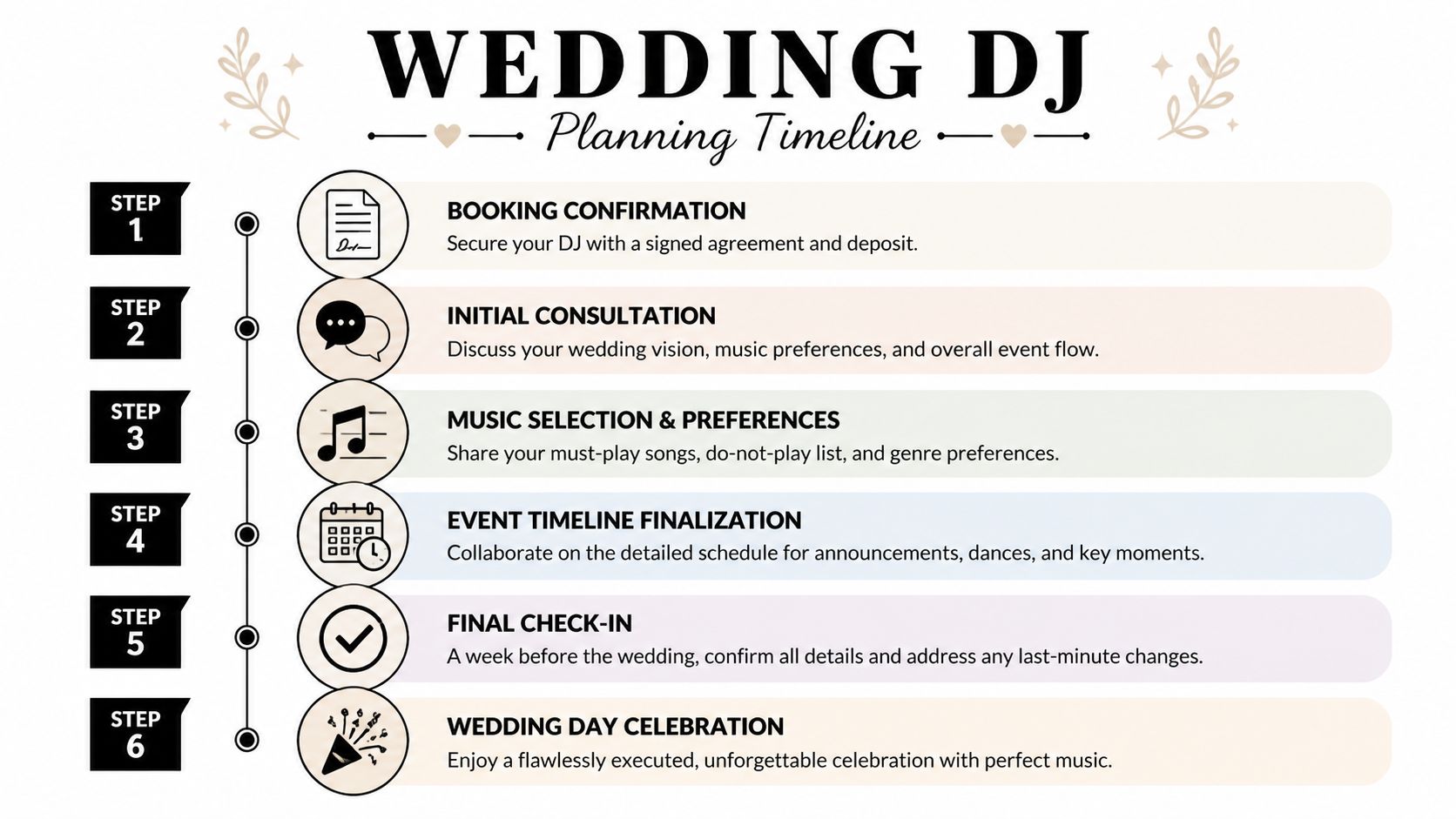
A good process usually moves through a few clear stages. You confirm the booking, talk through the shape of the day, share music preferences, and lock the key timings once the venue and other suppliers have settled their side of the schedule. If you want a simple brand reference for who’s handling that planning conversation, the VinylGold logo asset is here.
Build the soundtrack in layers
The best wedding music plans aren’t just “songs we like”. They’re layered by moment.
Ceremony music needs calm and confidence. Drinks reception music should leave room for conversation. Dinner usually needs warmth without stealing focus. The evening set then has to bridge generations, confidence levels, and changing energy in the room.
Get specific about preferences
Your must-play list matters, but so does your do-not-play list. Be honest. If certain songs, artists, or genres would make you cringe, say so early.
Useful guidance for your DJ includes:
- Core favourites: A handful of tracks that feel personal, not a list so long it handcuffs the night.
- Absolute no-go songs: The records that would break the mood for you.
- Guest priorities: Family tastes, friendship groups, and anyone important who’ll shape the floor.
- Key formal moments: First dance, cake cutting, final song, and any planned announcements.
Flow beats volume
An important planning job is getting all suppliers to hit the same rhythm. Your DJ should know when the photographer needs warning for the first dance, when catering is clearing, when the venue wants noise controlled, and how to pivot if timings shift. That’s what keeps the night feeling effortless to guests, even when the schedule changes behind the scenes.
A flawless wedding party rarely happens by accident. It happens because the music plan, the room plan, and the people plan all line up.
Conclusion Your Blueprint for an Unforgettable Night
The right DJ doesn’t just fill silence. They shape momentum, protect the atmosphere, and turn a reception into the part of the wedding people talk about afterwards.
That’s the main point of hiring a wedding dj well. You’re not buying a stack of songs. You’re choosing the person who will guide the room from polite anticipation to full celebration, while handling all the invisible details that keep the night on track.

If you approach the search with clear standards, ask better questions, and treat musical curation as part of the event design, you’ll make a stronger decision. That decision has a direct effect on how your guests feel, how your evening flows, and how many moments become lasting memories.
Keep a checklist when you enquire, compare, and sign. It’s one of the easiest ways to stay clear-headed while suppliers, budgets, and opinions all compete for space.
If you want a wedding DJ who works with intention, crowd awareness, and a customized approach to London and Kent weddings, have a look at VinylGold. You can explore the service, get a feel for the musical style, and decide whether it matches the atmosphere you want to create.