
The first time I dropped a Beatles mono cut into a room full of people who thought they knew the song, the reaction wasn’t academic. The track hit the centre of the room like a solid object, and suddenly the record felt less like heritage and more like presence.
The Shock of One Speaker Why Beatles Mono Mixes Matter
People often approach beatles mono albums as if they’re a collector’s side quest. They’re not. For a big stretch of the catalogue, mono is the version that carries the weight, the intent, and the impact in the most direct way.
A good mono Beatles record doesn’t sound smaller. It sounds more committed. The vocals sit in the middle with authority. The snare lands harder. The bass line feels locked to the song instead of spread across a wide picture. On a domestic hi-fi, that can feel intimate. On a dance floor or in a reception room, it can feel startlingly physical.
That’s why mono matters. It changes how you hear familiar songs. Tracks you’ve lived with for years stop feeling like museum pieces and start behaving like records again. You notice the punch before the detail. You notice the song before the production trick.
What mono does to the room
Stereo often gives you width. Mono gives you focus. With Beatles records, that focus can create a stronger emotional connection because everything arrives as one statement rather than a left-right conversation.
Practical rule: If a Beatles track sounds charming but a bit polite in stereo, the mono mix is often the first place to look for bite.
That’s especially true in live use. At weddings, private parties, and smaller event spaces, a centred mix often travels better than people expect. You don’t need guests to stand in the perfect listening position. The record presents itself.
Why listeners get hooked
The usual “aha” moment isn’t technical. It’s emotional. A mono Beatles album can make the band feel younger, hungrier, and more united. The performance snaps into one frame. Once you hear that properly, it’s hard to file mono away as an old format.
When Mono Was King The Beatles’ Original Vision
I first learned this the practical way, not from a hi-fi forum but from putting Beatles records on in rooms full of people. The songs that held the floor and changed the mood fastest were usually the mono mixes. They arrive as one solid statement. No wandering attention. No polite distance.
That makes sense once you place these albums back in their own time. In Britain through most of the 1960s, mono was the format the group, the producers, and the audience treated as standard. These LPs were mixed for radios, portable players, radiograms, pubs, and home systems where one speaker, or one dominant sound source, was normal. The job was to make the record connect immediately in ordinary rooms.
The band judged the records in mono
Sgt. Pepper’s Lonely Hearts Club Band is the clearest case. The band and engineers spent far more time on the mono mix than on the stereo version, and Geoff Emerick later recalled that they monitored from one speaker. That tells you how the important decisions were made. Balance, compression, vocal level, tape effects, the point where a drum fill should bite. Those calls were signed off in mono because mono was the working format.
From a collector’s angle, that matters. From a DJ’s angle, it matters even more. A record built to speak clearly from one source tends to keep its shape in real spaces where guests are chatting, glassware is clinking, and half the room is nowhere near an ideal stereo position. The Beatles and the Abbey Road team were not chasing width for its own sake. They were chasing impact.
The right question is simple: which mix did the band and staff actually fuss over?
George Harrison was never shy about his lack of enthusiasm for early stereo, and he was hardly alone. Stereo later became the prestige format. During the main Beatles mono years, it was often the alternate presentation.
Original vision means approved balances, not nostalgia
A lot of writers treat mono as a historical curiosity. That misses the point. With many Beatles albums, mono is the version where the musical priorities feel settled. The vocals sit where they should. The rhythm section pushes from underneath instead of spreading out. Effects sound placed rather than displayed.
Stereo still has its uses. On a quiet system at home, it can expose arrangement details, backing vocals, or guitar lines that are easier to isolate across the soundstage. I enjoy that too. But if the goal is to hear the record with the same force and concentration the band expected, mono usually gets you closer.
The sleeves matter here as well. Beatles albums were not only heard. They were lived with, stacked by the player, left out on furniture, stared at while the side spun. That is part of why studies of iconic album art for home decor feel relevant to this period. They show how records functioned as physical objects in everyday rooms, not just as files or collector trophies.
What you actually hear
The phrase “original vision” can sound a bit grand, so keep it practical. On a strong mono pressing, you will usually notice:
- A firmer centre: lead vocal, snare, and bass feel locked together.
- Cleaner decision-making: the mix pushes the song forward instead of inviting you to inspect the layout.
- More punch in imperfect rooms: the record still reads properly off-axis, at low volume, or through modest playback.
- A stronger group identity: the band sounds like four players driving the same performance at once.
That last point is the one that gets people. Mono often makes The Beatles feel less like a famous catalogue and more like a working band with something to prove. For anyone who plays records in the world, not just in the sweet spot between two speakers, that difference is not theoretical. It is physical.
The Core Collection A Tour of The UK Mono Albums
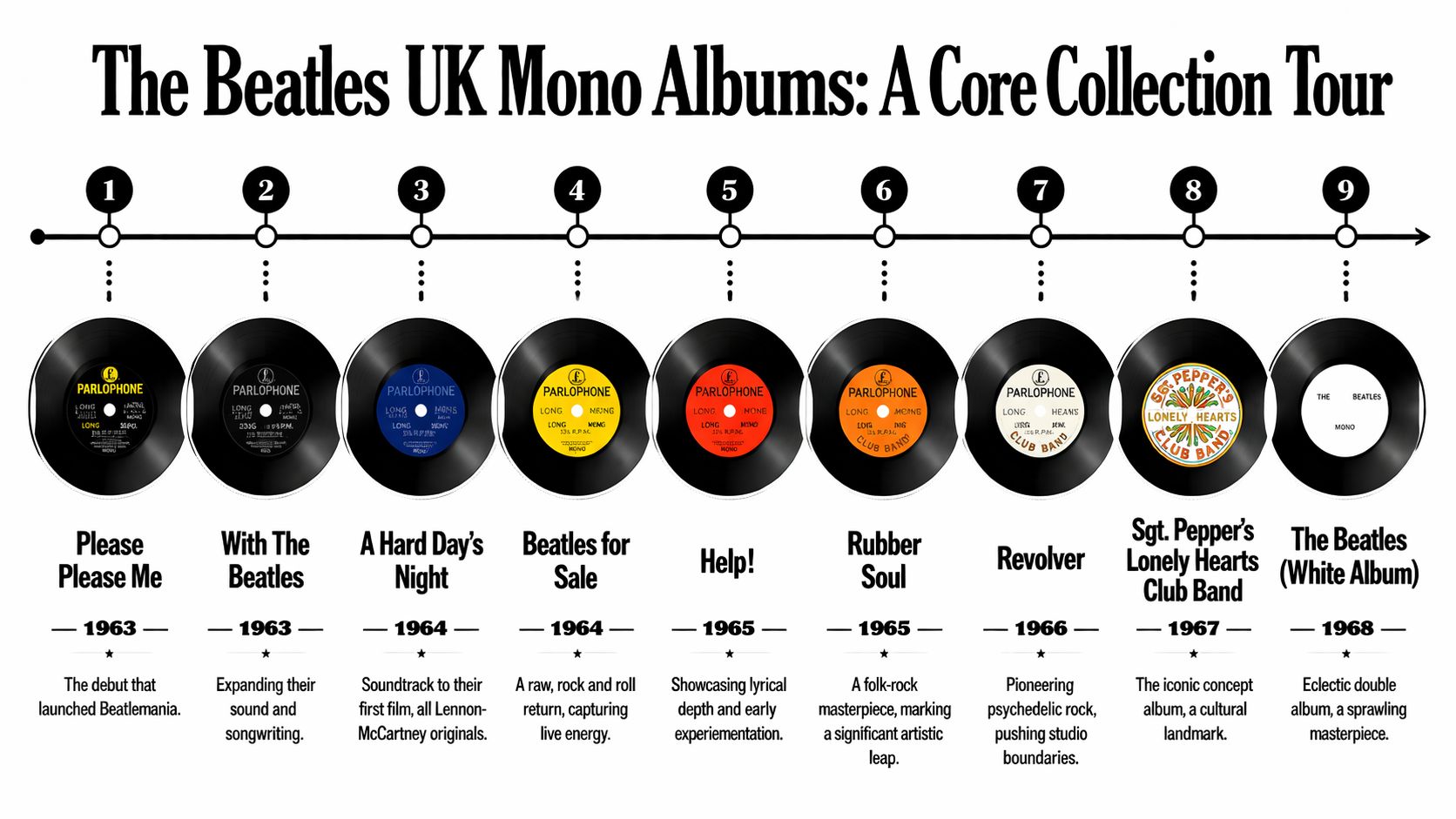
The official UK mono run tells a story of a band changing at speed while still being mixed for impact. Their debut Please Please Me began a streak of 11 consecutive No.1 albums, all available in mono, and titles such as Sgt. Pepper’s went on to sell over 5 million copies in the UK, during a period when mono held 80 to 90% market share, according to Chartmasters’ Beatles sales overview. That isn’t just commercial background. It explains why these records were built to hit hard in mono.
The early records feel like a band in the room
Please Please Me (1963) is the one to reach for when you want the direct line from club act to national phenomenon. In mono, the album’s energy feels concentrated rather than documented. The edges are raw in the right way.
With The Beatles (1963) pushes that attitude further. The mood is darker, tighter, and more forceful. On mono vinyl, this one often feels less decorative than the stereo presentation and more like a group staking ground.
A Hard Day’s Night (1964) has a special snap because the songs themselves are so lean. All-Lennon-McCartney material, no filler mood, and a mono mix that keeps everything moving. This is one of the easiest places for a new listener to understand what people mean by “punch”.
The mid period gains depth without losing drive
Beatles for Sale (1964) can surprise people who only know the bigger headline albums. In mono, its slightly weary, autumnal character still carries a strong rhythmic spine. It’s less flashy than what comes later, but it’s a superb room record.
Help! (1965) is more complicated. It contains major songs and a transitional feel, but this is one of the albums often discussed with caveats in mono. That doesn’t make it unimportant. It means you should listen with curiosity rather than assumption.
Some Beatles mono albums are instant recommendations. Others are rewarding because they expose the band in transition, rough edges included.
Rubber Soul (1965) is where many collections become serious. The mono presentation tends to pull the album together as a complete mood rather than a set of individually interesting tracks. The acoustic textures and rhythm section lock into a very persuasive whole.
The late mono records are where debate gets serious
Revolver (1966) is one of the great reasons to care about Beatles mono albums at all. The songs are adventurous, but the mono approach keeps them grounded. It can make the album feel less like a display of studio ideas and more like a sequence with momentum and muscle.
Sgt. Pepper’s Lonely Hearts Club Band (1967) is the landmark. If someone tells you mono doesn’t matter, this is the album that usually changes the argument. The record doesn’t just sound different. It behaves differently. The pacing, the density, and the confidence of the mix create a stronger sense of event.
The Beatles, or the White Album (1968) is the end of the line for the separate mono and stereo era. As a mono double album, it has a strange authority. The sprawl remains, but the centre focus can make the jumps between styles feel less fragmented and more like one band throwing open every door in the building.
Where to start if you’re new
If you don’t want to buy blind, use mood rather than chronology.
- For raw excitement: start with Please Please Me or A Hard Day’s Night.
- For songwriting and cohesion: go to Rubber Soul.
- For studio imagination with force: choose Revolver.
- For the full mono argument: play Sgt. Pepper’s.
- For the curious collector: save Help! and the White Album for when you want comparison and nuance.
What to listen for on each spin
Try this simple method on first listen:
- Keep the volume moderate at first. Mono reveals balance quickly.
- Focus on the snare and vocal. If they feel glued together, the mix is doing its job.
- Notice whether the bass pushes forward or just fills space.
- Ask one question: does the song feel more inevitable in mono?
If the answer is yes, you’re hearing why these records still matter.
Hearing the Difference Mono vs Stereo Showdown
The easiest way to explain the contrast is this. Mono is a portrait. Stereo is a panorama. A portrait can feel more intense because everything important is framed at once. A panorama can feel more spacious because your ear is invited to explore.
With Beatles records, that difference becomes obvious quickly. Mono tends to put the song’s force in front of you. Stereo can emphasise placement, spread, and contrast. Neither is automatically better in every circumstance. But they ask you to listen differently.
What your ears should track first
Start with three elements:
- The vocal position: in mono, the singer often feels planted right in the middle of the room.
- The drum impact: mono usually gives the kit a firmer core.
- The song’s forward motion: some stereo mixes sound wider but less urgent.
If you’re comparing on headphones, use something honest rather than hyped. A pair that exaggerates width can make stereo seem “better” by default. If you’re building a sensible setup, our expert guide to budget audiophile sound is a useful companion because it helps you choose gear that reveals mix choices without turning every record into a hi-fi parlour trick.
Why mono can feel more powerful
Mono removes the question of where to listen. There’s no hard-left guitar trying to drag your attention sideways, no vocal disconnected from the rhythm section in the other channel. The whole arrangement arrives as one shape.
That’s why mono often works so well in real rooms. Guests aren’t seated in a perfect triangle between speakers. They’re talking, moving, eating, dancing. A centred mix survives those conditions better than a wide one.
Listening test: Walk around the room while the record plays. If the song keeps its authority off-axis, mono is earning its keep.
A practical comparison method
Don’t compare entire albums straight through on first pass. Compare one song in mono, then the same song in stereo, and ask specific questions.
| What to compare | Mono tendency | Stereo tendency |
|---|---|---|
| Vocal presence | More centred and immediate | More separated from instruments |
| Rhythm section | Tighter, more unified | More spacious, sometimes lighter |
| Sense of space | Compact and forceful | Wider and more airy |
| Room playback | More consistent around the space | More dependent on listening position |
This clip is useful when you want to train your ear on mix differences rather than just read about them.
What works and what doesn’t
Mono works brilliantly when the arrangement needs to hit as one event. It also flatters rooms with awkward speaker placement or guests spread unevenly across the space.
Stereo works better when you want to showcase arrangement detail and openness, especially in seated listening. But some older stereo Beatles mixes can sound more like technical separation than musical drama. When that happens, mono usually wins on feel.
That’s the true showdown. Not old versus new. Not niche versus mainstream. It’s impact versus spread, and different songs favour different answers.
Anatomy of a Mono Record How to Identify a True Original
Buying original Beatles mono records can become expensive very quickly if you don’t know what you’re looking at. The problem isn’t just authenticity. It’s that UK collectors still don’t have enough practical guidance on which early Parlophone mono pressings offer the best sound, while some albums, including Help!, carry known mono caveats, as discussed in this review of Beatles remasters and mono versus stereo.
That means you need a field method. Not guesswork. Not seller poetry.
Start with label, sleeve, and runout
For early UK Beatles mono LPs, three things matter immediately:
- The label design
- The sleeve construction
- The matrix information in the dead wax
A true original feel starts before the stylus even drops. Early Parlophone labels, front-laminated sleeves, and period-correct details usually tell you whether you’re dealing with an era-appropriate copy or a later issue wearing old clothes.
What to inspect in person
Use this order when you’re holding a record in a shop.
- Label first: check that the Parlophone label matches the period you expect for the title.
- Sleeve next: look for front lamination and flipback construction on early UK sleeves.
- Runout after that: inspect the stamped matrix details in strong light.
- Vinyl surface last: hairlines matter less than groove wear. Groove wear is what kills Beatles mono playback.
If a seller gives you ten photos of the sleeve and none of the dead wax, they’re not helping you make a serious decision.
Key UK Mono Pressing Identifiers
Using Revolver as an example keeps things concrete. This isn’t a guarantee of sonic superiority on its own, but it’s the right starting framework.
| Identifier | First Pressing Detail |
|---|---|
| Label | UK Parlophone mono label appropriate to the original period |
| Catalogue format | Mono issue, not a stereo variant |
| Sleeve | Front-laminated sleeve with period construction details |
| Runout matrix | Early stamped matrix numbers, often collected by buyers as pressing clues |
| General presentation | Consistency between label, sleeve, and vinyl era |
A small visual cue can help when you’re organising listing screenshots or dealer notes. I often mark serious candidates with a simple record-collecting reference icon in my own notes so I don’t lose track of the copies worth revisiting.

What separates a keeper from a headache
An original mono pressing isn’t automatically the best buy. It has to survive actual playback.
Watch for these warning signs:
- Mistracked inner grooves: common on heavily played copies.
- Overgraded “excellent” condition: many Beatles records have been played on poor equipment.
- Mismatched parts: an early sleeve with a later disc, or vice versa.
- Romantic descriptions without specifics: “sounds amazing” means nothing if the seller won’t discuss crackle, distortion, or groove wear.
The smartest buying habit
Ask one practical question: How quiet is it in the spaces between songs and in quieter passages? A seller who knows records will answer clearly. A seller who only knows demand will answer theatrically.
That habit alone saves a lot of money and disappointment.
How to Buy Beatles Mono Albums in 2026
There are three sensible routes into Beatles mono albums. Buy an original UK pressing. Buy the modern all-analogue reissues. Or begin with accessible digital listening and decide later whether the records justify the shelf space.
The right choice for an individual often comes down to whether they want history, reliability, or access.
Route one for originals
Original UK mono LPs give you the closest physical link to the period. You get the right sleeves, labels, and a sense of object history that no reissue can fake. When the copy is clean, the experience is special.
The downside is simple. Buying originals requires patience, condition discipline, and a willingness to walk away. Too many copies look attractive and play tired.
Route two for the 2014 mono vinyl set
For listeners who want the musical case for mono without the stress of hunting fragile originals, the 2014 vinyl programme is the practical sweet spot. The 14-LP box set was cut directly from the original analogue tapes at Abbey Road without digital intervention, using original cutting notes, and the process delivered an exceptionally low noise floor of below -70dB on key albums, according to Audioholics’ review of The Beatles in Mono vinyl box set.
That matters because these records don’t just market authenticity. They’re engineered to preserve it. The low noise floor lets you hear the centre image, transient snap, and tonal choices without the distractions that often come with worn vintage copies.
Route three for digital sampling
If you’re still deciding whether mono is your thing, digital listening is the low-risk entry point. It won’t replace a great record on a turntable, but it will tell you whether you respond to the balances, the drive, and the feel.
This route is also useful if you’re making playlists for an event and want to test mono material against the rest of your library before committing to vinyl purchases.
Buyer’s shortcut: If you know you love the mono mixes but hate grading anxiety, buy the analogue reissues. If you love object history as much as sound, chase originals carefully.
A clean decision framework
Choose based on what kind of listener you are.
- You want historical ownership: hunt clean UK originals and learn pressing details properly.
- You want dependable playback: prioritise the 2014 analogue cuts.
- You want to compare before spending heavily: start digitally and keep notes.
- You want the records for regular use, not shrine duty: don’t over-romanticise noisy first pressings.
One small habit helps whichever route you choose. Keep a simple visual wantlist marker for your mono records in your buying folder or phone album so you can separate impulse buys from deliberate targets.

What not to do
Don’t buy a premium-priced original just because the sleeve looks lovely. Don’t assume every mono issue beats every stereo issue. And don’t ignore your actual use case. A collector, a home listener, and a working DJ need different copies for different reasons.
That last point matters most. The best Beatles mono album to buy is the one you’ll play.
Beyond Listening Using Mono Mixes for Events and DJ Sets
I’ve had Beatles mono cuts save a room more than once. In a long, chatter-heavy venue with people spread across the bar, tables, and dance floor, stereo can thin out if half the crowd is hearing more left than right. Put on a mono pressing of “I Saw Her Standing There” or “Paperback Writer” and the record holds together wherever people are standing. The groove lands in the middle. Vocals stay locked. The room feels connected.
That matters far more in DJ work than another round of audiophile argument. A mono Beatles track gives you a stable image, strong vocal focus, and a rhythm section that reads fast on a busy floor. In real rooms, that often beats width.
Where mono earns its place
Cocktail hour is an obvious fit, but not the only one. Early Beatles mono sides bring warmth without turning the event into a museum piece. They sit well under conversation, especially on smaller systems where hard-panned stereo can feel fussy or distracting.
Mono also works brilliantly as a change of texture. If the set has been full of wide soul, disco, or modern edits, a centred Beatles cut can tighten the energy in a single move. The floor hears the band as one unit. That creates impact. It can feel punchier, more intimate, and in the right moment, more urgent.
I use mono most in three situations:
- Difficult rooms: wide venues, odd corners, or guests spread well beyond the sweet spot.
- Vocal-led moments: first dances, singalongs, and records where the lyric has to carry.
- Reset points in a set: when the room needs focus after a run of bigger, wider productions.
What to listen for before you play one out
A mono mix is not automatically the right call. Some events want scale, shimmer, and low-end weight that later stereo productions deliver more easily. Beatles mono works best when you want centre, drive, and emotional directness.
Test it properly before the gig. Not just on headphones.
Play the record or file through the actual PA, or something close to it, and listen for three things. First, check vocal presence. The singer should sit right in front of the room, not buried under cymbals or crowd noise. Second, check how the kick, bass, and snare hit at low and medium volume, because plenty of wedding and private-event sets live there, not at club level. Third, check the transition in and out. Going from mono into a very wide stereo record can sound brilliant if you mean it, or clumsy if you do not.
A useful cue for that working approach is this DJ booth atmosphere reference. The point isn’t nostalgia. It’s control, mood, and choosing the version that serves the crowd.

Practical rules for using Beatles mono in a set
- Pick the right titles: rhythm-first tracks and strong vocal performances usually translate best.
- Watch your sequencing: mono feels stronger when it arrives with intent, not by accident.
- Respect the room: intimate events often reward mono more than peak-hour, big-room moments.
- Use clean copies: groove wear is far more obvious in mono because everything is stacked in the centre.
- Keep levels sensible: Beatles mono can sound dense. Let the record breathe instead of forcing volume.
The best result comes from treating these albums as working tools. A good mono Beatles side can warm a drinks reception, sharpen a dance floor, or pull a whole room into the chorus without anyone needing to know why it feels better. They just feel it.
If you want a DJ who understands how records feel in a room, not just how they look on a shelf, VinylGold brings that level of care to weddings, private parties, and events across London and Kent. The approach is simple: thoughtful programming, clean sound, and music choices that suit the crowd rather than fight it.