
A lot of event planners only start thinking seriously about sound once the playlist is sorted and the lighting plot is approved. Then the room goes live, guests arrive, and something feels off. The music is technically loud enough, the speeches are audible, but the space still feels flat. Nothing wraps around the crowd. Nothing pulls people into the moment.
That’s where surround sound speakers stop being a luxury idea borrowed from home cinema and start becoming a practical event tool. In real venues across London and Kent, audio rarely lands in an ideal room. You’re dealing with glass, odd corners, low ceilings, draughty marquees, listed buildings, tight load-ins, and timelines that don’t forgive mistakes. A well-planned surround setup can turn those constraints into something atmospheric, controlled, and memorable.
For weddings, that might mean a ceremony that feels intimate rather than thin. For a corporate party, it can mean a dance floor that feels alive without punishing the people at the bar. For a brand event, it can mean sound that doesn’t just play from the front of the room, but shapes the room.
Beyond Stereo Why Immersive Audio Matters for Events
A standard stereo setup can do a decent job. It gives you left and right, enough level, and a familiar layout that most venues and suppliers understand. But decent isn’t always enough when the job is to create atmosphere, not just playback music.
At events, guests don’t sit in a sweet spot like they would in a cinema. They move. They chat. They drift between the dance floor, dining tables, bar, terrace, and photo area. If all your energy comes from one forward-facing pair of speakers, the room often splits into two experiences. One area gets hit with too much sound. Another gets washed-out detail and weak impact.
What guests actually notice
People rarely say, “That was a good channel layout.” They say the room felt warm, exciting, cinematic, elegant, or flat. That reaction usually comes from how sound fills the space.
A wedding reception is a good example. During dinner, gentle ambient playback through a broader sound field can make the room feel polished rather than empty. Later, when the first dance starts and the floor opens, the same event needs focus, width, and low-end control. Stereo can handle that in a basic way. Surround can shape it with more intention.
Practical rule: Immersive audio matters most when you want the room to feel different from one phase of the event to the next.
That’s the key advantage. It’s not about showing off a spec sheet. It’s about controlling mood. You can place subtle textures around the room during arrivals, keep speech centred and intelligible, and then drive more energy into the rear of the space once the party starts. That shift feels deliberate to guests, even if they never think about the hardware behind it.
Sound as part of the event design
Planners already understand that flowers, table layouts, and lighting all affect how a room lands emotionally. Audio deserves the same treatment. The event feels more cohesive when sound is considered as part of the design language rather than a technical afterthought.
A lot of that comes down to tailoring the system to the crowd and room, not chasing the biggest rig. This event atmosphere visual captures the principle well. Audio works best when it feels personal to the room and the people in it.
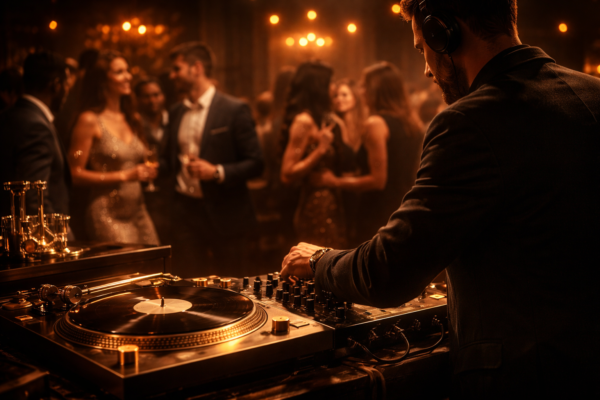
Stereo gives you playback. Surround gives you placement, depth, and better control over how the experience unfolds.
The Core Concept From Stereo to Surround Sound
A planner hears the difference straight away during speeches. With a standard left-right setup, guests near one side of the room often get too much of one speaker and not enough of the other. The result is familiar in hotel ballrooms and marquees across the UK. Music feels wide enough, but spoken word can lose its centre and drift.
With surround sound speakers, the system stops asking two boxes to cover every job. Audio is split into channels with clear roles, so speech, music, ambience, and low end can each sit where they make the most sense in the room.
Stereo gives you a stage. Surround gives you a room
Stereo builds an image across the front. In a well-behaved venue, that works nicely for DJ playback and general background music. In temporary event spaces, where speaker positions are dictated by décor, access, or awkward room shape, stereo often has to compromise.
Surround gives you more control because each channel carries a different part of the job.
- Front left and right carry the main musical content and left-right image.
- Centre keeps key information fixed in the middle, especially speech, vocals, and presenter audio.
- Surround channels carry atmosphere, reverb returns, playback effects, and movement.
- Subwoofer handles bass and low-frequency impact.
That division defines the shift from stereo to surround. The benefit on the night is control, not novelty.
Why the centre channel earns its place
For event work, the centre channel is usually the first reason to consider surround at all. If the client has speeches, awards, video playback, stings, or any moment where words matter, anchoring that content in a dedicated speaker makes the result more consistent across the room.
Dolby’s speaker setup guidance explains the centre speaker’s role as anchoring dialogue to the screen and stabilising the front soundstage in multichannel systems: https://www.dolby.com/about/support/guide/speaker-setup-guides/. The principle carries over well to events even when there is no cinema screen involved. A lectern mic, VO track, or branded video benefits from the same fixed point.
That matters even more in wide rooms where guests are seated off-axis.
If guests can hear that someone is speaking but have to strain to catch the words, the rig is doing half the job.
A centre speaker is not magic. It needs proper level matching and sensible placement. Done badly, it just adds another source of confusion. Done properly, it holds the message together while the left and right speakers keep the music open.
Each speaker needs a defined job
Good surround in event spaces is disciplined. It is not sound thrown into every corner for the sake of saying the event had immersive audio.
Here is the practical version:
| Setup element | What it contributes in practice |
|---|---|
| Front channels | Main musical image, impact, and forward energy |
| Centre channel | Clear speech, stable vocals, and stronger focus |
| Side or rear surrounds | Atmosphere, motion, and a sense that the room is active beyond the stage end |
| Subwoofer | Weight, warmth, and physical low-end energy |
This is also where some event teams get caught out. A surround rig can improve clarity and immersion, but it also adds more points of failure, more cabling, and more tuning time. In a venue with tight load-in, a hard curfew, and guests seated around the perimeter, that trade-off has to be worth it.
What event planners should take from this
The move from stereo to surround is a move from simple playback to sound placement. That gives DJs, production teams, and planners more ways to shape how the room feels at each stage of the event.
For straightforward music in a small, friendly room, stereo may still be the better call. For ceremonies, presentations, branded content, and parties where the brief includes immersion as well as volume, surround gives you better tools to keep speech stable, music spacious, and the whole event more intentional.
Decoding Surround Sound Formats 5.1, 7.1, and Atmos
The format decision usually gets made while the room is still half empty, the florist is dressing the tables, and the client wants to know whether the audio will feel special or just loud. That is the right moment to be practical.
For event work, 5.1, 7.1, and Atmos are not status labels. They are deployment choices. Each one changes how much kit you bring, how long you need to tune it, and how reliably it will perform in a ballroom, marquee, or listed venue that was never designed for immersive playback.
5.1 for most weddings and corporate events
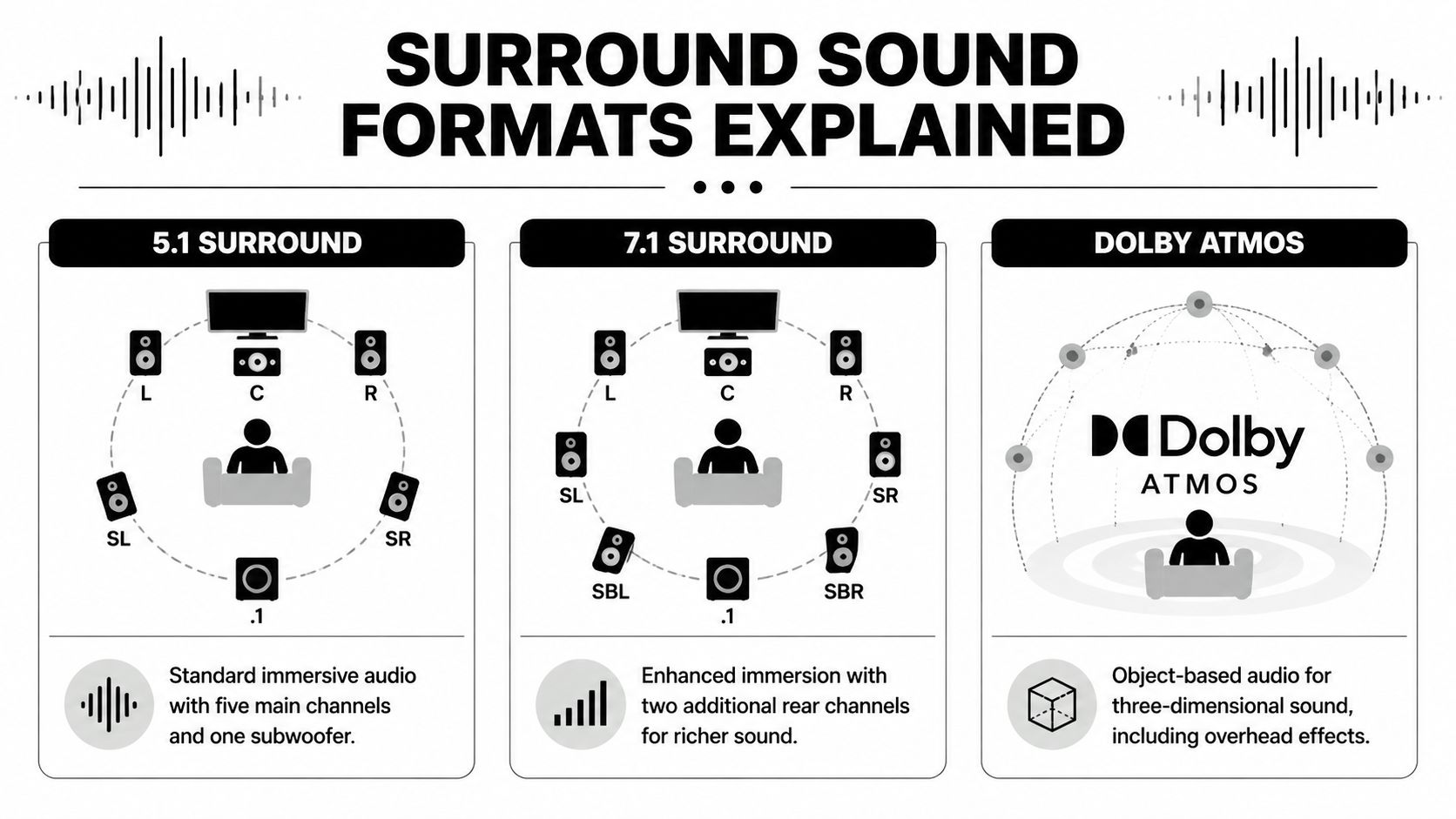
5.1 is still the working format I would choose first for many event jobs. You get left, centre, right, two surround channels, and a subwoofer channel handling the low-frequency effects. In practice, that gives you enough control to keep speeches anchored at the front, spread music wider through the room, and add atmosphere behind the audience without overcomplicating the load-in.
The layout is manageable in temporary spaces. Front speakers cover the main audience area. Surrounds sit to the sides or slightly behind the listening zone, high enough to avoid firing straight into the nearest row. The sub carries the weight. For weddings, awards nights, and product launches, that is often the sweet spot between impact and setup time.
It also suits how UK events run. Access windows are tight. Cable routes are rarely ideal. Furniture plans change after soundcheck. A well-planned 5.1 system gives you a clear surround effect without turning the day into an engineering exercise.
Why 5.1 holds up in temporary venues
Temporary venues punish overcomplicated designs. A system can look perfect on paper and still become awkward once the dance floor shifts, the stage moves 2 metres, or the venue refuses a cable run across a fire exit.
That is where 5.1 earns its keep. It is easier to trim, easier to troubleshoot, and more forgiving when the room is asymmetrical. You still need proper alignment, sensible crossover settings, and level control between the front and surround channels. Get those basics right and 5.1 sounds deliberate rather than gimmicky.
Low end is usually the part that catches teams out. In one room the bass feels tight. In the next, it bunches up under a balcony or vanishes at the bar. The answer is not a fancier format. It is better placement, measurement, and restraint.
A short explainer is useful here if you want a visual primer before getting into room planning:
7.1 when you want more wraparound effect
7.1 adds two more surround channels, which gives you better rear definition and smoother movement around the audience. In the right room, that extra pair helps the back of the sound field feel more continuous instead of vaguely pooled behind the crowd.
I would use 7.1 where the immersive effect is part of the brief, not just a nice extra. Brand launches, fashion events, dramatic walk-ins, and music-led parties with designed playback content can all benefit. If you are trying to place effects, textures, or transitions around the room with more precision, 7.1 gives you more to work with than 5.1.
There is a price for that control. You need more amplifier channels, more outputs from the processor, more speaker positions to get right, and more time to balance the rear image so it supports the event instead of distracting from it. In a venue with a short setup window, those trade-offs matter more than the format name.
Choose 7.1 when these conditions apply
- The room is large enough for separate side and rear information to be heard clearly.
- The content has been built for surround movement, such as launch films, dramatic intros, or spatial DJ edits.
- You have proper system control, including enough outputs, amps, and tuning time.
- The rear speaker locations are usable, with safe cable runs and sensible sightlines.
If those conditions are missing, 7.1 can become expensive clutter. A tidy 5.1 rig usually beats a rushed 7.1 deployment.
More channels expose weak system design faster than they improve it.
Atmos for premium experiential work
Atmos gets attention because clients recognise the name. The useful part is not the badge. It is the object-based approach, which lets sounds move in a three-dimensional space instead of being tied only to fixed channels.
For premium experiential work, that can be brilliant. Overhead movement, height effects, and precise sound placement can make an entrance sequence, branded moment, or immersive performance feel distinctly different from a standard surround setup.
It also asks much more of the venue and crew. You need suitable rigging or speaker positions above the audience, reliable processing, accurate timing, and a room that will support the effect instead of smearing it with reflections. In many temporary spaces, those conditions are hard to get.
That is why Atmos is not the automatic top-tier choice for events. In a clean, controlled environment with the right budget and enough prep, it can be spectacular. In a hotel suite with a low ceiling and a two-hour install, a disciplined 5.1 or 7.1 system will usually deliver a better result on the night.
Choosing the Right Speakers for Your Venue
The speaker choice usually gets tested five minutes after guests walk in. The planner wants clear speeches at the front, the client wants the room to feel bigger than it is, and the dancefloor still needs weight later on. In event work, the right boxes are the ones that keep control in a difficult room and still sound good once the venue fills up.
A speaker that flatters a demo room can turn awkward fast in a hotel ballroom, a listed hall, or a marquee on uneven ground. For UK events, I rate predictability higher than showroom polish. Gear needs to go up quickly, tune without drama, and behave once bodies, tables, drapes, and glass all start changing the room.
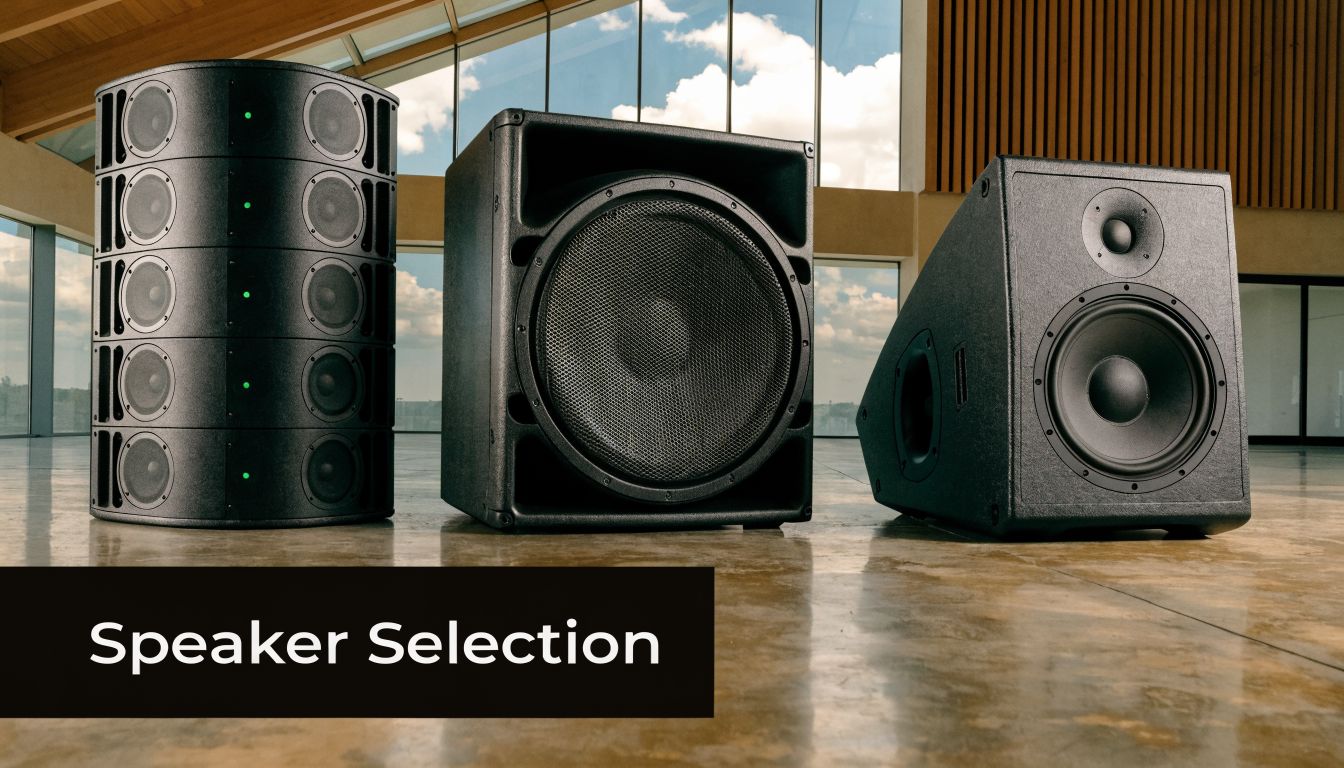
Start with coverage, not brochure language
Coverage decides whether surround feels immersive or messy.
For event spaces, I look at how evenly a speaker throws across the audience area, how well it keeps energy off problem surfaces, and whether its voicing stays listenable over a long day. Spec sheets matter, but only if they answer practical questions:
- Dispersion decides how much of the room gets useful sound and how much gets splash off walls and ceilings.
- Sensitivity affects how much level you get before the system starts feeling strained.
- Power handling only means something if the amp and processing are matched properly.
- Cabinet voicing affects fatigue. A box that sounds hyped in a short demo can become hard work during a wedding breakfast, awards dinner, and full evening party.
Front channels need consistency first. If the tonal balance shifts wildly from the middle of the room to the edges, music loses impact and spoken content loses focus. Surround channels have a different job. They usually work best when they spread cleanly and draw less attention to their exact location.
Match the speaker to the job it has to do
Trying to use the same speaker everywhere can make a temporary setup harder than it needs to be. In fixed cinema rooms, symmetry is easier to protect. In live events, you are often working around bars, draping, floral installations, projection screens, fire exits, and doors that staff need all night.
Front stage speakers
These carry the event. They need enough authority for music, enough detail for speech, and enough control to avoid tearing people’s heads off in the front third of the room.
For weddings and presentation-heavy corporate events, I would rather have a controlled, articulate top end than raw output. For parties, the same system still needs punch in the low-mids so the set has drive before the subs take over. If you want a visual sense of the kind of polished event setup clients respond to, this premium event sound system look and feel is closer to the brief than a hi-fi style surround diagram.
Surround speakers
Surround boxes should widen the experience, not keep reminding guests where they are hung. Smaller cabinets with sensible coverage often do the job better than oversized point-and-shoot speakers. In a corporate party or immersive brand event, I want the rear and side information to support movement, atmosphere, and detail without pulling focus from the main system.
Subwoofers
Low end is where plenty of surround event rigs lose discipline. One badly placed sub can drag the image to one side and make the whole system feel disconnected. Two well-managed subs in sensible positions usually beat one giant box forced into the only spare corner.
Amplification and headroom are part of the speaker choice
Speaker selection includes the amp channels, DSP, and processing time. Surround falls apart quickly when the electronics are under-specified. The effect is easy to hear on site. Rear channels start to harden up, timing feels less convincing, and the room stops feeling wrapped in sound.
As noted earlier, adding more channels only pays off if the system stays stable at event level. I have seen expensive speaker packages sound smaller than a modest rig because the amplifiers had no real headroom once the room filled and the DJ pushed the set on.
Active speakers can simplify this. Passive systems can still be the better option in larger or more bespoke builds where amp racks and processing are already part of the plan. The trade-off is labour and control. Active rigs save time and cable complexity. Passive rigs often give you more flexibility when you need to integrate surround feeds, live inputs, delays, and zone control in one package.
A simple venue-led decision filter
| Venue type | Speaker priority | Common mistake |
|---|---|---|
| Hotel ballroom | Controlled dispersion and speech clarity | Choosing boxes that are too aggressive for the front rows |
| Marquee | Even coverage and disciplined bass management | Assuming the fabric structure will somehow sort out the low end |
| Historic hall | Smooth voicing and careful level control | Letting the room’s reverberation smear speech and effects |
| Corporate event space | Fast deployment and clean integration with DJ kit, mics, and playback | Adding more channels than the schedule or crew can support |
Choose the speaker that solves the room and suits the event schedule.
If you are hiring rather than buying, ask the supplier three things. How does the system behave in awkward rooms, how quickly can it be tuned, and who is handling playback, processing, and fault-finding on the day. Those answers tell you far more than a glossy product page.
Placement and Room Acoustics for Events
Most surround diagrams assume a tidy, rectangular room with fixed seating and perfect symmetry. Event work in the UK rarely gives you that.
You’re more likely to be dealing with a narrow venue in London, a function room with one hard wall and one curtain wall, or a wedding space where the furniture layout changes twice in one day. Placement still matters in those rooms. You just have to treat the guidelines as principles, not commandments.
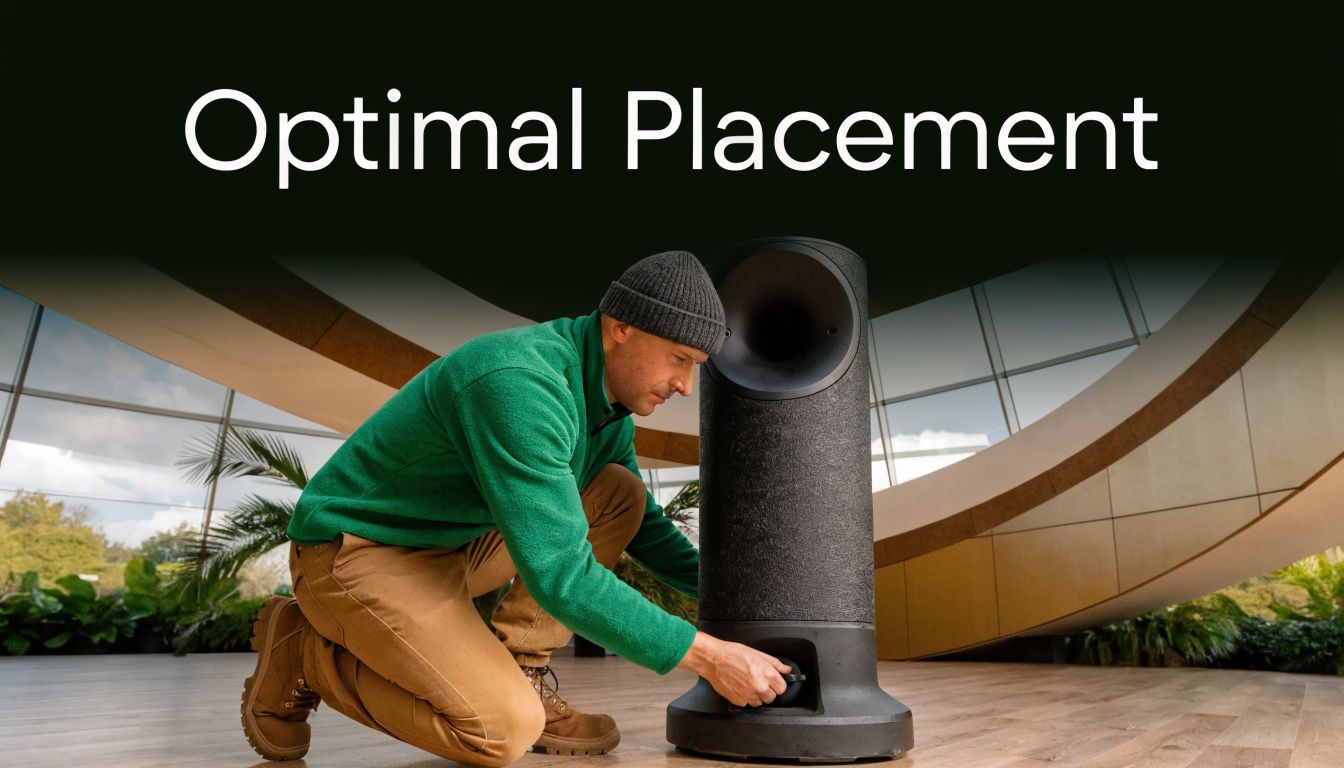
Small and awkward spaces need adjusted angles
Generic home cinema advice often falls short regarding one neglected issue: adapting speaker placement for compact UK spaces where boundary interference is common.
In London venues under 70 sqm, 42% report echo or muddied sound, and simple adjustments such as angling front speakers at 60° or using foam bass traps can reduce unwanted reflections by up to 30%, according to this placement-focused guide for surround speaker positioning.
That matters because many event spaces aren’t large enough to follow idealised wide-angle layouts without pushing speakers too close to walls. In those rooms, the cleaner solution is often to narrow the front angle slightly and prioritise coherence over textbook geometry.
What works in real venues
Here are the adjustments that tend to pay off fastest in temporary spaces:
- Pull front speakers off the wall when you can. Even a modest gap can reduce smear and make speech easier to follow.
- Avoid corner-loading the sub by default. Corners can exaggerate bass and turn one-note low end into a problem.
- Keep surrounds above direct ear line but not excessively high. You want space and diffusion, not obvious localisation.
- Aim for balanced arrival, not visual symmetry. If one side of the room is awkward, timing and level correction matter more than perfect visual matching.
Different room types, different compromises
Glass-walled or polished spaces
These rooms sound bright quickly. Hard reflections make upper mids and speech feel edgy.
Use softer toe-in on the fronts and avoid firing directly across glass where possible. If temporary treatment is allowed, even modest softening can help.
Marquees
People assume marquees are easy because the walls are soft. They aren’t. The low end can become vague, and top-end detail can disappear depending on the lining and occupancy.
High-ceiling halls
These venues can sound gorgeous or chaotic. If you let too much energy fly upward, clarity drops and timing gets messy.
In difficult rooms, the best placement is usually the one that preserves intelligibility first and spectacle second.
Build zones, not just a dance floor
A strong event layout often uses surround sound speakers to create more than one experience in the same venue. The dance floor needs punch and movement. Dining and lounge areas need enough presence to feel connected without making conversation hard.
That’s easier when the system is planned as a set of zones rather than one blunt wall of sound. This event setup visual reflects the wider point. Good event audio supports the feel of the whole room, not just the loudest part of it.
A quick placement sense-check
| Problem in the room | Likely cause | Practical adjustment |
|---|---|---|
| Muddy speech | Early reflections and poor front focus | Tighten front angle and re-aim centre coverage |
| Boomy dance floor | Sub interacting badly with boundaries | Move sub position and retune crossover |
| Surrounds too obvious | Rear boxes too low or too hot | Raise slightly and reduce level |
| Dead patch in the room | Coverage mismatch | Reposition fills or adjust channel delay |
Perfection isn’t the goal in event work. A controlled compromise is.
Integrating Surround Sound with DJ and Live Setups
A surround system only becomes useful at events when it works with the performance setup, not against it. That means signal flow has to stay tidy, transitions have to stay reliable, and the creative use of extra channels has to serve the room.
For DJs, the obvious mistake is treating surround as if it should carry the full main mix equally everywhere. It shouldn’t. The front of the system still needs to hold the musical core. The extra channels are there to add dimension, atmosphere, and better room management.
Where surround helps a DJ set
A surround-capable rig can do several jobs at once without feeling messy:
- Atmospheric support for intros, walk-ins, ceremony moments, and branded stings.
- Rear reinforcement that gives the dance floor more wrap without making the front painfully loud.
- Separate mood in adjacent areas so the room stays connected while guests can still talk away from the floor.
- Smarter low-end control for funk, disco, and house, where groove falls apart if the crossover is wrong.
That last point matters more than many DJs realise. The usual blanket advice around crossover points doesn’t always fit UK rooms. A more contrarian but practical view is that, in small to medium Kent and London venues, a 100-150Hz crossover is often needed to prevent subwoofer localisation and energy dips in funk mixes, especially with regional acoustic quirks in damp South East England. Newer correction tools such as Dirac Live Room Correction v4, launched in October 2025, are helping professionals auto-adjust for those conditions, as noted by What Hi-Fi? on room correction and crossover challenges.
Keep the routing realistic
Most DJ mixers and controllers are still designed around stereo output. To use surround properly, you need a processor or playback system that can route content intentionally to multiple channels.
That doesn’t mean every event needs complex live spatial mixing. Often the best use is selective:
- Keep your main programme strong in the front channels.
- Feed ambience, effects, or curated support content to surrounds.
- Tune delays carefully if the room is long.
- Protect the centre image for anything speech-led.
If the event also includes a live act, spoken content, or video playback, the processor becomes even more important. That’s where good planning saves headaches.
Think audio and lighting together
Immersion works best when sound and lighting support each other. If you’re designing a room with movement in the audio field, it helps to think about how the visual cues reinforce that movement. A useful outside reference for that broader event-design mindset is ABC Hire lighting solutions for events, particularly when you’re coordinating audio energy with wash, accent, and dance-floor looks.
And if you’re shaping the booth area as part of the event experience, this DJ booth image captures the balance well. Performance gear should feel integrated into the event, not dropped into it.
The best surround setup for a DJ is the one the crowd feels, not the one that distracts the DJ from mixing.
A Practical Checklist for Your Next Event
When you’re hiring or specifying surround sound speakers for an event, run through these questions before you commit to a format or speaker package.
Ask these before you book the system
-
What’s the main purpose of the audio
Is the focus speeches, ceremony ambience, dinner music, a full dance floor, or a mix of all four? A system that excels at speech-led clarity isn’t always the one you’d choose for a late-night party.
-
How awkward is the room
Look for glass, alcoves, low ceilings, balconies, curtains, bare floors, and odd room proportions. These shape the result more than brand names do.
-
How much time is there for setup and tuning
Surround only pays off if there’s enough time to place, route, and calibrate it properly. If access is tight, simpler may be better.
-
Does the event need immersion or just coverage
Some events benefit from atmosphere and movement. Others need only even, clean sound across the room.
Check the system itself
-
Speaker roles are clear
Front, centre, surround, and sub should each have a job. If every box is doing everything, something usually gets muddy.
-
Amplification has headroom
Don’t accept a channel count upgrade if the amp package is the weak point.
-
Cabling and placement are practical
A beautiful surround plan that blocks service routes or creates trip hazards won’t survive contact with a live event.
-
Bass strategy is sensible
Ask where the sub will go and how crossover will be tuned for the actual room.
Final decision filter
If the system improves clarity, atmosphere, and control without overcomplicating the event, it’s probably the right one. If it adds gear but not usable results, it isn’t.
Frequently Asked Questions
| Question | Answer |
|---|---|
| Can I use home surround sound speakers for a professional event? | Sometimes for a very small private setting, but it’s rarely a good idea. Event use demands sturdier cabinets, reliable amplification, faster setup, and better control in imperfect rooms. |
| Is 5.1 enough for most events? | Often, yes. For many weddings and corporate events, it gives a strong immersive effect without adding too much setup complexity. |
| When is 7.1 worth it? | When the event is music-heavy, the room is large enough to support the extra rear channels, and you have the processing and amplifier headroom to do it properly. |
| Do wireless rear speakers make sense at events? | They can, especially where cable runs are awkward, but reliability comes first. Any wireless element should be tested in the actual venue conditions. |
| Does surround make speeches clearer? | It can, especially if the system includes a properly used centre channel and sensible tuning. |
| Is Atmos necessary for a premium event? | Not always. A well-executed 5.1 or 7.1 setup often delivers a better real-world result than a compromised Atmos layout. |
If you’re planning a wedding, party, or corporate event and want sound that feels polished rather than generic, VinylGold delivers customized DJ experiences across London and Kent with the same focus this guide has argued for throughout: clear planning, reliable gear, and music that fits the room as well as the crowd.