

You’re probably looking at a stack of copies right now. One has a black Harvest label. Another is a heavy modern reissue. Another seller swears theirs is a “first press” but the sleeve looks too crisp and the price feels just high enough to make you nervous.
That’s the problem with pink floyd dark side of the moon vinyl in the UK. It’s one of the easiest classic albums to find, and one of the easiest to buy badly.
This record rewards careful buyers. It also punishes rushed ones. Pressing details matter, condition matters, and your reason for buying matters too. A collector chasing a proper early UK copy should shop differently from someone who wants a clean-playing version for regular listening, and differently again from a DJ who needs stability, low noise and a copy they won’t panic over handling.
An Eternal Echo The Enduring Legacy of Dark Side of the Moon
Walk into any decent record shop in Britain and you’ll see why this album confuses buyers. There isn’t just one Dark Side of the Moon. There are originals, later UK pressings, anniversary editions, heavyweight reissues and copies that look promising until you inspect the dead wax.

The reason people keep hunting it isn’t nostalgia alone. Nearly 52 years after its March 1973 release, The Dark Side of the Moon was approaching 1,000 weeks on Billboard’s Top Album chart as of January 7, 2026, and its global sales were estimated at more than 45 million copies according to AXS TV’s report on its chart run. Few records stay culturally alive across vinyl, cassette, CD, downloads and streaming in quite that way.
Why vinyl still makes the most sense
This album was built as a complete listening experience. Side breaks matter. Sequencing matters. The way tracks bleed emotionally into one another matters. On vinyl, you hear the album as an object and a performance, not just a playlist.
Its themes still land because they’re not locked to one era. Time, money, pressure, mortality and mental strain aren’t period details. They’re the reason younger listeners still find it, and older listeners keep returning to it.
Practical rule: If you only want a song or two, stream it. If you want the full argument of the record, buy the LP and play it front to back.
The UK angle matters
British buyers often get generic collecting advice copied from US forums. That’s not enough for this title. UK pressings, UK sleeves, UK provenance and UK market values all shape what counts as desirable here.
If part of your enjoyment comes from hearing the music performed live as well as owning the record, it’s worth finding the best Pink Floyd tribute bands so you can compare how different players handle the same material. That sharpens your ear for what the album itself does so well on vinyl.
The Prism’s First Light A History of Key Pressings
The album’s pressing history matters because buyers often assume age alone equals value. It doesn’t. With Dark Side, the story is more layered. Some copies are prized because they’re early. Others because they’re sonically useful. Others because they’re complete, clean and easy to enjoy.
The 1973 UK starting point
The key origin copy for British collectors is the original UK Harvest SHVL 804 issue. That’s the record many people still mean when they say they want the original. It was made for the market where the band’s identity was already rooted, and it remains the benchmark many later copies are judged against.
That UK importance isn’t just collector folklore. The Dark Side of the Moon reached 15x Platinum in the United Kingdom, equal to 4,500,000 copies sold in the region as of November 26, 2021, making the UK its second-largest market after the US, according to bestsellingalbums.org’s certification summary. That scale of demand helps explain why so many UK variants exist, and why British buyers still need pressing-level precision.
How the album moved through formats and eras
The original issue arrived in an era when the LP was still the centre of home listening. As playback habits shifted, the album didn’t fade. It migrated with listeners.
That long life produced several types of vinyl buyer:
- The purist wants an early UK copy with period-correct sleeve and inserts.
- The listener wants a clean, balanced reissue that plays well on a modern setup.
- The crossover collector wants both. One copy for preservation, one for use.
- The event DJ usually wants reliability over romance.
Why later reissues still matter
A lot of older advice dismisses reissues too quickly. That’s a mistake. Not every buyer needs the anxiety of chasing an early copy at collector prices. Good reissues can deliver a satisfying listen, a quieter surface and less fear every time the stylus drops.
The important thing is context. An original UK pressing carries historical pull, collectable details and a distinct aura. A later remaster may give you cleaner handling, easier replacement and less surface distraction.
The wrong question is “Which pressing is best?” The right question is “Best for what?”
The anniversary cycle changed buying habits
As the album passed major anniversaries, reissue campaigns brought it back into shops for a new generation. That widened the market. It also muddied it. Sellers started calling later editions “vintage”, and buyers who knew the cover art but not the pressing details began paying premium money for ordinary copies.
In practical terms, the history of Dark Side isn’t a neat ladder where each newer edition replaces the one before it. It’s a branching path. UK first pressings sit at one end as collector targets. Clean modern editions sit elsewhere as dependable listening copies. Between them are decades of variants that can be worthwhile, but only if you know why you’re buying them.
The Collector’s Code Identifying Original UK Pressings
If you want an original UK copy, treat the hunt like verification work, not treasure mythology. Sellers often say “first press” when they mean “old”. Those are not the same thing.
The core target is Harvest SHVL 804. In the UK market, near-mint original first pressings average £250-£450, with matrix variants such as A2/B1 attracting premiums, and 47 Discogs UK sales between January 2025 and March 2026 averaged £312, up 15% year-on-year, according to the cited market summary at this video source. That’s enough money to justify slowing down and checking every part of the package.
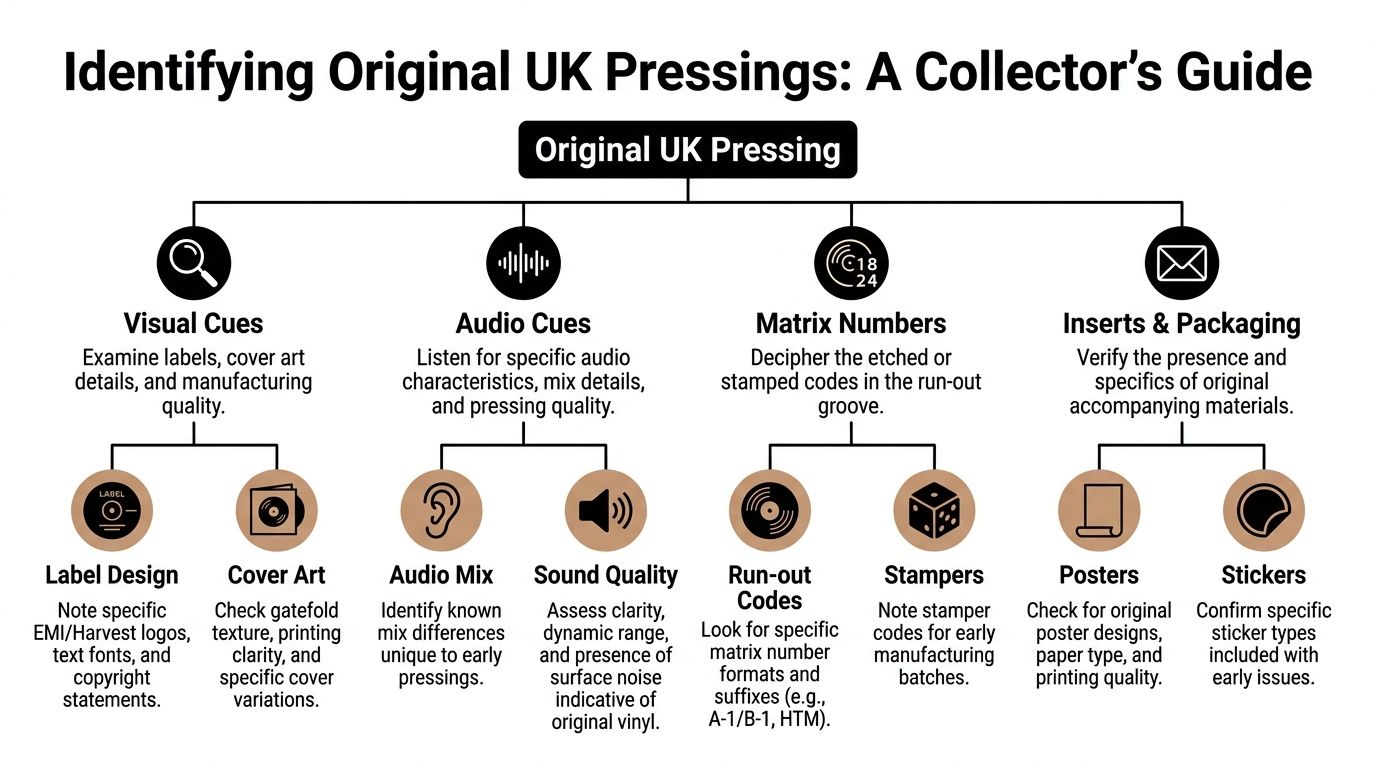
Start with the label and catalogue number
The label is your first filter, not your final proof.
Look for:
- Catalogue number SHVL 804 on the record and sleeve.
- Harvest branding consistent with an early UK issue.
- The solid light-blue prism label, which collectors watch closely because later changes altered the look.
A correct-looking label gets a copy into the conversation. It doesn’t close the case. Labels can mislead, especially if you’re inspecting in dim light at a fair.
Dead wax tells the truth
Runout grooves matter because they’re harder to fake convincingly in a casual sale. You want the matrix details to line up with an early UK pressing, and you want them to make sense with the rest of the package.
Key checks include:
- Read both sides carefully. Don’t rely on a seller’s transcription.
- Look for matrix combinations collectors recognise, including examples such as A2/B1.
- Check for runout text and etchings. Guidance around markings such as “THE POSTAL SERVICE / MADE IN GT BRITAIN” is often missing from generic listings.
- Make sure sleeve, labels and matrices belong together. A swapped record inside a convincing sleeve is one of the commonest collector headaches.
Bring a torch or use your phone light at an angle. Dead wax details disappear fast under market hall lighting.
Sleeve, posters and stickers
A genuine early UK copy isn’t just the disc. The package matters, and incompleteness affects both value and confidence.
Inspect these parts separately:
- Gatefold sleeve. UK copies can show lighter, flimsier cover stock than some buyers expect, especially if they’re used to thicker US sleeves.
- Posters. Check paper quality, print sharpness and fold wear that looks age-consistent rather than artificially distressed.
- Stickers. Originals add credibility when they match the rest of the copy’s wear profile.
- Spine and seams. Heavy damage doesn’t prove age. It may prove poor storage.
A quick field checklist
When you’re standing at a stall, use this order:
| Check | What you’re looking for | Why it matters |
|---|---|---|
| Catalogue | SHVL 804 | Confirms you’re in the right family of UK pressings |
| Label | Early Harvest presentation and blue prism style | Helps separate early copies from later variants |
| Matrix | Early UK runout combinations such as A2/B1 | Strongest evidence of pressing identity |
| Inserts | Original posters and stickers | Completeness affects collectability |
| Sleeve | Period-correct UK gatefold traits | Helps spot mismatched or rebuilt copies |
The smartest move in the room is often walking away. If a seller won’t let you inspect the runout, or talks more about “rare” than specifics, keep your money in your pocket.
Hearing the Difference Sound Mastering and Vinyl Quality
Two copies of Dark Side can look similar from across the room and behave very differently on a turntable. That’s why buyers who care about sound need to think beyond pressing date and collector status.
The original UK pressing of Harvest SHVL 804 measures DR10-DR11, and that dynamic range is preserved across later UK-region remasters including the 2016 edition and the 2023 50th Anniversary Remaster LP, according to the technical review at Magic Vinyl Digital. That tells you something important straight away. Later versions didn’t crush the life out of the record.
What an original UK pressing tends to sound like
A strong early UK copy has the sort of presentation many collectors chase instinctively. It feels direct, textured and grounded through the midrange. Effects land with weight, and transitions can feel more physical than polished.
That doesn’t mean every original beats every reissue. Condition changes everything. A worn “collectable” original with groove damage will lose to a clean modern cut every time in actual listening pleasure.
What the 2016 and 50th Anniversary cuts do differently
The later remasters tend to feel more controlled. The cited review notes a fuller bass response from the 2016 cut and positions the 50th Anniversary gatefold edition as especially practical for event use because its 180g pressing offers low-noise floors and warp resistance.
That translates into a simple real-world trade-off:
- Original UK copy for character, history and collector appeal.
- Modern 180g reissue for cleaner playback, easier handling and less anxiety.
For domestic listening on a revealing system, that can come down to taste. For event use, practicality usually wins.
The DJ and system-matching question
Not every record that sounds wonderful in a quiet room behaves well in a live setting. DJs care about cueing confidence, stable tracking and how a record sits in a wider set.
If you’re using modern gear and care about predictable playback, a clean recent copy is usually the sensible option. If you want a visual nod to that world, this DJ booth image captures the kind of environment where low noise and physical stability matter just as much as romance.
Here’s how I’d frame the main use-cases:
For pure listening at home
Choose the copy that gives you the best combination of mastering and condition within budget. If a seller offers an early UK pressing with trustworthy grading and complete inserts, that’s the emotionally satisfying route. If not, a recent remaster can be the better sonic buy.
For regular casual play
A modern copy makes more sense. You’ll play it more freely, worry less about sleeve wear, and still hear the scale of the production.
For events and DJ work
The cited review clearly favours the 50th Anniversary gatefold edition for event settings because of its low-noise floor and warp resistance. That’s the sort of practical detail that matters under warm room conditions and repeated handling.
Buy your collector copy with your heart. Buy your playing copy with your hands.
What doesn’t work
Some buyers split the difference badly. They pay collector money for a merely decent older copy, then treat it like a utility record. That’s the worst of both worlds.
Another common mistake is assuming heavier vinyl automatically means better sound. Weight can help with handling and stability, but mastering and pressing quality still decide whether the record is enjoyable.
A final point. Dark Side is full of quiet passages, effects and long decays. That means surface noise exposes itself quickly. On this album, “plays fine” often means “annoying once the room goes quiet”.
A Buyer’s Guide to Value Price and Condition
Price only makes sense when you tie it to pressing, condition and completeness. Too many buyers focus on the first word in a listing, such as “original”, and ignore the last useful facts, such as sleeve splits, missing posters or spindle wear.
For UK buyers, the strongest hard pricing data in the source material sits around original first pressings. Those copies average £250-£450 in near-mint condition, with the already-noted Discogs UK average at £312 across the logged sales in that period. Everything below that top tier needs judgement rather than blind trust.
Condition changes the whole conversation
A near-mint original and a very good plus original are not emotionally the same object. One feels like stewardship. The other feels like ownership with compromise.
Use these value rules:
- Play grade matters as much as visual grade on this album because quieter passages expose defects.
- Completeness matters. Missing posters or stickers make a difference.
- Sleeve honesty matters. A superb disc in a tired sleeve may still suit a listener, but not a collector paying top-end money.
- Seller vocabulary matters. “Looks unplayed” is not a grade.
If you want a broader framework for thinking about collectable record pricing, it helps to learn how others value your vinyl collection before applying those habits to Floyd.
UK Market Value for Dark Side of the Moon Vinyl 2026 Estimates
| Pressing | Condition (Near Mint) | Condition (Very Good Plus) | Notes |
|---|---|---|---|
| Original UK first pressing Harvest SHVL 804 | £250-£450 | Lower than near-mint, varies by completeness and play quality | Matrix variants such as A2/B1 may fetch premiums |
| Original UK first pressing average from logged UK sales | £312 average | Not specified in source data | Based on 47 Discogs UK sales in the cited period |
| Later UK pressings and modern reissues | Qualitative only | Qualitative only | Price depends heavily on exact edition, seller confidence and condition |
A visually rich listing can still hide the wrong purchase. This event image is a reminder that records live in real spaces. Light, handling and storage all shape how a copy ages.

What I’d pay for, and what I wouldn’t
I’d pay strong money for a verified UK first pressing with believable wear, correct inserts and clean runouts. I wouldn’t pay a premium for a seller’s enthusiasm.
I’d also avoid overpaying for “first press style” copies that have one attractive feature but not the full package. This title is too well-known to buy on hope.
Hunting for Treasure Where and How to Buy Safely
The safest place to buy depends on your risk tolerance. Online gives you reach. In-person gives you speed of judgement. Neither is safe if you skip the checks.

Buying online without getting stung
For pink floyd dark side of the moon vinyl, online buying only works when the seller provides enough evidence. You need more than a cover photo.
Ask for:
- Runout photos on both sides.
- Label close-ups under decent light.
- Front, back and inside gatefold images.
- Pictures of posters and stickers if they’re included.
- A play-grade description, not just “visually excellent”.
If the seller resists, move on. There will always be another copy.
A useful reminder of how branding and trust shape buying decisions sits even in something as simple as a record-service logo. Presentation matters, but proof matters more.

Buying in person at shops and fairs
Physical buying has one huge advantage. You can inspect before paying. Use that advantage properly.
Hold the disc by the edges and tilt it under direct light. You’re looking for hairlines, feelable scratches, hazing and signs of groove wear. Then inspect the sleeve for ringwear, seam splits and moisture damage.
Don’t let a famous title rush you. Common excitement leads to expensive mistakes.
A quick visual guide can help if you’re newer to physical inspection:
Red flags worth taking seriously
Some warning signs are small on their own, but stack up fast:
- “No time to check matrix numbers.” That usually means they know you should care.
- Over-cleaned sleeves with vague record photos. The package may be nicer than the disc.
- Mismatched wear. A battered sleeve with a “mint” disc deserves scrutiny.
- Stories instead of details. Provenance can be lovely, but it isn’t authentication.
The best purchases usually feel a bit boring in the moment. The seller answers clearly. The photos line up. The details are consistent. That’s exactly what you want.
Preserving the Masterpiece Care and Playback
Once you’ve bought your copy, the next job is not damaging it. This album has too many quiet moments to tolerate sloppy care.
Clean lightly and often
For day-to-day use, a carbon fibre brush is enough to lift loose surface dust before play. If you’ve picked up a copy from a market or a charity shop and the grooves look grimy, use a proper wet clean before the first spin.
Don’t over-handle the playing surface. Fingerprints become audible faster than many buyers expect, especially on records with quieter passages.
Store it like a collectable object
Always store the LP vertically, not flat in a stack. Use a decent inner sleeve and a protective outer sleeve to keep the gatefold artwork from scuffing.
Keep it away from heat sources and direct sunlight. Warps don’t care how rare the record is.
Playback setup matters
A worn stylus can turn a good copy into a damaged one. Make sure your cartridge is aligned properly and your tracking force is sensible for the setup.
If a record sounds harsh, mistracks or distorts, don’t assume the pressing is bad. Check your turntable first. Many supposedly “poor” copies are just being played on badly adjusted decks.
A valuable record doesn’t need precious ritual. It needs clean handling, sensible storage and a turntable that isn’t fighting it.
Frequently Asked Questions about DSotM Vinyl
Is the 50th Anniversary LP worth buying if I’m not a hard-core collector
Yes, for many buyers it’s the sensible choice. The source material notes that the 2024 50th anniversary remaster on 180g by James Guthrie offers cleaner stereo imaging for high-end systems, while UK tester forums reported that originals gave stronger immersion on setups such as Technics SL-1200s. In that cited poll, 12% preferred originals for live mixing due to punchier bass on “Money”, based on 150 responses, as referenced in the product-source material at the Pink Floyd shop listing.
If you want a clean, presentable copy that suits modern playback, it makes sense. If your main thrill is period authenticity, it won’t replace an early UK pressing.
Should I buy an original UK pressing as my only copy
Only if you’re comfortable with the cost and the care it requires. Many collectors are happier owning two copies. One original for collecting, one later issue for regular play.
That approach also removes the temptation to overplay an expensive copy just because it’s the one you’re proudest of.
How much should matrix numbers influence my decision
A lot, if you’re buying a copy represented as early and valuable. Matrix details are among the strongest checks you have against misdescribed stock.
If you’re only buying a listening copy, they matter less than condition and trustworthy mastering.
Are missing posters and stickers a deal-breaker
Not always. For a listener, missing inserts may barely matter. For a collector, they reduce desirability and should affect the price.
The key is paying the right money for the right level of completeness. Missing parts don’t make a record bad. They make it different.
Do original UK copies always sound better than remasters
No. A clean original can sound magnificent. A worn original can be disappointing. A good remaster can beat a damaged early copy with ease.
That’s why condition is never a side note on this title. It’s central.
Is this a good album for DJs to play out
It can be, but context matters. In a listening-led set, selected passages or transitions can work beautifully. In a busy party room, the practical choice is usually a stable, quieter modern pressing rather than a collectable original.
That’s especially true if you care about predictable cueing and low surface distraction.
If you’re building an event around records people love, not just tracks that fill silence, VinylGold is worth a look. The focus is on thoughtful DJing, strong sound, and music with personality for weddings, parties and events across London and Kent.