

When you’re dealing with digital audio, a coaxial cable audio connection is your secret weapon. It’s a single, robust cable that delivers a high-fidelity signal, built tough to shut out interference. Think of it as a shielded tunnel, getting your sound from the deck to the PA system without a single bit of corruption.
What Is Coaxial Audio and Why Should DJs Care
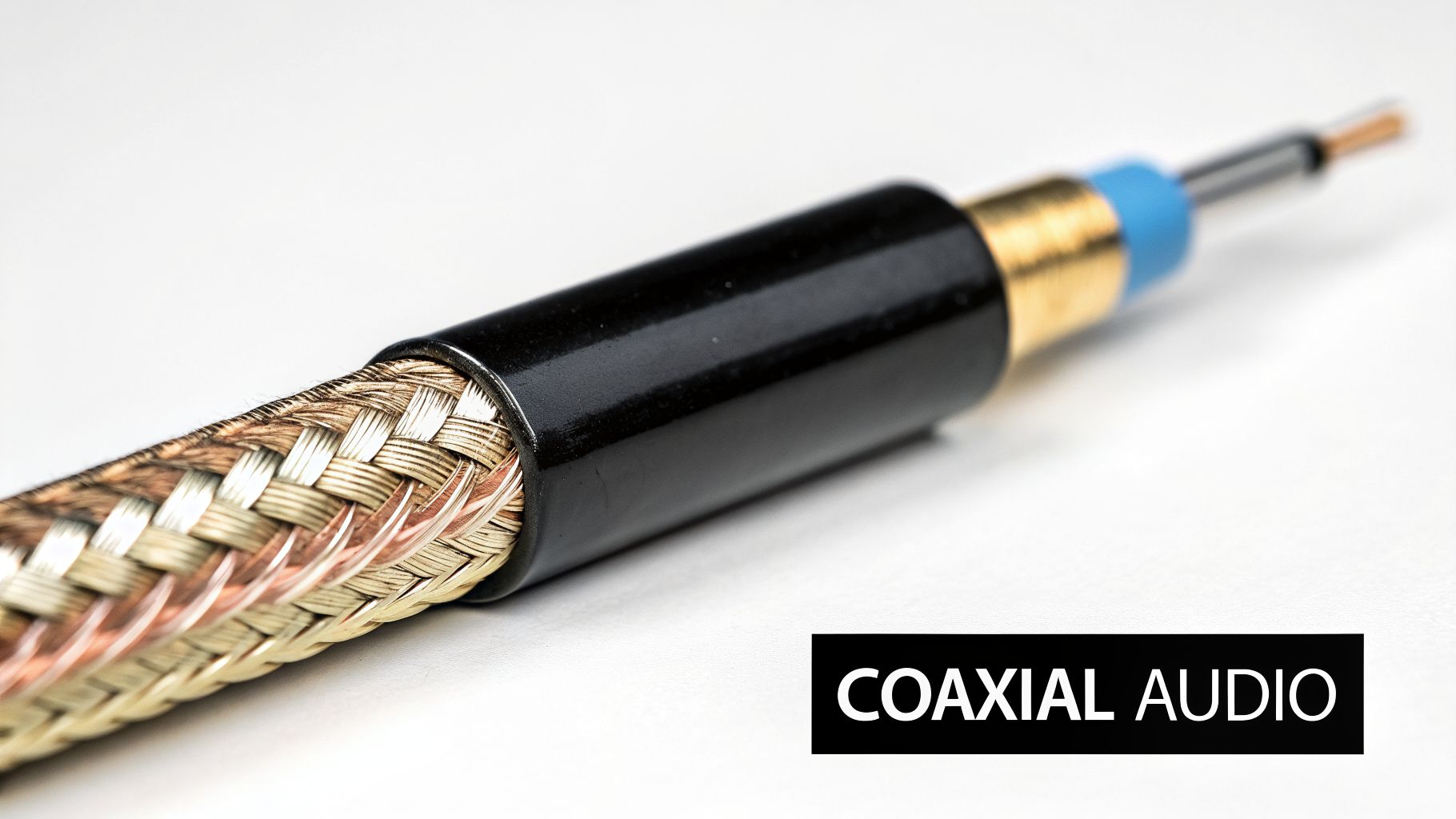
Picture your audio signal as a VIP that needs a secure escort from the booth to the amp. A coaxial audio cable is that security detail, creating a protected path that blocks out the noisy crowd of radio signals and electrical hum that can completely tank a set. For any DJ who cares about clean, pristine audio, this makes it an incredibly reliable choice.
At its heart, the cable’s design is all about defence. Its layered build is simple but brutally effective, with each part playing a key role in protecting the integrity of your sound. For a flawless performance at all kinds of events, from weddings to high-energy DJ parties, a solid coaxial connection is non-negotiable.
The Anatomy of a Coaxial Cable
The structure of a coaxial cable is brilliantly simple. It’s made of four distinct layers, all working together to keep your audio signal pure. Understanding how it’s built helps you appreciate why it’s such a trusted format in pro audio.
- Central Conductor: This is the core, usually a solid copper wire. It’s the highway your actual audio signal travels down.
- Dielectric Insulator: Surrounding the conductor is a layer of plastic foam. Its only job is to keep the core perfectly centred and isolated from the shield, which is crucial for preventing signal loss.
- Metallic Shield: A braided copper mesh wraps around the insulator, acting like a fortress. This is the part that blocks radio frequency (RF) and electromagnetic (EM) interference—the stuff that causes all that unwanted buzzing and humming.
- Outer Jacket: The final rubberised skin protects the whole assembly from physical damage. Think of all the times cables get stepped on, bent, or yanked at a gig. This layer takes the abuse.
By keeping the audio signal completely isolated, a coaxial cable stops the kind of degradation that can turn a crisp, punchy track into a muddy, lifeless mess. This protection is what makes it a staple in both home hi-fi setups and professional event production.
This tough construction guarantees that what you send from your controller is exactly what the crowd hears from the speakers. It doesn’t matter if you’re spinning laid-back tunes at a corporate event or pushing the bass at a packed club; the quality of your coaxial cable audio link is fundamental to a great set. If you’re looking for more ways to create incredible experiences, check out our guide on making music feel personal.

Right, let’s get into the nitty-gritty of what makes a coaxial audio cable tick. To really get it, we need to talk about two things that define its performance: S/PDIF and 75 Ohm impedance. These aren’t just specs on a box; they’re the rules that make sure your digital audio gets from A to B without getting mangled.
Think of S/PDIF (which stands for Sony/Philips Digital Interface) as the language your digital gear speaks. It’s a protocol that packages up stereo digital audio into a single stream of ones and zeros. This is how your CDJ, mixer, and amp stay perfectly in sync.
The Importance of 75 Ohm Impedance
Now, that S/PDIF signal needs a clean, clear motorway to travel down. That motorway is a cable built with 75 Ohm impedance. This specific electrical resistance is exactly what the S/PDIF standard was designed for, creating a perfectly matched system from end to end.
When the impedance matches, the digital signal flows smoothly. You don’t get any nasty signal reflections bouncing back down the cable. Those reflections are a kind of digital distortion that causes jitter—tiny timing errors in the digital stream. To your ears, jitter sounds like a loss of clarity, a flattened soundstage, or even audible clicks and dropouts.
Using a true 75 Ohm coaxial cable is like giving your audio a direct, private line. It ensures the timing of the digital ‘heartbeat’ stays rock-steady, preserving every last drop of detail and accuracy from the original recording.
The science here goes back further than you’d think. The core theory of coaxial transmission was patented way back in 1880 by English physicist Oliver Heaviside. Later experiments in the 1920s at Bell Labs refined the ideas of impedance matching and noise rejection. For a DJ spinning tracks at a wedding in Kent, this history means modern coax cables have the interference shielding needed to keep the sound absolutely pure. You can learn more about the origins of coaxial technology and how it all came together.
The Common Mistake: Using Standard RCA Cables
And here’s where so many people go wrong. A standard analogue RCA cable—the classic red and white ones—will physically plug into a coaxial digital port. But those cables are absolutely not designed with a 75 Ohm impedance.
Using one for a digital connection creates an impedance mismatch. It’s like forcing a three-lane motorway down a tiny country lane. The result is signal reflection and a compromised digital stream. Sure, it might “work” over short distances, but you’re actively degrading your audio quality.
To guarantee flawless coaxial cable audio performance, always, always check that your cable is explicitly rated for 75 Ohm digital use. It’s a small detail, but it’s the one that ensures your entire rig, from the controller to the speakers, performs exactly as the manufacturers intended.
Choosing Your Connection: RCA vs BNC Connectors
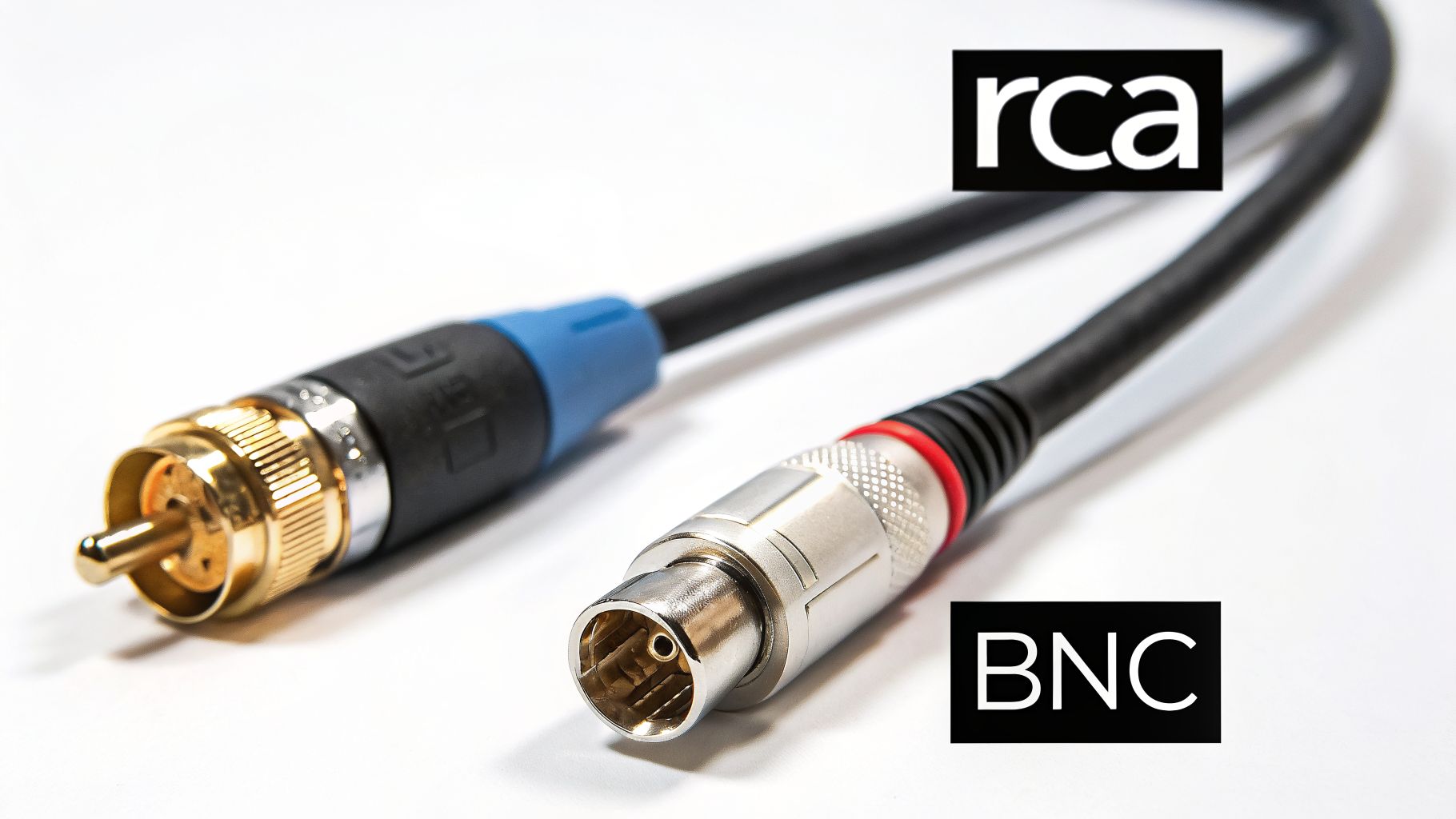
While the science inside a coaxial audio cable is pretty consistent, the part you actually plug in can be a different story. For digital audio, you’ll almost always run into one of two types: the familiar RCA plug or the pro-grade BNC connector.
Knowing the difference isn’t just trivia. For anyone running a live event or DJ set, it’s crucial for keeping your audio signal locked in and secure. One connector is all about convenience; the other is built for absolute, rock-solid reliability.
The Everyday Standard: RCA Connectors
If you’ve ever hooked up a home hi-fi, a games console, or most entry-to-mid-level DJ controllers, you know the RCA connector. It’s that simple push-in plug, and it’s become the default for consumer and prosumer gear. Its biggest advantage is that everyone knows it and it’s dead simple to use. No locking, no twisting, just plug and play.
For a static home setup or a small, controlled event, RCAs will do the job just fine. But that simple friction-fit design is also their greatest weakness in a pro environment. A stray foot, a tight cable pull, or even a vibrating stage can be enough to knock it loose. The result? A disastrous audio dropout right in the middle of your set.
The Professional’s Choice: BNC Connectors
Step into any broadcast studio or peek at the back of high-end event audio gear, and you’ll find BNC (Bayonet Neill–Concelman) connectors. They’re less common in home audio, but BNC is the undisputed king for professional digital connections where failure simply isn’t an option. Its secure locking mechanism is a game-changer.
The BNC connector’s quarter-turn locking system creates a robust physical connection that cannot be pulled out by accident. For a working DJ, this is essential insurance against signal loss during a live performance.
This design guarantees the connection maintains perfect electrical contact, even with heavy vibrations or cable movement. It’s exactly why you’ll see BNC used for mission-critical links, like connecting a high-end DJ mixer to an external word clock or linking video gear where signal integrity is everything.
To help you decide which connector is right for your rig, here’s a quick look at how they stack up.
RCA vs BNC Connector Comparison for Coaxial Audio
This table breaks down the core differences to help you choose the right coaxial audio connector for your DJ or event equipment.
| Feature | RCA Connector | BNC Connector |
|---|---|---|
| Connection Type | Push-in (Friction-fit) | Quarter-turn lock |
| Security | Low (can be pulled out easily) | High (securely locked in place) |
| Common Use | Home audio, consumer electronics, many DJ controllers | Professional broadcast, high-end event gear, test equipment |
| Best For | Static setups, home use, budget-conscious rigs | Live events, mobile DJing, mission-critical connections |
While a lot of your gear might have RCA connections, thinking about an upgrade to hardware with BNC inputs is a smart long-term move. It gives you peace of mind, knowing your crucial coaxial cable audio links are physically secure. That lets you focus on the mix, not on whether your cables are about to let you down.
Putting Coaxial Cables Into Action for DJs and Events
All this tech talk is fine, but where does a coaxial cable audio connection actually fit into your setup? For any DJ or event pro, building a clean and dependable signal path is everything. It’s the thin line between a flawless gig and a complete technical disaster.
Let’s walk through a couple of real-world situations where coaxial cables become the unsung heroes, keeping your audio pure all the way from the source to the speakers.
Scenario 1: The Wedding DJ Setup
Picture this: you’re behind the decks at a wedding, running a high-end controller like a Pioneer DJ DDJ-1000. A lot of gear in this class comes with a digital coaxial output for one simple reason—to preserve the best possible audio quality.
Your signal chain could look something like this:
- DJ Controller: The coax output sends a clean S/PDIF signal straight from the controller’s brain.
- Coaxial Cable: A proper 75 Ohm coaxial cable takes that digital stream and runs with it.
- DAC or Active Speaker: The cable plugs into a dedicated digital-to-analogue converter (DAC) or right into a premium active speaker that has its own coaxial input.
This approach completely sidesteps the controller’s built-in DAC, letting a superior, external unit do the heavy lifting of converting the signal to analogue. The result is a sound that’s noticeably cleaner and more detailed when it hits the PA system. That’s exactly the kind of clarity you need for those make-or-break moments, from the first dance to the last song of the night. You can see what we mean when you check out these golden vibes in the DJ booth.
Scenario 2: Large-Scale Event Audio
Now, imagine you’re running sound for a huge corporate event in a London ballroom or a stage at a music festival. Audio signals here have to travel serious distances, from the main mixing desk out to different amp racks and speaker arrays. Trying to run long analogue cables is just asking for signal degradation and noise.
In large venues, coaxial cables are essential for linking system components. They can run for considerable lengths without the significant signal loss or interference that plagues analogue connections, ensuring every speaker in the venue receives a perfectly synchronised, clean digital signal.
This ability to send a perfect signal over a long distance isn’t some new-fangled trick. Back in 1936, the General Post Office laid a pioneering coaxial line between London and Birmingham to carry 40 telephone channels at once, proving the technology’s long-haul reliability. You can read more about the history of this technology from ShowMeCables.com. Whether you’re linking a CDJ to a mixer or sending a master clock signal across an entire festival site, coaxial ensures everything stays locked in perfect digital sync.
Coaxial vs Optical vs HDMI: Which Digital Cable Should You Use?
Walking into the world of digital connections can feel like a mess of options, with each one promising perfect audio. When you’re staring at coaxial, optical, and HDMI ports, the right choice really just boils down to your setup and what you’re trying to do. Let’s cut through the noise and figure out the best cable for your rig.
At their heart, both a coaxial cable audio connection and an optical (TOSLINK) cable are built to do the same thing. They both send a digital audio stream using the S/PDIF protocol, which means the actual ones and zeroes making up your music are identical. The real difference is how they get that data from A to B.
Coaxial vs Optical: Same Language, Different Messengers
A coaxial cable moves your audio as an electrical signal down a copper wire. Think of it as a well-paved, shielded motorway for your sound. It’s tough, reliable, and doesn’t mind being bent or coiled—a huge plus for any working DJ or sound tech.
An optical cable, on the other hand, flashes pulses of light through a delicate fibre-optic strand. This clever design makes it totally immune to electrical and radio frequency interference, which can be a lifesaver in a room buzzing with electronic gear. The trade-off is fragility; a sharp bend or a kink can snap the internal fibre and cut your signal dead.
For most DJ and live event work, the sheer durability of a coaxial cable gives it the win. While optical is a great choice for a permanent home hi-fi system, the rough-and-tumble reality of a gig makes coaxial the more dependable partner.
Coaxial technology has been a trusted workhorse for delivering high-quality signals for decades. It was the backbone of the UK’s cable television boom, with the first network going live in Gloucester way back in 1950. By the late 1970s, an estimated 2.5 million British homes were watching TV through coaxial systems, proving its long-standing reliability. You can read more about the history of UK cable television on Wikipedia.
Where Does HDMI Fit In?
HDMI is the all-in-one connector. It was built from the ground up to carry both high-definition video and sophisticated, high-resolution audio formats like Dolby TrueHD or DTS-HD Master Audio. This makes it non-negotiable for home cinema setups where you’re connecting a Blu-ray player or games console to a TV and surround sound receiver.
For a pure audio rig like a DJ setup, however, HDMI is usually overkill. You simply don’t need its video-carrying muscle. Sticking to a dedicated coaxial cable audio link keeps your signal path clean, simple, and focused on one job: delivering flawless sound.
This chart lays out a simple decision-making process for a typical DJ audio setup.
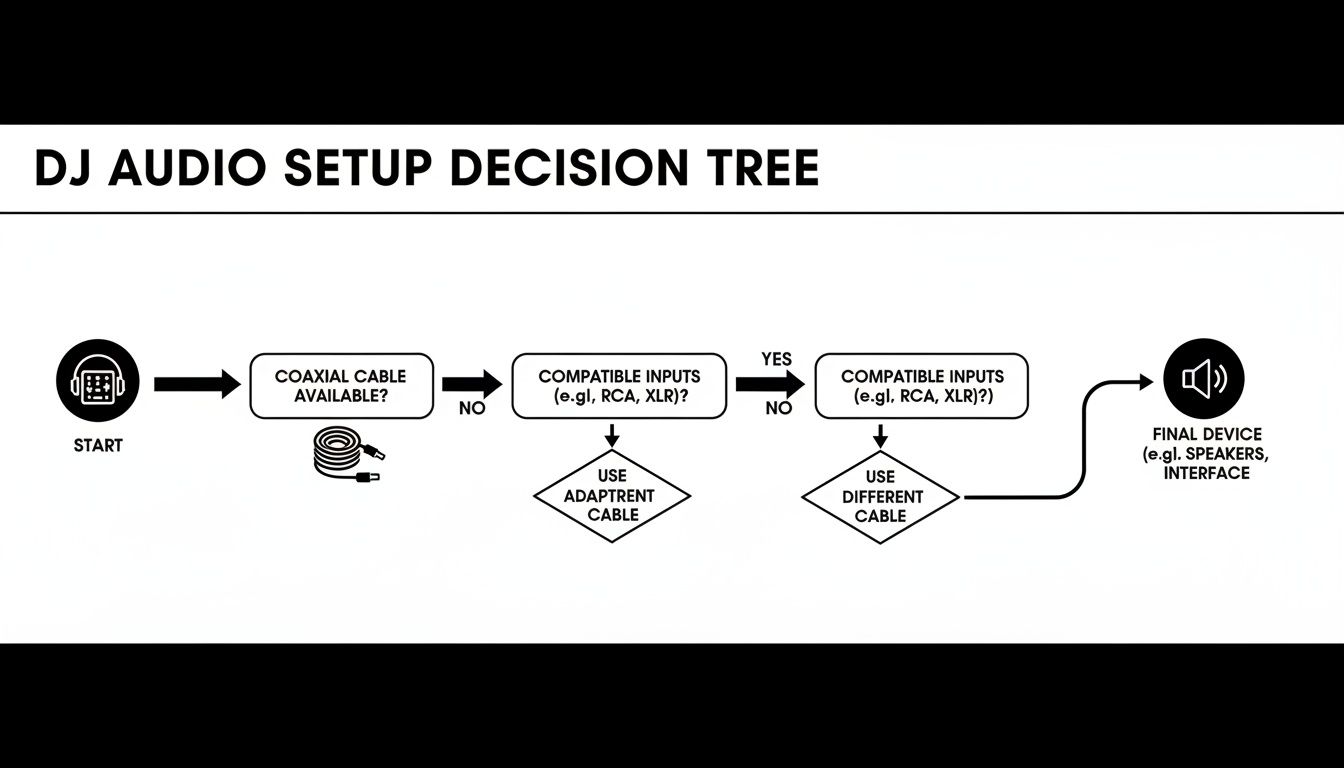
As the decision tree shows, when you need a dedicated audio path from a DJ controller to a mixer or speaker, a coaxial cable gives you a direct and robust connection. For DJs who put a premium on durability and straightforward, high-quality audio, the choice is pretty clear.
How to Buy and Maintain Your Coaxial Audio Cables
Pouring money into high-end audio gear only makes sense if you connect it all with quality cables. A solid coaxial cable audio link is one of the smartest, most affordable ways to defend your sound quality. But with so many options out there, how do you choose the right one? And once you’ve got it, what’s the secret to keeping it working perfectly, gig after gig?
Think of your cables as a crucial part of your professional reputation. It’s always tempting to grab the cheapest option off the shelf, but that’s almost always a false economy. A poorly made cable is a weak link waiting to fail, ready to introduce noise, dropouts, or total connection loss right when the pressure is on.
What to Look For When Buying
When you’re shopping for a coaxial audio cable, it all comes down to build quality. These are the details that separate a clean, reliable signal from a noisy, problematic one.
-
Certified 75 Ohm Impedance: This is non-negotiable. The cable must be explicitly rated at 75 Ohms. Anything else will cause signal reflections inside the wire, leading to jitter and degrading your audio.
-
High-Quality Shielding: Look for a dense, braided copper shield. This is your frontline defence against all the radio frequency (RF) interference floating around at live events from phones, lights, and other wireless gear.
-
Gold-Plated Connectors: Gold is king when it comes to fighting corrosion and oxidation. This means your connections stay clean and solid over time, preventing the crackles and dropouts that come from tarnished connectors.
A well-built cable is an investment in reliability. You can extend its life even further with smart cable management, and using things like cord strain relief connectors is vital for securing your connections and preventing damage to your gear.
Essential Maintenance Tips
Even the toughest cables need a bit of care to stay in peak condition. Treating your gear with respect is what ensures it’s ready to perform when you are.
A cable’s biggest enemy isn’t use—it’s abuse. Proper coiling, cleaning, and storage can double the lifespan of your coaxial cables, saving you money and preventing on-stage emergencies.
To keep your cables in top shape, always coil them using the “over-under” method. It feels a bit strange at first, but it prevents twisting and stressing the delicate conductors inside. Every so often, give the connectors a quick clean with a specialised contact cleaner to remove any dust or grime that’s built up.
For more advice on curating the best DJ gear, you can explore the Vinyl Gold collection.

Your Coaxial Audio Questions Answered
Even when you think you’ve got a handle on coaxial audio, a few common questions always seem to surface. Let’s clear the air and tackle the big ones so you can get the absolute best sound from your setup.
Can I Just Use a Regular RCA Cable for Digital Audio?
Technically, a standard analogue RCA cable—the red and white ones you have lying around—will plug into a coaxial digital port. But you absolutely shouldn’t use it. It’s a classic mistake. Analogue RCA cables simply aren’t built to the 75 Ohm impedance spec required for a clean digital signal.
That impedance mismatch creates signal reflections inside the wire, causing jitter, which are tiny timing errors in the digital stream. To your ears, this translates into a loss of detail, a collapsed soundstage, and in worse cases, annoying clicks or complete audio dropouts. Always grab a cable specifically marked as a 75 Ohm digital coaxial cable to keep your signal pure.
Is a More Expensive Coaxial Cable Really Worth It?
Yes, but only up to a point. You don’t need to break the bank, but investing in a well-made cable pays for itself in reliability. The real-world benefits come down to better materials and solid construction.
A higher-quality coaxial audio cable gives you better shielding to fight off interference and more durable connectors to guarantee a solid link. This isn’t magic; it’s just robust engineering protecting your sound in tough live environments.
Good shielding, like dense copper braiding, is vital for rejecting the radio frequency noise that’s everywhere at events. Gold-plated connectors resist corrosion, ensuring a solid connection gig after gig. A cheap, poorly shielded cable is just a weak link waiting to fail when you can least afford it.
How Long Can a Coaxial Audio Cable Run?
A quality 75 Ohm coaxial cable can run a surprisingly long way before the signal starts to break down, typically up to 10 metres without any loss you’d notice. This makes it far better than analogue cables for connecting gear across a stage or a large room.
If you push it much further, you might start to get some signal attenuation. But for most DJ booths, event spaces, and studio rigs, a standard-length coaxial cable will give you a perfectly reliable, high-fidelity connection every time.
At VinylGold, we believe every link in your audio chain matters. For curated DJ gear that delivers flawless sound and professional reliability, explore our collection at https://www.vinylgold.co.uk.