
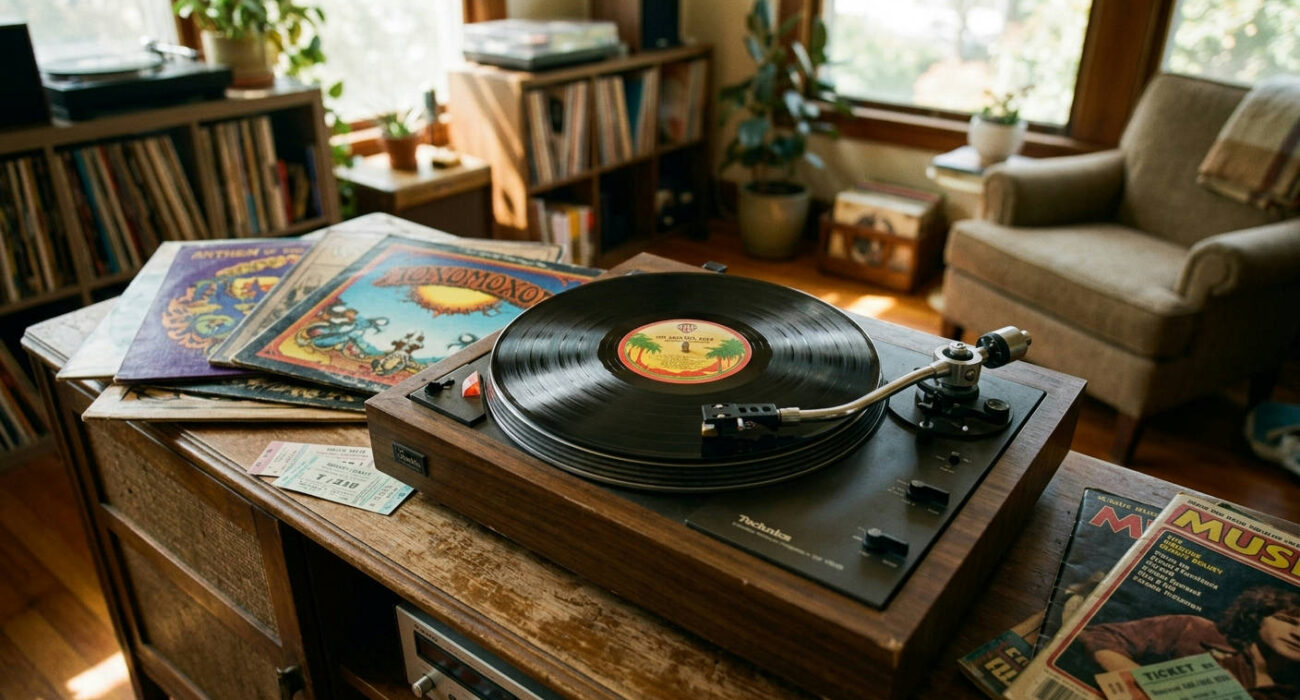
Trying to navigate the cosmic, sprawling, and often confusing world of the Grateful Dead’s early work can feel like a trip in itself. If you’re looking for a no-nonsense guide, you’ve found it. At Vinyl Gold UK, we live and breathe this stuff. So let’s cut through the haze and get straight to the definitive guide to the Grateful Dead early albums tracklist, from their garage-rock beginnings to their psychedelic zenith.
What Defines the “Early” Grateful Dead?
Before we drop the needle on the first record, we need to set the stage. What period are we even talking about? For our purposes, the “early” era covers the band’s formation and their initial run of studio and live albums on Warner Bros. Records, from 1967 to 1970.
This is the period where they transformed from a scrappy bar band into the architects of a whole new musical form.
From Jug Band Roots to Psychedelic Pioneers
The Grateful Dead didn’t just appear out of thin air. They grew out of the folk and blues revival of the early 60s. Jerry Garcia, Bob Weir, and Ron “Pigpen” McKernan were initially part of Mother McCree’s Uptown Jug Champions.
This foundation in traditional American music is crucial. It’s the earthy anchor that kept their most far-out psychedelic explorations from floating away entirely. When they plugged in and became The Warlocks, and later the Grateful Dead, they dragged those roots with them into the electric chaos of Ken Kesey’s Acid Tests.
The Core Line up of the Formative Years
The classic line up that recorded these seminal albums was a volatile and brilliant mix of personalities.
- Jerry Garcia: Lead guitar and vocals. The reluctant guru and the band’s musical heart.
- Bob Weir: Rhythm guitar and vocals. The perfect, often intricate, foil to Garcia’s melodic flights.
- Ron “Pigpen” McKernan: Organ, harmonica, and vocals. The bluesman, the frontman, the soul of the early band.
- Phil Lesh: Bass. Not just a rhythm player, but a melodic and improvisational force trained in avant-garde composition.
- Bill Kreutzmann: Drums. The steady, swinging engine room.
Mickey Hart would join as a second drummer in 1967, creating the legendary “Rhythm Devils” percussion duo with Kreutzmann that defined their sound for decades. Lyricist Robert Hunter also became an official, non-performing member during this time, and his words were as vital as any instrument.
Studio vs. Live: The Duality Begins
Right from the start, there was a tension between the band’s studio recordings and their legendary live shows. They were, first and foremost, a live band. Capturing that lightning in a bottle on a vinyl LP was a challenge they wrestled with throughout this entire period.
Some albums tried to replicate the live energy, while others were meticulously crafted studio experiments. Understanding this duality is key to appreciating each Grateful Dead early albums tracklist on its own terms.
The Debut: The Grateful Dead (1967) – A Raw Psychedelic Blast
The band’s self-titled debut is a snapshot of a band in a hurry. Recorded in just a few days in Los Angeles, it’s a frantic, speed-fuelled attempt to capture their live sound. It doesn’t quite succeed, but it’s a thrilling document nonetheless.
This album is less about cosmic improvisation and more about raw, high-energy garage psychedelia. It’s the sound of the Haight-Ashbury scene boiling over.
Full Track list and Song-by-Song Breakdown
The track list is a mix of blues covers, folk traditionals, and a few originals that hint at the magic to come.
- Side One:
- “The Golden Road (To Unlimited Devotion)”
- “Beat It On Down the Line”
- “Good Morning, Little Schoolgirl”
- “Cold Rain and Snow”
- “Sitting on Top of the World”
- Side Two:
- “Cream Puff War”
- “Morning Dew”
- “New, New Minglewood Blues”
- “Viola Lee Blues”
The Sound: Garage Rock Meets The Acid Tests
The production is thin, and the band famously complained that the label rushed them. But what it lacks in polish, it makes up for in pure, unadulterated energy. Pigpen’s snarling vocals on “Good Morning, Little Schoolgirl” and Garcia’s razor-sharp guitar licks throughout are highlights.
This record is the closest they ever got to sounding like a conventional 60s rock band, but the seeds of weirdness are already sown, especially in the sprawling, ten-minute jam on “Viola Lee Blues.” This track is the first real glimpse on record of the improvisational beast the Dead were becoming on stage.
Key Tracks to Revisit
“The Golden Road (To Unlimited Devotion)” is the perfect album opener, a two-minute blast of pure psychedelic pop that should have been a massive hit. “Viola Lee Blues,” however, is the main event. It’s a statement of intent, a declaration that this band wasn’t going to be constrained by the three-minute single format.
Find This Raw Debut on Vinyl
Getting a clean original pressing can be tricky, but modern reissues capture the raw energy perfectly. It’s an essential piece of the puzzle for any collector.
Unpacking the Ambitious Grateful Dead early albums track list of Anthem of the Sun (1968)
If the first album was a rush job, Anthem of the Sun was the polar opposite. This is one of the most bizarre, ambitious, and revolutionary rock albums ever made. The band, unhappy with their debut, decided to take control.
Their goal was to create a record that bridged the gap between their studio precision and their live improvisational fire. Their solution? To literally splice them together.
A “Collage” of Studio and Live Recordings
The album is a meticulously constructed sound collage, weaving together studio takes with live recordings from various concerts. This technique, known as “live/studio hybridization,” was unheard of at the time. A single verse might be from a studio take, while the guitar solo that follows is from a gig in a completely different city.
“We were making a record for people on acid. There’s nothing on that record that is not intentional. We were trying to create a polychromatic sound experience.” – Phil Lesh

This makes for a disorienting, challenging, and ultimately rewarding listening experience. It’s not a record you put on in the background. It demands your full attention.
The Experimental Grateful Dead early albums track list Explained
The track list itself is broken into two main suites, with several movements.
- Side One:
- “That’s It for the Other One” (I. Cryptical Envelopment, II. Quadlibet for Tenderfeet, III. The Faster We Go, the Rounder We Get, IV. We Leave the Castle)
- “New Potato Caboose”
- “Born Cross-Eyed”
- Side Two:
- “Alligator”
- “Caution (Do Not Stop on Tracks)”
The centrepiece, “That’s It for the Other One,” is a direct tribute to Neal Cassady, the Beat Generation icon and driver of the Merry Pranksters’ bus, who had recently died. The track is a perfect example of the album’s collage technique.
The Role of Tom Constanten
A key figure in this album’s creation was pianist Tom “T.C.” Constanten. A friend of Phil Lesh from their university days studying avant-garde music, T.C. brought a whole new level of experimentalism to the band. His prepared piano and electronic keyboard work added layers of strange, beautiful noise to the proceedings.
Why This Album Divides Fans (And Why We Love It)
For some Deadheads, Anthem is a masterpiece, the purest distillation of the band’s psychedelic mission. For others, it’s an unlistenable mess. There’s not much middle ground.
We at Vinyl Gold UK fall firmly into the masterpiece camp. It’s a brave, uncompromising piece of art that sounds like nothing else before or since. It’s the sound of a band pushing the limits of what a rock record could be.
Aoxomoxoa (1969): The Peak of Psychedelia and Hunter’s Ascent
Following the wild experimentation of Anthem, the band dove even deeper into the sonic abyss with Aoxomoxoa. The title itself is a palindrome, meant to be visually and sonically symmetrical, which tells you everything you need to know about the mindset behind it.
This album represents the absolute peak of the Dead’s high-psychedelic studio era. It’s dense, strange, and beautiful, and it’s where the legendary songwriting partnership of Jerry Garcia and Robert Hunter truly blossomed.
The Palindromic Puzzle and Its Meaning
Pronounced by the band as “ox-oh-mox-oh-ah,” the title was created by cover artist Rick Griffin. It was just a cool-looking palindrome he came up with, but the band and fans have imbued it with all sorts of mystical meaning over the years.
The album cover itself, a psychedelic explosion of life, death, and rebirth imagery, is one of the most iconic of the 1960s. It perfectly captures the music within.
Full Track list Analysis
Every track on Aoxomoxoa is a gem, showcasing a band at the height of their creative powers.
- Side One:
- “St. Stephen”
- “Dupree’s Diamond Blues”
- “Rosemary”
- “Doin’ That Rag”
- “Mountains of the Moon”
- Side Two:
- “China Cat Sunflower”
- “What’s Become of the Baby”
- “Cosmic Charlie”
“St. Stephen” is the quintessential early Dead anthem, a complex, multi-part suite that became a live staple. “China Cat Sunflower” introduced one of Garcia’s most iconic guitar riffs, a song that would evolve for decades to come. “What’s Become of the Baby” is perhaps the strangest track the band ever recorded—Garcia’s heavily processed vocals over a wash of electronic noise, a track that still sounds unsettling in 2026.
The Hunter-Garcia Partnership Solidifies
This is Robert Hunter’s album. His poetic, mythic, and often inscrutable lyrics elevated the band’s music to a new level. From the story-song of “Dupree’s Diamond Blues” to the cosmic imagery of “China Cat Sunflower,” Hunter’s words gave Garcia’s melodies a depth and resonance they’d never had before. This partnership would become one of the greatest in American music history.
The 1971 Remix vs. The Original 1969 Mix
Here’s where it gets interesting for collectors. The album was recorded on ground-breaking 16-track tape technology, which the band and engineers were still learning to use. The process was long and expensive, nearly bankrupting Warner Bros.
In 1971, Garcia and Lesh, unhappy with the original mix, went back and remixed the entire album. This 1971 remix is the version most people are familiar with, as it was the standard for decades. It’s cleaner, with more prominent vocals. The original 1969 mix is muddier, denser, and, some argue, more authentically psychedelic. Finding an original 1969 pressing is a holy grail for many collectors.
The Live Revolution: Live/Dead (1969)
After two incredibly dense and expensive studio albums, the band and the label decided on a different approach: release a live album. But this wasn’t just any live album. Live/Dead was a revolutionary statement.
It was one of the first live rock albums recorded using 16-track mobile recording, and it finally captured the true, untamed essence of the Grateful Dead experience. For many, this is where the real story begins.
Why a Live Album is Essential to the Early Canon
The Grateful Dead early albums tracklist is incomplete without Live/Dead. This is the album that proved what everyone who saw them already knew: the real magic happened on stage. It showed the world that a rock concert could be a place for deep, collective improvisation and musical exploration on par with jazz.
Tracklist Deep Dive: “Dark Star” – The 23-Minute Epic
The tracklist is a showcase of their live prowess, with each side of the double LP dedicated to showcasing a different aspect of their sound.
- Side One:
- “Dark Star”
- Side Two:
- “St. Stephen”
- “The Eleven”
- Side Three:
- “Turn On Your Love Light”
- Side Four:
- “Death Don’t Have No Mercy”
- “Feedback”
- “And We Bid You Goodnight”

The entire first side is dedicated to a 23-minute version of “Dark Star,” a song that was previously a failed single. Here, it becomes the ultimate vehicle for the band’s improvisational journey. It’s a patient, sprawling, and utterly mesmerizing piece of music that defines what the Dead were all about.
Side three is given over to a blistering, 15-minute showcase for Pigpen on the blues rave-up “Turn On Your Love Light.” It’s a sweat-drenched performance that captures his charisma as a frontman.
Capturing the Fillmore West Magic
The album was recorded over a series of shows at San Francisco’s legendary Fillmore West in early 1969. The venue was the band’s home turf, and you can hear the comfortable, symbiotic energy between the band and the audience. This isn’t just a recording of a concert; it’s a recording of a happening, a communal event.
As music journalist Robert Christgau famously wrote in his review:
“This is a good album. The Dead are a good band. For the first time on record, they sound like it.”
This album cemented their reputation. It proved they weren’t just studio freaks; they were arguably the best live band in the world.
The Acoustic Pivot: Workingman’s Dead & American Beauty (1970)
After the psychedelic firestorm of the late 60s, 1970 saw a dramatic and unexpected shift. The band, exhausted by the complexity of their previous albums and facing financial pressure, stripped their sound back to its core.
The result was two back-to-back masterpieces, Workingman’s Dead and American Beauty. These albums traded acid-drenched exploration for finely crafted, country- and folk-infused songs with gorgeous vocal harmonies. They are, in many ways, the perfection of the song-form they had been reaching for.
Why 1970 Marks a New “Early” Era
These two albums represent the end of their initial psychedelic phase and the beginning of their reign as one of America’s greatest song-writing bands. The focus shifted from extended jams to tight, melodic tunes you could sing along to. It was a shocking turn, but one that produced some of their most beloved and enduring music.
Workingman’s Dead Tracklist: Americana and Folk Roots
Released in June 1970, Workingman’s Dead is the grittier of the two. It’s filled with stories of outlaws, railroad workers, and everyday folk, drawing heavily on the Bakersfield country sound of Buck Owens and Merle Haggard.
- Side One:
- “Uncle John’s Band”
- “High Time”
- “Dire Wolf”
- “New Speedway Boogie”
- Side Two:
- “Cumberland Blues”
- “Black Peter”
- “Easy Wind”
- “Casey Jones”
“Uncle John’s Band” and “Casey Jones” became instant classics, while “New Speedway Boogie” was a direct, somber reflection on the tragedy of the Altamont Free Concert.
American Beauty Tracklist: Harmonies, Hits, and Timeless Songs
Recorded just a few months later and released in November 1970, American Beauty is a more polished, lush, and optimistic record. If Workingman’s Dead is the dusty porch, American Beauty is the warm living room.
- Side One:
- “Box of Rain”
- “Friend of the Devil”
- “Sugar Magnolia”
- “Operator”
- “Candyman”
- Side Two:
- “Ripple”
- “Brokedown Palace”
- “Till the Morning Comes”
- “Attics of My Life”
- “Truckin'”
The tracklist is staggering. “Friend of the Devil,” “Sugar Magnolia,” “Ripple,” and “Truckin'” are not just great Grateful Dead songs; they are foundational texts of American popular music, as documented by the Library of Congress’s National Recording Registry.
The Influence of Crosby, Stills & Nash
A key influence on this new sound was Crosby, Stills & Nash. Stephen Stills and David Crosby spent time with Garcia and Weir, teaching them intricate vocal harmony arrangements. This newfound skill is all over both albums, especially on tracks like “Uncle John’s Band” and “Attics of My Life,” adding a layer of beauty and sophistication to their sound.
Collecting the Early Albums on Vinyl in 2026
Exploring the Grateful Dead early albums tracklist is one thing, but owning them on vinyl is another experience entirely. The warmth, the large-format artwork, and the ritual of dropping the needle bring you closer to the music’s original intent.
Original Pressings vs. Modern Reissues
For the purist, hunting down original 1960s pressings on the Warner Bros. “seven arts” or green labels is a thrilling quest. These pressings have a specific sonic character that many collectors swear by. However, they can be expensive and hard to find in good condition.
Fortunately, we live in a golden age of reissues. In 2026, there are countless high-quality, 180-gram reissues available, often sourced from the original master tapes. These offer pristine sound without the pops and crackles of a 60-year-old record.
Tips for Grading and Buying Vintage Grateful Dead Vinyl
If you’re going the vintage route, pay close attention to the grading. Look for records graded as VG+ (Very Good Plus) or higher. Check for visible scratches, but also for groove wear, which can make a record look fine but sound terrible.
Always inspect the cover for seam splits, ring wear, and writing. The iconic artwork is part of the package, and you want it to be in the best possible shape.
The Importance of a Good Turntable
You can have the rarest pressing in the world, but it won’t sound right on a cheap, subpar turntable. A quality setup is essential to unlock the sonic details in these rich, complex recordings. You don’t have to break the bank, but investing in a decent deck, cartridge, and phono stage will pay dividends.
For those just starting their vinyl journey or looking to upgrade, our guide to the best turntables under £300 in the UK is the perfect place to start. A good turntable will make the intricate layers of Anthem of the Sun and the warm harmonies of American Beauty truly sing.
The Foundation of a Long, Strange Trip
These six albums—from the garage rock of their debut to the cosmic Americana of American Beauty—are the bedrock of the entire Grateful Dead phenomenon. They represent a period of relentless creativity and fearless experimentation that changed the rules of what a rock band could be.
Understanding the Grateful Dead early albums tracklist is to understand the band’s DNA. Every jam, every song, and every cultural movement they sparked has its roots right here in these grooves. So pick a record, drop the needle, and get experienced.