
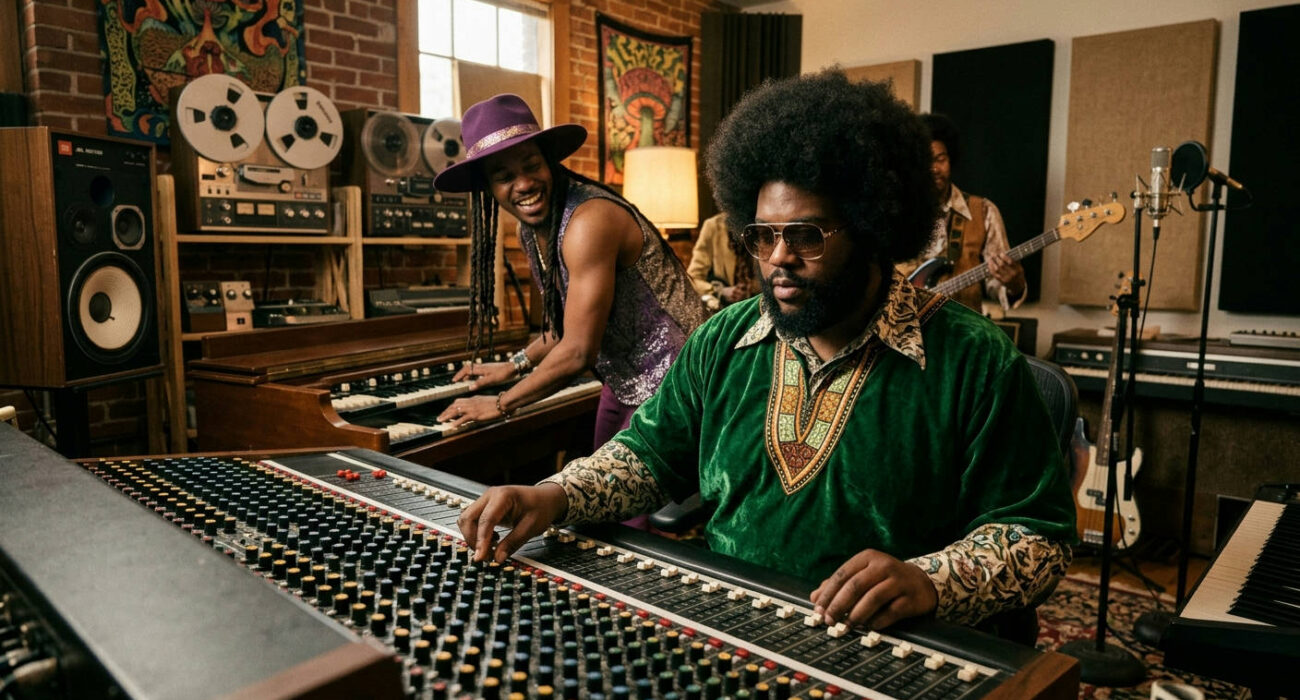
Forget what you think you know about funk. Before the chart-topping anthems and the cartoonish Mothership spectacle, a sonic revolution was brewing in the basements and studios of Detroit. This was the raw, unfiltered genesis of a two-headed monster that would permanently alter the DNA of music. We’re talking about the foundational, earth-shattering impact of the early Parliament Funkadelic studio albums. These records weren’t just groovy—they were a psychedelic, blues-drenched, rock-and-roll Molotov cocktail tossed into the pristine studios of the 1970s. This is your definitive guide to that glorious, chaotic beginning.
The P-Funk Duality: Two Bands, One Cosmic Mind
You can’t get to the heart of P-Funk without understanding its central gimmick: it was two bands at once. This wasn’t just a clever marketing ploy; it was a brilliant creative and legal manoeuvre orchestrated by the mastermind, George Clinton. Each entity had its own distinct mission, sound, and philosophy, creating a universe of music from a shared pool of ridiculously talented musicians.
Funkadelic: The Raw, Rock-Infused Acid Trip
Funkadelic was the id. It was the primal scream, the distorted guitar wail, the sound of a bad trip turning into a moment of profound clarity. This was Clinton’s vehicle for exploring the outer reaches of psychedelic rock, heavily dosed with the grimiest funk imaginable. Think of it as the troubled, brilliant offspring of Jimi Hendrix, Sly Stone, and the MC5.
The early Funkadelic sound was defined by fuzzed-out bass, sprawling, unstructured jams, and the blistering, blues-on-LSD guitar work of Eddie Hazel. The lyrical themes were heavy, tackling everything from social decay and political disillusionment to existential dread and the nature of consciousness itself. This wasn’t music for the dance floor; it was music for expanding your mind, whether you wanted to or not.
Parliament: The Tight, Horn-Driven Funk Opera
If Funkadelic was the id, Parliament was the superego, albeit a very strange and flamboyant one. This was the more “commercial” of the two projects, but commercial in the P-Funk universe still meant wildly unconventional. Parliament was built on tight, infectious grooves, jaw-dropping horn arrangements from James Brown alumni Fred Wesley and Maceo Parker, and Bootsy Collins’ revolutionary “space bass.”
Parliament’s music was a sci-fi funk opera. Clinton created an elaborate mythology involving characters like Dr. Funkenstein, Star Child, and Sir Nose D’Voidoffunk, all culminating in the arrival of the holy Mothership. The sound was cleaner, more structured, and built around hooks you could chant along to. It was still deeply weird, but it was a weirdness you could dance to, making it the perfect Trojan horse to get the P-Funk philosophy onto mainstream radio in 2026 and beyond.
Why the Split? A Stroke of Genius
The dual-band strategy was born from necessity. Clinton’s original vocal group, The Parliaments, had a hit with “(I Wanna) Testify” on the Revilot label. Contractual disputes tied up the name “The Parliaments,” preventing him from recording under that moniker elsewhere.
His solution was simple and brilliant. He took the same backing musicians, renamed them Funkadelic, and signed them to Westbound Records in 1968. This allowed him to explore a heavier, rock-oriented sound. A few years later, once the legal dust settled, he revived the Parliament name for a different label, Casablanca Records, focusing on a more horn-driven, R&B-influenced funk. Same circus, different tents.
The Essential Early Parliament Funkadelic Studio Albums You Must Own
This is the bedrock. These are the records that built the P-Funk empire, one fuzzed-out bassline and cosmic incantation at a time. Getting your hands on quality pressings of these is a rite of passage for any serious vinyl collector.
Funkadelic – Funkadelic (1970): The Grimy Blueprint
The self-titled debut is the sound of the big bang. It’s raw, sludgy, and utterly unapologetic. This is where the core trio of Eddie Hazel (guitar), Billy “Bass” Nelson (bass), and Tiki Fulwood (drums) laid down the template. It’s less a collection of songs and more a series of hypnotic, blues-drenched vamps.
Tracks like “Mommy, What’s a Funkadelic?” serve as a mission statement, while the organ-heavy groove of “I’ll Bet You” shows the deep soul roots that anchor even their wildest explorations. It’s a challenging listen, but it’s the essential starting point. This is the sound of a band inventing a genre in real-time.
Funkadelic – Free Your Mind… and Your Ass Will Follow (1970): The Psychedelic Manifesto
Released the same year as the debut, this album doubles down on the chaos. The liner notes famously state, “This album was recorded while the group was under the influence of LSD.” It sounds like it. The entire record, particularly the ten-minute title track, feels like one continuous, unhinged jam session.
This album is a test. It challenges the very definition of a song, pushing structure and melody to their breaking points in favour of pure, uncut psychedelic funk energy. It’s a sonic statement of purpose, a command to abandon inhibition and let the music take over your nervous system.
Funkadelic – Maggot Brain (1971): The Guitar God Opus
This is the one. If you only own one early Funkadelic record, make it Maggot Brain. It’s a masterpiece of emotional depth and instrumental virtuosity. The album’s legendary title track is ten minutes of pure, distilled anguish and beauty, a guitar solo that tells a story more profound than any lyric could.

The legend goes that George Clinton, high on acid, told guitarist Eddie Hazel to play as if he’d just been told his mother was dead. Then, halfway through, to play as if he’d just found out she was alive after all. The result is one of the greatest guitar performances ever committed to tape.
But the album is far more than its title track. “Can You Get to That” is a stunning, acoustic-driven piece of apocalyptic gospel-folk, while “Super Stupid” is a blistering proto-metal track detailing a drug deal gone wrong. Maggot Brain is the moment Funkadelic transcended their own chaos to create something truly timeless. Eddie Hazel’s playing here puts him in the same stratosphere as his contemporary, Jimi Hendrix.
Parliament – Osmium (1970): The Strange, Unconventional Debut
While Funkadelic was melting minds, Clinton resurrected the Parliament name for this bizarre and brilliant debut on Invictus Records. Osmium is the weirdest record in the entire P-Funk catalogue, and that’s saying something. It’s a head-spinning mix of gospel, country, bagpipes (“Little Ole Country Boy”), scat-singing, and nascent funk.
It’s often overlooked, but Osmium is a treasure trove of musical ideas. “I Call My Baby Pussycat” is a raw, stomping funk number, while “Funky Woman” lays the groundwork for the tighter grooves that would come later. It’s an essential piece of the puzzle, showing the sheer breadth of Clinton’s musical palette before he streamlined the Parliament sound.
Parliament – Up for the Down Stroke (1974): The Funk Gets Its Polish
After a four-year hiatus, Parliament returned, reborn and rebranded for Casablanca Records. This is the album where the classic Parliament sound truly coalesces. The key additions were former J.B.’s members Bootsy Collins on bass and the Horny Horns, led by Fred Wesley and Maceo Parker.
The title track is a mission statement: a tight, polished, and irresistibly funky groove that reworks their old song “Testify.” The album is slicker than anything that came before it, with complex horn charts and Bootsy’s bubbling bass driving the rhythm. This was the start of Parliament’s ascent to funk superstardom.
Chocolate City (1975): The Political Groove
With the sound established, Parliament turned its focus to a powerful concept. Chocolate City was an Afrofuturist vision of Washington D.C. and other major American cities under Black political and cultural control. The title track features “the bullet-proof voice of our minister of information, Chocolate City’s main man, C.C.” listing off cities he’d place under the control of Black icons like Aretha Franklin and Stevie Wonder.
It’s a bold, celebratory, and deeply funky political statement. Tracks like “Ride On” and “Let Me Be” are masterclasses in mid-tempo groove, cementing the rhythm section of Bootsy Collins and Jerome “Bigfoot” Brailey as one of the tightest units in music history. This album proved that P-Funk could make you think just as hard as it made you dance.
The Sonic Architects: Key Players Behind the P-Funk Sound
P-Funk was never about one person, even with a leader as iconic as George Clinton. It was a collective, a rotating cast of musical geniuses who each brought a unique element to the cosmic stew. Understanding their contributions is key to appreciating the depth of the early Parliament Funkadelic studio albums.
George Clinton: The Mad Scientist and Visionary
Clinton was the ringmaster. He was the producer, the main songwriter, the conceptualist, and the talent scout who assembled this incredible crew. His genius lay in his ability to manage dozens of volatile personalities and steer two distinct musical projects simultaneously, all while crafting a complex mythology that tied everything together. He didn’t just write songs; he built worlds.
Eddie Hazel: The Guitar God of Maggot Brain
Edward Earl Hazel was the soul of early Funkadelic. His guitar playing was a visceral force of nature, a blend of blues pain, rock and roll fire, and psychedelic exploration. He could be frighteningly aggressive one moment (“Super Stupid”) and achingly beautiful the next (“Maggot Brain”). His influence on generations of guitarists is immeasurable, yet he remains a cult hero. Without Hazel, the early Funkadelic sound simply would not exist.
Bernie Worrell: The Keyboard Wizard
The late, great Bernie Worrell was the classically trained secret weapon of P-Funk. He was the man who brought synthesizers to the funk. While others were using keyboards for simple chords, Worrell was using his Minimoog to create bubbling basslines, otherworldly textures, and complex, classically-inspired harmonies. His work on tracks like “Flash Light” would come later, but his foundational contributions on albums like Up for the Down Stroke provided the harmonic sophistication that elevated P-Funk above their peers.
Bootsy Collins & Catfish Collins: The Rubber Band Rhythm
When brothers William “Bootsy” Collins (bass) and Phelps “Catfish” Collins (rhythm guitar) left James Brown’s band and joined P-Funk in 1972, they brought a new level of rhythmic precision and unadulterated funk. Catfish’s steady, in-the-pocket rhythm playing was the anchor, while Bootsy’s revolutionary “space bass” – a bubbling, melodic, heavily-effected style – became a defining element of the Parliament sound and an influence on virtually every funk and rock bassist who followed.
Collecting Early P-Funk on Vinyl: A Guide for 2026
Hunting for these records on wax is a rewarding journey. The album art is iconic, and the sound of an original pressing is a revelation. Here’s what you need to know to start your collection.

Original Pressings vs. Reissues: What’s the Deal?
There’s no single right answer here; it depends on your budget and your priorities.
- Original Pressings: These are the records released at the time on labels like Westbound (for Funkadelic) and Casablanca (for Parliament). They hold historical value and, for audiophiles, the original mastering often has a warmth and punch that reissues can’t replicate. The downside? They can be expensive and hard to find in good condition.
- Reissues: In recent years, high-quality reissues have made these albums accessible again. Companies like 4 Men With Beards and the revived Westbound label have released 180-gram versions that often sound fantastic and are free from the wear and tear of a 50-year-old record. They’re the perfect entry point.
Your Guide to finding the best early Parliament Funkadelic studio albums on Amazon
Finding these classics is easier than ever. When searching, be sure to look for reputable sellers and check reviews on the quality of the specific pressing. Here are some quick links to get you started on your quest. Remember, you’re not just buying a record; you’re acquiring a piece of history.
- Find a copy of Funkadelic’s Maggot Brain on vinyl: https://www.amazon.com/s?k=Funkadelic+Maggot+Brain+Vinyl&tag=vinylgolduk-21
- Search for Parliament’s Up for the Down Stroke on vinyl: https://www.amazon.com/s?k=Parliament+Up+for+the+Down+Stroke+Vinyl&tag=vinylgolduk-21
- Track down Funkadelic’s self-titled debut on vinyl: https://www.amazon.com/s?k=Funkadelic+self+titled+vinyl&tag=vinylgolduk-21
Identifying a Quality Pressing
Whether you’re crate-digging or buying online, inspect the goods. Hold the record up to a light and look for deep scratches or scuffs. Check for warps by laying it on a flat surface. A little surface noise or a few pops are part of the vinyl experience, but avoid anything that looks like it’s been used as a frisbee.
The Unstoppable Legacy: How P-Funk Rewired Music
The influence of the early Parliament Funkadelic studio albums is staggering and inescapable. They didn’t just create great music; they provided a sonic toolkit that would be plundered, sampled, and revered for decades to come.
The Sample Source for Hip-Hop’s Golden Age
You cannot tell the story of hip-hop without P-Funk. George Clinton’s grooves are woven into the fabric of the genre.
Chuck D of Public Enemy famously stated, “To this day, there has been nothing like Parliament-Funkadelic. There has been nothing that has come close, as far as I’m concerned.”
From Dr. Dre building the entire G-Funk sound on the foundation of Parliament’s laid-back funk to De La Soul, Digital Underground (“The Humpty Dance” is built around Parliament’s “Let’s Play House”), and Snoop Dogg, the P-Funk catalogue has been one of the most sampled in history. Their breakbeats, basslines, and vocal snippets became the building blocks for a new generation. Exploring P-Funk is like discovering the secret origins of your favourite hip-hop classics, much like the work of their contemporaries in Public Enemy.
Redefining Rock and Funk
P-Funk completely blurred the lines between genres. Funkadelic proved that a Black band could play rock music as heavy and psychedelic as anyone, inspiring countless artists like Prince, Lenny Kravitz, and the Red Hot Chili Peppers. Parliament, in turn, created a new strain of funk that was more complex, conceptual, and theatrical than anything that had come before, influencing everyone from Talking Heads to modern funk-fusion acts.
The Afrofuturist Vision
Long before the term became widely known, Parliament-Funkadelic was a leading force in Afrofuturism. Their mythology of space aliens coming to liberate humanity with the power of funk was a powerful and subversive metaphor. It created a separate reality, a “counter-mythology,” as George Clinton called it, that offered an imaginative escape and a vision of Black empowerment. This cosmic storytelling paved the way for artists like Sun Ra, Janelle Monáe, and Outkast.
Beyond the Hits: Deep Cuts and Overlooked Gems
Once you’ve absorbed the classics, the P-Funk universe offers endless rabbit holes to explore. The sheer volume of their output means there are incredible tracks hiding in plain sight.
Exploring Funkadelic’s B-Sides
Don’t just listen to the hits. The album cuts on the early Parliament Funkadelic studio albums are where the real madness lies. “Wars of Armageddon” from Maggot Brain is a nine-minute sound collage of screaming, animal noises, and nuclear explosions set to a funk beat—it’s terrifying and brilliant. On Free Your Mind, tracks like “Some More” are prime examples of the band locking into a hypnotic, repetitive groove and riding it into oblivion.
The Parliaments’ Pre-Funk Doo-Wop Era
To truly understand the journey, go back to the very beginning. Before the acid and the space bass, there was The Parliaments, a sharp doo-wop group. Their 1967 hit “(I Wanna) Testify” is a fantastic piece of Northern Soul. Listening to it provides a stunning contrast and highlights the radical transformation Clinton and his crew underwent in just a few short years. It’s a testament to their induction into the Rock & Roll Hall of Fame that they mastered so many forms.
The records we’ve discussed represent more than just music. They are artifacts from a cultural explosion, a time when a group of wildly innovative musicians decided to tear down every conceivable boundary. The early Parliament Funkadelic studio albums are a testament to the power of pure, unfiltered creativity. They are essential listening, required for anyone who cares about the history of rock, soul, funk, and hip-hop. Dive in, get your hands on the vinyl, and free your mind. The rest, as they say, will follow. For more deep dives into musical pioneers, check out the rest of our articles on the Vinyl Gold UK blog.