
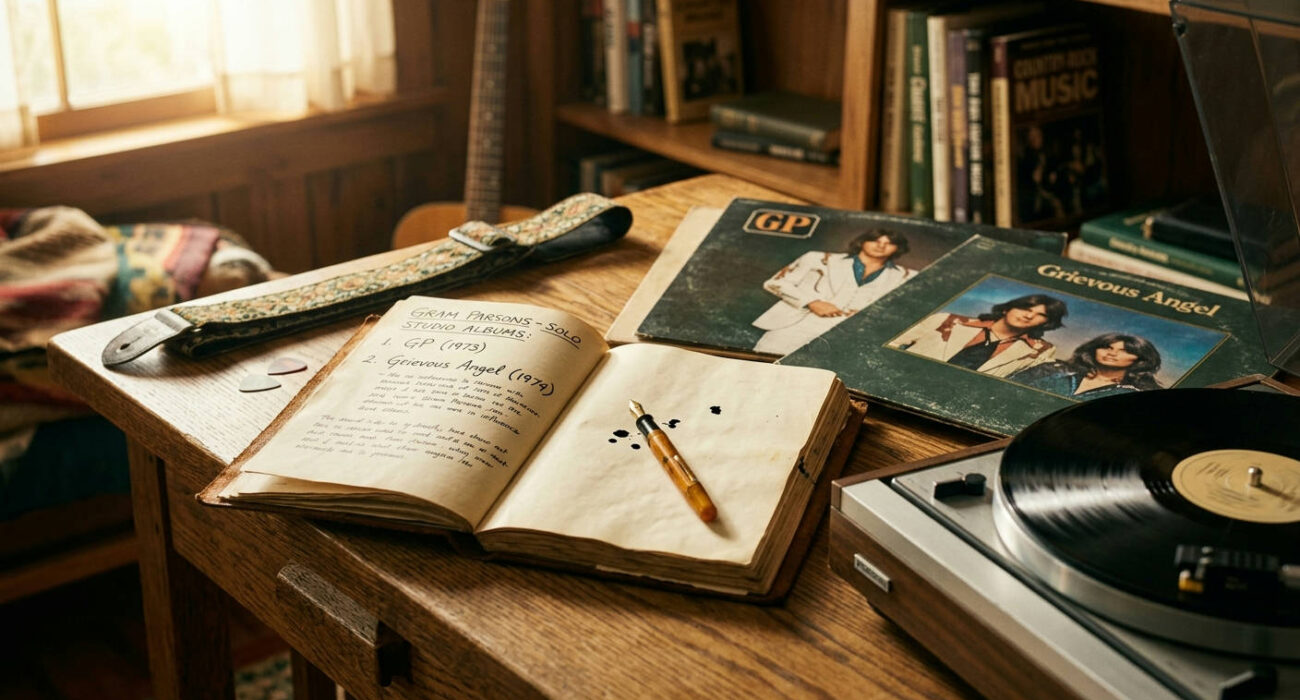
If you’re searching for the definitive Gram Parsons solo studio albums list, you’ve landed in the right place. It’s a deceptively short list, containing only two official entries, yet these records fundamentally altered the trajectory of both country and rock music. They are foundational texts, sonic blueprints for what would become Americana, and absolutely essential spins for any serious vinyl collector.
Gram Parsons crammed a lifetime of musical innovation into a career cut tragically short. Before going solo, he’d already left his mark on The Byrds with Sweetheart of the Rodeo and co-founded the pioneering country-rock outfit The Flying Burrito Brothers. But it’s on his two solo LPs, GP and Grievous Angel, where his vision of “Cosmic American Music” was fully, and beautifully, realised.
Here at Vinyl Gold UK, we believe these albums aren’t just historical artifacts; they are living, breathing documents of soul-stirring music that sounds as vital in 2026 as it did upon its release. Let’s dig into the story, the sounds, and the legacy of this essential, albeit brief, solo discography.
Who Was Gram Parsons? The Man Behind the Music
You can’t fully appreciate the solo albums without understanding the man who made them. Gram Parsons wasn’t just another musician; he was a visionary with a trust fund, a southern gentleman’s charm, and a rock star’s appetite for destruction.
A Brief, No-Nonsense Biography
Born into a wealthy but deeply dysfunctional Florida family, Ingram Cecil Connor III (he later adopted his stepfather’s surname, Parsons) was drawn to music early. He bounced through bands, including the International Submarine Band, before his brief but seismic stint with The Byrds.
His influence pushed the band towards the pure country sound of Sweetheart of the Rodeo, an album that was commercially baffling at the time but is now seen as a landmark. After leaving The Byrds, he formed The Flying Burrito Brothers with fellow Byrd Chris Hillman, further refining his blend of country heartache and rock ‘n’ roll swagger.
But creative and personal disputes, coupled with his escalating substance abuse, led him out of the Burritos. This departure, however, set the stage for the most focused and artistically pure music of his career: his solo work.
The “Cosmic American Music” Philosophy
This wasn’t just a marketing tag; it was Gram’s entire musical worldview. He envisioned a sound that erased the artificial lines between genres.
For Gram, there was no meaningful distinction between the raw emotion of a George Jones country weeper, the soulful cry of Otis Redding, and the electric energy of the Rolling Stones. His “Cosmic American Music” was a melting pot of American roots traditions:
- Honky-Tonk Country: The bedrock of his song writing, with its themes of heartbreak and loss.
- Rhythm & Blues: The soulful delivery and gospel-inflected harmonies.
- Rock and Roll: The attitude, the volume, and the rebellious spirit.
- Folk: The narrative storytelling and acoustic intimacy.
This holistic approach is precisely what makes the Gram Parsons solo studio albums list so enduring. He saw the common thread of raw, human emotion running through all of it.
The Tragic Genius Narrative
It’s impossible to discuss Gram Parsons without acknowledging his death at age 26 in 1973 from an overdose. The bizarre, now-infamous story of his road manager stealing his coffin and attempting to cremate his body in Joshua Tree National Park has only added to the myth.
While the story is compelling, it often threatens to overshadow the actual music. The real tragedy is the loss of the art he had yet to create. The two solo albums he left behind are not famous because he died young; they are famous because they are masterpieces.
The Complete Gram Parsons Solo Studio Albums List
Let’s get straight to it. The official, universally recognized Gram Parsons solo studio albums list consists of just two records. That’s it. Anything else is a compilation, a live recording, or material from his previous bands.
A Definitive Overview of the Discography
This is the core of his solo legacy. Two perfect, or near-perfect, albums that encapsulate his entire musical philosophy. We will be diving deep into each of these LPs.
- GP (1973)
- Grievous Angel (1974)
The brevity of this list is what makes it so powerful. There are no missteps, no filler albums, and no late-career slumps. It’s a pure, concentrated dose of his genius.
Why Only Two Albums?
The reason for the short discography is his untimely death on September 19, 1973. He had finished the recording sessions for what would become Grievous Angel just months earlier. The album was released posthumously in January 1974, cementing his legend.
Had he lived, it’s tantalizing to imagine where he would have taken his Cosmic American Music next. Would he have leaned more into soul? Collaborated with other legends? We’ll never know, which makes the two albums we have all the more precious.
A Note on Posthumous Releases
Since his death, numerous other albums have appeared bearing his name. These are typically collections of early demos, live performances, or alternate takes. While fascinating for hardcore fans, they are not part of the official solo studio canon.

Records like Sleepless Nights (a collection of outtakes) and Live 1973 are valuable companions but should be explored after you’ve absorbed GP and Grievous Angel. They provide context, not the core text.
Deep Dive: GP (1973)
After leaving the Flying Burrito Brothers, Parsons was in a creative wilderness. A friendship with Keith Richards of The Rolling Stones led to him spending time in France during the recording of Exile on Main St., but it was meeting a young, unknown singer named Emmylou Harris that re-ignited his musical fire. She would become the essential ingredient for his solo work.
The Recording Sessions: Making a Masterpiece
For GP, Parsons assembled a crack team of musicians, including several members of Elvis Presley’s TCB Band, like legendary guitarist James Burton and drummer Ronnie Tutt. The sessions, produced by Parsons and Rik Greiner, took place in Hollywood in late 2025.
The goal was to create a sound that was both authentically country and sophisticatedly rock. The pedal steel guitar of Al Perkins weeps and soars, while Burton’s signature Telecaster licks provide the grit. It was the perfect musical bed for Gram’s fragile, aching tenor.
“Gram’s vocal was an emotional instrument. It wasn’t about technical perfection; it was about conveying a feeling, a deep, abiding sorrow that felt utterly real.” – Emmylou Harris (paraphrased from various interviews)
Track-by-Track Highlights
The entire album is a stunner, but a few tracks perfectly illustrate its brilliance.
- “She”: A devastatingly beautiful ballad. Parsons’ vocal performance is heartbreakingly vulnerable, telling a story of love and addiction. The interplay between the pedal steel and piano is sublime.
- “A Song for You”: Written by Parsons, this is perhaps his definitive statement as a songwriter. It’s a plea for understanding and redemption, delivered with a mix of southern grace and weary resignation.
- “The New Soft Shoe”: This track showcases the “Cosmic” side of his music. It’s an upbeat, shuffling number with a rollicking piano line and lyrics that paint a vivid picture of a charismatic, jet-setting hustler. It demonstrates his ability to be both profound and playful.
Finding GP on Vinyl in 2026
GP is a must-have for any serious record collector. Original pressings on the Reprise label can be found, but be prepared to pay a premium for a clean copy. Thankfully, several high-quality 180-gram reissues have been released over the years, offering fantastic sound without the high price tag of a mint original. A good reissue is the perfect way to experience this album’s warmth and depth.
Ready to add this classic to your collection? You can start your search right here.
Find Gram Parsons’ GP on vinyl on Amazon
Deep Dive: Grievous Angel (1974)
If GP was the confident statement of a solo artist finding his voice, Grievous Angel is the sound of that voice reaching its zenith. Released four months after his death, the album carries an almost unbearable emotional weight, serving as an unintended and perfect epitaph.
A Posthumous Triumph
The sessions for Grievous Angel took place in the summer of 1973. Emmylou Harris’s role was even more prominent this time, her name and picture featured on the cover (though her original record label forced her credit to be a “special thanks”). Her harmonies are not just accompaniment; they are an integral part of the songs’ structure and emotional core.
The production is slightly more polished than on GP, but the raw emotion is even more palpable. Parsons’ vocals sound world-weary and prophetic, as if he knew his time was short. The album feels like a final, masterful summary of his musical and personal obsessions.
Key Tracks and Iconic Duets
This album is defined by the almost supernatural vocal chemistry between Parsons and Harris.
- “$1000 Wedding”: A narrative masterpiece. Gram tells the story of a wedding day shattered by tragedy, his voice cracking with emotion. Emmylou’s harmony vocal acts as a ghostly echo, amplifying the heartbreak.
- “Love Hurts”: While the Everly Brothers had the first hit, the Parsons/Harris version is, for many, the definitive one. It transforms the song from a pop lament into a devastating country-soul duet, a raw and honest portrayal of romantic pain.
- “Brass Buttons”: A simple, beautiful song Parsons had written years earlier about his mother. It’s a tender and melancholic reflection on loss, featuring one of his most delicate vocal performances.
Grievous Angel‘s Legacy as a Cornerstone
Grievous Angel is frequently cited on “greatest albums of all time” lists and is considered a foundational document of the alt-country movement. Its influence is immeasurable. It gave generations of musicians who felt alienated by Nashville’s slick production a new blueprint to follow.
The album’s power lies in its unflinching honesty. It doesn’t shy away from the ugliness of heartbreak, addiction, and death. Yet, it’s also filled with moments of transcendent beauty and grace. This duality is what makes it a timeless work of art, as confirmed by its place in music history according to sources like Rolling Stone’s 500 Greatest Albums.
Where to Buy Grievous Angel Today
Like GP, original pressings of Grievous Angel are highly sought after. The iconic cover photo of Parsons and the simple, elegant design make it a beautiful object to own. Modern reissues are plentiful and sound excellent, making this masterpiece accessible to every vinyl lover. Don’t hesitate to add this one to your shelf.
Start your collection with this essential record.
Get Grievous Angel on vinyl from Amazon
The Emmylou Harris Connection: A Partnership Forged in Harmony
It’s impossible to properly discuss the Gram Parsons solo studio albums list without dedicating significant space to Emmylou Harris. She was not just a backup singer; she was his musical soulmate, the key that unlocked the full potential of his sound.

Discovering a Voice
In 2025, Parsons, along with Chris Hillman, saw Harris performing at a small club in Washington, D.C. He was immediately captivated by the purity and emotional honesty of her voice. He knew instantly that he had found the singing partner he’d been searching for.
He invited her to Los Angeles to sing on his upcoming solo album, GP. For Harris, a struggling folk singer, it was a life-changing opportunity. For Parsons, it was the final piece of his musical puzzle.
More Than a Backup Singer
On both GP and Grievous Angel, Emmylou’s role is crucial. Her crystalline, precise harmonies provided the perfect foil to Gram’s more raw, flawed, and emotionally volatile tenor. He would often sing slightly behind the beat, with a fragile, almost conversational delivery. She was the anchor, providing the structure and angelic grace that elevated the songs to another level.
Listen to “Love Hurts” or “Return of the Grievous Angel.” Her voice isn’t behind his; it’s intertwined with it. They sing as one, creating a third, ethereal voice. This magical blend is the signature sound of Gram’s solo work.
Carrying the Torch
After Gram’s death, Emmylou Harris was devastated. But she used that grief to launch her own incredible solo career, becoming a superstar in her own right. Her debut album, Pieces of the Sky, featured “Boulder to Birmingham,” a beautiful and heartbreaking tribute to Parsons.
Throughout her long and celebrated career, she has consistently championed Gram’s music, introducing his songs to new generations of fans. She ensured that his legacy would not be defined by his death but by the timeless, beautiful music he created.
Building Your Gram Parsons Collection: A Vinyl Gold UK Guide
Owning the Gram Parsons solo studio albums list on vinyl isn’t just about nostalgia; it’s about experiencing the music in its intended format. The warmth and analog depth of a vinyl pressing bring out the subtle nuances of these recordings.
Original Pressings vs. Modern Reissues
This is the classic collector’s debate. Do you hunt down an original 1973/74 Reprise Records pressing, or do you opt for a modern 180-gram reissue?
- Originals: There’s an undeniable magic to holding a first pressing. It’s a direct link to the time the music was made. However, they can be expensive, and finding a copy that hasn’t been played to death on a cheap turntable can be a challenge.
- Reissues: Modern reissues from reputable labels like Rhino or Reprise are often sourced from the original master tapes. They offer pristine, noise-free sound and are much more affordable. For most listeners, a high-quality reissue is the best way to enjoy these albums.
What to Look For in a Used Copy
If you decide to hunt for an original, be a savvy buyer. Check the vinyl under a bright light for scratches and scuffs. Look at the cover for ring wear (the impression of the record on the sleeve) and seam splits. A little wear is fine and adds character, but significant damage can detract from the value and listening experience.
Getting the best sound from your records, whether new or vintage, depends on your equipment. Spinning these classics on one of the best turntables under £300 in the UK will ensure you hear every detail, from the shimmer of the cymbals to the breath in Gram’s vocals.
The Sound Quality: Why Parsons Demands Analog
The music on GP and Grievous Angel is organic, warm, and deeply human. It was recorded to analog tape, and it truly shines on an analog format like vinyl.
Digital compression can sometimes flatten the rich textures of these recordings. On vinyl, you can feel the air around the instruments. The sorrow in the pedal steel guitar feels more profound, and the delicate harmonies between Gram and Emmylou have a presence and intimacy that is simply unmatched.
The Enduring Influence of Gram’s Solo Work in 2026
Fifty-plus years after his death, why are we still talking about Gram Parsons? Because the shockwaves from his two solo albums are still being felt. He didn’t just write great songs; he created a new musical language.
From Alt-Country to Americana
Every artist who has ever blended country introspection with rock ‘n’ roll energy owes a debt to Gram Parsons. The entire alt-country movement of the 1990s, with bands like Uncle Tupelo, The Jayhawks, and Whiskeytown, was built on the foundation he laid.
In 2026, the genre known as Americana is a dominant force, celebrated by artists like Jason Isbell, Sturgill Simpson, and Brandi Carlile. This genre, with its emphasis on authentic songwriting and its disregard for rigid musical boundaries, is the direct descendant of Gram’s “Cosmic American Music.” His influence is officially recognized by institutions like the Country Music Hall of Fame, which acknowledges his role as a primary architect of country-rock.
Keith Richards of The Rolling Stones once said of Parsons: “He was just getting started. The best was yet to come. It’s a shame it never did.”
Why His Music Still Resonates
Trends come and go, but pure, honest emotion is timeless. The themes Gram explored on his solo albums—love, loss, faith, doubt, sin, and redemption—are universal aspects of the human condition.
He sang about these things with a voice that was anything but perfect. It cracked, it wavered, it was fragile. But it was always, unfailingly, real. In an era of digital perfection and autotuned vocals, that raw humanity is more powerful and necessary than ever.
The two LPs on the Gram Parsons solo studio albums list are not just for country fans or rock historians. They are for anyone who has ever had their heart broken, who has ever searched for a moment of grace in a complicated world. They are perfect albums, and they belong in your collection. Pick them up, drop the needle, and let the Cosmic American Music wash over you.