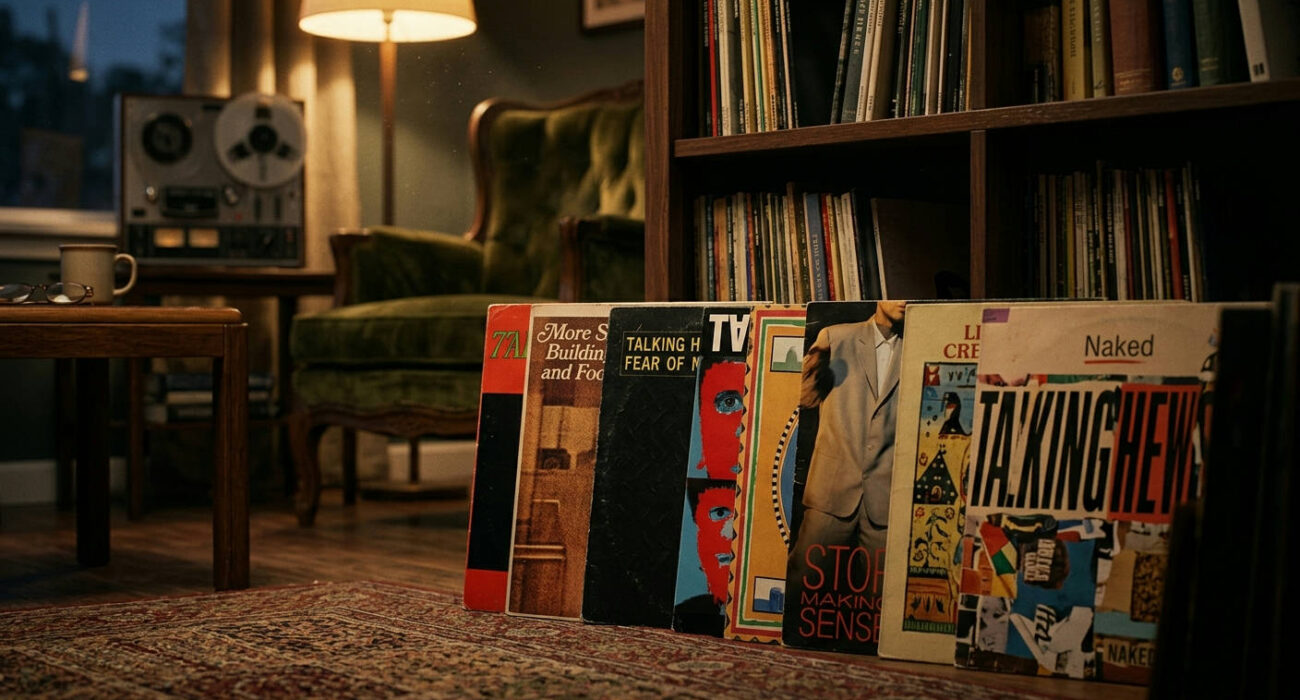
Trying to pin down Talking Heads is like trying to nail jelly to a wall. They were punk, but they weren’t just punk. They were new wave, but that label feels too small. They were funk, worldbeat, pop, and avant-garde art project all rolled into one twitchy, brilliant package. For anyone looking to dive into their groundbreaking sound, the only place to start is with the Talking Heads complete studio album list. It’s a journey through one of the most inventive and influential catalogs in modern music.
From their raw, nervous beginnings at CBGB to their globe-trotting final recordings, the band never stood still. David Byrne, Tina Weymouth, Chris Frantz, and Jerry Harrison were sonic architects, constantly dismantling and rebuilding their own sound. At Vinyl Gold UK, we believe understanding this evolution is key to appreciating their genius. This guide will walk you through every studio album, track the band’s transformation, and show why these records are more vital in 2026 than ever.
The Art-Punk Genesis: From CBGB to Brian Eno
Before they were global icons, Talking Heads were four art students who brought a different kind of energy to the gritty New York punk scene of the mid-70s. Their sound was lean, anxious, and cerebral—a stark contrast to the leather-clad fury of bands like the Ramones.
Formation and Early Buzz
David Byrne, Chris Frantz, and Tina Weymouth met at the Rhode Island School of Design (RISD), later moving to a New York City loft where they began honing their unique sound. After adding Harvard-educated Jerry Harrison on keyboards and guitar, the classic lineup was set.
Their early shows at the legendary CBGB club quickly earned them a reputation. They didn’t look or sound like anyone else. Byrne’s jerky, convulsive stage presence and lyrics about civil servants, psycho-killers, and the mundane anxieties of modern life set them apart. They signed with Sire Records in 1976, setting the stage for their official debut.
Talking Heads: 77 (1977)
The first album is a perfect snapshot of the band in its rawest form. It’s a minimalist, wiry record driven by tight rhythms and Byrne’s yelping, neurotic vocals. The production is sparse, leaving nowhere for the band’s incredible chemistry to hide.
The standout track is, of course, “Psycho Killer.” Its menacing bassline, courtesy of Tina Weymouth, is one of the most iconic in rock history. But the whole album is a treasure trove of nervous energy, from the jittery “Uh-Oh, Love Comes to Town” to the oddly uplifting “Pulled Up.” It’s the sound of a band brimming with ideas, just starting to figure out how to channel them.
Get your hands on this foundational piece of new wave. Find the Talking Heads: 77 vinyl on Amazon.
More Songs About Buildings and Food (1978)
If 77 was the blueprint, this album was the first major expansion. The crucial new element was producer Brian Eno. He didn’t just record the band; he became a collaborator, pushing them into new sonic territory.
Eno helped them fatten their sound, adding layers of synthesizers and studio effects without sacrificing their core energy. The rhythm section of Weymouth and Frantz became even tighter and more funk-influenced. The album’s big hit was a cover of Al Green’s “Take Me to the River,” a soulful, slinky interpretation that proved they could be commercially successful without compromising their art-school sensibilities. Tracks like “The Good Thing” and “Found a Job” show a band gaining immense confidence.
The Eno Trilogy: Radical Reinvention and Polyrhythmic Perfection
The collaboration with Brian Eno that began on their second album blossomed into a full-blown creative partnership. The next two albums, Fear of Music and Remain in Light, represent one of the most astonishingly creative periods for any band, ever. This is where Talking Heads went from a great new wave band to something entirely new.
Fear of Music (1979)
As the title suggests, this is a darker, more claustrophobic record. The themes are paranoia, societal collapse, and urban dread. The music is denser and more experimental, incorporating the African polyrhythms that would come to define their next phase.
The album opens with the tribal chant of “I Zimbra,” featuring lyrics from a Dadaist poem and guest guitarist Robert Fripp. It’s a bold declaration of intent. From there, the record lurches through paranoid anthems like “Life During Wartime” (“This ain’t no party, this ain’t no disco…”) and the hauntingly sparse “Memories Can’t Wait.” It’s an unsettling but utterly compelling listen.
“The beat is central. It’s the foundation. Everything else is decoration.” – David Byrne
This philosophy is on full display here. The rhythms are complex and hypnotic, pulling you into the album’s anxious world. It’s a challenging record that rewards deep listening.
Grab the tense masterpiece on vinyl. Search for Fear of Music vinyl on Amazon.
Remain in Light (1980)

This is it. The masterpiece. Remain in Light is not just the peak of the Eno collaboration; it’s a landmark album that redefined what a rock band could sound like. Inspired heavily by Nigerian funk pioneer Fela Kuti, the band built the songs from the ground up, starting with looped, layered rhythms.
Byrne’s lyrics became more abstract, delivered in a style that was part preacher, part rambling madman. The band was expanded with additional musicians, including legendary guitarist Adrian Belew, creating a dense, swirling vortex of sound. The recording process was unconventional, with instrumental tracks built first and vocals added later, often in a stream-of-consciousness style.
“Once in a Lifetime” became their most iconic song, a frantic meditation on suburban ennui with an unforgettable music video. But the entire album is a journey, from the propulsive funk of “Crosseyed and Painless” to the hypnotic groove of “The Great Curve.” The influence of bands like Parliament and Funkadelic is woven deep into the album’s DNA, creating a fusion of art-rock and deep funk that had never been heard before. It’s an essential album for any serious music collection.
Your Essential ## Talking Heads Complete Studio Album List: A Breakdown
Navigating the discography can be daunting. Here’s a quick-glance guide to the core eight studio albums that form the definitive catalog. Each one is a distinct chapter in the band’s story.
The Core Eight: An Annotated Discography
- Talking Heads: 77 (1977): The raw, minimalist art-punk debut.
- More Songs About Buildings and Food (1978): The first collaboration with Brian Eno, adding funk and polish.
- Fear of Music (1979): A darker, more paranoid, and rhythmically complex exploration.
- Remain in Light (1980): The Afrobeat-inspired, polyrhythmic masterpiece.
- Speaking in Tongues (1983): The joyful, funky, and commercially successful breakthrough.
- Little Creatures (1985): A return to straightforward pop and rock songcraft.
- True Stories (1986): The quirky, Americana-tinged soundtrack to David Byrne’s film.
- Naked (1988): The final album, a sophisticated fusion of worldbeat and pop.
Beyond the Studio: Key Live Albums
While this article focuses on the studio LPs, no discussion is complete without mentioning their incredible live presence. The Name of This Band Is Talking Heads is a fantastic double album showcasing their evolution from a quartet to a funk orchestra. And of course, Stop Making Sense is widely considered one of the greatest concert films and live albums of all time.
### Which Album from the Talking Heads Complete Studio Album List Should You Start With?
It depends on what you’re looking for. Here’s our Vinyl Gold UK recommendation:
- For the Pop Fan: Start with Speaking in Tongues. It’s their most accessible and joyous album, full of hits like “Burning Down the House” and “This Must Be the Place (Naive Melody).”
- For the Experimentalist: Dive straight into Remain in Light. It’s their most ambitious and rewarding album, a true sonic adventure.
- For the Punk Purist: Go back to the beginning with Talking Heads: 77. It’s the purest distillation of their early, nervous energy.
Pop Stardom and a New Direction
After the intense, groundbreaking work on Remain in Light, tensions in the band were high. They took a brief hiatus, with Byrne and Eno releasing My Life in the Bush of Ghosts and Frantz and Weymouth finding huge success with their side project, Tom Tom Club. When Talking Heads reconvened, they did so without Eno, embarking on the most commercially successful phase of their career.
Speaking in Tongues (1983)
This is the sound of a band letting loose. Speaking in Tongues is a vibrant, joyous explosion of synth-funk. It’s less dense and experimental than its predecessor but no less brilliant. The rhythms are infectious, and the melodies are some of the strongest they ever wrote.
“Burning Down the House” was the massive MTV hit that propelled them to a new level of stardom. The song’s irresistible groove and nonsensical lyrics captured the zeitgeist of the early 80s. But the album’s heart is “This Must Be the Place (Naive Melody),” a uniquely sincere and beautiful love song that stands as one of their finest achievements.
The album was also famous for its special edition packaging designed by artist Robert Rauschenberg, which won a Grammy. This album cemented their status as both pop stars and art-world darlings.
Find the album that brought them to the masses. Get the Speaking in Tongues vinyl on Amazon.
Little Creatures (1985)
After the massive tour for Stop Making Sense, the band deliberately scaled things back. Little Creatures is a conscious pivot away from the complex polyrhythms and toward a more direct, American-influenced songwriting style. It’s filled with quirky character sketches and catchy, guitar-driven tunes.
Singles like “And She Was” and “Road to Nowhere” were radio staples. The sound is cleaner and more straightforward, drawing on elements of pop, country, and folk. Some critics at the time saw it as a retreat from their more ambitious work, but in 2026, it stands as a charming and exceptionally well-crafted pop album. It showcases their versatility as songwriters.
True Stories (1986)
This is the oddball of the Talking Heads complete studio album list. True Stories is the soundtrack to David Byrne’s directorial film debut of the same name. Uniquely, the album features the band performing the songs, while in the movie, the actors sing them.

The album is a celebration of American eccentricity, with a sound that leans heavily into country, Tex-Mex, and pop. “Wild Wild Life” became another big hit, but the entire record is filled with Byrne’s keen observations and catchy, off-kilter melodies. It’s a whimsical and often overlooked gem in their discography.
The Final Act and An Enduring Legacy
The band’s internal relationships had become strained by the late 1980s. They would come together for one final studio album, a sophisticated and globe-trotting effort that served as a fitting, if unintentional, swan song.
Naked (1988)
For their final album, Talking Heads decamped to Paris to work with a host of international musicians. Naked is their most musically diverse record, incorporating Latin, African, and Caribbean influences into their art-pop framework.
The album is lush and immaculately produced. Songs like “(Nothing But) Flowers” find Byrne satirizing a utopian return to nature, backed by a joyous, brass-filled arrangement. “Mr. Jones” is a funky slice of tropical pop. It’s a polished, mature album that shows the band was still capable of exploring new sounds, even as they were nearing their end. The band never officially announced a breakup but quietly dissolved after its release.
Aftermath and Influence
The legacy of Talking Heads is immense. David Byrne has gone on to a wildly successful and eclectic solo career. Tina Weymouth and Chris Frantz continued with Tom Tom Club, and Jerry Harrison became a sought-after record producer.
Their influence echoes through countless bands that followed. You can hear their DNA in the art-rock of Radiohead, the nervy post-punk of Franz Ferdinand, and the rhythmically intricate indie-pop of Vampire Weekend. They proved that a band could be intelligent, experimental, and wildly popular all at the same time.
“They were a band that made you think and dance. That’s a rare combination, and it’s why their music has lasted.” – Music Critic Alan Cross, 2025
### Why the Talking Heads Complete Studio Album List Remains Essential in 2026
Decades after their last record, the music of Talking Heads feels more relevant than ever. Byrne’s lyrical obsessions—consumerism, media overload, the search for meaning in a confusing world—are the defining anxieties of the 21st century. Their fusion of global rhythms with pop sensibilities predicted the borderless nature of modern music creation. They were ahead of their time, and in 2026, the world has finally caught up to them.
Collecting Talking Heads on Vinyl: A Vinyl Gold UK Perspective
For vinyl collectors, the Talking Heads complete studio album list offers a rich and rewarding pursuit. From original pressings to modern reissues, their work sounds incredible on a turntable. Here at Vinyl Gold UK, we’ve seen a huge resurgence in interest in their catalog.
Original Pressings vs. 2026 Reissues
There’s a constant debate among collectors. Original pressings from Sire Records have a certain magic and warmth, the “authentic” sound of the era. They also hold significant collector value, especially if they are in near-mint condition.
However, high-quality 180-gram reissues from recent years, often remastered from the original tapes, can offer stunning clarity and a lower noise floor. For many listeners, a modern reissue is the best way to experience these albums. The choice comes down to personal preference and budget.
Caring for Your Collection
Whether you’re spinning a vintage find or a brand new reissue, proper care is essential for getting the best sound. Keep your records clean with an anti-static brush and store them upright, away from heat and sunlight.
Of course, the sound you get is only as good as the equipment you play it on. A quality turntable can make all the difference, bringing out the intricate layers of a record like Remain in Light. If you’re looking to upgrade your setup without breaking the bank, our guide to the best turntables under 300 in the UK is the perfect place to start.
The Ultimate Collector’s Item
For the truly dedicated collector, the holy grail is the limited-edition version of Speaking in Tongues designed by Robert Rauschenberg. The album came in a clear plastic case with a clear vinyl record and three rotating colour-printed discs that allowed the owner to create their own cover art variations. It’s a stunning piece of art in its own right and a testament to the band’s commitment to visual and musical innovation.
The Same As It Ever Was
The journey through the Talking Heads complete studio album list is one of constant motion and fearless creativity. They started as a twitchy, minimalist punk band and evolved into a global funk orchestra, all while retaining the singular, intelligent vision that made them special.
They never made the same album twice. Each record is a distinct world, a new set of questions, and a different rhythmic path. Their music is a blueprint for how to be artistically ambitious while connecting with a massive audience. That’s why, decades later, we’re still listening, still dancing, and still trying to figure it all out. Their music is not a relic of the past; it’s a living, breathing part of our present.